Photo via Times of India

Stanford’s 20-year blood-cancer therapy treats first commercial patient; trial found 78% free of GVHD

Read the original at Times of India ↗
Cite

TOI Science Desk. (2026, October 8). Stanford’s 20-year blood-cancer therapy treats first commercial patient; trial found 78% free of GVHD. Times of India. https://timesofindia.indiatimes.com/science/discovery/stanford-spent-more-than-20-years-developing-a-blood-cancer-transplant-therapy-its-first-commercial-patient-has-now-been-treated-after-a-trial-found-78-were-free-from-moderate-to-severe-gvhd-at-one-year/articleshow/134788057.cms

Dated when The Aporia collected the article, usually within hours of publication. Check the original for its exact date and byline.

Times of India · collected 2026-10-08 · by TOI Science Desk

Quick Summary

Stanford researchers have treated their first commercial patient with Orca-T, a blood-cancer therapy that received FDA approval in June 2026 after successful phase 3 trials. These trials showed that 78% of patients using Orca-T were free from moderate-to-severe graft-versus-host disease (GVHD) one year post-transplantation, compared to 38.4% for standard transplants. The therapy involves a controlled sequence of cell administration to reduce GVHD while supporting immune recovery.
Written by AI on 2026-10-08, from this article's own text only (the story summary below draws on all the coverage).

AI analysis

Story summary

Stanford University’s blood-cancer therapy Orca-T has treated its first commercial patient outside a clinical trial after receiving FDA approval in June 2026. The treatment, developed over two decades at Stanford, significantly reduces the risk of graft-versus-host disease (GVHD), a major complication following stem cell transplants. According to a phase 3 trial, one year post-transplantation, 78% of patients receiving Orca-T were free from moderate-to-severe GVHD, compared to only 38.4% for standard transplantation methods. GVHD occurs when donor immune cells attack the patient’s tissues, recognizing them as foreign. The therapy aims to manage different cell populations to support recovery while minimizing this harmful immune reaction.

Written for “Stanford Cancer Therapy Treats Patient” on 2026-11-03, grounded in this article and the 0 other(s) covering the same event.

Story

📰 Stanford Cancer Therapy Treats Patient
Health · 1 article(s) covering the same event.

Compared with similar articles

Nothing to compare against. No article is close enough to this one for the pipeline to have linked or judged the pair.
How this article was measured signals, leaning charts, publisher record, byline, topics and claims

Signals How these are calculated →

Claims extracted
44
sentences that state something as happening or true
Uncertain
18%
8 of 44 hedged ("reportedly", "may", "according to")
Leaning
not political
takes no side on a contested political question
Publisher signals
59/100
Times of India's corrections and hedging, across everything collected from it. Not a measure of accuracy.
Outlets on this story
1
Health
Same framing elsewhere
1
articles that frame the event the way this one does
Analyzed 2026-10-08 · how these are computed

How this is being covered How these are calculated →

Article leaning vs. publisher reliability
Source leaning vs. consistency

Publisher

Times of India · 3984 article(s) · 3 correction(s) detected
Running correction rate · 3 correction(s)

Who wrote this

TOI Science Desk
308 article(s) here · 1 carrying a prediction
🔮 Researchers are continuing to examine daily measurements to determine whether temperatures will climb further.
🔮 According to Reuters reporting by Will Dunham, a new study published in the journal Spixiana documents more than 90 Bangka slow lorises identified between 2015 and 2025.
🔮 “Normally, my job is quite monotonous, so I wanted to create something that would entertain people, turning my ‘serious’ job into something fun,” he said in a Guinness World Records news release.
🔮 The subsequent collision between the two galaxy clusters may then have compressed the cloud or re-energised its particles, causing it to shine more brightly in radio wavelengths once again.
🔮 The mathematicians at the University of California, Davis, argue that the answer may already lie within Einstein’s own equations and that an invisible form of energy may not be needed at all.
🔮 The work will be carried out by the West Tennessee River Basin Authority, which is preparing a plan to restore the river and the land around it.
🔮 Cornell University scientists have developed genetically engineered tomato plants that turn red-purple when nitrogen becomes scarce, giving farmers a visible warning that crops may need fertiliser.
🔮 By studying these crystals and other mineral grains, scientists could establish the meteorite's age and identify later changes caused by water.
🔮 Centuries later, bronze objects found in Scandinavia would preserve chemical signatures consistent with the metals produced at this Spanish site, offering evidence of connections that may have crossed much of Europe.
🔮 Deposited impurities and staining may also have contributed, while low temperatures and humidity could cause the fabric to crack.
Wire or desk byline, not an individual reporter.
Also by TOI Science Desk
Nothing else under this byline is closely related to this article, so these are simply their most recent.
All 308 articles by TOI Science Desk →

Topics

FDA Orca-T Stanford U.S. Food and Drug Administration the Stanford Cancer Institute

Subjects

Stanford ORG · 6× FDA ORG · 3× the Stanford Cancer Institute ORG · 2× Negrin PERSON · 1× Robert Negrin PERSON · 1× Stanford Cancer Institute ORG · 1× Stanford Medicine ORG · 1× U.S. Food and Drug Administration ORG · 1× the Blood and Marrow Transplantation & Cellular Therapy Division ORG · 1×

Narrative

The early trial results also point to why the approach attracted attention: one year after transplantation, 78% of patients receiving Orca-T were free from moderate-to-severe GVHD, compared with 38.4% after standard transplantation.
framing: assertive · carried by 1 article(s) · first seen 2026-10-08
🔮 The thinking behind the approach is relatively straightforward: if the different cell populations can be carefully controlled, doctors may be able to support blood and immune-system recovery while reducing the immune reaction responsible for GVHD.

Claims (44 extracted, 8 hedged)

A blood-cancer treatment that Stanford researchers have spent more than two decades developing has now reached an important milestone. asserted
researchers → spend → milestone
Its first commercial patient has been treated following U.S. Food and Drug Administration approval. asserted
patient → treat → approval
According to the Stanford Cancer Institute, the therapy, known as Orca-T, was given to a patient at Stanford Medicine outside a clinical trial. uncertain
therapy → accord → trial
The treatment received FDA approval in June 2026 after a phase 3 trial found that 78% of patients receiving Orca-T were free from moderate-to-severe graft-versus-host disease (GVHD) one year after transplantation. asserted
% → receive → transplantation
Among patients who received a standard transplant, the figure was 38.4%. asserted
figure → receive → transplant
Why GVHD remains a concern For people with blood cancers, a stem cell transplant can offer a chance to rebuild the blood and immune system with healthy cells from a donor. asserted
transplant → remain → donor
But the procedure also carries serious risks, including GVHD. asserted
procedure → carry → GVHD
The condition occurs when immune cells from the donor recognise the patient's tissues as foreign and begin attacking them. asserted
cells → occur → them
GVHD can affect different parts of the body and can become a significant complication following transplantation. asserted
GVHD → affect → transplantation
At the same time, donor immune cells have an important role in fighting cancer. asserted
cells → have → cancer
This creates a difficult balance for doctors: they want the new immune system to help eliminate cancer cells without causing excessive damage to healthy tissue. asserted
system → create → tissue
Orca-T was developed with that problem in mind. asserted
T → develop → mind
A different approach to donor cells In a conventional transplant, different types of donor cells are generally delivered together. asserted
types → deliver → cells
Orca-T takes a more controlled approach. asserted
T → take → approach
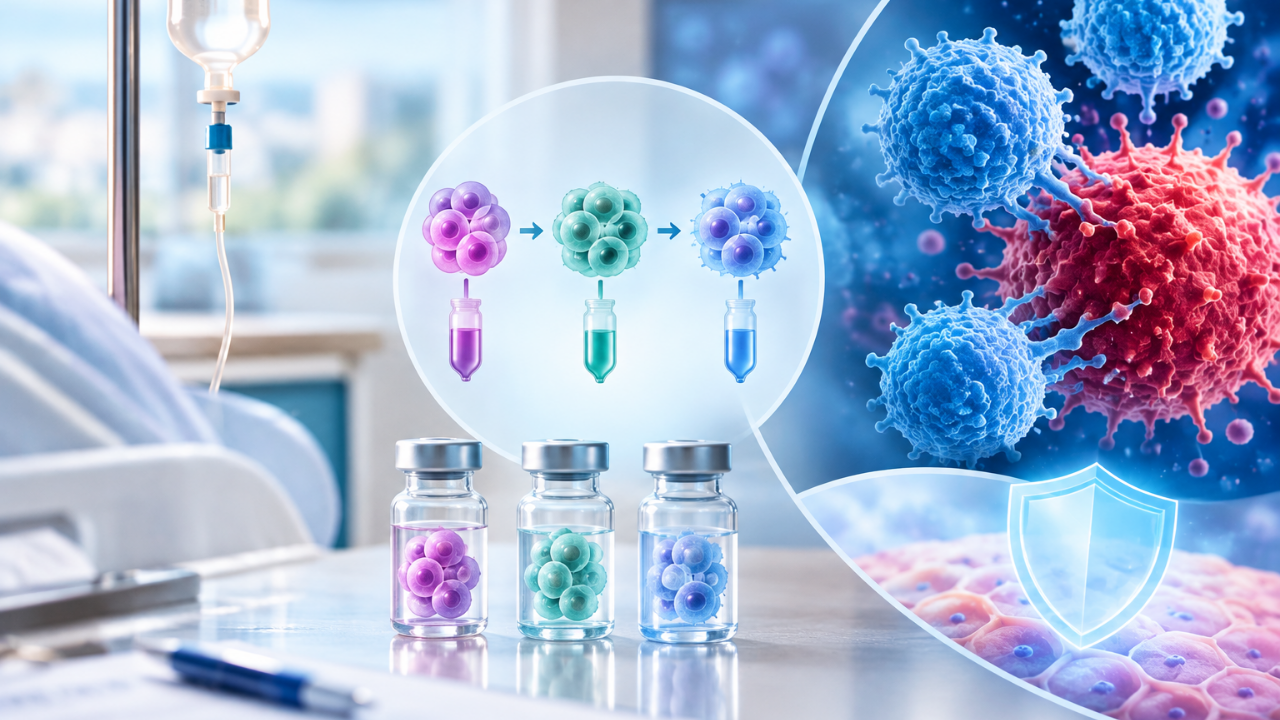
The treatment separates the cells and gives them to the patient in a specific sequence. asserted
treatment → separate → sequence
It begins with stem and early blood-forming cells. asserted
It → begin → cells
Patients then receive regulatory T cells, or Tregs, which play a role in controlling immune responses. asserted
which → receive → responses
Several days later, mature immune cells are administered. asserted
cells → administer → ?
The thinking behind the approach is relatively straightforward: if the different cell populations can be carefully controlled, doctors may be able to support blood and immune-system recovery while reducing the immune reaction responsible for GVHD. uncertain
doctors → control → GVHD
The treatment is the result of research at Stanford that stretches back more than 20 years. asserted
that → stretch → Stanford
Researchers spent years studying Treg cells and their potential role in making donor stem cell transplantation safer. asserted
transplantation → spend → cells
What the clinical trial showed The results from a phase 3 clinical trial became an important part of the treatment's path towards approval. asserted
results → show → approval
One year after transplantation, 78% of patients who received Orca-T were free from moderate-to-severe GVHD. asserted
who → receive → GVHD
That compared with 38.4% of patients who underwent standard transplantation, according to the Stanford Cancer Institute. uncertain
who → compare → Institute
The findings helped support the FDA's approval of Tregzi, the approved form of Orca-T, in June 2026. asserted
findings → help → June
Stanford said the treatment became the first Treg cell-based immunotherapy approved by the FDA for clinical use. asserted
treatment → say → use
The difference seen in the trial is significant because GVHD can be one of the most difficult complications following a donor stem cell transplant. asserted
GVHD → see → transplant
A treatment that can lower the risk of moderate-to-severe GVHD could therefore change how some patients experience the recovery period following transplantation. uncertain
patients → lower → transplantation
First commercial patient treated asserted
patient → treat → ?
The first commercial patient to receive Orca-T at Stanford has high-risk leukemia. asserted
patient → receive → leukemia
According to Stanford, the patient was interested in the therapy partly because it requires less chemotherapy and has a lower side-effect profile. uncertain
it → accord → profile
The treatment was administered as an approved therapy rather than as part of a clinical trial. asserted
treatment → administer → trial
For the researchers involved, the treatment represents a major moment after years of work. asserted
treatment → involve → work
Robert Negrin, a Stanford Cancer Institute member and former chief of the Blood and Marrow Transplantation & Cellular Therapy Division, was among those involved in the research and development of the therapy. asserted
Negrin → involve → therapy
Stanford said some of Negrin's first discoveries related to Orca-T were published more than two decades ago. asserted
some → say → T
What began as laboratory research has since moved through clinical development and testing before reaching patients as an FDA-approved treatment. asserted
began → begin → treatment
Research continues after approval FDA approval does not mark the end of Stanford's work on Orca-T. asserted
approval → continue → work
Researchers are continuing to study how the therapy could be used in other groups of patients and in combination with other treatments. uncertain
therapy → continue → treatments
Recent and ongoing research includes a completed trial involving older patients, work looking at Orca-T alongside CAR-T cell therapy and trials involving people who do not have matched donors. asserted
who → include → donors
These studies could help determine how widely the approach can eventually be used. uncertain
approach → help → ?
…and 4 more, not listed.

💬Give feedback
🕘History 🎫Support