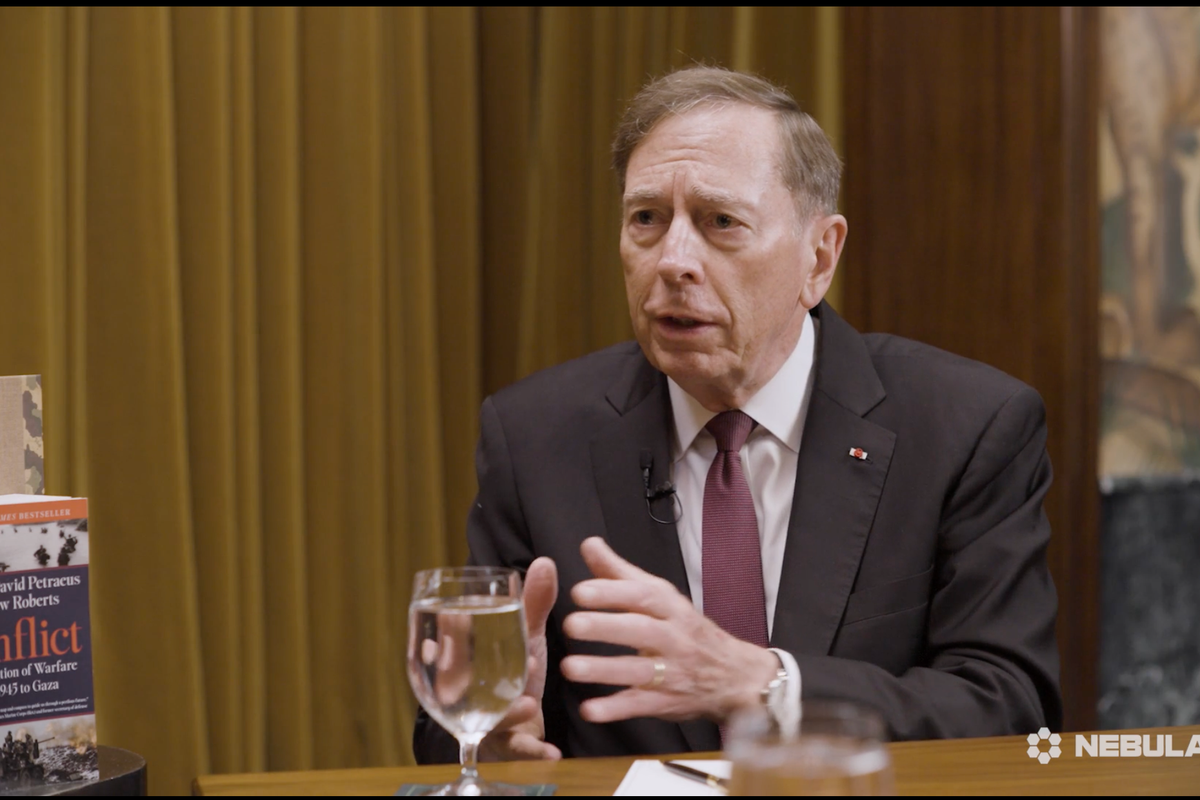
Photo via The Independent

AI military officers could be making battlefield decisions by 2030, says former CIA chief

Read the original at The Independent ↗
Cite

Reynolds, J. C. (2026, October 8). AI military officers could be making battlefield decisions by 2030, says former CIA chief. The Independent. https://www.independent.co.uk/news/world/ai-military-war-cia-petraeus-ukraine-b3063036.html

Dated when The Aporia collected the article, usually within hours of publication. Check the original for its exact date and byline.

The Independent · collected 2026-10-08 · by James C. Reynolds

Quick Summary

Retired General David Petraeus predicts that autonomous AI military officers capable of making battlefield decisions with minimal human oversight will be operational by 2030, according to an interview on the Forecast2050 podcast. He envisions these systems as "generic artificial intelligence staff officers" that never need rest and can operate independently or in coordinated groups without waiting for human approval. Petraeus also anticipates seeing self-governing drones used in Ukraine by late 2026, highlighting the rapid advancement of AI in warfare. However, a study from the Alan Turing Institute suggests that while AI can assist commanders and speed up decision-making, it cannot replace human judgment or accountability entirely.
Written by AI on 2026-10-08, from this article's own text only (the story summary below draws on all the coverage).

AI analysis

Story summary

Retired General David Petraeus, former CIA director, predicts that AI military officers capable of autonomous decision-making could begin operating on battlefields by 2027. He made this assertion during a recent interview with investor Finn Murphy on the Forecast2050 podcast, set to be released soon. These agentic AI staff officers would gather intelligence and make decisions with minimal human oversight. Petraeus emphasized the transformative potential of recursive learning in AI models, enabling continuous self-improvement over time. This forecast underscores an escalating debate about integrating advanced technology into military operations, highlighting both its revolutionary capabilities and ethical concerns.

Written for “AI In Military By 2030” on 2026-10-31, grounded in this article and the 1 other(s) covering the same event.

Story

📰 AI In Military By 2030
Technology · 2 article(s) covering the same event. See how they differ ↓

Compared with similar articles

This article reads unscored and hedges 17% of its claims. Each row says how that neighbour differs.
The Independent
Hedges 5 of 29 claims Outlet record 59/100
How this article was measured signals, leaning charts, publisher record, byline, topics and claims

Signals How these are calculated →

Claims extracted
29
sentences that state something as happening or true
Uncertain
17%
5 of 29 hedged ("reportedly", "may", "according to")
Leaning
not political
takes no side on a contested political question
Publisher signals
59/100
The Independent's corrections and hedging, across everything collected from it. Not a measure of accuracy.
Outlets on this story
2
Technology
Same framing elsewhere
2
articles that frame the event the way this one does
Analyzed 2026-10-08 · how these are computed

How this is being covered How these are calculated →

Article leaning vs. publisher reliability
Source leaning vs. consistency

Publisher

The Independent · 3448 article(s) · 7 correction(s) detected
Running correction rate · 7 correction(s)

Who wrote this

James C. Reynolds
61 article(s) here · 1 carrying a prediction
🔮 Some 20,000 protesters were expected to march in the Italian capital on Friday morning, as part of wider demonstrations scheduled in more than 50 cities over war and the rising cost of living.
🔮 The eldest son of former far-right president Jair Bolsonaro had been expected to win the election but ended up losing in a shock result to leftist incumbent Luiz Inacio Lula da Silva.
🔮 His Russian counterpart, Yana Lantratova, added that space would also be provided for their pets.
🔮 Flydubai Flight 1073 from Dubai to Tel Aviv plunged 16,000ft in 30 seconds before the attacker was overwhelmed and two other pilots who were on board were able to safely land in Saudi Arabia. Capt Machchhar, still wearing a sling and with stitches in the back of his head, told UAE president Sheikh Mohammed during yesterday’s ceremony that it would still be another two months before he heals fully.
🔮 Eisenkot’s bloc was projected to win 48 seats in the election with almost all votes counted, while Netanyahu is on course for 53.
🔮 “It will not be enough to extinguish the anger.”
🔮 US president Donald Trump has said he will “take a look” at helping Benjamin Netanyahu after the prime minister claimed the Israel election was “stolen”.
🔮 Benjamin Netanyahu and his allies are on track to win the most seats in Israel’s parliament, despite weeks of polling predicting he would not survive Tuesday’s election.
🔮 Israel’s longest-serving prime minister was on course to win 53 seats in parliament between his Likud party and allies on the right, well ahead of the 48 forecast for the opposition bloc of rival Gadi Eisenkot.
Also by James C. Reynolds
Nothing else under this byline is closely related to this article, so these are simply their most recent.
All 61 articles by James C. Reynolds →

Topics

CIA Independent The Independent US Central Command Ukraine

Subjects

Petraeus PERSON · 2× US Central Command ORG · 2× Ukraine GPE · 2× Barack Obama PERSON · 1× CIA ORG · 1× David Petraeus PERSON · 1× Finn Murphy PERSON · 1× Independent ORG · 1× The Independent ORG · 1× the Alan Turing Institute ORG · 1×

Narrative

“Just four years from now, we will have autonomous systems, and I think we will have the beginning of autonomous systems of autonomous systems; we will have AI agents, so you'll have agentic AI staff officers,” he told investor Finn Murphy on the Forecast2050 podcast, to be released on Thursday.
framing: assertive · carried by 2 article(s) · first seen 2026-10-08
🔮 Log in AI military officers could be making decisions on the battlefield within just four years, the former head of the CIA has said amid growing debate over the use of the technology in war.

Claims (29 extracted, 5 hedged)

Log in AI military officers could be making decisions on the battlefield within just four years, the former head of the CIA has said amid growing debate over the use of the technology in war. uncertain
head → log → war
Ret. Gen. David Petraeus said he believed that warfare would begin to see the adoption of AI staff officers that are capable of gathering information and making decisions with little to no human input by 2030. asserted
that → say → 2030
“Just four years from now, we will have autonomous systems, and I think we will have the beginning of autonomous systems of autonomous systems; we will have AI agents, so you'll have agentic AI staff officers,” he told investor Finn Murphy on the Forecast2050 podcast, to be released on Thursday. asserted
he → have → Thursday
He also cited the potential of recursive learning, when an AI model uses its own data and processes to improve itself. asserted
model → cite → itself
”All of that, just again in three and a half years is going to be truly revolutionary. asserted
All → go → years
We'd be much better off if we were anticipating more of that,” the former head of US Central Command said in comments shared exclusively with The Independent ahead of publication. asserted
head → anticipate → publication
There is skepticism over whether AI could replace the traditional military chain of command. uncertain
AI → be → command
A study published last year by the Alan Turing Institute found that AI could assist commanders and improve the speed of decision-making, but not replace human judgment or accountability for life-or-death decisions. uncertain
AI → publish → decisions
The former four-star general, who served under president Barack Obama from 2011-2012, described such systems as “generic artificial intelligence staff officers who will never sleep, never eat, never take a break”. asserted
who → serve → break
He has previously said he believes that autonomous systems will “very soon” be working together in platoon or battalion-sized units, able to share information and coordinate without human intervention, adding: “The side that waits for human approval before acting will lose.” asserted
that → say → approval
Speaking to CNBC in May, he described ‘autonomous systems of autonomous systems’, where sensors would be able to collect battlefield data and relay it to an autonomous HQ, which could then direct autonomous weapons with little to no human input. uncertain
which → speak → input
The former intelligence chief told Forecast2050 added that he expected to see self-governing drones being used in the war in Ukraine by the end of this year. asserted
drones → tell → year
“We'll see this emerging in Ukraine I think by the end of this year, very likely by the end of 2026. asserted
I → see → 2026
You'll see increasing numbers of autonomous unmanned systems. asserted
You → see → systems
And the reason that's so dramatic is because it now eliminates the limit that you have on the number of systems based on the number of pilots that you have.” asserted
you → eliminate → that
The early adoption of artificial intelligence in warfare remains controversial. asserted
adoption → remain → warfare
US Senate Democrats wrote to defence secretary Pete Hegseth in March seeking information about a reported strike on a girls’ school in southern Iran and requesting to know whether AI was used in planning or executing an attack. asserted
AI → write → attack
Admiral Brad Cooper, the head of US Central Command, has confirmed the US military has used AI to sift through large amounts of data, without detailing specifics. asserted
military → confirm → specifics
He said human operatives will “always make final decisions on what to shoot and what not to shoot, and when to shoot”. asserted
operatives → say → what
Petraeus also said the UK was well positioned to become a world leader in autonomous warfare in spite of its financial woes, while the US is still missing the elements of institutional change needed to transition. asserted
US → say → change
“Interesting, I think the UK could be postured to lead this,” he said. uncertain
he → think → this
“They’re a smaller force. asserted
They → ’re → ?
They have a bit more centralisation in their ministry of defence ... asserted
They → have → defence
they’ve now done essentially a defence budget that includes much more in the way of unmanned systems and forces.” asserted
that → do → systems
Petraeus noted the UK was facing “significant economic challenges”, including government funding, sluggish growth and challenges with healthcare. asserted
UK → note → healthcare
The intelligence chief also insisted on the importance of the US maintaining its ties to its Western allies, amid concern in Europe around the Trump administration’s pivot away from the old continent to face down the perceived threat from China. asserted
US → insist → China
“At the present moment I think that US leadership still is important together with allies and partners, like-minded that cherish the same ideals and values and principles for which we have fought over the years. asserted
we → think → years
And there’s more challenges out there than at any time, I’d contend, since World War Two,” he said. asserted
he → ’ → War
The joint US and Western relationship with China remains “the most important challenge in the world”, he said, adding: “We have to try to get that right in every way that we can.” asserted
we → remain → way

💬Give feedback
🕘History 🎫Support