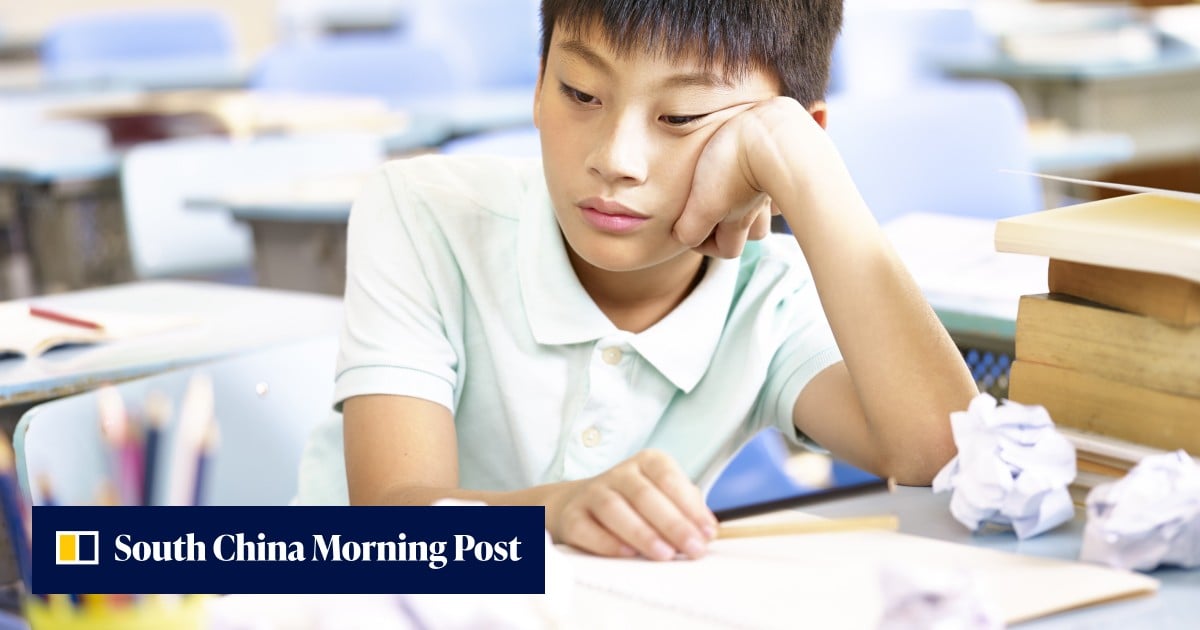
Photo via South China Morning Post

Why Asian parents are trapped in a private tuition arms race

Read the original at South China Morning Post ↗
Cite

Lim, K. (2026, October 9). Why Asian parents are trapped in a private tuition arms race. South China Morning Post. https://www.scmp.com/week-asia/people/article/3370328/why-asian-parents-are-trapped-private-tuition-arms-race?utm_source=rss_feed

Dated when The Aporia collected the article, usually within hours of publication. Check the original for its exact date and byline.

South China Morning Post · collected 2026-10-09 · by Kolette Lim

Quick Summary

Grace, a 38-year-old Singaporean mother and founder of a creative agency, enrolls her two children in Chinese private tuition at age three to provide them with greater exposure to their ancestral language. She acknowledges pressure from other parents who also enroll their young children in multiple classes to secure an academic advantage. The article highlights the widespread practice across Asia where parents invest heavily in private tutoring despite concerns about stress on children and economic disparities between families that can afford extra lessons and those that cannot.
Written by AI on 2026-10-09, from this article's own text only (the story summary below draws on all the coverage).

AI analysis

Story summary

In Singapore and South Korea, many Asian parents are enrolling their young children in private tutoring sessions to ensure they have a competitive academic advantage. Grace, a 38-year-old mother of two, started Chinese tuition for her kids when they were three years old. She initiated this despite neither she nor her partner speaking fluent Mandarin at home. Grace acknowledges the societal pressure driving such decisions but also recognizes that not all families can afford these extra classes, highlighting an increasing disparity between socioeconomic groups. This trend is causing concern due to its potential impact on children's well-being and educational equity across Asia.

Written for “Asian Tutoring Competition” on 2026-11-04, grounded in this article and the 0 other(s) covering the same event.

Story

📰 Asian Tutoring Competition
Education · 1 article(s) covering the same event.

Compared with similar articles

Nothing to compare against. No article is close enough to this one for the pipeline to have linked or judged the pair.
How this article was measured signals, leaning charts, publisher record, byline, topics and claims

Signals How these are calculated →

Claims extracted
7
sentences that state something as happening or true
Uncertain
0%
0 of 7 hedged ("reportedly", "may", "according to")
Leaning
Leans left
of the writing, not the subject · beta estimate
Publisher signals
62/100
South China Morning Post's corrections and hedging, across everything collected from it. Not a measure of accuracy.
Outlets on this story
1
Education
Same framing elsewhere
1
articles that frame the event the way this one does
Analyzed 2026-10-09 · how these are computed

How this is being covered How these are calculated →

Article leaning vs. publisher reliability
Source leaning vs. consistency

Publisher

South China Morning Post · 3696 article(s) · 8 correction(s) detected
Running correction rate · 8 correction(s)

Who wrote this

Kolette Lim
15 article(s) here · 0 carrying a prediction
🔮 At a summit earlier this month, Singapore launched a refreshed cybersecurity strategy that would see it progressively deploy AI across its cyber defence operations and work with industry partners to accelerate adoption, as it seeks to bolster protection for its critical infrastructure.
🔮 On Monday, Singapore’s Coordinating Minister for National Security K Shanmugam told local media the country would use “every legal and regulatory lever” at its disposal to “exert pressure where it matters – including on [companies’] bottom lines, including on their access to financing, and including on their standing with investors”.
🔮 From public service to private romance FirstDate is being piloted among government employees aged 21 to 35 amid Singapore’s efforts to raise its fertility rate “It’s like ‘Why not?’, and I think it does have a few screening procedures so it might save you some trouble like having to deal with impersonators or people who do not match with their advertised profiles,” said Clare, who requested not to use her real name.
🔮 Singapore must be able to say ‘no’ to US, China to preserve trust: Foreign Minister Vivian Balakrishnan says Singapore must maintain trust with Washington and Beijing without becoming a proxy for either He also warned that the global landscape would remain unsettled if China and the United States failed to address their respective domestic issues.
🔮 With global acts also touring Asia, UK star Ed Sheeran’s concert fallout in the US raises the question of how the saga would play out regionally In Malaysia, where public support for the Palestinian cause runs deep, promoters must still weigh an artist’s politics against commercial considerations and concert rules.
🔮 Observers say that through resonating with the hosts, Chan managed to convey Singapore’s sterner message of a call for major powers to build trust instead of coercion, though there is a risk that linguistic bonds may raise the expectation for Singapore to sympathise with Beijing’s interests.
🔮 “I guessed that they might not have been doing that well since branches have been closing over the years, but I did not expect the whole chain to disappear just like that,” he said.
🔮 Only later would they realise the lessons were part of the trap.
Also by Kolette Lim
Nothing else under this byline is closely related to this article, so these are simply their most recent.
All 15 articles by Kolette Lim →

Topics

Asian Singapore South Korea

Subjects

Grace PERSON · 2× Singapore GPE · 2× Asian NORP · 1× South Korea GPE · 1×

Narrative

Her dilemma reflects a wider tension across Asia, where parents continue to invest in private tuition to give their children an academic edge, despite growing concerns over the stress placed on young learners and the widening gap between families who can afford extra classes and those who cannot.
framing: assertive · carried by 1 article(s) · first seen 2026-10-09
2026-10-09 · South China Morning Post
Why Asian parents are trapped in a private tuition arms race · assertive framing

Claims (7 extracted, 0 hedged)

Why Asian parents are trapped in a private tuition arms race From Singapore to South Korea, fear of falling behind fuels a costly cycle of extra lessons despite the toll it takes on children asserted
it → trap → children
Grace often hears other Singapore mothers debating how much private tuition their children need. asserted
children → hear → tuition
Some rush to enrol their offspring in multiple classes before they turn five, while others try to resist the pressure to add lessons outside school. asserted
others → rush → school
She enrolled her two children, now aged four and seven, in Chinese tuition when they were three to give them greater exposure to their ancestral tongue. asserted
they → enrol → tongue
“Neither of their parents speaks fluent Mandarin at home … asserted
Neither → speak → home
I guess there is some degree of pressure involved too,” said Grace, 38, the founder of a creative agency. asserted
Grace → guess → agency
Her dilemma reflects a wider tension across Asia, where parents continue to invest in private tuition to give their children an academic edge, despite growing concerns over the stress placed on young learners and the widening gap between families who can afford extra classes and those who cannot. asserted
who → reflect → classes
💬Give feedback
🕘History 🎫Support