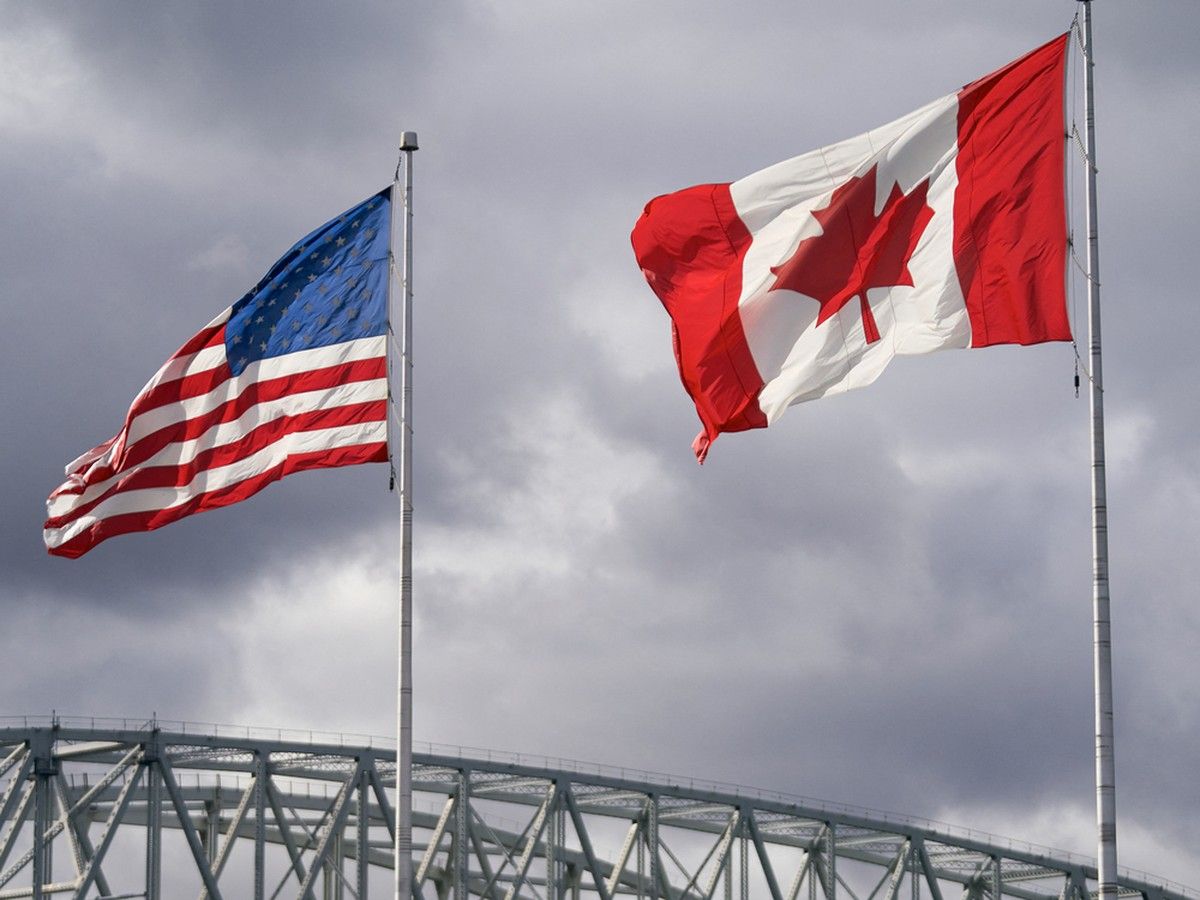
Photo via National Post

Seven Canadian provinces trail behind most U.S. states on economic performance: study

Read the original at National Post ↗
Cite

Hutchings, E. (2026, October 9). Seven Canadian provinces trail behind most U.S. states on economic performance: study. National Post. https://nationalpost.com/news/canada/seven-canadian-provinces-trail-behind-most-u-s-states-on-economic-performance-study

Dated when The Aporia collected the article, usually within hours of publication. Check the original for its exact date and byline.

National Post · collected 2026-10-09 · by Ellie Hutchings

Quick Summary

A study by the Fraser Institute comparing economic performance across Canadian provinces and U.S. states found that seven of the ten lowest-ranking jurisdictions are Canadian provinces based on GDP per person in 2024. New Brunswick ranked last, followed closely by other Maritime provinces like Prince Edward Island and Nova Scotia. The research also revealed that median employment incomes in all U.S. states were higher than those in any Canadian province in 2024, with Alberta being the only exception to this trend since 1999.
Written by AI on 2026-10-09, from this article's own text only (the story summary below draws on all the coverage).

AI analysis

Story summary

A new Fraser Institute study comparing economic performance in 60 jurisdictions across Canada and the United States found that seven of the ten poorest-performing areas are Canadian provinces. In 2024, New Brunswick ranked lowest at 59, followed by Prince Edward Island (59), Nova Scotia (58), Manitoba (56), Quebec (55), Newfoundland and Labrador (52), and Ontario (51). British Columbia was the next worst-performing province at 49, while Saskatchewan ranked better at 35, with Alberta being the only Canadian province in the top half, ranking 25th. This study highlights a significant decline in Canada’s economic performance relative to the U.S., as in 1999 six Canadian provinces were among the bottom ten by GDP per person, whereas today Alberta remains Canada's best performer but is no longer one of the top-ranked regions overall.

Written for “Economic Performance Comparison” on 2026-11-04, grounded in this article and the 0 other(s) covering the same event.

Story

📰 Economic Performance Comparison
Economy/Business · 1 article(s) covering the same event.

Compared with similar articles

Nothing to compare against. No article is close enough to this one for the pipeline to have linked or judged the pair.
How this article was measured signals, leaning charts, publisher record, byline, topics and claims

Signals How these are calculated →

Claims extracted
26
sentences that state something as happening or true
Uncertain
8%
2 of 26 hedged ("reportedly", "may", "according to")
Leaning
Leans right
of the writing, not the subject · beta estimate
Publisher signals
60/100
National Post's corrections and hedging, across everything collected from it. Not a measure of accuracy.
Outlets on this story
1
Economy/Business
Same framing elsewhere
1
articles that frame the event the way this one does
Analyzed 2026-10-09 · how these are computed

How this is being covered How these are calculated →

Article leaning vs. publisher reliability
Source leaning vs. consistency

Publisher

National Post · 1242 article(s) · 2 correction(s) detected
Running correction rate · 2 correction(s)

Who wrote this

Ellie Hutchings
21 article(s) here · 1 carrying a prediction
🔮 Adams, best known for his successful party-rock anthems and love ballads, released the song titled “Lake Ontario” as part of his new album, How’s It Goin,’ which will be released on Nov. 6.
🔮 To make things even more complicated, the Ontario government announced on Oct. 13 that northwestern parts of the province that have usually kept their clocks in sync with neighbouring Manitoba will also be making DST permanent.
🔮 It says that if the borders close to Ontario’s waste, the province will run out of landfill capacity by 2034.
🔮 I had to stop, because if you don’t stop, people will forever say to you, ‘Show me a trick.’”
🔮 A Member of European Parliament (MEP) said that becoming an associate member of the EU would turn Canada “into a living hell” and asked “is Mark Carney stupid enough to fall for it?” during a debate on Thursday.
🔮 The analysis also looked at national real estate data on mortgage rates as well as the mortgage stress test to determine how much a prospective buyer would need to earn to qualify for a mortgage on an average-priced home in their local market.
🔮 On Friday, Carney will attend another rally in Edmonton and visit Red Deer with Alberta Premier Danielle Smith, all as part of his efforts to drum up support for keeping Alberta in Confederation.
🔮 The statement added that the nations will “continue to support efforts to deliver on these elections.”
🔮 The latest Fraser Institute study is the second in a two-part series looking at whether Canada’s economic growth will outpace that of the U.S. in the 21st century.
🔮 Americans once spent US$1 billion on prescription drugs from Canada, but new import rules might mean they no longer spend anything at all.
Also by Ellie Hutchings
Nothing else under this byline is closely related to this article, so these are simply their most recent.
All 21 articles by Ellie Hutchings →

Topics

Alberta Canada Canadian Canadians U.S.

Subjects

Canadian NORP · 10× U.S. GPE · 10× Canada GPE · 8× Alberta GPE · 4× Canadians NORP · 4× Manitoba GPE · 3× Prince Edward Island GPE · 3× Americans NORP · 2× Nova Scotia GPE · 2× the Fraser Institute ORG · 2×

Narrative

New Brunswick ranked lowest, followed by Prince Edward Island (at number 59), Nova Scotia (58), Manitoba (56), Quebec (55), Newfoundland and Labrador (52) and Ontario (51). B.C. ranked 49th, while Saskatchewan ranked 35th, and Alberta — the only province in the top half — ranked 25th. For comparison, in 1999 six Canadian provinces ranked among the bottom 10 in terms of GDP per person, while Alberta, which has remained Canada’s top-ranked province, was 7th-highest. In the U.S., Mississippi ranked the lowest, at number 57, between Nova Scotia and Manitoba, followed by West Virginia (54) and Arkansas (53), both of which were sandwiched between Quebec and Newfoundland and Labrador.
framing: assertive · carried by 1 article(s) · first seen 2026-10-09
🔮 The latest Fraser Institute study is the second in a two-part series looking at whether Canada’s economic growth will outpace that of the U.S. in the 21st century.

Claims (26 extracted, 2 hedged)

A new study comparing economic performance in all of the Canadian provinces and U.S. states has found that, of the 60 jurisdictions, seven of the 10 lowest-ranking are in Canada. asserted
seven → compare → Canada
The research by the Fraser Institute looked at living standards, incomes, private sector employment and labour productivity to compare the economic growth of the two countries. asserted
research → look → countries
It found that, in every category, Canadians have fallen further behind Americans. asserted
Canadians → find → Americans
New Brunswick ranked lowest, followed by Prince Edward Island (at number 59), Nova Scotia (58), Manitoba (56), Quebec (55), Newfoundland and Labrador (52) and Ontario (51). B.C. ranked 49th, while Saskatchewan ranked 35th, and Alberta — the only province in the top half — ranked 25th. For comparison, in 1999 six Canadian provinces ranked among the bottom 10 in terms of GDP per person, while Alberta, which has remained Canada’s top-ranked province, was 7th-highest. In the U.S., Mississippi ranked the lowest, at number 57, between Nova Scotia and Manitoba, followed by West Virginia (54) and Arkansas (53), both of which were sandwiched between Quebec and Newfoundland and Labrador. asserted
both → rank → Quebec
At the top of the table for GDP per person is New York, followed by Washington, Massachusetts and California. asserted
York → follow → Washington
Jake Fuss, director of fiscal studies at the Fraser Institute and co-author of the new research study, said in a news release: “By comparing important economic outcomes in Canadian provinces and American states, it’s easy to see how Canadians stack up to their counterparts south of the border, and in recent years, Canadians have been falling further behind.” asserted
Canadians → say → years
Meanwhile, the study also found that most U.S. states out-earned most Canadian provinces. asserted
states → find → provinces
Inflation-adjusted median employment income — wages and salaries — increased faster in most states than in Canadian provinces in recent years and, in 2024, median employment incomes in all 50 states were higher than in all ten Canadian provinces. asserted
incomes → adjust → provinces
In 2010, meanwhile, only eight Canadian provinces ranked among the bottom 10 in terms of median employment income, while Canada’s top province (Alberta again) ranked 12th-highest. asserted
province → rank → income
By 2024, Alberta was the only jurisdiction in both countries where median income had declined and now ranks 51st. asserted
income → decline → countries
Prince Edward Island was the jurisdiction with the lowest median employment income in 2024, followed by Manitoba and then Newfoundland and Labrador. asserted
Island → follow → Manitoba
Elsewhere, the research found that from 1999 to 2024 every Canadian province experienced a decline in private-sector employment as a share of total employment, meaning the government sector outgrew the private sector in every province. asserted
sector → find → province
This was not the case for most U.S. states, where 31 out of 50 saw an increase in private-sector employment between 1999 and 2024. asserted
This → see → 1999
And from 2007 to 2024, all but five U.S. states experienced stronger labour productivity growth than every Canadian province. asserted
states → experience → province
Meanwhile, Prince Edward Island was the only jurisdiction in both countries where labour productivity declined. asserted
productivity → decline → countries
“The evidence is clear,” Fuss said. asserted
Fuss → say → ?
“The 21st century has, so far, not belonged to Canadians, who have seen their living standards and incomes fall further behind those of Americans.” asserted
standards → belong → Americans
The latest Fraser Institute study is the second in a two-part series looking at whether Canada’s economic growth will outpace that of the U.S. in the 21st century. asserted
growth → look → century
The first part of the research compared Canada and the U.S. nationally, and similarly found that Canada’s economic performance has fallen further behind that of the U.S. over the past quarter century. asserted
performance → compare → century
In 1999, inflation-adjusted GDP per person in Canada was $48,076, while in the U.S. it was $58,842. asserted
it → adjust → U.S.
By 2024, GDP per person had grown to $83,286 in the U.S. compared to just $59,529 in Canada — meaning the gap had widened from $10,766 to $23,757 over 25 years. asserted
gap → grow → years
And in 2010 (the earliest year of comparable data), inflation-adjusted median employment income was $6,126 higher in the U.S. than in Canada. asserted
income → adjust → Canada
But by 2024, that gap had increased to $8,663. asserted
gap → increase → 8,663
The Fraser Institute outlined three factors that explain the widening gap in economic performance between the two countries: a decline in private sector employment as a share of total employment in Canada, slower growth in labour productivity (a key driver of income growth, according to the think tank), and changes in business investment in Canada. uncertain
that → outline → Canada
The research found that business investment in Canada — which equips workers with the tools and technology they need to produce goods and services — dropped from nearly 90 cents per worker for every dollar invested in the U.S. to 54 cents between 2007 and 2024. asserted
they → find → 2007
The Fraser Institute suggests in its research that “serious and fundamental fiscal and economic reforms need to occur” for there to be any hope of Canada’s economic growth outpacing the U.S. uncertain
growth → suggest → U.S.

💬Give feedback
🕘History 🎫Support