
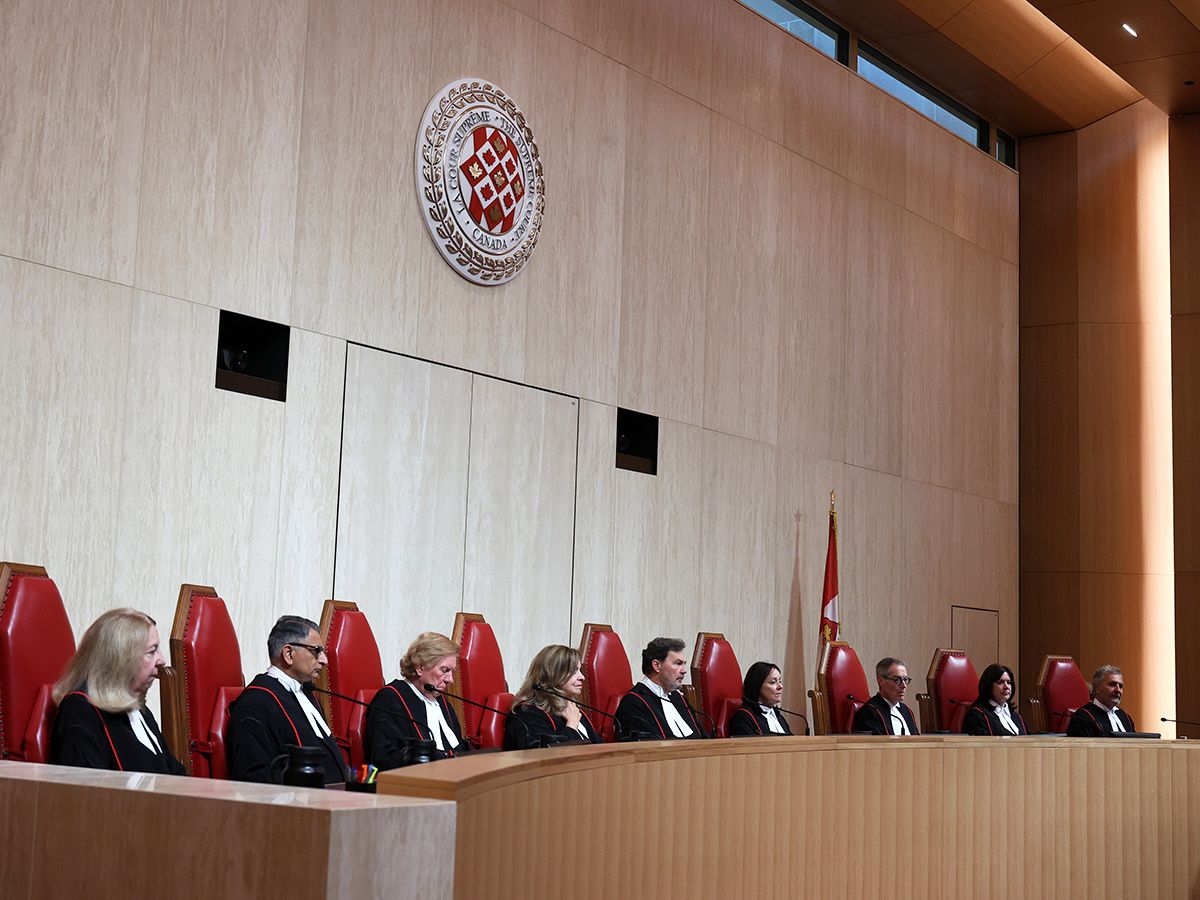
Photo via CBC News

Top court sets sentencing framework for cases involving Indigenous offenders, victims

Read the original at CBC News ↗
Cite

Top court sets sentencing framework for cases involving Indigenous offenders, victims. (2026, October 9). CBC News. https://www.cbc.ca/news/canada/nova-scotia/mi-kmaq-nova-scotia-supreme-court-of-canada-sentencing-9.7375720?cmp=rss

Dated when The Aporia collected the article, usually within hours of publication. Check the original for its exact date and byline.

CBC News · collected 2026-10-09 · by CBC

Quick Summary

The Supreme Court of Canada has established a new sentencing framework for cases where Indigenous offenders commit crimes against Indigenous victims, specifically focusing on intimate partner violence. In a 5-4 decision issued today, the court upheld a reduced three-year prison term for a Mi'kmaw man with severe mental health issues who was convicted of aggravated assault against his Mi'kmaw partner in Nova Scotia. The ruling emphasizes the need to address the disproportionate imprisonment of Indigenous people and the high rates of violence against Indigenous women through a lens that recognizes the historical context of colonization and reconciliation efforts.
Written by AI on 2026-10-09, from this article's own text only (the story summary below draws on all the coverage).

AI analysis

Story summary

The Supreme Court of Canada ruled on February 3, 2023, setting guidelines for sentencing cases where both the Indigenous offender and the Indigenous female victim are involved in intimate partner violence. In a 5-4 decision, the court emphasized that judges must consider principles related to Indigenous offenders alongside those aimed at protecting victims when determining sentences. The case specifically involves Harry Arthur Cope, a Mi'kmaw man with severe mental health challenges from Nova Scotia who was originally sentenced to five years for aggravated assault against his partner in 2019 but had the sentence reduced on appeal. This ruling aims to address systemic issues like high incarceration rates among Indigenous people and disproportionately high levels of violence against Indigenous women, which are rooted in historical colonization.

Written for “Indigenous Sentencing Framework” on 2026-11-01, grounded in this article and the 2 other(s) covering the same event.

Story

📰 Indigenous Sentencing Framework
Politics · 3 article(s) covering the same event. Compare every outlet's account →

Compared with similar articles

This article reads leans left and hedges 0% of its claims. Each row says how that neighbour differs.
The Globe and Mail
⚖️ Leans strongly left further left than this Hedges 1 of 31 claims Outlet record 52/100
National Post
Hedges 1 of 40 claims Outlet record 60/100
How this article was measured signals, leaning charts, publisher record, byline, topics and claims

Signals How these are calculated →

Claims extracted
6
sentences that state something as happening or true
Uncertain
0%
0 of 6 hedged ("reportedly", "may", "according to")
Leaning
Leans left
of the writing, not the subject · beta estimate
Publisher signals
74/100
CBC News's corrections and hedging, across everything collected from it. Not a measure of accuracy.
Outlets on this story
3
Politics
Same framing elsewhere
1
articles that frame the event the way this one does
Analyzed 2026-10-09 · how these are computed

How this is being covered How these are calculated →

Article leaning vs. publisher reliability
Source leaning vs. consistency

Publisher

CBC News · 1792 article(s) · 5 correction(s) detected
Running correction rate · 5 correction(s)

Who wrote this

No reporter is named on this article, beyond the feed's “CBC”.

Topics

Indigenous Mi'kmaw N.S. Supreme Court of Canada The Supreme Court of Canada

Subjects

Indigenous NORP · 6× Mi'kmaw NORP · 3× N.S. GPE · 1× Nova Scotia GPE · 1× Supreme Court of Canada ORG · 1× The Supreme Court of Canada ORG · 1× the Nova Scotia Court of Appeal ORG · 1× the Supreme Court ORG · 1×

Narrative

Top court sets sentencing framework for cases involving Indigenous offenders, victims Supreme Court of Canada rules on appeal involving Mi'kmaw offender and victim from N.S. The Supreme Court of Canada says in cases where an Indigenous offender commits an offence against an intimate partner who is an Indigenous woman, a judge must apply sentencing principles related to both Indigenous offenders and victims of crime in a harmonious way.
framing: assertive · carried by 1 article(s) · first seen 2026-10-09

Claims (6 extracted, 0 hedged)

Top court sets sentencing framework for cases involving Indigenous offenders, victims Supreme Court of Canada rules on appeal involving Mi'kmaw offender and victim from N.S. The Supreme Court of Canada says in cases where an Indigenous offender commits an offence against an intimate partner who is an Indigenous woman, a judge must apply sentencing principles related to both Indigenous offenders and victims of crime in a harmonious way. asserted
judge → set → way
In a 5-4 judgment today, the top court provided guidance and set out a new framework for determining an appropriate sentence in such cases. asserted
court → provide → cases
The court says Indigenous people are disproportionately and excessively imprisoned, while Indigenous women and girls suffer from unacceptably high levels of violence and abuse. asserted
women → say → violence
It says both of these issues have been shaped by the experiences of colonization, and addressing them together is central to the ongoing process of reconciliation. asserted
addressing → say → reconciliation
The ruling comes in the case of a Mi'kmaw man with severe mental health challenges who was sentenced in Nova Scotia to five years in prison after pleading guilty to aggravated assault against his partner, a Mi'kmaw woman. asserted
who → come → partner
A majority of the Nova Scotia Court of Appeal reduced the sentence to three years, and the Supreme Court ruled today the three-year sentence should stand. asserted
sentence → reduce → years
💬Give feedback
🕘History 🎫Support