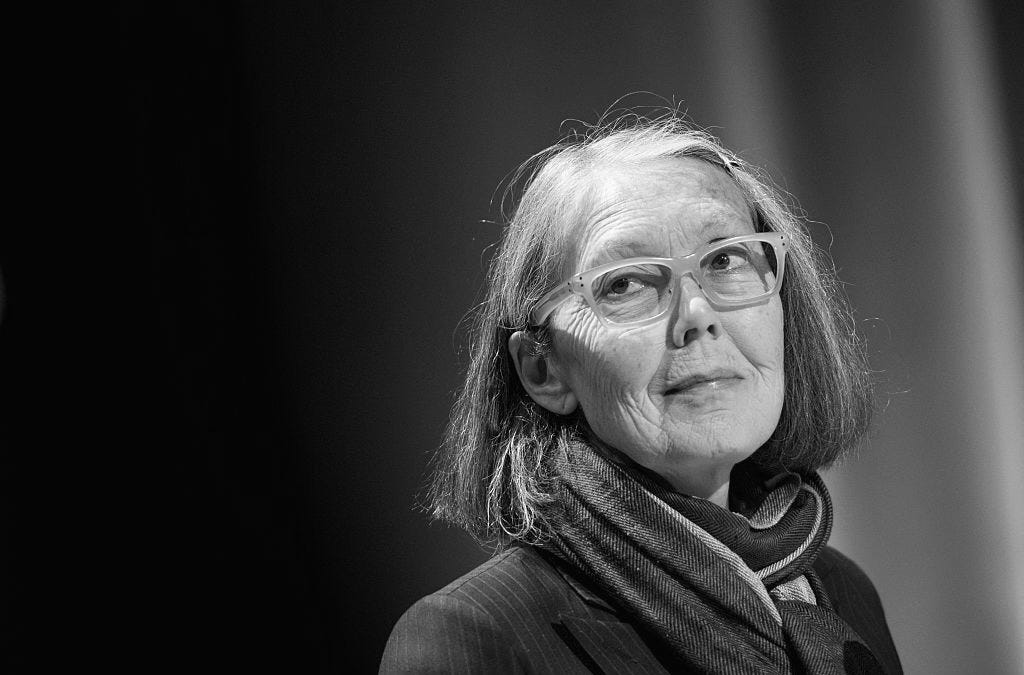
Photo via The Free Press

Anne Carson and the Beauty of the Unsaid

Read the original at The Free Press ↗
Cite

Klavan, S. (2026, October 9). Anne Carson and the Beauty of the Unsaid. The Free Press. https://www.thefp.com/p/anne-carson-nobel-prize-sappho-greek-literature

Dated when The Aporia collected the article, usually within hours of publication. Check the original for its exact date and byline.

The Free Press · collected 2026-10-09 · by Spencer Klavan

Quick Summary

Anne Carson received the Nobel Prize in Literature on Thursday, drawing attention to her influential translations, particularly her work with Sappho's poetry. The article highlights "Fragment 31" from Sappho’s collection, which survives due to a quote by Longinus but remains incomplete. This fragment exemplifies Sappho's revered status as "The 10th Muse," emphasizing the enduring impact of ancient literature and its modern interpretations.
Written by AI on 2026-10-10, from this article's own text only (the story summary below draws on all the coverage).

AI analysis

Story summary

Anne Carson, a renowned translator and poet, was awarded the Nobel Prize in Literature recently. The author Spencer Klavan first encountered Carson’s work through her translation of Sappho's Fragment 31 from ancient Greek, which he considers one of the most valuable poems in Western literature. Sappho, an esteemed figure in ancient Greek poetry, had much of her work partially preserved or quoted by other writers due to the fragility of papyrus materials used during her time. Fragment 31, as recorded incompletely but extensively by the literary critic Longinus, comprises four short stanzas plus a line hinting at additional lost content, exemplifying why Sappho was once referred to as "The 10th Muse," placing her alongside mythical goddesses of song and literature.

Written for “Anne Carson Poetry Analysis” on 2026-10-31, grounded in this article and the 0 other(s) covering the same event.

Story

📰 Anne Carson Poetry Analysis
Entertainment · 1 article(s) covering the same event.

Compared with similar articles

This article reads unscored and hedges 22% of its claims. Each row says how that neighbour differs.
New York Post
Hedges 3 of 39 claims Outlet record 66/100
“Article A reports on Anne Carson winning the Nobel Prize in Literature, while Article B reflects on her work and its significance after she has already won.”
Toronto Star
Hedges 4 of 31 claims Outlet record 64/100
“The articles discuss Anne Carson winning the Nobel Prize in Literature but describe different aspects and reactions around the event, not the exact moment or celebration of it.”
Semafor
Hedges 0 of 2 claims Outlet record 60/100
“The articles discuss different aspects of Anne Carson's work and achievements but do not describe the same specific incident.”
BBC News
Hedges 1 of 11 claims Outlet record 68/100
“Article A reports on Anne Carson winning the Nobel Prize in Literature, while Article B discusses her work and impact but does not describe the award ceremony or announcement as a specific event.”
Toronto Star
Hedges 1 of 15 claims Outlet record 64/100
“Article A reports on the surge in sales and interest in Anne Carson's books following her Nobel Prize win, while Article B discusses the content of her work and its literary significance.”
The Sydney Morning Herald
Hedges 1 of 23 claims Outlet record 61/100
“While both articles discuss Anne Carson winning the Nobel Prize in Literature, Article B focuses on her work and its impact rather than reporting on the actual announcement or awarding of the prize.”
Dawn
Hedges 0 of 10 claims Outlet record 72/100
“Article A reports on Anne Carson winning the Nobel Prize in Literature, while Article B discusses her work and its influence but does not focus on the prize announcement itself.”
The Guardian
Hedges 0 of 19 claims Outlet record 66/100
“Article A reports on Anne Carson winning the Nobel Prize in Literature, while Article B discusses her work and impact following her win.”
Al Jazeera
Hedges 1 of 22 claims Outlet record 60/100
“Article A reports on Carson winning the Nobel Prize, while Article B discusses her literary work and influence before mentioning she won the prize.”
CBC News
Hedges 3 of 51 claims Outlet record 74/100
“The articles discuss Anne Carson's work and recognition, but they do not describe the same specific incident or occurrence.”
How this article was measured signals, leaning charts, publisher record, byline, topics and claims

Signals How these are calculated →

Claims extracted
9
sentences that state something as happening or true
Uncertain
22%
2 of 9 hedged ("reportedly", "may", "according to")
Leaning
not political
takes no side on a contested political question
Publisher signals
96/100
The Free Press's corrections and hedging, across everything collected from it. Not a measure of accuracy.
Outlets on this story
1
Entertainment
Same framing elsewhere
1
articles that frame the event the way this one does
Analyzed 2026-10-10 · how these are computed

How this is being covered How these are calculated →

Article leaning vs. publisher reliability
Source leaning vs. consistency

Publisher

The Free Press · 405 article(s) · 0 correction(s) detected
No corrections detected for this publisher. That may mean careful reporting, or simply that nothing has been checked.

Who wrote this

Spencer Klavan
2 article(s) here · 1 carrying a prediction
🔮 You may not have heard of Anne Carson before she was awarded the Nobel Prize in Literature on Thursday.
2026-10-09 · mixed framing · Anne Carson and the Beauty of the Unsaid
🔮 I think I can!’ she said”—and of course it’s The Little Engine That Could, the classic folktale made famous by Arnold “Watty Piper” Munk.
2026-08-27 · assertive framing · Dolly Parton Thought She Could, and She Did
Also by Spencer Klavan
Dolly Parton Thought She Could, and She Did
2026-08-27 · The Free Press
Nothing else under this byline is closely related to this article, so these are simply their most recent.

Topics

Greek Western

Subjects

Sappho PERSON · 4× Carson PERSON · 2× Anne Carson PERSON · 1× Greek NORP · 1× Longinus PERSON · 1× Western NORP · 1×

Narrative

I first encountered Carson’s work when I read her rendition of a poem that means more to me than almost any other in the world—the Sappho poem known simply as “Fragment 31.”
framing: mixed · carried by 1 article(s) · first seen 2026-10-10
🔮 You may not have heard of Anne Carson before she was awarded the Nobel Prize in Literature on Thursday.
2026-10-10 · The Free Press
Anne Carson and the Beauty of the Unsaid · mixed framing

Claims (9 extracted, 2 hedged)

You may not have heard of Anne Carson before she was awarded the Nobel Prize in Literature on Thursday. uncertain
she → hear → Thursday
But if you’ve ever come across any verse by Sappho, the grande dame of ancient Greek literature, you may well have read it in a translation from Carson’s 2002 collection, If Not, Winter. uncertain
you → come → collection
I first encountered Carson’s work when I read her rendition of a poem that means more to me than almost any other in the world—the Sappho poem known simply as “Fragment 31.” asserted
that → encounter → Fragment
It’s among Western literature’s most valuable treasures. asserted
It → ’ → treasures
Sappho is one of those artists who deserves every bit of her awesome reputation. asserted
who → deserve → reputation
Much of her work was preserved only partially, in quotations or on torn and decayed slips of papyrus. asserted
Much → preserve → papyrus
We can read “Fragment 31” today because it was quoted incompletely, but at length, by the literary critic Longinus. asserted
it → read → critic
In its surviving form, it has four short stanzas, plus an extra line to hint that there once was more. asserted
it → survive → stanzas
But even those brief words demonstrate why some ancient readers called Sappho “The 10th Muse,” numbering her among the mythical goddesses of song and literature. asserted
readers → demonstrate → song
💬Give feedback
🕘History 🎫Support