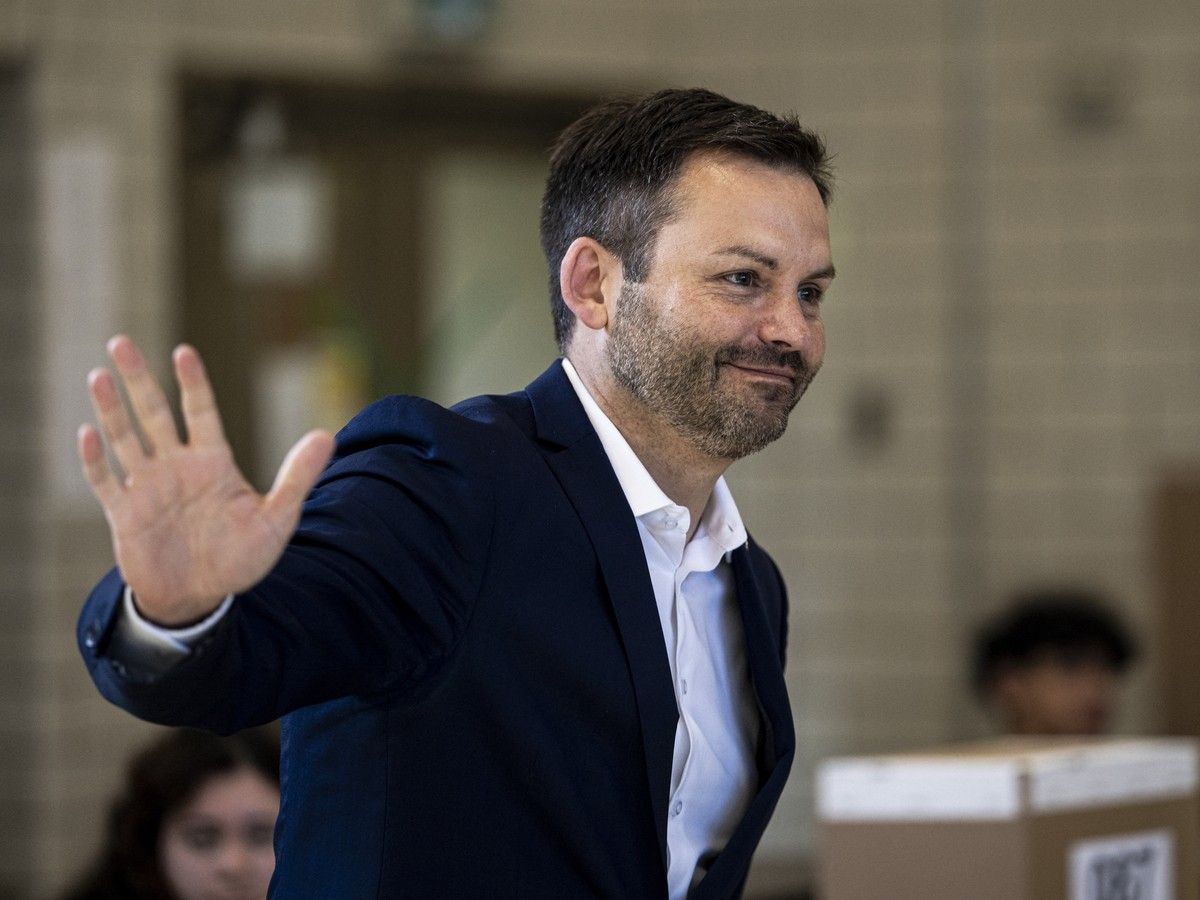
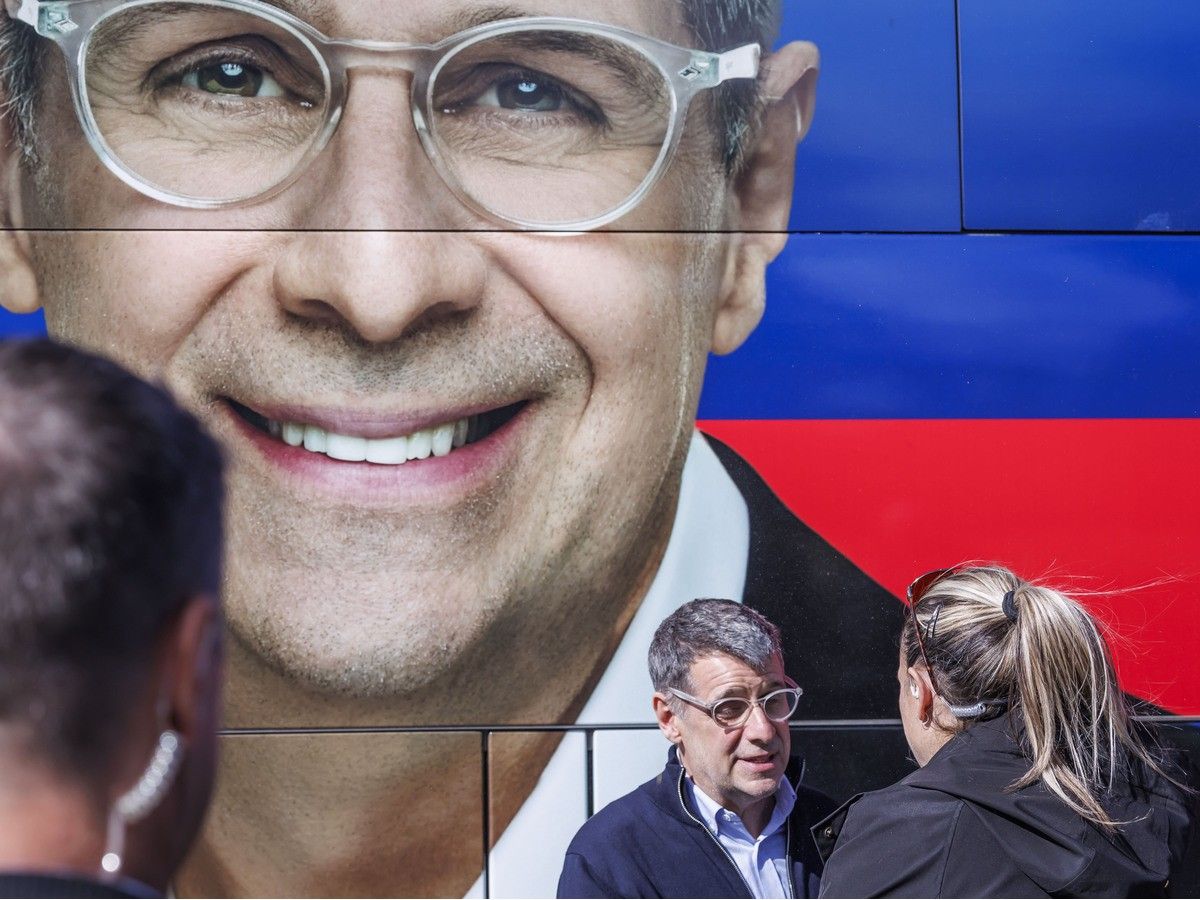
Photo via The Globe and Mail

Incoming Parti Québécois eyes friends and foes across the aisle

Read the original at The Globe and Mail ↗
Cite

Forrest, M., & Andrew-Gee, E. (2026, October 10). Incoming Parti Québécois eyes friends and foes across the aisle. The Globe and Mail. https://www.theglobeandmail.com/canada/article-incoming-parti-quebecois-friends-foes-across-aisle-minority-government/

Dated when The Aporia collected the article, usually within hours of publication. Check the original for its exact date and byline.

The Globe and Mail · collected 2026-10-10 · by Maura Forrest, Eric Andrew-Gee

Quick Summary

Paul St-Pierre Plamondon, the premier-designate of Quebec's incoming minority Parti Québécois (PQ) government with 59 seats, plans to collaborate with other parties to maintain power and potentially hold an independence referendum. The PQ needs support from either the right-wing Conservative Party or left-wing Québec solidaire to achieve a majority in the National Assembly. Québec solidaire, which won nine seats, proposes a more inclusive and costly process for independence compared to the PQ's approach. This political landscape could influence whether and when Quebec moves towards a referendum on sovereignty.
Written by AI on 2026-10-10, from this article's own text only (the story summary below draws on all the coverage).

AI analysis

Story summary

After the recent election in Quebec, the Parti Québécois (PQ) emerged with 59 seats, just five shy of a majority. Premier-designate Paul St-Pierre Plamondon has pledged to collaborate across party lines, despite ideological differences with rival parties like the left-wing Québec solidaire and right-wing Conservative Party. These smaller parties now hold significant leverage over the PQ's ability to govern effectively or call for an independence referendum. Political science lecturer André Lamoureux predicts that future negotiations will be marked by "rivalry and contention on many issues." While St-Pierre Plamondon avoided discussing sovereignty during the campaign, he reaffirmed his commitment to the cause in a victory speech, though he has promised not to hold a referendum while President Donald Trump is in office due to current unpopularity of independence in Quebec.

Written for “Quebec Politics Parti Québécois” on 2026-10-30, grounded in this article and the 0 other(s) covering the same event.

Story

📰 Quebec Politics Parti Québécois
Politics · 1 article(s) covering the same event.

Compared with similar articles

This article reads leans right and hedges 10% of its claims. Each row says how that neighbour differs.
South China Morning Post
⚖️ Leans left further left than this Hedges 1 of 5 claims Outlet record 64/100
“The articles describe different stages and outcomes of the election process in Quebec, not the same specific moment or incident.”
The Guardian
⚖️ Leans strongly right further right than this Hedges 2 of 27 claims Outlet record 66/100
“While both articles discuss the outcome and implications of the same election in Quebec, Article A focuses on the expected victory of the Parti Québécois (PQ) based on polls before or shortly after the election date, while Article B discusses the post-election situation where PQ is forming a minority government with potential support from other parties. These are related but distinct moments in time.”
Global News
Hedges 3 of 34 claims Outlet record 63/100
“The articles describe different stages of political transition in Quebec, with Article A focusing on election results and potential alliances, while Article B covers an actual meeting between outgoing and incoming premiers.”
National Post
⚖️ Leans left further left than this Hedges 7 of 92 claims Outlet record 60/100
“Article A discusses the election results and victory of Parti Québécois, while Article B focuses on the political situation following the election where PQ is a minority government.”
The Globe and Mail
⚖️ Leans right Hedges 4 of 38 claims Outlet record 52/100
“While both articles discuss the Parti Québécois's projected victory in Quebec, Article A focuses on the initial election results and promises made during that time, while Article B discusses the political landscape and potential collaboration post-election.”
Toronto Star
Hedges 2 of 31 claims Outlet record 64/100
“Article A describes the immediate outcome of an election where Parti Québécois won a minority government, while Article B discusses potential political strategies and alliances after the PQ's victory, days later.”
Toronto Star
⚖️ Leans left further left than this Hedges 2 of 31 claims Outlet record 64/100
“While both articles discuss the political situation following an election that brought the Parti Québécois into power, they describe different aspects and stages of the event. Article A covers the party's resurgence from a weak position to gaining influence in the assembly, while Article B focuses on the PQ's efforts to form a government with support from other parties.”
CBC News
Hedges 3 of 39 claims Outlet record 74/100
“The articles discuss different aspects of the political situation in Quebec and do not describe the same specific incident or occurrence.”
National Post
⚖️ Leans right Hedges 2 of 53 claims Outlet record 60/100
“The articles describe different aspects of the election outcomes and political situations in Quebec, not a single specific incident.”
BBC News
⚖️ Leans left further left than this Hedges 4 of 29 claims Outlet record 69/100
“While both articles discuss the PQ's election victory in Quebec, Article A focuses on the projected outcome and its implications for Canada, while Article B discusses the political situation post-election with a focus on the distribution of seats and potential collaboration across parties.”
How this article was measured signals, leaning charts, publisher record, byline, topics and claims

Signals How these are calculated →

Claims extracted
39
sentences that state something as happening or true
Uncertain
10%
4 of 39 hedged ("reportedly", "may", "according to")
Leaning
Leans right
of the writing, not the subject · beta estimate
Publisher signals
52/100
The Globe and Mail's corrections and hedging, across everything collected from it. Not a measure of accuracy.
Outlets on this story
1
Politics
Same framing elsewhere
1
articles that frame the event the way this one does
Analyzed 2026-10-10 · how these are computed

How this is being covered How these are calculated →

Article leaning vs. publisher reliability
Source leaning vs. consistency

Publisher

The Globe and Mail · 1010 article(s) · 35 correction(s) detected
Running correction rate · 35 correction(s)

Who wrote this

Maura Forrest
13 article(s) here · 1 carrying a prediction
🔮 The federal government denied the province’s request to have its leader deliver a speech and hold its own reception, instead offering a seat at the head table for the opening supper and a role greeting visiting dignitaries at the airport. “The federal government would have us believe that the Premier of Quebec being granted permission to serve shrimp cocktails at a reception constitutes an acceptable and sufficient form of influence for representing Quebec’s interests,” said Mr. St-Pierre Plamondon in a social-media post on Tuesday.
🔮 Ms. Poulin did not respond to questions about how the alleged theft of military ammunition could have taken place, and when the CAF became aware of the issue.
🔮 With the PQ at 59 seats, five shy of a majority, premier-designate Paul St-Pierre Plamondon has vowed to collaborate across the aisle, while his rival party leaders are starting to hint at what they will demand in return. “It will be a context of rivalry and contention on many issues,” said André Lamoureux, a political-science lecturer at the University of Quebec at Montreal.
🔮 We’ve got plenty of urgent problems to solve, so I think the upcoming months will more be about … things that are urgent,” he said.
🔮 The results of Monday’s election will shake up Quebec’s political landscape, with the PQ returning to power after being nearly wiped out four years ago, while the Coalition Avenir Québec is facing extinction after eight years in government.
2026-10-06 · assertive framing · Five takeaways from the Quebec election results
🔮 The separatist Parti Québécois is projected to form government in Quebec after promising to hold an independence referendum in the next four years, with the prospect of such a vote increasing if the PQ is able to eke out a majority.
🔮 The Parti Québécois, polls show, will likely take the reins of power from the governing Coalition Avenir Québec on Monday after a lacklustre campaign in which voters expressed a desire for change but little enthusiasm for any of their options.
🔮 The leader of the Parti Québécois says he will break with the monarchy in Quebec if he becomes premier, invoking the spectre of a constitutional battle that critics say could help him drum up support for an unpopular referendum on independence.
🔮 On Oct. 5, Quebeckers will select from five major political parties who are all likely to win at least a handful of seats in the province’s National Assembly.
🔮 On Friday, the PQ confirmed it will cost at least $130-million to hold an independence referendum in a first mandate, as Leader Paul St-Pierre Plamondon has promised to do if his party forms government on Oct. 5.
Also by Maura Forrest
Five takeaways from the Quebec election results
2026-10-06 · The Globe and Mail
Nothing else under this byline is closely related to this article, so these are simply their most recent.
All 13 articles by Maura Forrest →
Eric Andrew-Gee
14 article(s) here · 1 carrying a prediction
🔮 The federal government denied the province’s request to have its leader deliver a speech and hold its own reception, instead offering a seat at the head table for the opening supper and a role greeting visiting dignitaries at the airport. “The federal government would have us believe that the Premier of Quebec being granted permission to serve shrimp cocktails at a reception constitutes an acceptable and sufficient form of influence for representing Quebec’s interests,” said Mr. St-Pierre Plamondon in a social-media post on Tuesday.
🔮 With the PQ at 59 seats, five shy of a majority, premier-designate Paul St-Pierre Plamondon has vowed to collaborate across the aisle, while his rival party leaders are starting to hint at what they will demand in return. “It will be a context of rivalry and contention on many issues,” said André Lamoureux, a political-science lecturer at the University of Quebec at Montreal.
🔮 We’ve got plenty of urgent problems to solve, so I think the upcoming months will more be about … things that are urgent,” he said.
🔮 The results of Monday’s election will shake up Quebec’s political landscape, with the PQ returning to power after being nearly wiped out four years ago, while the Coalition Avenir Québec is facing extinction after eight years in government.
2026-10-06 · assertive framing · Five takeaways from the Quebec election results
🔮 The separatist Parti Québécois is projected to form government in Quebec after promising to hold an independence referendum in the next four years, with the prospect of such a vote increasing if the PQ is able to eke out a majority.
🔮 The Parti Québécois, polls show, will likely take the reins of power from the governing Coalition Avenir Québec on Monday after a lacklustre campaign in which voters expressed a desire for change but little enthusiasm for any of their options.
🔮 The PLQ brand was tarnished, and the new chief would have little time to introduce himself to voters ahead of a fall campaign. Those circumstances set the Liberals back, but a deeper obstacle was at play as well: what Mr. Aucoin called Quebec’s “deep blue streak,” has lately risen to the surface.
🔮 As a child, Barry may not have reached for that classical allusion, but it comes to his lips easily now, at the age of 83, sitting in his office at the University of Calgary department of political science.
🔮 Quebec Premier Christine Fréchette is warning of U.S. attempts to sow division between the province and Canada less than two weeks from an election that could see the sovereigntist Parti Québécois come to power.
🔮 On Friday, the PQ confirmed it will cost at least $130-million to hold an independence referendum in a first mandate, as Leader Paul St-Pierre Plamondon has promised to do if his party forms government on Oct. 5.
Also by Eric Andrew-Gee
Five takeaways from the Quebec election results
2026-10-06 · The Globe and Mail
Nothing else under this byline is closely related to this article, so these are simply their most recent.
All 14 articles by Eric Andrew-Gee →

Topics

Canada Conservative Party Montreal Quebec Québec solidaire

Subjects

Montreal GPE · 3× Canada GPE · 2× NDP ORG · 2× Quebec GPE · 2× Québec solidaire ORG · 2× the National Assembly ORG · 2× André Lamoureux PERSON · 1× Conservative Party ORG · 1× Parti Québécois ORG · 1× Paul St-Pierre Plamondon PERSON · 1×

Narrative

With the PQ at 59 seats, five shy of a majority, premier-designate Paul St-Pierre Plamondon has vowed to collaborate across the aisle, while his rival party leaders are starting to hint at what they will demand in return. “It will be a context of rivalry and contention on many issues,” said André Lamoureux, a political-science lecturer at the University of Quebec at Montreal.
framing: assertive · carried by 1 article(s) · first seen 2026-10-10
🔮 With the PQ at 59 seats, five shy of a majority, premier-designate Paul St-Pierre Plamondon has vowed to collaborate across the aisle, while his rival party leaders are starting to hint at what they will demand in return. “It will be a context of rivalry and contention on many issues,” said André Lamoureux, a political-science lecturer at the University of Quebec at Montreal.
2026-10-10 · The Globe and Mail
Incoming Parti Québécois eyes friends and foes across the aisle · assertive framing

Claims (39 extracted, 4 hedged)

Two parties at opposite ends of Quebec’s ideological spectrum have been thrust into the national spotlight after an election that leaves the province’s political future – and possibly the unity of Canada – in their hands. uncertain
that → thrust → hands
The left-wing Québec solidaire and right-wing Conservative Party both won enough seats in Monday’s vote to potentially decide whether the incoming minority Parti Québécois government stays in power long enough to launch an independence referendum. asserted
government → win → referendum
With the PQ at 59 seats, five shy of a majority, premier-designate Paul St-Pierre Plamondon has vowed to collaborate across the aisle, while his rival party leaders are starting to hint at what they will demand in return. “It will be a context of rivalry and contention on many issues,” said André Lamoureux, a political-science lecturer at the University of Quebec at Montreal. asserted
Lamoureux → vow → Montreal
Mr. St-Pierre Plamondon has promised not to hold a referendum while U.S. President Donald Trump is in the White House, and throughout the campaign spoke little about sovereignty, which is currently unpopular in Quebec. asserted
which → promise → Quebec
But during his victory speech Monday, he reaffirmed his commitment to fighting for independence. asserted
he → reaffirm → independence
The premier-designate suggested that opposition lawmakers could help realize his plan to hold a vote on secession, though he has also made clear that sovereignty will not be among his early priorities. uncertain
be → suggest → priorities
In reality, partisan jockeying may well bring down his government long before he can hold an independence vote. uncertain
he → bring → vote
The Quebec Liberal Party will retain its position as Official Opposition with 40 seats, though it seems least inclined to collaborate with its old adversaries in the PQ. asserted
it → retain → PQ
Although there are some areas that the two parties agree on, such as trimming bureaucracy and building housing, the animosity between the federalists and sovereigntists runs deep, noted Mr. Lamoureux. asserted
Lamoureux → be → federalists
The Liberals may have their first chance to clash with the government over its plans to abolish the role of lieutenant-governor, which Leader Charles Milliard said was “constitutionally an issue” and “not a priority for Quebeckers” in a postelection interview with Montreal radio station CJAD. uncertain
Milliard → have → CJAD
The government’s most likely partner in its goal of separating from Canada is Québec solidaire, with its nine seats concentrated in the cores of Montreal and Quebec City. asserted
seats → separate → Montreal
The PQ needs a majority of votes in the National Assembly to adopt a referendum question. asserted
PQ → need → question
QS was born in 2006, partly out of frustration with the PQ’s drift to the right on economic and identity issues, and they diverge sharply on everything from immigration to the question of how to bring about independence. asserted
they → bear → independence
The left-wing party describes its vision of separation as “inclusive” and proposes a four-year process that would involve consulting minorities on a proposed constitution, which would then be put to a referendum, at a cost of $840-million. asserted
which → describe → million
The PQ wants a more pared-back constitutional consultation at far less cost. asserted
PQ → want → cost
Despite these differences, party leaders have collaborated before, including on a “roadmap” to independence in 2017, when both were in opposition. asserted
both → collaborate → opposition
Their bases are deeply at odds, however, on ideological grounds and have blocked attempted reconciliations in the past, including when QS members voted down a proposed alliance with the PQ ahead of the 2018 election. asserted
members → block → election
Despite its iron-clad commitment to independence, QS draws major support from urban progressives who like its environmental and social policies but are not interested in separation. asserted
who → draw → separation
Polls show that only a minority of the party’s supporters would vote Yes in a referendum. asserted
minority → show → referendum
QS is also conscious of avoiding the fate that befell the NDP in last year’s federal election, when the New Democrats were decimated after propping up a minority Liberal government. asserted
Democrats → avoid → government
The QS caucus will include Alexandre Boulerice, a former NDP MP now representing the Montreal riding of Gouin in the National Assembly. asserted
caucus → include → Assembly
“Politically, it wasn’t a winning choice for the NDP,” said Quentin Janel, QS director of communications. asserted
Janel → win → communications
“And we have fundamental disagreements with the PQ on immigration and inclusivity, which makes it out of the question to strike a formal pact with the government on that level. asserted
it → have → level
The most likely dance partner for the PQ on many bread-and-butter issues is the provincial Conservative Party, founded in 2009, which had never won a seat in the National Assembly and now has 19, clustered in the Quebec City area. asserted
which → found → area
(An earlier iteration of the party dissolved in 1936). asserted
iteration → dissolve → 1936
The breakout star of the 2026 election was Conservative Leader Éric Duhaime, who campaigned on the cost of living and voters’ dissatisfaction with the Coalition Avenir Québec government’s management of public funds. asserted
who → campaign → funds
Mr. Duhaime promised to act as a watchdog on behalf of taxpayers if voters gave his party the balance of power, and during a press conference in Quebec City on Wednesday, he said his caucus members are united by their commitment to fiscal conservatism. asserted
members → promise → conservatism
“These are people fighting for individual freedom, for civil liberties, for democracy, and also for more money in your pockets – a smaller government that’s tightening its belt,” he said. asserted
he → fight → belt
“That’s the Quebec version of conservatism today.” asserted
That → ’ → conservatism
Shortly before the campaign, Mr. Duhaime unveiled a plan to cut government spending by $47-billion over five years, in part by eliminating 20,000 public-service jobs. asserted
Duhaime → unveil → jobs
The proposal was the cornerstone of his campaign, and it set the narrative for an election that saw most parties announce measures to shrink the size of the bureaucracy, said Rudy Husny, a political analyst and former federal Conservative adviser. asserted
Husny → set → bureaucracy
There is considerable common ground between the Conservatives and Mr. St-Pierre Plamondon’s PQ, the most “centre-right” version of the party that Quebec has seen, Mr. Husny said. asserted
Husny → be → that
Both parties want to scrap the sales tax on used goods and to abolish Santé Québec, a Crown corporation created by the CAQ government to operate Quebec’s health care network, which critics have labelled as little more than a new layer of bureaucracy. asserted
critics → want → bureaucracy
On Wednesday, Mr. Duhaime said he also supports the PQ’s plan to freeze the salaries of elected officials. asserted
he → say → officials
But the Conservative Leader has been adamant that his party wants nothing to do with a vote on sovereignty. asserted
party → want → sovereignty
“Our position is non-negotiable,” said spokesperson Cédric Lapointe in a statement. asserted
Lapointe → say → statement
Mr. Husny said it’s very unlikely the PQ will launch the process to hold a referendum in this mandate, especially given Mr. St-Pierre Plamondon’s promise to wait until Mr. Trump leaves office in 2029. asserted
Trump → say → 2029
Quebec’s two previous minority governments survived less than two years. asserted
governments → survive → years
This election campaign was primarily about change, he said. asserted
he → say → change

💬Give feedback
🕘History 🎫Support