Photo via Times of India

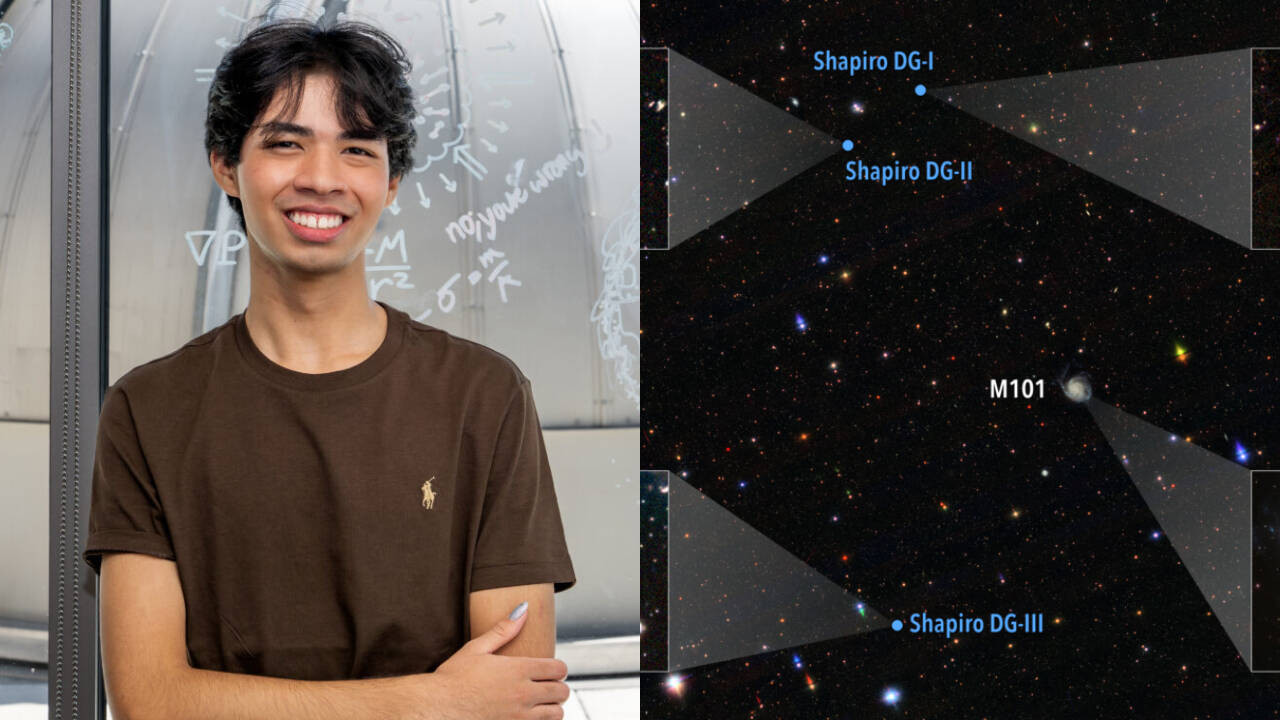
18-year-old Julian Shapiro discovers three unusual dwarf galaxies in high school

Read the original at Times of India ↗
Cite

TOI Science Desk. (2026, October 10). 18-year-old Julian Shapiro discovers three unusual dwarf galaxies in high school. Times of India. https://timesofindia.indiatimes.com/science/discovery/meet-julian-shapiro-the-18-year-old-new-yorker-who-discovered-three-unusual-dwarf-galaxies-while-still-in-high-school-became-sole-author-of-an-astrophysical-journal-paper-and-won-a-25000-davidson-fellowship/articleshow/134789449.cms

Dated when The Aporia collected the article, usually within hours of publication. Check the original for its exact date and byline.

Times of India · collected 2026-10-10 · by TOI Science Desk

Quick Summary

Eighteen-year-old Julian Shapiro discovered three unusual dwarf galaxies while still in high school, leading to recognition as a 2026 Davidson Fellow and authorship of an Astrophysical Journal paper alone. These galaxies, now named Shapiro Dwarf Galaxies I, II, and III, are notable because they appear isolated from other galaxies yet have stopped forming stars—contrary to expectations. One possible explanation is that these galaxies were once closer to a massive galaxy like the Pinwheel Galaxy, where forces stripped away their star-forming gas before ejecting them into more distant regions of space. Shapiro’s findings challenge existing models and provide evidence for the existence of backsplash galaxies predicted by the Lambda-CDM model.
Written by AI on 2026-10-10, from this article's own text only (the story summary below draws on all the coverage).

AI analysis

Story summary

18-year-old Julian Shapiro, a high school student from New York, discovered three unusual dwarf galaxies using publicly available data. The findings were published in the Astrophysical Journal, with Shapiro as the sole author. Now an undergraduate astrophysics student at UC Berkeley, he identified these galaxies while still in high school and was recognized as a 2026 Davidson Fellow for his work. Named Shapiro Dwarf Galaxies I, II, and III, these celestial bodies are small and isolated from other galaxies. Most notably, they have ceased forming stars despite being in regions where dwarf galaxies typically retain the necessary cold gas for star formation. The discovery challenges existing theories about how galaxies evolve and interact with their surroundings.

Written for “Young Scientist Discovers Galaxies” on 2026-11-01, grounded in this article and the 0 other(s) covering the same event.

Story

📰 Young Scientist Discovers Galaxies
Science · 1 article(s) covering the same event.

Compared with similar articles

Nothing to compare against. No article is close enough to this one for the pipeline to have linked or judged the pair.
How this article was measured signals, leaning charts, publisher record, byline, topics and claims

Signals How these are calculated →

Claims extracted
30
sentences that state something as happening or true
Uncertain
23%
7 of 30 hedged ("reportedly", "may", "according to")
Leaning
not political
takes no side on a contested political question
Publisher signals
59/100
Times of India's corrections and hedging, across everything collected from it. Not a measure of accuracy.
Outlets on this story
1
Science
Same framing elsewhere
1
articles that frame the event the way this one does
Analyzed 2026-10-10 · how these are computed

How this is being covered How these are calculated →

Article leaning vs. publisher reliability
Source leaning vs. consistency

Publisher

Times of India · 3858 article(s) · 2 correction(s) detected
Running correction rate · 2 correction(s)

Who wrote this

TOI Science Desk
299 article(s) here · 1 carrying a prediction
🔮 The work will be carried out by the West Tennessee River Basin Authority, which is preparing a plan to restore the river and the land around it.
🔮 Cornell University scientists have developed genetically engineered tomato plants that turn red-purple when nitrogen becomes scarce, giving farmers a visible warning that crops may need fertiliser.
🔮 By studying these crystals and other mineral grains, scientists could establish the meteorite's age and identify later changes caused by water.
🔮 Centuries later, bronze objects found in Scandinavia would preserve chemical signatures consistent with the metals produced at this Spanish site, offering evidence of connections that may have crossed much of Europe.
🔮 She explored whether an inexpensive device could capture airborne genetic material and support the detection of bacterial pathogens.
🔮 This control may help it maintain its orientation and move along a narrow path without losing its bearings.
🔮 The university says the sculpture will subsequently go on permanent display at its Turner Museum of Glass.
🔮 By bringing together nature, wellness facilities and educational spaces, Winter Garden aimed to create a setting where visitors could exercise, learn about nutrition and gardening, and spend time outdoors.
🔮 Also discovered was a 4,500-year-old humanoid idol, which archaeologists hope will help shed light on the cultural traditions of the region.
🔮 When garlic mustard spreads across the forest floor, other plants may struggle to obtain the resources they need to survive.
Wire or desk byline, not an individual reporter.
Also by TOI Science Desk
Nothing else under this byline is closely related to this article, so these are simply their most recent.
All 299 articles by TOI Science Desk →

Topics

Astrophysical Journal Berkeley News New Yorker UC Berkeley

Subjects

Shapiro PERSON · 4× Berkeley GPE · 3× Berkeley News ORG · 2× Astrophysical Journal ORG · 1× Davidson PERSON · 1× Julian Shapiro PERSON · 1× New Yorker NORP · 1× UC Berkeley ORG · 1× the Astronomical League’s ORG · 1×

Narrative

These are dwarf galaxies that once travelled close to a much larger galaxy, passed through its gravitational environment and lost much of their star-forming gas before being propelled back into a more distant region of space.
framing: mixed · carried by 1 article(s) · first seen 2026-10-10
🔮 Others begin much closer to home, with a teenager willing to spend hours combing through publicly available data and asking why something does not quite fit the expected picture.

Claims (30 extracted, 7 hedged)

Some astronomical discoveries begin with powerful telescopes pointed at distant corners of the universe. asserted
discoveries → begin → universe
Others begin much closer to home, with a teenager willing to spend hours combing through publicly available data and asking why something does not quite fit the expected picture. asserted
something → begin → picture
For Julian Shapiro, that curiosity led to three peculiar dwarf galaxies, an Astrophysical Journal paper with his name alone on it and recognition as a 2026 Davidson Fellow, states the latest report by Berkeley News. asserted
report → lead → News
Now an undergraduate astrophysics student at UC Berkeley, the 18-year-old New Yorker made the discovery while still in high school. asserted
Yorker → make → school
Three galaxies that broke the pattern The galaxies, now catalogued as Shapiro Dwarf Galaxies I, II and III, share an unusual combination of characteristics. asserted
galaxies → break → characteristics
They are small, relatively isolated from other galaxies and, most importantly, appear to have stopped forming stars, states the report. asserted
report → appear → stars
If we go by the Berkeley News report, dwarf galaxies in sparsely populated regions of space are generally expected to retain the cold gas required to create new stars. asserted
galaxies → go → stars
By contrast, quenched dwarf galaxies, those that have effectively switched off their star-making activity are more commonly found close to massive galaxies. asserted
that → quench → galaxies
There, gravitational and hydrodynamic forces can strip away the gas that fuels star formation. asserted
that → strip → formation
Shapiro’s three discoveries appear to sit in the wrong neighbourhood for their condition, the report claims. uncertain
report → appear → condition
The backsplash galaxy theory One possible explanation is that the galaxies were not always as isolated as they appear today. asserted
they → appear → ?
According to the report, Shapiro’s research suggests they could be examples of so-called backsplash galaxies. uncertain
they → accord → galaxies
These are dwarf galaxies that once travelled close to a much larger galaxy, passed through its gravitational environment and lost much of their star-forming gas before being propelled back into a more distant region of space. asserted
that → travel → space
The Pinwheel Galaxy, also known as Messier 101, is considered the leading candidate for the massive host that may have interacted with the newly identified dwarfs, the online report adds. uncertain
report → know → dwarfs
A second possibility applies particularly to Shapiro Dwarf Galaxy II. asserted
possibility → apply → Galaxy
Its position near the spiral galaxy NGC 5585 leaves open the possibility that it could actually be a faint satellite rather than a backsplash galaxy. uncertain
it → leave → possibility
Either scenario could help explain how galaxies that appear isolated today became unable to form new stars. uncertain
that → help → stars
Testing a long-standing prediction The discovery has implications beyond three unusual objects, adds the report. asserted
report → test → objects
The standard cosmological model, known as Lambda-CDM, predicts that backsplash galaxies should exist in significant numbers. asserted
galaxies → know → numbers
Finding convincing examples in the nearby universe, however, has proved difficult. asserted
Finding → find → universe
Shapiro used simulations to estimate where such galaxies should be found around a Milky Way-like galaxy and where existing telescope archives would be capable of detecting them. asserted
archives → use → them
He then developed methods for identifying potential candidates and assessing whether their apparent isolation was genuine. asserted
isolation → develop → candidates
A significant portion of the work involved estimating distances. asserted
portion → involve → distances
Without accurate measurements, a galaxy that appears isolated could simply be much farther away from Earth than its apparent neighbours. uncertain
that → appear → neighbours
And follow-up observations using high-resolution space telescopes could help establish the galaxies’ precise locations and determine whether their unusual lack of star formation is indeed the result of a past encounter. uncertain
lack → follow → encounter
From high school to Berkeley What makes the discovery particularly striking is when it happened. asserted
it → make → Berkeley
Shapiro conducted the research while still in high school, before beginning his undergraduate studies at Berkeley. asserted
Shapiro → conduct → Berkeley
His work has now earned him the 2026 Davidson Fellowship, which carries a $25,000 award, as well as the Astronomical League’s National Young Astronomer Award in 2025. asserted
which → earn → 2025
As per the report, at Berkeley, he is pursuing astrophysics alongside mathematics and physics coursework. asserted
he → pursue → coursework
He has also joined the research group of renowned astronomer Alex Filippenko; his next projects include investigating the Hubble tension, the continuing disagreement over how quickly the universe is expanding. asserted
universe → join → tension

💬Give feedback
🕘History 🎫Support