Photo via Times of India

Scientists found how coelacanths' hinged skulls grow and their brains stay tiny

Read the original at Times of India ↗
Cite

TOI Science Desk. (2026, October 10). Scientists found how coelacanths' hinged skulls grow and their brains stay tiny. Times of India. https://timesofindia.indiatimes.com/science/discovery/in-2019-scientists-found-clues-to-how-the-living-coelacanths-hinged-skull-grows-and-why-its-brain-stays-tiny-shedding-light-on-skull-evolution/articleshow/134707077.cms

Dated when The Aporia collected the article, usually within hours of publication. Check the original for its exact date and byline.

Times of India · collected 2026-10-10 · by TOI Science Desk

Quick Summary

Scientists have revealed how coelacanths' skulls grow while keeping their brains small, using advanced imaging techniques on rare museum specimens. Published in Nature in 2019, the study led by Hugo Dutel from the University of Bristol found that the coelacanth's braincase is split by a joint and its brain occupies just one percent of the cavity, an unprecedented mismatch among living vertebrates. The research sheds light on the development of this deep-sea fish thought extinct for seventy million years until 1938 when it was rediscovered off South Africa.
Written by AI on 2026-10-10, from this article's own text only (the story summary below draws on all the coverage).

AI analysis

Story summary

In 2019, scientists at the National Museum of Natural History in Paris published a groundbreaking study in the journal *Nature* about the development of the skull and brain in coelacanths, Latimeria chalumnae. These deep-sea fish were thought extinct for seventy million years until one was accidentally caught by a South African fisherman in 1938. The study used non-invasive scanning techniques at the European Synchrotron to reveal that coelacanths have a hinged braincase, allowing their skulls to grow while keeping their brains extremely small—occupying only about one percent of the available space within the skull cavity. This finding is crucial for researchers studying tetrapod evolution because coelacanths are closely related to four-limbed vertebrates including amphibians, mammals, and reptiles.

Written for “Coelacanth Skull Growth” on 2026-11-02, grounded in this article and the 0 other(s) covering the same event.

Story

📰 Coelacanth Skull Growth
Science · 1 article(s) covering the same event.

Compared with similar articles

Nothing to compare against. No article is close enough to this one for the pipeline to have linked or judged the pair.
How this article was measured signals, leaning charts, publisher record, byline, topics and claims

Signals How these are calculated →

Claims extracted
25
sentences that state something as happening or true
Uncertain
16%
4 of 25 hedged ("reportedly", "may", "according to")
Leaning
not political
takes no side on a contested political question
Publisher signals
59/100
Times of India's corrections and hedging, across everything collected from it. Not a measure of accuracy.
Outlets on this story
1
Science
Same framing elsewhere
1
articles that frame the event the way this one does
Analyzed 2026-10-10 · how these are computed

How this is being covered How these are calculated →

Article leaning vs. publisher reliability
Source leaning vs. consistency

Publisher

Times of India · 3941 article(s) · 3 correction(s) detected
Running correction rate · 3 correction(s)

Who wrote this

TOI Science Desk
306 article(s) here · 1 carrying a prediction
🔮 “Normally, my job is quite monotonous, so I wanted to create something that would entertain people, turning my ‘serious’ job into something fun,” he said in a Guinness World Records news release.
🔮 The subsequent collision between the two galaxy clusters may then have compressed the cloud or re-energised its particles, causing it to shine more brightly in radio wavelengths once again.
🔮 The mathematicians at the University of California, Davis, argue that the answer may already lie within Einstein’s own equations and that an invisible form of energy may not be needed at all.
🔮 The work will be carried out by the West Tennessee River Basin Authority, which is preparing a plan to restore the river and the land around it.
🔮 Cornell University scientists have developed genetically engineered tomato plants that turn red-purple when nitrogen becomes scarce, giving farmers a visible warning that crops may need fertiliser.
🔮 By studying these crystals and other mineral grains, scientists could establish the meteorite's age and identify later changes caused by water.
🔮 Centuries later, bronze objects found in Scandinavia would preserve chemical signatures consistent with the metals produced at this Spanish site, offering evidence of connections that may have crossed much of Europe.
🔮 Deposited impurities and staining may also have contributed, while low temperatures and humidity could cause the fabric to crack.
🔮 Two male king cobras meeting during the breeding season may engage in a prolonged contest, using their bodies to wrestle for control rather than relying on the venomous strikes associated with these snakes.
🔮 The project could offer a new way to build more affordable and sustainable homes across Canada.
Wire or desk byline, not an individual reporter.
Also by TOI Science Desk
Nothing else under this byline is closely related to this article, so these are simply their most recent.
All 306 articles by TOI Science Desk →

Topics

Nature Paris South African the National Museum of Natural History the University of Bristol

Subjects

ESRF ORG · 1× Hugo Dutel PERSON · 1× Nature ORG · 1× Paris GPE · 1× South African NORP · 1× the National Museum of Natural History ORG · 1× the University of Bristol ORG · 1×

Narrative

A coelacanth thought extinct for seventy million years was caught alive in 1938 The European Synchrotron explains that the coelacanth is a marine fish closely related to tetrapods, the four-limbed vertebrates that include amphibians, mammals and reptiles.
framing: assertive · carried by 1 article(s) · first seen 2026-10-10
🔮 An enlarging notochord may shape the braincase and the brain's relative size In most vertebrates, the report explains, the vertebral column replaces the notochord early in embryonic development.

Claims (25 extracted, 4 hedged)

In 2019, scientists unveiled the first observations of how the skull and brain develop in the living coelacanth, Latimeria chalumnae, a deep-sea fish once thought extinct for seventy million years. asserted
skull → unveil → years
A team working with the National Museum of Natural History in Paris scanned rare museum specimens without damaging them and published the results in the journal Nature. asserted
team → work → journal
The findings shed light on a hinged braincase and a surprisingly small brain. asserted
findings → shed → braincase
The coelacanth's braincase is split by a joint, and its brain fills only one per cent of the cavity, a mismatch unequalled among living vertebrates. asserted
brain → split → vertebrates
This opened new avenues for research. asserted
This → open → research
A coelacanth thought extinct for seventy million years was caught alive in 1938 The European Synchrotron explains that the coelacanth is a marine fish closely related to tetrapods, the four-limbed vertebrates that include amphibians, mammals and reptiles. asserted
that → think → amphibians
Scientists believed coelacanths had died out seventy million years ago, until a South African fisherman accidentally caught a living one in 1938. asserted
fisherman → believe → 1938
Eighty years after that discovery, Latimeria still matters to researchers who want to understand where tetrapods came from and how their closest fossil relatives, the lobe-finned fishes, evolved. asserted
relatives → matter → where
The study ‘ Neurocranial development of the coelacanth and the evolution of the sarcopterygian head’ was led by Hugo Dutel, a research associate in palaeobiology at the University of Bristol, and was published in Nature in April 2019. asserted
study → lead → April
A hinged braincase and a tiny brain, the puzzling features of the living coelacanth According to the report, one of the coelacanth's most unusual features is its hinged braincase. uncertain
one → hinge → features
Among the other animals that share it are many fossil lobe-finned fishes from the Devonian period, roughly 410 to 360 million years ago. asserted
fishes → share → period
A joint called the intracranial joint splits the coelacanth's braincase completely into a front part and a back part. asserted
joint → call → part
The brain itself sits far to the rear of the skull and fills only one per cent of the cavity that houses it. asserted
that → sit → it
The article says this mismatch is unequalled among living vertebrates. asserted
mismatch → say → vertebrates
How the skull grows and why the brain stays so small had puzzled scientists for years, so the team examined specimens at different stages of development from several public natural history collections. asserted
team → grow → collections
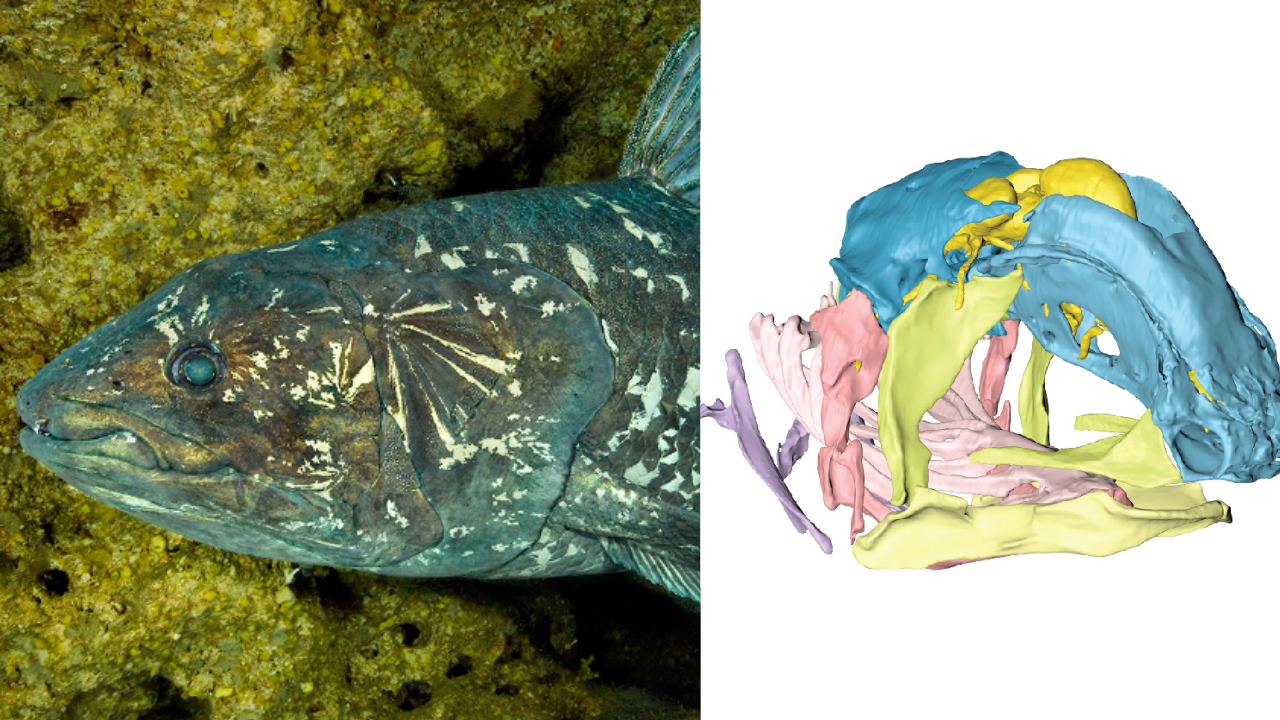
Coelacanths live in the deep ocean and are a critically endangered species (Image: ESRF) Scanning a five-centimetre fetus with X-rays to build three-dimensional models Adult coelacanths are well represented in museums, but fetuses are extremely rare. asserted
fetuses → live → museums
The researchers therefore used advanced imaging to see inside the specimens without harming them. asserted
researchers → use → them
The European Synchrotron reports that they digitised a fetus only five centimetres long, the earliest stage available for Latimeria, using synchrotron X-ray microtomography on a beamline called ID19. asserted
they → report → beamline
The team combined those data with magnetic resonance imaging and micro-computed tomography scans to build detailed three-dimensional models. asserted
team → combine → models
The models showed how the skull, the brain and the notochord, a tube running below the brain and spinal cord in early life, change from fetus to adult. asserted
skull → show → adult
The researchers also compared their observations with what is known about skull formation in other vertebrates. asserted
what → compare → vertebrates
An enlarging notochord may shape the braincase and the brain's relative size In most vertebrates, the report explains, the vertebral column replaces the notochord early in embryonic development. uncertain
column → enlarge → development
In Latimeria, the notochord instead expands considerably. asserted
notochord → expand → Latimeria
The authors suggest this enlargement likely influences how the braincase is patterned and might underpin the formation of the intracranial joint. uncertain
braincase → suggest → joint
It may also affect the brain, whose relative size drops dramatically during development. uncertain
size → affect → development

💬Give feedback
🕘History 🎫Support