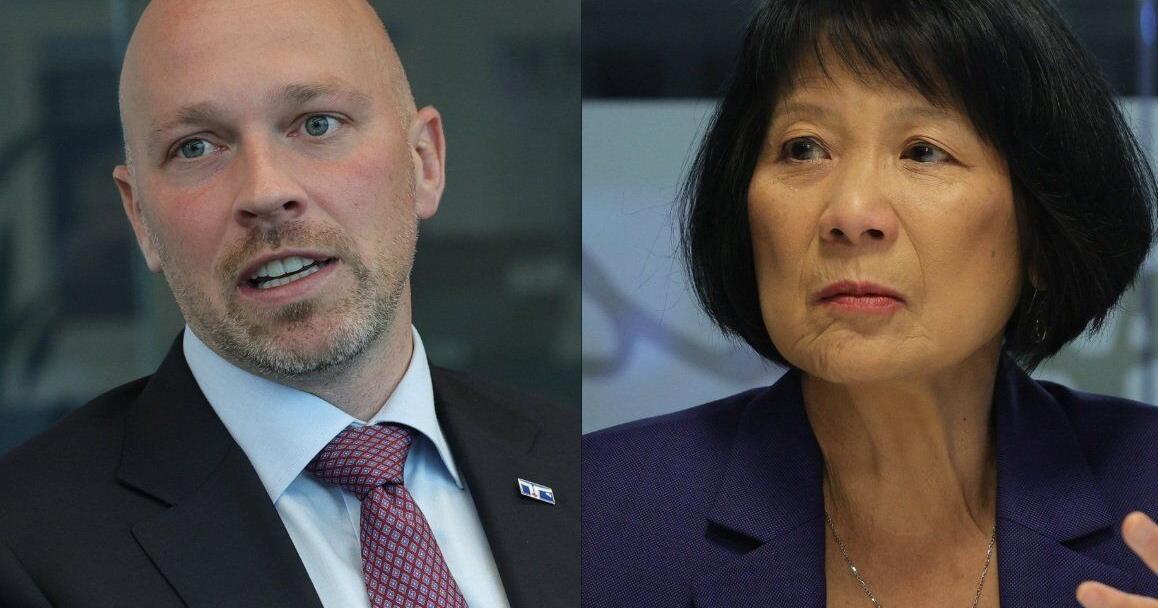
Photo via Toronto Star

The Campaign Pitch: What if there was a $9 charge to drive downtown?

Read the original at Toronto Star ↗
Cite

Takagi, A. (2026, October 10). The Campaign Pitch: What if there was a $9 charge to drive downtown? Toronto Star. https://www.thestar.com/news/gta/city-hall/the-campaign-pitch-what-if-there-was-a-9-charge-to-drive-downtown/article_356d3af8-c1ef-4f62-934e-4c43867364e7.html

Dated when The Aporia collected the article, usually within hours of publication. Check the original for its exact date and byline.

Toronto Star · collected 2026-10-10 · by Andy Takagi analysis

Quick Summary

The Star and the University of Toronto's School of Cities are exploring solutions to Toronto’s traffic issues ahead of the municipal election. Researchers Marianne Hatzopoulou and Steven Farber propose a congestion pricing scheme where drivers would pay $9 to enter downtown, defined by St. Clair Avenue to the north, the Humber River to the west, and the Don River to the east. This initiative could generate an estimated $500 million annually and reduce traffic congestion, as seen in other cities like London and New York. However, implementing such a plan would require provincial approval due to recent legislation limiting local tolling powers.
Written by AI on 2026-10-10, from this article's own text only (the story summary below draws on all the coverage).

AI analysis

Story summary

The Toronto Star is collaborating with the University of Toronto's School of Cities to propose solutions for urban issues ahead of the city’s municipal election. Researchers Marianne Hatzopoulou and Steven Farber, alongside Toronto’s first "Bicycle Mayor" Lanrick Bennett Jr., advocate for implementing a congestion pricing system in downtown Toronto. This would involve charging drivers $9 to enter the downtown area as a strategy to alleviate traffic congestion.

The proposal draws on successful examples from other cities where similar measures have been implemented. In London, traffic decreased by 30%, and average speeds increased by five kilometers per hour. Meanwhile, in Singapore, bus ridership rose by 8% following the introduction of congestion pricing. These outcomes highlight how such a system could potentially improve public transportation usage while reducing vehicular traffic in Toronto’s downtown core.

Written for “Traffic Mitigation Fee Proposal” on 2026-11-03, grounded in this article and the 0 other(s) covering the same event.

Story

📰 Traffic Mitigation Fee Proposal
Politics · 1 article(s) covering the same event.

Compared with similar articles

This article reads leans left and hedges 19% of its claims. Each row says how that neighbour differs.
Toronto Star
Hedges 5 of 52 claims Outlet record 64/100
“The articles describe different events: one about a proposal for congestion pricing and another about mayoral candidates answering questions from journalists.”
Toronto Star
Hedges 3 of 40 claims Outlet record 64/100
“The articles discuss different aspects of the municipal election campaign without describing the same specific incident.”
The Globe and Mail
Hedges 2 of 43 claims Outlet record 52/100
“The articles discuss different issues related to urban transportation policies but do not describe the same specific incident.”
How this article was measured signals, leaning charts, publisher record, byline, topics and claims

Signals How these are calculated →

Claims extracted
27
sentences that state something as happening or true
Uncertain
19%
5 of 27 hedged ("reportedly", "may", "according to")
Leaning
Leans left
of the writing, not the subject · beta estimate
Publisher signals
64/100
Toronto Star's corrections and hedging, across everything collected from it. Not a measure of accuracy.
Outlets on this story
1
Politics
Same framing elsewhere
1
articles that frame the event the way this one does
Analyzed 2026-10-10 · how these are computed

How this is being covered How these are calculated →

Article leaning vs. publisher reliability
Source leaning vs. consistency

Publisher

Toronto Star · 11143 article(s) · 28 correction(s) detected
Running correction rate · 28 correction(s)
2026-10-26
Correction
2026-10-24
Correction
2026-10-07
Correction
2026-09-24
Correction

Who wrote this

Andy Takagi
3 article(s) here · 1 carrying a prediction
🔮 Protesters were warned that they would be arrested if they continued to disrupt work.
🔮 Affiliated faculty at the school have taken on some of the city’s thorniest problems and the Star has presented their solutions to the two main contenders running to be mayor.
🔮 Mayoral hopeful Brad Bradford is proposing to take out priority bus lanes in Scarborough, on one of the busiest transit corridors in the city.
Also by Andy Takagi
Nothing else under this byline is closely related to this article, so these are simply their most recent.

Topics

Star Toronto U of T the School of Cities the University of Toronto

Subjects

Toronto GPE · 6× Farber PERSON · 4× TTC ORG · 3× Star ORG · 2× the School of Cities ORG · 2× Lanrick Bennett Jr. PERSON · 1× Marianne Hatzopoulou PERSON · 1× Steven Farber PERSON · 1× U of T ORG · 1× the University of Toronto ORG · 1×

Narrative

“Brad’s focus is on the levers the City actually controls: construction co-ordination with one person accountable to the Mayor, published timelines and real consequences for projects that linger, traffic agents at the intersections that matter, transit lane enforcement, and a TTC reliable enough that people choose it, starting with a 15-minute service guarantee.”
framing: assertive · carried by 1 article(s) · first seen 2026-10-10
🔮 Affiliated faculty at the school have taken on some of the city’s thorniest problems and the Star has presented their solutions to the two main contenders running to be mayor.
2026-10-10 · Toronto Star
The Campaign Pitch: What if there was a $9 charge to drive downtown? · assertive framing

Claims (27 extracted, 5 hedged)

The Star is partnering with the School of Cities at the University of Toronto to offer up some big ideas during the run-up to this month’s municipal election. asserted
Star → partner → election
Affiliated faculty at the school have taken on some of the city’s thorniest problems and the Star has presented their solutions to the two main contenders running to be mayor. asserted
Star → take → contenders
Would you pay $9 to drive downtown? asserted
you → pay → 9
That’s what U of T researchers Marianne Hatzopoulou and Steven Farber, along with Toronto’s first “Bicycle Mayor” Lanrick Bennett Jr., are proposing as a way to curb the city’s traffic woes. asserted
researchers → ’ → woes
Congestion pricing, when drivers have to pay a toll to get into the city’s downtown core, could reduce traffic and meaningfully push more drivers onto other modes of transit, the experts say. uncertain
experts → have → transit
But what would it look like? asserted
it → look → what
Success in other cities Congestion pricing has become a widely used tool across the world. asserted
pricing → become → world
Some of the world’s largest and most congested cities have used it to tackle their gridlocked streets. asserted
Some → congest → streets
Traffic in London decreased by 30 per cent and average speeds rose by five kilometres an hour. asserted
speeds → decrease → kilometres
Bus ridership in Singapore was boosted by eight per cent. asserted
ridership → boost → cent
Most recently, in New York, transit ridership was boosted by seven per cent and their congestion levy pulled in $550 million for the state government, according to the School of Cities. uncertain
levy → boost → Cities
In Toronto, Hatzopoulou, Bennett Jr. and Farber paint a picture of what a congestion charge might look like here. uncertain
charge → paint → what
With a congestion zone of St. Clair Avenue to the north, the Humber River to the west and the Don River to the east — and of charge of $9 to enter that area — the city could rake in an estimated $500 million. uncertain
city → enter → million
That’s without taking into consideration things like dynamic pricing, where prices would go up or down depending on the time of day. asserted
prices → ’ → day
There would also need to be some exceptions for lower-income drivers, and a commensurate improvement in the TTC to ferry more riders, the experts note. asserted
experts → need → riders
A congestion price would have two benefits, explained Farber — a human geography professor at U of T. asserted
Farber → have → U
First, discouraging drivers from entering the city and second, collecting revenue that could then be spent on improving public transit. uncertain
that → discourage → transit
“The evidence around congestion charging is really clear,” Farber said. asserted
Farber → say → charging
“It’s essentially one of the only things that we can do that actually helps bring down congestion levels in dense urban environments like downtown Toronto.” asserted
that → ’ → Toronto
Toronto isn’t going to be building new highways or tearing down buildings to put in more roads that cut through the middle of the city, Farber said, “Therefore, our only real policy levers are to curb the demand for car use.” asserted
levers → go → use
As part of its 2025 Bill 24, the province removed the city’s power to toll highways. asserted
province → remove → highways
That means the city would need to negotiate with the province to get approval for any kind of congestion charge in Toronto. asserted
city → mean → Toronto
What do the candidates think? asserted
candidates → think → What
As mayor, Olivia Chow appointed “the Toronto’s first Chief Congestion Officer, hiring more than 100 traffic agents, expanding smart signals, shortening road closures and advancing a co-ordinated congestion action plan. asserted
Chow → appoint → plan
She plans to keep TTC fares frozen, introduce a 10 ride per week fare cap, and invest in better service to get people to take transit. asserted
people → plan → transit
Further, the City of Toronto does not have the power to enact this levy, and the province has been clear it would not provide any such powers.” asserted
it → have → powers
“Brad’s focus is on the levers the City actually controls: construction co-ordination with one person accountable to the Mayor, published timelines and real consequences for projects that linger, traffic agents at the intersections that matter, transit lane enforcement, and a TTC reliable enough that people choose it, starting with a 15-minute service guarantee.” asserted
people → control → guarantee

💬Give feedback
🕘History 🎫Support