Photo via Dawn

Poverty’s long shadow

Read the original at Dawn ↗
Cite

Poverty’s long shadow. (2026, October 11). Dawn. https://www.dawn.com/news/2036296/povertys-long-shadow

Dated when The Aporia collected the article, usually within hours of publication. Check the original for its exact date and byline.

Dawn · collected 2026-10-11 · by Editorial

Quick Summary

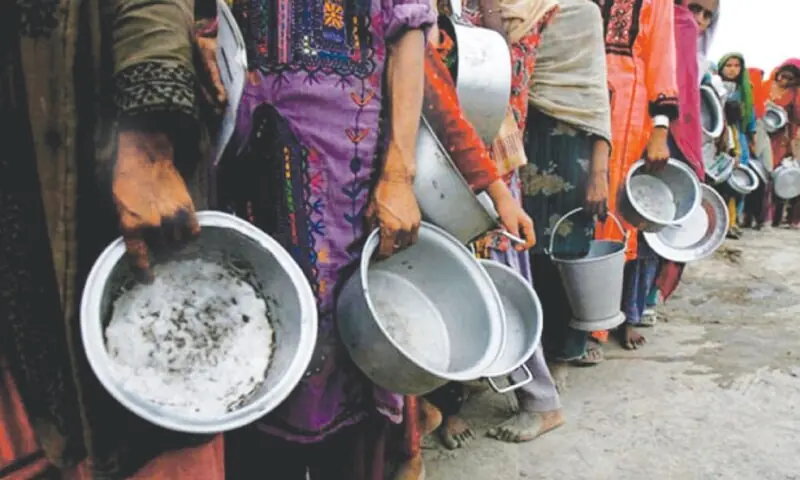
Pakistan contributes significantly to rising poverty levels in the Middle East, North Africa, and Afghanistan-Pakistan region, accounting for nearly half of those living in extreme poverty according to the World Bank. The article discusses how repeated crises such as the pandemic, floods, inflation, and economic instability have pushed millions into hardship with little chance to recover between disasters. Each crisis leads to long-term setbacks like depleted savings or children being withdrawn from school, making it difficult for families to bounce back even when economic conditions improve.
Written by AI on 2026-10-11, from this article's own text only (the story summary below draws on all the coverage).

AI analysis

Story summary

Pakistan accounts for nearly half of extreme poverty in the Middle East, North Africa, and the Afghanistan-Pakistan region, according to the World Bank. Millions of Pakistanis have faced ongoing crises such as the pandemic, deadly floods, soaring inflation, and economic uncertainty without much chance to recover between events. Each crisis deepens poverty by forcing families to deplete savings, sell livestock, borrow money for food, or withdraw children from school.

Even after prices stabilize and incomes improve, these losses are not easily reversed. For example, a farmer who has sold his animals or a small trader who has closed his business cannot quickly resume earning a livelihood. This explains why poverty can rise even as the broader economy recovers, with repeated crises accumulating damage that leaves vulnerable families less able to withstand further blows. Fresh dangers, such as potential conflicts involving Iran, are emerging and could exacerbate these issues further.

Written for “Poverty Issues” on 2026-11-04, grounded in this article and the 0 other(s) covering the same event.

Story

📰 Poverty Issues
Economy/Business · 1 article(s) covering the same event.

Compared with similar articles

This article reads leans strongly left and hedges 26% of its claims. Each row says how that neighbour differs.
New York Post
Hedges 1 of 17 claims Outlet record 66/100
“Article A describes the immediate financial aid provided by Pakistan's government due to rising energy prices caused by U.S.-Iran war tensions. Article B discusses broader, long-term issues of poverty and economic hardship in Pakistan.”
Dawn
Hedges 2 of 19 claims Outlet record 72/100
“The articles discuss similar topics related to poverty in Pakistan and the region but do not describe a single specific incident or occurrence happening at a particular time.”
Let them eat cake Different event
Dawn
⚖️ Leans strongly left Hedges 1 of 32 claims Outlet record 72/100
“The articles discuss similar topics but cover different aspects and timeframes of Pakistan's economic plight.”
How this article was measured signals, leaning charts, publisher record, byline, topics and claims

Signals How these are calculated →

Claims extracted
19
sentences that state something as happening or true
Uncertain
26%
5 of 19 hedged ("reportedly", "may", "according to")
Leaning
Leans strongly left
of the writing, not the subject · beta estimate
Publisher signals
72/100
Dawn's corrections and hedging, across everything collected from it. Not a measure of accuracy.
Outlets on this story
1
Economy/Business
Same framing elsewhere
1
articles that frame the event the way this one does
Analyzed 2026-10-11 · how these are computed

How this is being covered How these are calculated →

Article leaning vs. publisher reliability
Source leaning vs. consistency

Publisher

Dawn · 2683 article(s) · 3 correction(s) detected
Running correction rate · 3 correction(s)

Who wrote this

No reporter is named on this article, beyond the feed's “Editorial”.

Topics

Afghanistan Iran PAKISTAN Pakistanis the World Bank

Subjects

PAKISTAN GPE · 2× the World Bank ORG · 2× Afghanistan GPE · 1× Dawn ORG · 1× Iran GPE · 1× Pakistanis NORP · 1×

Narrative

It needs to identify families at greatest risk, strengthen early-warning and disaster-response systems, protect farming livelihoods and ensure that financial help reaches vulnerable households before they are forced into desperate choices.
framing: mixed · carried by 1 article(s) · first seen 2026-10-11
🔮 Families may exhaust their savings, sell livestock, borrow money to buy food, or withdraw children from school to save expenses.
2026-10-11 · Dawn
Poverty’s long shadow · mixed framing

Claims (19 extracted, 5 hedged)

PAKISTAN’S contribution to rising poverty across the Middle East, North Africa and the Afghanistan-Pakistan region is troubling. asserted
contribution → rise → East
According to the World Bank, the country accounts for nearly half of the region’s people living in extreme poverty. uncertain
country → accord → poverty
Ours is a story of repeated hardship. asserted
Ours → repeat → hardship
Millions of Pakistanis have endured the pandemic, deadly floods, soaring inflation, and years of economic uncertainty, often with little opportunity to recover before the next crisis arrives. asserted
crisis → endure → opportunity
For a poor household, each setback leaves lasting damage. asserted
setback → leave → damage
Families may exhaust their savings, sell livestock, borrow money to buy food, or withdraw children from school to save expenses. uncertain
Families → exhaust → expenses
Even when prices stabilise and incomes improve, the losses are not easily reversed. asserted
losses → stabilise → ?
A farmer who has sold his animals or a small trader who has closed his business cannot simply resume earning a livelihood. asserted
who → sell → livelihood
This helps explain why poverty can continue to rise even as the wider economy shows signs of recovery. asserted
economy → help → recovery
The damage caused by successive crises has accumulated, leaving vulnerable families with fewer resources to withstand another blow. asserted
damage → cause → blow
Fresh dangers are emerging. asserted
dangers → emerge → ?
The World Bank has warned that the conflict involving Iran could push up fuel and commodity prices, weaken remittances and increase borrowing costs. uncertain
conflict → warn → costs
Adverse weather could also drive up food prices and hurt agricultural livelihoods. uncertain
weather → drive → livelihoods
For households still struggling with the effects of earlier shocks, another spell of inflation could prove devastating. uncertain
spell → struggle → inflation
The government must, therefore, go beyond providing relief after disaster strikes. asserted
disaster → go → relief
It needs to identify families at greatest risk, strengthen early-warning and disaster-response systems, protect farming livelihoods and ensure that financial help reaches vulnerable households before they are forced into desperate choices. asserted
they → need → choices
Keeping children in school and preventing families from losing their means of earning a living must also be priorities. asserted
Keeping → keep → living
Poverty reduction cannot succeed if every new crisis pushes people back into hardship. asserted
crisis → succeed → hardship
Pakistan must protect the fragile gains its poorest citizens manage to make. asserted
citizens → protect → gains

💬Give feedback · no sign-in needed

No sign-in needed for now. Your note is sent without a name, so it cannot be answered.

🕘History 🎫Support