Photo via Times of India

Nasa-backed spacecraft to inspect dead space objects, test future repair and debris removal tech

Read the original at Times of India ↗
Cite

TOI Science Desk. (2026, October 11). Nasa-backed spacecraft to inspect dead space objects, test future repair and debris removal tech. Times of India. https://timesofindia.indiatimes.com/science/space/a-washing-machine-sized-nasa-supported-spacecraft-will-approach-four-defunct-satellites-and-rocket-bodies-testing-technology-that-could-one-day-help-repair-spacecraft-or-remove-orbital-debris/articleshow/134866200.cms

Dated when The Aporia collected the article, usually within hours of publication. Check the original for its exact date and byline.

Times of India · collected 2026-10-11 · by TOI Science Desk

Quick Summary

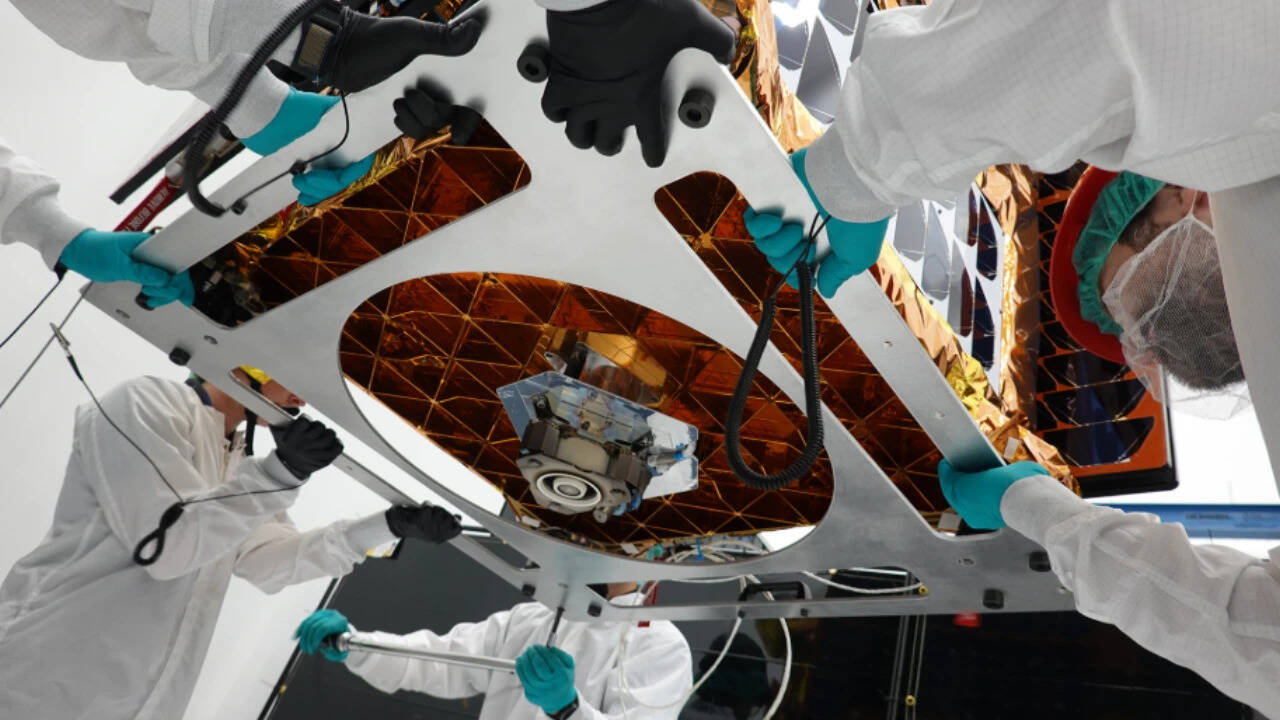
NASA-backed spacecraft named Otter, developed by Starfish Space and launched on October 1 from Vandenberg Space Force Base in California, is set to inspect up to four inactive space objects in Earth's orbit starting early 2027. The mission aims to test autonomous navigation and inspection technologies that could eventually enable spacecraft repair or debris removal, using software for real-time decision-making without constant human intervention.
Written by AI on 2026-10-11, from this article's own text only (the story summary below draws on all the coverage).

AI analysis

Story summary

NASA-backed Otter spacecraft, developed by Starfish Space, launched from Vandenberg Space Force Base in California on October 1, aims to inspect dead objects in Earth's orbit. The Small Spacecraft Propulsion and Inspection Capability (SSPICY) mission will test navigation, inspection, and maneuvering technologies for up to four inactive US-origin space objects starting early 2027. NASA’s Small Business Innovation Research and Small Business Technology Transfer programs provided funding during the spacecraft's development phase. Otter will assess conditions without physical contact, paving the way for future satellite repairs and debris removal in space.

Written for “Spacecraft For Object Inspection Tech…” on 2026-11-03, grounded in this article and the 0 other(s) covering the same event.

Story

📰 Spacecraft For Object Inspection Tech…
Technology · 1 article(s) covering the same event.

Compared with similar articles

Nothing to compare against. No article is close enough to this one for the pipeline to have linked or judged the pair.
How this article was measured signals, leaning charts, publisher record, byline, topics and claims

Signals How these are calculated →

Claims extracted
50
sentences that state something as happening or true
Uncertain
18%
9 of 50 hedged ("reportedly", "may", "according to")
Leaning
not political
takes no side on a contested political question
Publisher signals
59/100
Times of India's corrections and hedging, across everything collected from it. Not a measure of accuracy.
Outlets on this story
1
Technology
Same framing elsewhere
1
articles that frame the event the way this one does
Analyzed 2026-10-11 · how these are computed

How this is being covered How these are calculated →

Article leaning vs. publisher reliability
Source leaning vs. consistency

Publisher

Times of India · 4017 article(s) · 4 correction(s) detected
Running correction rate · 4 correction(s)

Who wrote this

TOI Science Desk
308 article(s) here · 1 carrying a prediction
🔮 Researchers are continuing to examine daily measurements to determine whether temperatures will climb further.
🔮 According to Reuters reporting by Will Dunham, a new study published in the journal Spixiana documents more than 90 Bangka slow lorises identified between 2015 and 2025.
🔮 “Normally, my job is quite monotonous, so I wanted to create something that would entertain people, turning my ‘serious’ job into something fun,” he said in a Guinness World Records news release.
🔮 The subsequent collision between the two galaxy clusters may then have compressed the cloud or re-energised its particles, causing it to shine more brightly in radio wavelengths once again.
🔮 The mathematicians at the University of California, Davis, argue that the answer may already lie within Einstein’s own equations and that an invisible form of energy may not be needed at all.
🔮 The work will be carried out by the West Tennessee River Basin Authority, which is preparing a plan to restore the river and the land around it.
🔮 Cornell University scientists have developed genetically engineered tomato plants that turn red-purple when nitrogen becomes scarce, giving farmers a visible warning that crops may need fertiliser.
🔮 By studying these crystals and other mineral grains, scientists could establish the meteorite's age and identify later changes caused by water.
🔮 Centuries later, bronze objects found in Scandinavia would preserve chemical signatures consistent with the metals produced at this Spanish site, offering evidence of connections that may have crossed much of Europe.
🔮 Deposited impurities and staining may also have contributed, while low temperatures and humidity could cause the fabric to crack.
Wire or desk byline, not an individual reporter.
Also by TOI Science Desk
Nothing else under this byline is closely related to this article, so these are simply their most recent.
All 308 articles by TOI Science Desk →

Topics

California NASA Otter Small Spacecraft Propulsion and Inspection Capability Starfish Space

Subjects

NASA ORG · 5× California GPE · 1× Starfish Space ORG · 1×

Narrative

The agency's Small Business Innovation Research and Small Business Technology Transfer programmes also provided funding awards to Starfish Space during the early development of the spacecraft's key technologies.
framing: assertive · carried by 1 article(s) · first seen 2026-10-11
🔮 , will test whether a spacecraft can independently navigate towards inactive satellites and rocket bodies, examine their condition and move between different orbits.

Claims (50 extracted, 9 hedged)

A spacecraft about the size of a washing machine is preparing to approach objects that are no longer working in Earth's orbit. asserted
that → prepare → orbit
The mission, supported by NASA asserted
mission → support → NASA
, will test whether a spacecraft can independently navigate towards inactive satellites and rocket bodies, examine their condition and move between different orbits. asserted
spacecraft → test → orbits
The technology could eventually help repair spacecraft or remove unwanted objects from space. uncertain
technology → help → space
The mission, called Small Spacecraft Propulsion and Inspection Capability (SSPICY), was launched on October 1 from Vandenberg Space Force Base in California. asserted
mission → call → California
It involves a spacecraft named Otter, developed by US-based company Starfish Space. asserted
It → involve → Space
According to NASA, Otter will approach up to four inactive space objects of US origin in low Earth orbit, including satellites and rocket bodies. uncertain
Otter → accord → satellites
The inspections are expected to begin in early 2027. asserted
inspections → expect → 2027
During this phase, Otter will travel to within hundreds of yards of each object and examine it without making physical contact. asserted
Otter → travel → contact
Much of the navigation will be handled by the spacecraft's own software, with minimal assistance from controllers on Earth. asserted
Much → handle → Earth
The mission is not intended to repair satellites or remove space debris immediately. asserted
mission → intend → debris
Instead, it will test several technologies together to determine whether they can support such operations in the future. asserted
they → test → future
NASA says this will be the first time these capabilities are demonstrated as an integrated system. asserted
capabilities → say → system
How will spacecraft inspect objects in orbit? asserted
spacecraft → inspect → orbit
Approaching an inactive satellite is different from approaching one that is still operating. asserted
that → approach → one
A spacecraft that is no longer functioning may be spinning or positioned in a way that makes it difficult for another spacecraft to approach safely. uncertain
spacecraft → function → way
To carry out the inspections, Otter will use autonomous guidance and control software. asserted
Otter → carry → software
This means the spacecraft will be able to make navigation decisions without waiting for instructions from ground controllers at every stage. asserted
spacecraft → mean → stage
Its computer vision system and sensors will help it observe nearby objects and determine how to approach them. asserted
it → help → them
The software will use this information to make navigation decisions in real time as Otter moves closer to its targets. asserted
Otter → use → targets
During each inspection, the spacecraft will collect information about the object's spin rate, orientation and surface condition. asserted
spacecraft → collect → rate
Spin rate refers to how quickly an object rotates, while orientation describes the direction in which it is positioned. asserted
it → refer → which
Examining the surface will provide information about its physical condition. asserted
Examining → examine → condition
These observations are important for understanding how a future spacecraft might safely approach an object that is no longer under active control. uncertain
that → understand → control
How will Otter travel between different objects? asserted
Otter → travel → objects
The SSPICY mission will also demonstrate how a small spacecraft can move between objects travelling in different orbits. asserted
spacecraft → demonstrate → orbits
Otter is equipped with an electric propulsion system that will allow it to travel between inspection targets. asserted
it → equip → targets
The mission will test how this system works alongside other technologies needed for precise movement in space. asserted
system → test → space
Another important component is an articulating robotic boom. asserted
component → articulate → ?
This movable structure will be used to test the positioning of the spacecraft's thrusters, which provide the force needed to change its movement. asserted
which → use → movement
By adjusting the direction in which the thrusters point, the spacecraft will test precise manoeuvring between different orbits. asserted
spacecraft → adjust → orbits
NASA says the combination of electric propulsion, autonomous navigation, sensors and the robotic boom is central to the demonstration. asserted
combination → say → demonstration
Although these technologies have different functions, the mission will examine how they perform together during a series of close approaches. asserted
they → have → approaches
Why is NASA testing this technology? asserted
NASA → test → technology
The mission comes as increasing numbers of satellites are being launched into Earth's orbit. asserted
numbers → come → orbit
Thousands of satellites are launched each year to support services such as communications, weather forecasting and navigation. asserted
Thousands → launch → communications
However, satellites and rocket bodies can remain in orbit after they stop working. asserted
they → remain → orbit
Objects that experience problems or are no longer in service may collide with one another or break apart. uncertain
that → experience → one
Such incidents can produce orbital debris, ranging from large fragments to much smaller particles. asserted
incidents → produce → particles
These objects create concerns for spacecraft operating in the same environment. asserted
objects → create → environment
…and 10 more, not listed.

💬Give feedback
🕘History 🎫Support