Engineers at the University of Bristol have developed a miniature liquid-metal pump weighing just 0.2 grams that could help soft robots move without bulky pumping systems.
uncertain
robots → develop → systems
With a volume of 0.086 cubic centimetres, the device can drive a robotic butterfly’s flapping wings, change the colours of a bracelet and power a wearable that squeezes a fingertip to simulate touch.
asserted
that → drive → touch
The researchers say the pump operates at less than 1 volt, while the university’s announcement puts its operating voltage below 0.1 volts.
asserted
announcement → say → volts
The findings, published in Nature Communications on May 12, 2026, could open new possibilities for lightweight wearable devices and flexible robots.
uncertain
findings → publish → devices
How does the liquid-metal pump work?
asserted
pump → work → ?
The device, known as a liquid-metal magnetohydrodynamic (LIMA) pump, uses electromagnetic forces to move liquid through a small, flexible channel.
asserted
device → know → channel
Its operation rests on magnetohydrodynamics, the physical principle describing how electrically conducting fluids respond to magnetic fields.
asserted
fluids → rest → fields
The pump contains a tiny droplet of liquid metal, surrounded by sodium hydroxide solution, positioned between electrodes, with a small permanent magnet placed beneath the channel.
asserted
pump → contain → channel
When current passes through the liquid metal, the magnetic field produces a force known as the Lorentz force.
asserted
field → pass → force
This moves the droplet back and forth, pushing the surrounding fluid and creating a pumping action.
asserted
This → move → action
In the tests, the current reached about 8 amps at roughly 0.1 volts, for a maximum power draw of 0.8 watts.
asserted
current → reach → watts
The resulting flow can inflate or deflate soft actuators, allowing them to bend, contract or move.
asserted
them → result → actuators
Reversing the current’s polarity reverses the direction of pumping.
asserted
Reversing → reverse → pumping
Continuous one-way flow requires valves, and the portable version of the system pairs the pump with valves, a microcontroller and an AA battery.
asserted
version → require → valves
A robotic butterfly demonstrates the technology
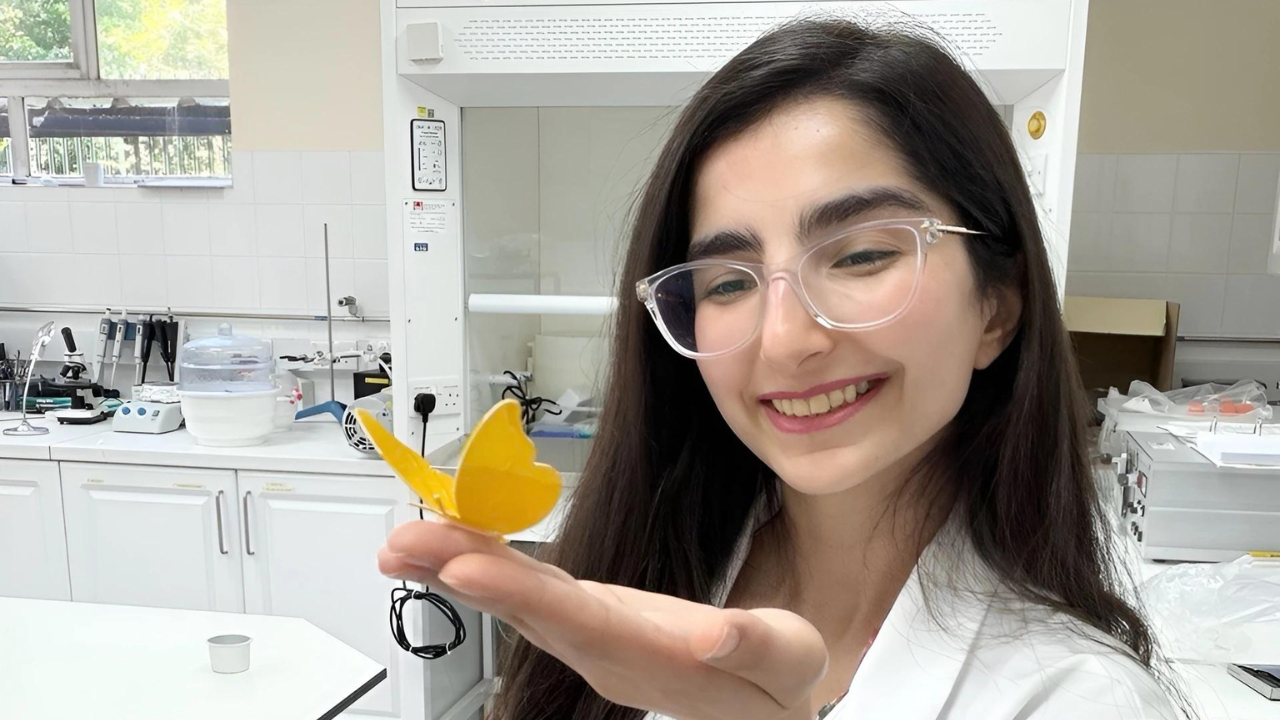
One demonstration involved a robotic butterfly whose wings could be raised and lowered using signals generated by the pump.
uncertain
wings → demonstrate → pump
The pump produces a stream of alternating liquid-metal and sodium hydroxide droplets that travels through a tube to a remote receptor.
asserted
that → produce → receptor
When a liquid-metal droplet bridges the receptor, it completes an electrical connection that activates shape-memory alloy actuators attached to the wings.
asserted
that → bridge → wings
When a sodium hydroxide droplet passes through, the connection breaks and the wings relax.
asserted
wings → pass → ?
By adjusting the rate and duty cycle of the droplet stream, the researchers could control the wing-flapping pattern.
uncertain
researchers → adjust → pattern
The pump therefore does more than move fluid, since it also helps transmit control signals to components elsewhere in a soft robotic system.
asserted
it → do → system
The wings themselves are moved by the shape-memory alloy actuators, not by the liquid metal acting as a motor.
asserted
wings → move → motor
The researchers also demonstrated wearable uses.
asserted
researchers → demonstrate → uses
The colour-changing bracelet contains fluidic channels through which two differently coloured liquids can be pumped, and its colour changed in 28 seconds.
asserted
colour → change → seconds
That shows how fluid movement could alter the look of a flexible accessory without a conventional electronic display.
uncertain
movement → show → display
Another prototype combined a wristband with a soft fingertip pouch.
asserted
prototype → combine → pouch
Shape-memory alloy actuators in the wristband squeezed the wrist, driven by coded signals from the pump.
asserted
actuators → squeeze → pump
The finger actuator delivered a gentle pressure sensation through hydraulic pumping and a stronger one through a gas-generating chemical reaction, in which citric acid and sodium bicarbonate pumped together produce carbon dioxide.
asserted
acid → deliver → dioxide
In a preliminary test, a blindfolded participant correctly identified the three tactile modes.
asserted
participant → identify → modes
The timing of each mode was controlled manually with valves, and the authors state that the experiment is a prototype demonstration rather than a validated human-robot interaction study.
asserted
experiment → control → valves
They say future work will test a larger group of participants.
asserted
work → say → participants
Could it make robots lighter and more flexible?
uncertain
robots → make → ?
Many soft robots use silicone or elastomer components that move when air or liquid is pumped into them.
asserted
air → use → them
Conventional systems often depend on external compressors or rigid pumps, which add weight, occupy space and restrict movement.
asserted
which → depend → movement
The Bristol design integrates the pumping mechanism into a unit of 0.2 grams and 0.086 cubic centimetres, small enough to distribute through a robot’s body rather than connecting every actuator to a central compressor.
asserted
design → integrate → compressor
The researchers also used the pump to power flexible, jointed actuators inspired by arthropod legs.
asserted
researchers → use → legs
One of them deflected by more than 45 degrees from its starting position, showing that a very small pump can drive a larger soft component.
asserted
pump → deflect → component
The pump does not remove the need for other actuators, however: the butterfly prototype still relies on shape-memory alloy to move its wings.
asserted
prototype → remove → wings
Bristol’s press release points to uses ranging from robotic legs to haptic gloves in medical and industrial settings.
asserted
release → point → settings
Firouznia said the pump could be deployed in lab-on-a-chip devices for disease diagnosis, as micropumps for robotic clothing and in tiny actuators for environmental sampling.
uncertain
pump → say → sampling
Study co-author Jonathan Rossiter, professor of robotics at Bristol, said further research is under way on applications from smart bandages to edible robots.
asserted
research → say → robots
…and 9 more, not listed.
 The Aporia