Photo via Times of India

University of Glasgow develops £20 ultrasound device to produce fertiliser from air and water

Read the original at Times of India ↗
Cite

TOI Science Desk. (2026, October 12). University of Glasgow develops £20 ultrasound device to produce fertiliser from air and water. Times of India. https://timesofindia.indiatimes.com/science/discovery/university-of-glasgow-develops-20-ultrasound-device-to-produce-fertiliser-from-air-and-water-aiming-to-help-farmers-in-remote-areas/articleshow/134883471.cms

Dated when The Aporia collected the article, usually within hours of publication. Check the original for its exact date and byline.

Times of India · collected 2026-10-12 · by TOI Science Desk

Quick Summary

Chemists and engineers at the University of Glasgow have created a £20 prototype device that uses ultrasound waves, water, and air to produce nitrate, an essential plant nutrient. Published in Cell Reports Physical Science, the study demonstrates that by bubbling air through deionised water and applying focused ultrasound waves, the team can create conditions where nitrogen from the air combines with oxygen to form nitrate. Laboratory tests show the device generates a concentration of around 40 micromolar of nitrate over eight minutes in 20 millilitres of water. While promising for potential decentralized fertilizer production, particularly for remote farmers, the prototype is still experimental and uses more energy than traditional methods like the Haber-Bosch process.
Written by AI on 2026-10-12, from this article's own text only (the story summary below draws on all the coverage).

AI analysis

Story summary

Chemists and engineers at University of Glasgow have created a prototype device that costs only £20, which uses ultrasound, water, and air to produce nitrate, an essential nutrient for plant growth. Published in *Cell Reports Physical Science*, the study titled "Towards decentralized nitrogen fixation using pulsed ultrasound" details how sound waves can convert atmospheric nitrogen into nitrate. The process involves bubbling air through deionised water to dissolve nitrogen and oxygen before applying focused ultrasound waves to create tiny bubbles, leading to nitrate formation.

Although promising for remote farmers who could produce fertiliser on demand, reducing dependency on large industrial facilities, the device is still in its experimental phase. Current limitations include higher energy consumption compared to traditional methods like the Haber-Bosch process, and further research is needed to assess how well the produced nitrate supports plant growth.

Written for “Affordable Fertilizer Technology Deve…” on 2026-11-03, grounded in this article and the 0 other(s) covering the same event.

Story

📰 Affordable Fertilizer Technology Deve…
Science · 1 article(s) covering the same event.

Compared with similar articles

Nothing to compare against. No article is close enough to this one for the pipeline to have linked or judged the pair.
How this article was measured signals, leaning charts, publisher record, byline, topics and claims

Signals How these are calculated →

Claims extracted
28
sentences that state something as happening or true
Uncertain
25%
7 of 28 hedged ("reportedly", "may", "according to")
Leaning
not political
takes no side on a contested political question
Publisher signals
59/100
Times of India's corrections and hedging, across everything collected from it. Not a measure of accuracy.
Outlets on this story
1
Science
Same framing elsewhere
1
articles that frame the event the way this one does
Analyzed 2026-10-12 · how these are computed

How this is being covered How these are calculated →

Article leaning vs. publisher reliability
Source leaning vs. consistency

Publisher

Times of India · 3982 article(s) · 3 correction(s) detected
Running correction rate · 3 correction(s)

Who wrote this

TOI Science Desk
307 article(s) here · 1 carrying a prediction
🔮 According to Reuters reporting by Will Dunham, a new study published in the journal Spixiana documents more than 90 Bangka slow lorises identified between 2015 and 2025.
🔮 “Normally, my job is quite monotonous, so I wanted to create something that would entertain people, turning my ‘serious’ job into something fun,” he said in a Guinness World Records news release.
🔮 The subsequent collision between the two galaxy clusters may then have compressed the cloud or re-energised its particles, causing it to shine more brightly in radio wavelengths once again.
🔮 The mathematicians at the University of California, Davis, argue that the answer may already lie within Einstein’s own equations and that an invisible form of energy may not be needed at all.
🔮 The work will be carried out by the West Tennessee River Basin Authority, which is preparing a plan to restore the river and the land around it.
🔮 Cornell University scientists have developed genetically engineered tomato plants that turn red-purple when nitrogen becomes scarce, giving farmers a visible warning that crops may need fertiliser.
🔮 By studying these crystals and other mineral grains, scientists could establish the meteorite's age and identify later changes caused by water.
🔮 Centuries later, bronze objects found in Scandinavia would preserve chemical signatures consistent with the metals produced at this Spanish site, offering evidence of connections that may have crossed much of Europe.
🔮 Deposited impurities and staining may also have contributed, while low temperatures and humidity could cause the fabric to crack.
🔮 Two male king cobras meeting during the breeding season may engage in a prolonged contest, using their bodies to wrestle for control rather than relying on the venomous strikes associated with these snakes.
Wire or desk byline, not an individual reporter.
Also by TOI Science Desk
Nothing else under this byline is closely related to this article, so these are simply their most recent.
All 307 articles by TOI Science Desk →

Topics

Cell Reports Physical Science School of Chemistry University of Glasgow the University of Glasgow’s

Subjects

Symes PERSON · 2× the University of Glasgow’s ORG · 2× Cell Reports Physical Science ORG · 1× Lukman Yusuf PERSON · 1× Mark Symes PERSON · 1× Paul Prentice PERSON · 1× School of Chemistry ORG · 1× University of Glasgow ORG · 1× Yusuf PERSON · 1×

Narrative

What makes the £20 ultrasound device different from earlier methods Professor Symes asked Dr Lukman Yusuf, the paper’s lead author, to build a working nitrate production system as cheaply as possible using commercially available components.
framing: mixed · carried by 1 article(s) · first seen 2026-10-12
🔮 The technology could eventually allow farmers in remote areas to make fertiliser on demand, reducing their reliance on large industrial production facilities.

Claims (28 extracted, 7 hedged)

Chemists and engineers have developed a £20 prototype device that uses ultrasound, water and air to produce nitrate, an important nutrient for plant growth. asserted
that → develop → growth
The technology could eventually allow farmers in remote areas to make fertiliser on demand, reducing their reliance on large industrial production facilities. uncertain
farmers → allow → facilities
According to a study by University of Glasgow researchers, published in Cell Reports Physical Science titled ‘ Towards decentralized nitrogen fixation using pulsed ultrasound’, the process builds on a discovery that was first identified in the 1930s and uses sound waves to convert nitrogen from the air into nitrate. uncertain
that → accord → nitrate
However, the prototype remains at an experimental stage. asserted
prototype → remain → stage
Although laboratory tests have demonstrated nitrate production, the device currently uses proportionately more energy than the Haber-Bosch process. asserted
device → demonstrate → process
Researchers also need to determine how effectively the nitrate produced by the device can support plant growth. asserted
nitrate → need → growth
How the £20 ultrasound device produces nitrate from air and water The process begins by bubbling air through deionised water for a few minutes to dissolve nitrogen and oxygen. asserted
process → produce → nitrogen
The researchers then use focused ultrasound waves to create tiny bubbles in the water. asserted
researchers → use → water
These bubbles oscillate rapidly and heat up, with the gases in it reaching temperatures of 5,000°C during repeated pressure-driven implosions. asserted
gases → oscillate → implosions
The extreme conditions break apart nitrogen molecules and combine them with oxygen to produce nitrate. asserted
conditions → break → nitrate
To identify the most effective method, the team tested different ultrasound settings and used a high-speed camera to observe the bubbles as they oscillated and imploded. asserted
they → identify → bubbles
The experiments showed that four-millisecond bursts of ultrasound delivered every 80 milliseconds produced the best results, allowing the team to generate nitrate in laboratory tests. asserted
team → show → tests
How much nitrate can the ultrasound device produce in eight minutes During laboratory experiments, the researchers produced a nitrate concentration of around 40 micromolar in 20 millilitres of water over eight minutes. asserted
researchers → produce → minutes
Although the concentration remained relatively low, the results indicate that the process could be optimised and scaled up to produce more agriculturally useful quantities in future tests. uncertain
process → remain → tests
Professor Mark Symes of the University of Glasgow’s School of Chemistry said the team wanted to explore whether fertiliser production could be made possible with minimal capital investment for individual farmers. uncertain
production → say → farmers
The existing industrial system relies on factories that can cost hundreds of millions of pounds to produce fertiliser in large quantities. asserted
that → exist → quantities
The researchers hope their approach could decentralise production and make nitrate available to farmers through a simpler, more affordable process. uncertain
nitrate → hope → process
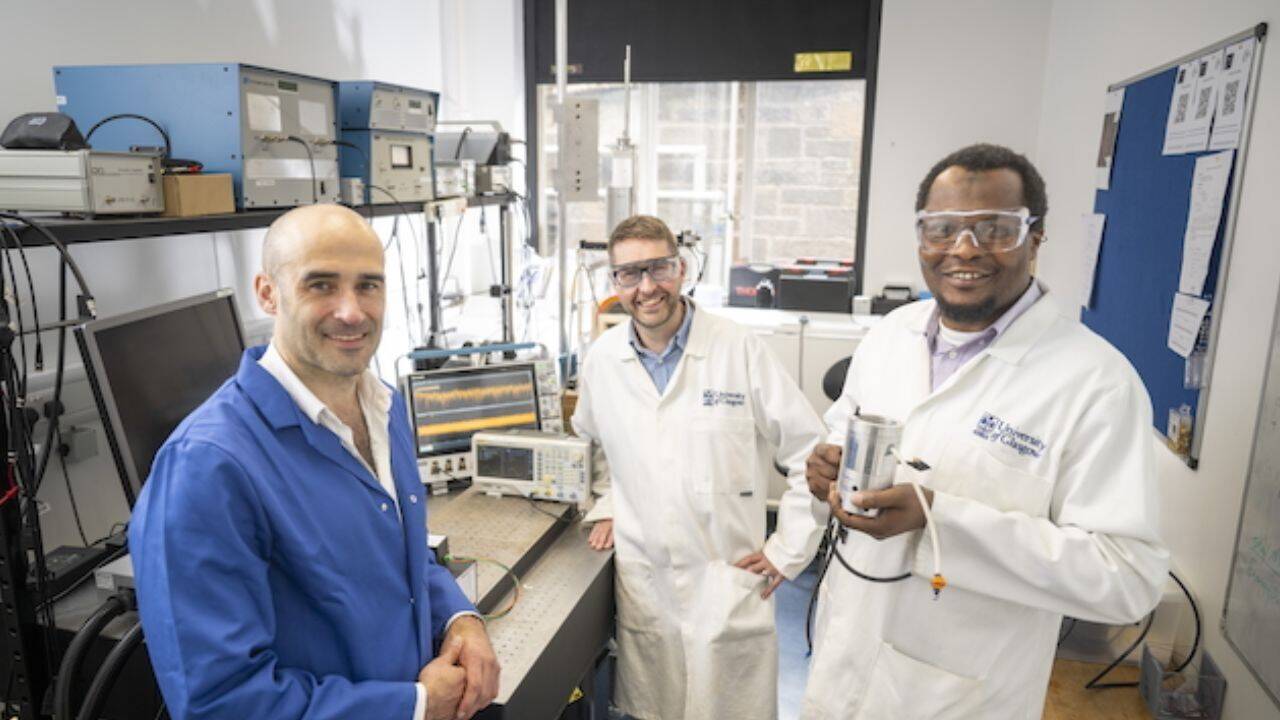
What makes the £20 ultrasound device different from earlier methods Professor Symes asked Dr Lukman Yusuf, the paper’s lead author, to build a working nitrate production system as cheaply as possible using commercially available components. asserted
Symes → make → components
Dr Yusuf developed a working demonstrator roughly the size of a can of coffee beans for about £20. asserted
Yusuf → develop → 20
The underlying process was first identified in the 1930s but was never widely adopted for fixing nitrogen from air. asserted
process → underlie → air
According to Professor Symes, advances in affordable ultrasound technology have created new opportunities in sonochemistry, which uses sound waves to drive chemical reactions. uncertain
which → accord → reactions
The researchers believe their results mark a substantial improvement in sonochemical nitrate production. asserted
results → believe → production
However, the current prototype remains an experimental system, and further development is required before the technology can be used in practical agricultural settings. asserted
technology → remain → settings
How are researchers working to improve the £20 fertiliser device The team acknowledges that its prototype currently consumes proportionately more energy than the Haber-Bosch process. asserted
prototype → work → process
Further research is also required to determine whether the nitrate produced can effectively support plant growth. asserted
nitrate → require → growth
Dr Paul Prentice of the University of Glasgow’s James Watt School of Engineering said, “Our plan is to spend the next 12 months working intensively to refine the process we’ve pioneered, and reduce the amount of energy it requires.” asserted
it → say → energy
These developments could help establish whether the technology is suitable for real-world applications. uncertain
technology → establish → applications
The research received funding from the Engineering and Physical Sciences Research Council and the Royal Society. asserted
research → receive → Council

💬Give feedback
🕘History 🎫Support