Scientists exploring the deep sea have discovered unusual patterns of holes in seafloor sediment, but their origin remains unknown despite closer examination and sediment sampling.
asserted
origin → explore → examination
NOAA’s Voyage to the Ridge 2022 expedition observed the formations at depths of about 2,540 metres, with further sightings between 1,440 and 1,500 metres.
asserted
expedition → observe → metres
Researchers documented holes in 2004 along the northern Mid-Atlantic Ridge, north of the Azores.
asserted
Researchers → document → Azores
Researchers Michael Vecchione and Odd Aksel Bergstad later examined these earlier observations in a scientific paper, suggesting that the raised sediment could indicate excavation by organisms.
uncertain
sediment → examine → organisms
Neither investigation established what created the holes, leaving their origin an unresolved question in deep-sea research.
asserted
what → establish → research
What did scientists discover about the mysterious holes on the Pacific seafloor
asserted
scientists → discover → seafloor
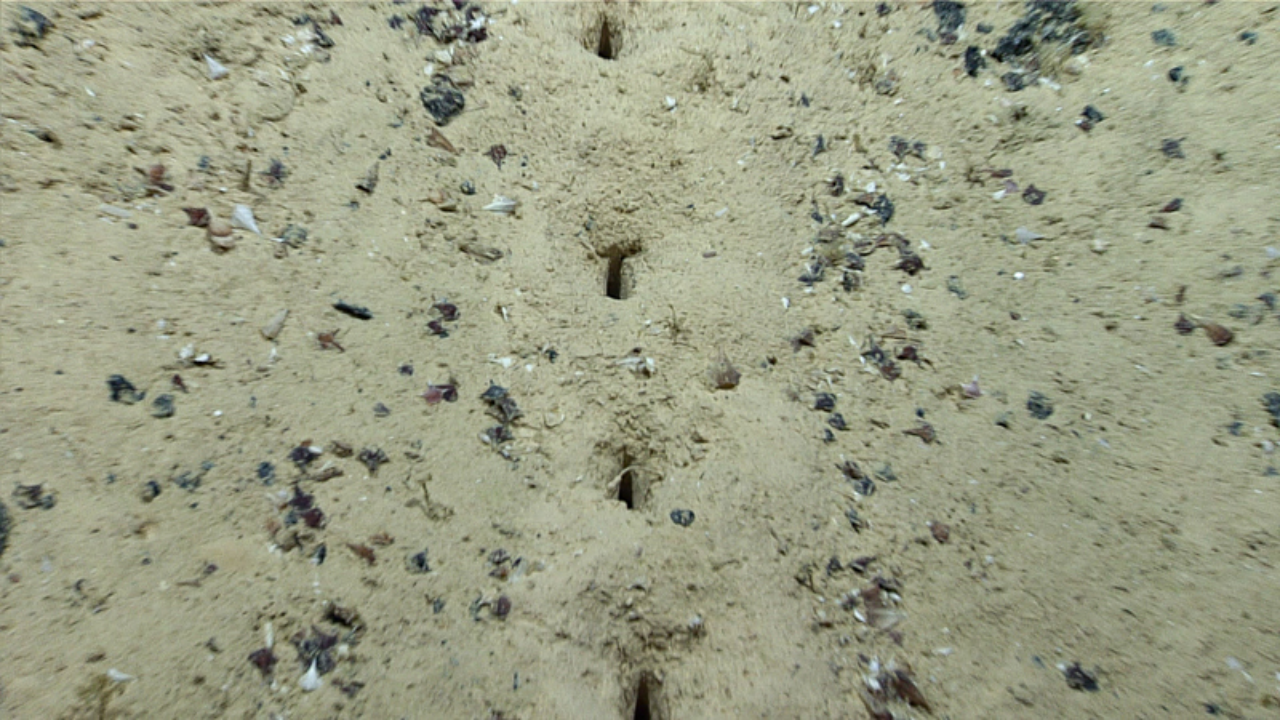
According to the National Oceanic and Atmospheric Administration, during Dive 04 of the second Voyage to the Ridge 2022 expedition, scientists observed several sets of holes in seafloor sediment at a depth of approximately 2,540 metres (1.6 miles).
uncertain
scientists → accord → metres
NOAA described the formations as “several sublinear sets of holes in the sediment on the seafloor”.
asserted
NOAA → describe → seafloor
The holes looked almost human-made, while the small piles of sediment around them suggested that material had been excavated.
uncertain
material → look → them
Researchers attempted to examine the openings using tools attached to a remotely operated vehicle (ROV), but they were unable to look inside or probe the holes successfully.
asserted
they → attempt → holes
They also could not determine whether the openings were connected beneath the sediment surface.
uncertain
openings → determine → surface
The formations therefore remained unexplained despite direct observations during the expedition.
asserted
formations → remain → expedition
PC: Numerous Sublinear Sets of Holes in Sediment on the Northern Mid-Atlantic Ridge Point to Knowledge Gaps in Understanding Mid-Ocean Ridge Ecosystems
What did scientists find in the Pacific seafloor holes
asserted
find → understand → holes
The formations were observed again during Dive 09 of the same expedition.
asserted
formations → observe → expedition
The holes appeared at four locations during the dive, at depths ranging from approximately 1,440 to 1,500 metres (4,724 to 4,921 feet).
asserted
holes → appear → feet
The additional sightings allowed the expedition team to collect sediment from holes that appeared to have formed more recently.
asserted
that → allow → holes
The ROV pilots used a suction sampler to retrieve sediment, but examination of the recovered material revealed no clues about what had created the openings.
asserted
what → use → openings
A water sample was also collected for later environmental DNA (eDNA) analysis to investigate what organisms might be living in or around the holes.
uncertain
organisms → collect → holes
NOAA's report did not identify a confirmed cause for the formations.
asserted
report → identify → formations
What did scientists discover about the Mid-Atlantic Ridge holes
On 13 July 2004, a remotely operated vehicle recorded numerous sets of holes during an expedition investigating biodiversity along the northern Mid-Atlantic Ridge, north of the Azores.
asserted
vehicle → discover → Azores
the observations were made at approximately 2,082 metres below the surface.
asserted
observations → make → surface
The researchers described series that were straight or gently curved, with some intersecting or crossing.
asserted
some → describe → series
Individual series ranged from less than one metre to many metres in length.
asserted
series → range → length
The holes themselves measured approximately 6 centimetres by 1.5 centimetres, based on comparisons with nearby shells.
asserted
holes → measure → shells
These measurements relate to the 2004 observations, rather than measurements reported for the 2022 expedition.
asserted
measurements → relate → expedition
What could have created the mysterious seafloor holes
The sediment surrounding the holes that appeared to be more recent was raised, whereas older holes were partly filled with sediment and had less noticeable raised edges.
uncertain
holes → create → edges
However, close-up observations did not show living organisms inhabiting the holes, and the researchers could not determine whether the openings were connected below the surface.
uncertain
openings → show → surface
The raised sediment might indicate excavation by an organism living within the sediment, or digging and removal by an animal on the sediment surface, potentially using a feeding appendage.
uncertain
sediment → raise → appendage
They also considered whether the formations could be related to the activity of a large bottom-dwelling crustacean, but explicitly stated that there was no evidence supporting that speculation.
uncertain
formations → consider → speculation
What are the mysterious seafloor holes called
The researchers used the term “lebensspuren”, which translates as “life traces”, to describe the formations.
asserted
which → call → formations
The term refers to patterns in surface sediment resulting from bioturbation, the disturbance of sediment by living organisms.
asserted
term → refer → organisms
Such traces can indicate biological activity even when the organisms responsible are not visible during underwater surveys.
asserted
organisms → indicate → surveys
The formations resemble ichnofossils reported from deep-marine rocks.
asserted
formations → resemble → rocks
Ichnofossils are preserved traces of biological activity, including tracks, trails and burrows, rather than the preserved bodies of the organisms themselves.
asserted
Ichnofossils → preserve → organisms
However, the resemblance does not establish that the seafloor holes were created by a particular species or that they have the same origin as any known fossil trace.
asserted
they → establish → trace
What theories could explain the mysterious seafloor holes
NOAA invited members of the public to suggest possible explanations for the formations after scientists were unable to determine their origin.
uncertain
scientists → explain → origin
Responses included suggestions involving an unknown crab species and gas rising from beneath the seafloor, among other hypotheses.
asserted
Responses → include → hypotheses
These were suggestions rather than confirmed scientific findings.
asserted
These → confirm → findings
The sediment sampling conducted during the later expedition did not reveal what made the holes, while the earlier study could not identify the responsible organism or establish how the formations were constructed.
uncertain
formations → conduct → organism
Further investigation would be needed to determine their origin and clarify what they reveal about life and sediment processes along mid-ocean ridges.
asserted
they → need → ridges
 The Aporia