Photo via Al Jazeera

Maps show how Israel’s ‘Yellow Line’ keeps squeezing Palestinians in Gaza

Read the original at Al Jazeera ↗
Cite

Haddad, M. (2026, October 12). Maps show how Israel’s ‘Yellow Line’ keeps squeezing Palestinians in Gaza. Al Jazeera. https://www.aljazeera.com/news/2026/10/12/maps-show-how-israels-yellow-line-keeps-squeezing-palestinians-in-gaza?traffic_source=rss

Dated when The Aporia collected the article, usually within hours of publication. Check the original for its exact date and byline.

Al Jazeera · collected 2026-10-12 · by Mohammed Haddad

Quick Summary

Al Jazeera reports that Israel has expanded its military control in Gaza beyond what was agreed upon in a U.S.-brokered ceasefire, now occupying nearly two-thirds of the territory and restricting access for Palestinians. On Sunday, Israeli forces moved yellow concrete blocks in Shujayea, forcing residents to leave their homes. The original “Yellow Line” established under President Trump’s plan was supposed to allow gradual Israeli withdrawals but instead has seen further territorial seizures by Israel. Maps provided show how the controlled area has grown since the ceasefire began.
Written by AI on 2026-10-12, from this article's own text only (the story summary below draws on all the coverage).

AI analysis

Story summary

On Sunday, Israeli forces moved yellow concrete blocks dozens of meters westward in Shujayea, a neighborhood in southeastern Gaza City, forcing Palestinian families to flee and increasing the area under Israeli military control. This action violates a United States-brokered ceasefire agreement and reflects Israel's ongoing expansion into Gaza despite initial promises to gradually withdraw from areas designated by what was known as the "Yellow Line" under former US President Donald Trump’s 20-point plan. Currently, nearly two-thirds of Gaza is either directly controlled by Israeli military or subject to access restrictions. With over 90 percent of Gaza's 2.1 million inhabitants already facing significant hardships due to prolonged conflict and siege conditions, this latest development exacerbates the dire living conditions for Palestinians who are forced into an ever-smaller portion of their territory.

Written for “Israeli Borders In Gaza” on 2026-10-30, grounded in this article and the 0 other(s) covering the same event.

Story

📰 Israeli Borders In Gaza
Politics · 1 article(s) covering the same event.

Compared with similar articles

This article reads leans strongly left and hedges 6% of its claims. Each row says how that neighbour differs.
With or without Hamas Different event
Al Jazeera
⚖️ Leans strongly left Hedges 0 of 47 claims Outlet record 60/100
“The articles discuss related situations in Gaza over time, but describe different aspects and phases of the conflict rather than a single specific incident.”
Al Jazeera
⚖️ Leans strongly left Hedges 6 of 65 claims Outlet record 60/100
“The articles discuss different aspects of Israel's actions in Gaza; Article A focuses on Netanyahu's warning and election context, while Article B discusses the expansion of Israeli military occupation.”
Al Jazeera
⚖️ Leans strongly left Hedges 2 of 53 claims Outlet record 60/100
“The articles describe different situations involving Palestinian displacement and occupation under Israeli control but refer to distinct locations (Gaza Strip vs West Bank) with separate incidents.”
Gaza: Still Reporting Different event
Al Jazeera
⚖️ Leans left further right than this Hedges 0 of 6 claims Outlet record 60/100
“Article A discusses Israel's expansion of military control in Gaza and violation of a ceasefire agreement, while Article B focuses on a journalist's personal experience and reporting during forced evacuations and displacement due to the conflict. Although both articles discuss ongoing issues in Gaza, they describe different specific events.”
The Independent
⚖️ Leans strongly left Hedges 0 of 30 claims Outlet record 59/100
“The articles describe different situations in Gaza and the West Bank, not a single specific incident at the same time and place.”
Al Jazeera
⚖️ Leans left further right than this Hedges 6 of 44 claims Outlet record 60/100
“While both articles discuss Israel's actions in Gaza and violations of a ceasefire agreement, they describe different aspects over time rather than the same specific incident.”
Dawn
⚖️ Leans strongly left Hedges 13 of 88 claims Outlet record 72/100
“The articles discuss similar topics related to Israel's actions in Gaza over a year's span but describe different stages of the ongoing situation rather than a single, specific incident.”
Dawn
⚖️ Leans strongly left Hedges 13 of 88 claims Outlet record 72/100
“The articles discuss related events over a period of time rather than a single specific incident.”
Zeteo
⚖️ Leans strongly left Hedges 0 of 8 claims
“The articles discuss related issues but describe different aspects of Israel's actions in Gaza over time, not a single specific incident.”
How this article was measured signals, leaning charts, publisher record, byline, topics and claims

Signals How these are calculated →

Claims extracted
36
sentences that state something as happening or true
Uncertain
6%
2 of 36 hedged ("reportedly", "may", "according to")
Leaning
Leans strongly left
of the writing, not the subject · beta estimate
Publisher signals
60/100
Al Jazeera's corrections and hedging, across everything collected from it. Not a measure of accuracy.
Outlets on this story
1
Politics
Same framing elsewhere
1
articles that frame the event the way this one does
Analyzed 2026-10-12 · how these are computed

How this is being covered How these are calculated →

Article leaning vs. publisher reliability
Source leaning vs. consistency

Publisher

Al Jazeera · 4438 article(s) · 2 correction(s) detected
Running correction rate · 2 correction(s)

Who wrote this

Mohammed Haddad
8 article(s) here · 1 carrying a prediction
🔮 The next government, like every government in Israel’s history, will have to be a coalition.
🔮 According to Palestinian political analyst Ehab Jabareen, much of Jewish Israeli politics now works from “assumptions that would have been treated as right-wing a generation ago”.
🔮 Shas left the government in July 2025 but remained in the coalition and New Hope will merge into Likud for this election.
2026-10-20 · assertive framing · Israel’s elections 2026 explained in maps and charts
🔮 They were expected to make further withdrawals gradually, but instead, they have seized more territory.
🔮 On Tuesday, nearly 130 heads of state and government are expected to begin taking the podium at the annual United Nations General Assembly (UNGA) in New York as the high-level general debate opens.
🔮 This year’s El Nino began developing in June 2026 and is expected to peak by early 2027, with forecasters warning it could be one of the strongest ever recorded.
Also by Mohammed Haddad
Nothing else under this byline is closely related to this article, so these are simply their most recent.
All 8 articles by Mohammed Haddad →

Topics

Gaza Israel Israeli Palestinians the Gaza Strip

Subjects

Gaza GPE · 12× Israel GPE · 10× Israeli NORP · 9× Palestinians NORP · 5× Gaza City GPE · 2× OCHA ORG · 2× Strip GPE · 2× the Gaza Strip GPE · 2× Donald Trump PERSON · 1× United States GPE · 1×

Narrative

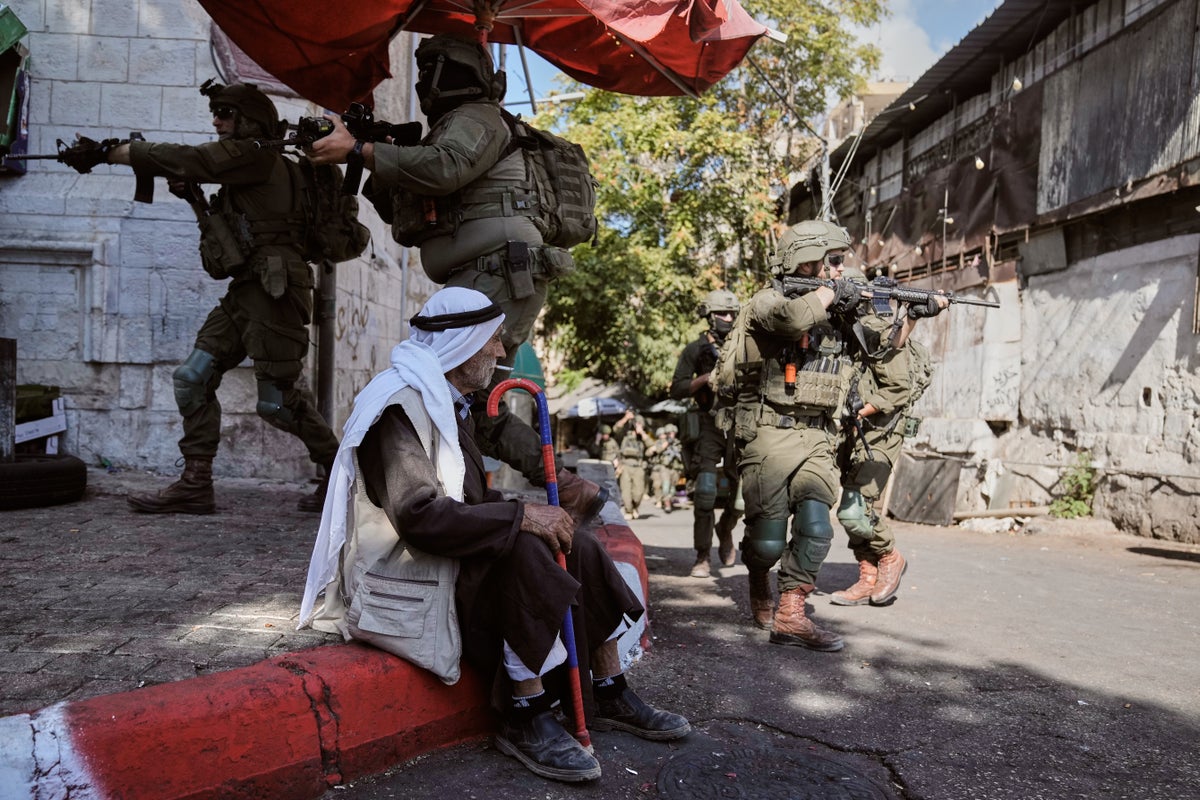
On Sunday, Israeli forces moved yellow concrete blocks dozens of metres west in Shujayea, a neighbourhood in southeastern Gaza City, forcing Palestinian families to flee and bringing more of the neighbourhood under Israeli military control.
framing: assertive · carried by 1 article(s) · first seen 2026-10-12
🔮 They were expected to make further withdrawals gradually, but instead, they have seized more territory.

Claims (36 extracted, 2 hedged)

Israel has expanded its military occupation in the Gaza Strip in violation of a United States-brokered ‘ceasefire’, forcing Palestinians into an ever-smaller share of the besieged territory, devastated by Israel’s ongoing genocidal war. asserted
Israel → expand → war
The original ‘Yellow Line’, established under US President Donald Trump’s 20-point plan to end the war, marked the area to which Israeli forces initially withdrew. asserted
forces → establish → which
They were expected to make further withdrawals gradually, but instead, they have seized more territory. asserted
they → expect → territory
On Sunday, Israeli forces moved yellow concrete blocks dozens of metres west in Shujayea, a neighbourhood in southeastern Gaza City, forcing Palestinian families to flee and bringing more of the neighbourhood under Israeli military control. asserted
forces → move → control
“It’s not simply about where the ‘Yellow Line’ is today but where it can move next,” Al Jazeera’s Ibrahim al-Khalili said, reporting from Gaza City. asserted
Khalili → ’ → City
“For families who have been repeatedly displaced in the past three years, the situation remains dire, and they have to make the impossible decision of where they can go.” asserted
they → displace → decision
More than 90 percent of Gaza’s 2.1 million population has been forcibly displaced by Israel’s war, launched on October 7, 2023, after Hamas-led attacks on southern Israel. asserted
percent → displace → Israel
Using maps, Al Jazeera shows how much of Gaza Israel has grabbed since the ‘ceasefire’. asserted
Israel → use → ceasefire
Before the war, Palestinians were spread across the Gaza Strip, a 365sq km (141sq-mile) territory roughly 41km (25 miles) long and from 6km to 12km (4 to 7 miles) wide. asserted
Palestinians → spread → km
That made it one of the most densely populated places on Earth with about 6,000 people per square kilometre, similar to Nairobi or London. asserted
it → make → Nairobi
Each person had, on average, about 160sq metres (1,722sq ft) of land. asserted
person → have → land
Israel enforced a buffer zone along the fence with Israel, and Palestinians who approached it risked being shot. asserted
who → enforce → it
In 2010, the United Nations Office for the Coordination of Humanitarian Affairs (OCHA) estimated that the restricted area covered 17 percent of Gaza’s land and 35 percent of its farmland. asserted
area → estimate → farmland
Under the first phase of the “ceasefire”, Israeli forces were to withdraw to the “Yellow Line” within 24 hours, after which a 72-hour period began for the handover of Israeli captives held in Gaza. asserted
period → withdraw → Gaza
Trump first published a map of the line on his Truth Social platform. asserted
Trump → publish → platform
The line left Israel in control of 53 percent of the Strip, mostly farmland and border areas in the east, and confined Palestinians to the remaining 47 percent, about 172sq km (66sq miles). asserted
line → leave → percent
By October 2025, two years of war had killed more than 67,000 Palestinians, and tens of thousands more had left the territory, reducing Gaza’s population to about 2.1 million. asserted
thousands → kill → million
Pushed into less than half of Gaza’s territory under the “ceasefire”, its density doubled to about 12,000 people per square kilometre, comparable to New York City. asserted
density → push → City
Each person was left with about 82sq metres (883sq ft). asserted
person → leave → metres
Since the “ceasefire”, Israeli forces have repeatedly moved the yellow concrete blocks marking the “Yellow Line” farther west, sometimes overnight, expanding the areas under their control. asserted
forces → move → control
Satellite imagery has also documented continued demolitions in areas held by Israeli forces. asserted
imagery → document → forces
The research group Forensic Architecture estimated that Israel controlled 58 percent of Gaza by December. asserted
Israel → estimate → December
In March, the Israeli military sent aid agencies maps of a new “orange line”, a restricted zone beyond the “Yellow Line” where humanitarian movements must be coordinated with the army. asserted
movements → send → army
According to OCHA, restrictions now cover 65 percent of Gaza. uncertain
restrictions → accord → Gaza
Israel itself said it controls about 70 percent of the territory, a UN official told the Security Council in June. asserted
official → say → June
That leaves 2.1 million people in about 35 percent of the Strip, roughly 128sq km (49sq miles). asserted
That → leave → Strip
The population density has nearly tripled since before the war to about 16,000 people per square kilometre, close to central Tokyo. asserted
density → triple → Tokyo
Each person now has about 61sq metres (657sq ft) of land for everything: shelter, roads, schools, hospitals and farmland. asserted
person → have → everything
Unlike Tokyo, Gaza has little space left to house its people. asserted
Gaza → have → people
The UN Satellite Centre, UNOSAT, found 82 percent of structures in the Strip are damaged or destroyed. asserted
percent → find → Strip
The UN Food and Agriculture Organization says only 3 percent of Gaza’s cropland is both undamaged and accessible. asserted
percent → say → cropland
OCHA says the remaining 35 percent of Gaza is “already overcrowded” and access restrictions are a key obstacle as aid groups try to relocate families before the rainy season. asserted
groups → say → season
More than 950,000 people live in displacement sites at risk of flooding, according to the UN, most of them in tents and makeshift shelters, as seen in the satellite image below. uncertain
most → live → image
Approaching the ‘Yellow Line” can be deadly. asserted
Approaching → approach → Line
Israel treats areas beyond it as a free-fire zone, and Palestinians who come near it have been shot. asserted
who → treat → it
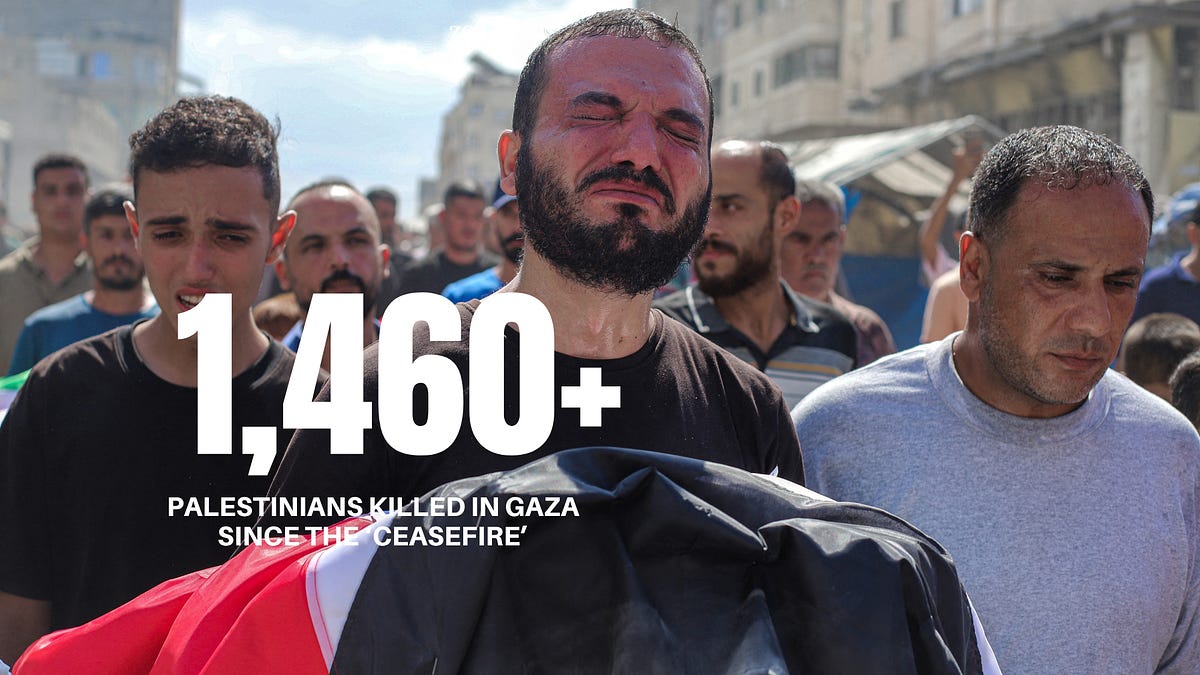
Nearly 1,500 people have been killed across Gaza since the ceasefire was announced. asserted
ceasefire → kill → Gaza

💬Give feedback
🕘History 🎫Support