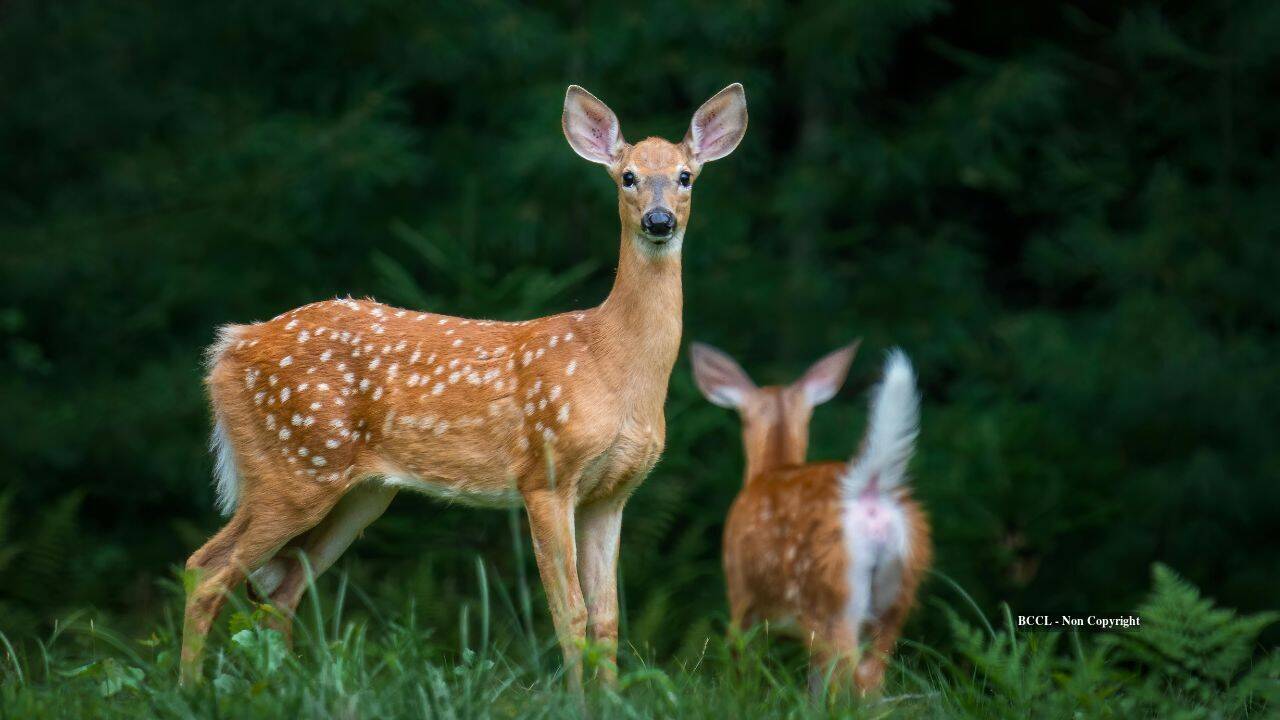
Photo via Times of India

Deer fled 64% of the time from human voices, but soon ignored them

Read the original at Times of India ↗
Cite

TOI Science Desk. (2026, September 10). Deer fled 64% of the time from human voices, but soon ignored them. Times of India. https://timesofindia.indiatimes.com/science/wildlife/in-2023-researchers-tested-human-voices-predator-calls-dog-barks-and-flashing-lights-on-elk-and-deer-in-british-columbia-human-shouts-scared-them-most/articleshow/133966453.cms

Dated when The Aporia collected the article, usually within hours of publication. Check the original for its exact date and byline.

Times of India · collected 2026-09-10 · by TOI Science Desk

Quick Summary

A study published in Ecology and Evolution found that deer fled from human voices 64% of the time when they first heard them, but learned to ignore the noise after just a few days. The researchers tested sound-based deterrents on British Columbia farms, where deer are a persistent problem for farmers. The study suggests that while sound can be an effective tool in some cases, it may not provide long-term solutions due to wildlife adaptation and habituation. Over time, the deer became desensitized to human voices, highlighting both the potential and limitations of using sound as a deterrent.
Written by AI on 2026-09-10, from this article's own text only (the story summary below draws on all the coverage).

AI analysis

Story summary

In British Columbia, farmers have been struggling with white-tailed deer and mule deer that enter their fields to feed on crops at dusk. To find non-lethal ways to protect their harvest, scientists tested whether sound could scare the deer away. They broadcast recordings of human voices, wolf howls, and cougar calls near the fields and found that 64% of the time, the deer would flee when they heard human voices. However, after just a few days, the deer became desensitized to these sounds and began to ignore them. This study highlights both the potential and limitations of using sound as a wildlife deterrent in agricultural landscapes, and suggests that other methods may be needed to effectively manage deer populations.

Written for “Deer Habituation to Human Voices” on 2026-11-04, grounded in this article and the 0 other(s) covering the same event.

Story

📰 Deer Habituation to Human Voices
Environment · 1 article(s) covering the same event.

Compared with similar articles

Nothing to compare against. No article is close enough to this one for the pipeline to have linked or judged the pair.
How this article was measured signals, leaning charts, publisher record, byline, topics and claims

Signals How these are calculated →

Claims extracted
77
sentences that state something as happening or true
Uncertain
9%
7 of 77 hedged ("reportedly", "may", "according to")
Leaning
not political
takes no side on a contested political question
Publisher signals
59/100
Times of India's corrections and hedging, across everything collected from it. Not a measure of accuracy.
Outlets on this story
1
Environment
Same framing elsewhere
1
articles that frame the event the way this one does
Analyzed 2026-09-10 · how these are computed

How this is being covered How these are calculated →

Article leaning vs. publisher reliability
Source leaning vs. consistency

Publisher

Times of India · 4121 article(s) · 4 correction(s) detected
Running correction rate · 4 correction(s)

Who wrote this

TOI Science Desk
308 article(s) here · 1 carrying a prediction
🔮 Researchers are continuing to examine daily measurements to determine whether temperatures will climb further.
🔮 According to Reuters reporting by Will Dunham, a new study published in the journal Spixiana documents more than 90 Bangka slow lorises identified between 2015 and 2025.
🔮 “Normally, my job is quite monotonous, so I wanted to create something that would entertain people, turning my ‘serious’ job into something fun,” he said in a Guinness World Records news release.
🔮 The subsequent collision between the two galaxy clusters may then have compressed the cloud or re-energised its particles, causing it to shine more brightly in radio wavelengths once again.
🔮 The mathematicians at the University of California, Davis, argue that the answer may already lie within Einstein’s own equations and that an invisible form of energy may not be needed at all.
🔮 The work will be carried out by the West Tennessee River Basin Authority, which is preparing a plan to restore the river and the land around it.
🔮 Cornell University scientists have developed genetically engineered tomato plants that turn red-purple when nitrogen becomes scarce, giving farmers a visible warning that crops may need fertiliser.
🔮 By studying these crystals and other mineral grains, scientists could establish the meteorite's age and identify later changes caused by water.
🔮 Centuries later, bronze objects found in Scandinavia would preserve chemical signatures consistent with the metals produced at this Spanish site, offering evidence of connections that may have crossed much of Europe.
🔮 Deposited impurities and staining may also have contributed, while low temperatures and humidity could cause the fabric to crack.
Wire or desk byline, not an individual reporter.
Also by TOI Science Desk
Nothing else under this byline is closely related to this article, so these are simply their most recent.
All 308 articles by TOI Science Desk →

Topics

British Columbia Ecology and Evolution

Subjects

British Columbia GPE · 3× Ecology and Evolution ORG · 1×

Narrative

Others seemed less bothered, perhaps because they’ve worked out how to live with these predators without always feeling threatened, or because the recordings didn’t include the full context of a real predator encounter, like scent or movement.
framing: assertive · carried by 1 article(s) · first seen 2026-09-10
🔮 They broadcast recordings of human shouts, wolf howls and cougar calls near the fields to see if the sounds would scare deer away.
2026-09-10 · Times of India
Deer fled 64% of the time from human voices, but soon ignored them · assertive framing

Claims (77 extracted, 7 hedged)

On the edge of farm fields in British Columbia, where cultivated land meets forest and mountain, farmers have long struggled with deer that slip in at dusk to feed on crops. asserted
that → meet → crops
In search of non-lethal ways to protect their harvest, scientists tested a simple idea. asserted
scientists → protect → idea
They broadcast recordings of human shouts, wolf howls and cougar calls near the fields to see if the sounds would scare deer away. asserted
sounds → broadcast → deer
Deer ran off about 64 per cent of the time when they heard human voices, but over just a few days they learned that the noises posed no real threat and began to ignore them. asserted
noises → run → them
As detailed in a new study published in Ecology and Evolution, the work highlights both the promise and the limits of using sound as a wildlife deterrent in agricultural landscapes. asserted
work → detail → landscapes
When crops such as berries, vegetables and forage plants ripen, the fields become an easy, high-energy buffet. asserted
fields → ripen → berries
A small herd can cause significant damage in a single night, reducing yields and income for farms that are already operating on tight margins. asserted
that → cause → margins
Traditional responses include fencing, hunting, repellents and, in some cases, lethal control. asserted
responses → include → cases
Each approach has drawbacks. asserted
approach → have → drawbacks
Hunting can reduce numbers but rarely eliminates the problem, and it raises ethical and safety concerns near populated areas. asserted
it → reduce → areas
Chemical repellents must be reapplied frequently and may not work in wet weather. uncertain
repellents → reapplie → weather
Farmers and wildlife managers have been looking for tools that are effective, humane and compatible with living in a landscape shared by people, crops and wildlife. asserted
that → look → people
Testing sound as a deterrentSound-based deterrents are not new. asserted
deterrents → test → deterrentSound
Farmers have used propane cannons, air horns and radio broadcasts for years to try to keep animals away from fields. asserted
Farmers → use → fields
Many wildlife species are wary of sudden, loud or unfamiliar noises, especially those that might signal a predator or a human presence. uncertain
that → signal → predator
If the right sounds are played at the right times, animals may avoid the area altogether. uncertain
animals → play → area
What has been less clear is which sounds work best, how long they remain effective and whether animals quickly learn to tune them out. asserted
animals → work → them
To answer these questions, researchers set up an experiment on the margins of crop fields in British Columbia. asserted
researchers → answer → Columbia
They installed speakers connected to motion sensors or timers, programmed to play different categories of audio when deer were detected or at regular intervals through the evening and night. asserted
deer → instal → evening
The test sounds fell into three broad groups. asserted
sounds → fall → groups
One was human voices, including shouts, yells and other vocalisations that might suggest people are nearby. uncertain
people → include → shouts
Another was wolf howls and other canid calls, representing a natural predator of deer. asserted
Another → represent → deer
The third was cougar vocalisations, another top predator that shares the region with deer. asserted
that → share → deer
The team then monitored deer behaviour using cameras and direct observation to see how often the animals fled, how far they moved and how quickly they returned. asserted
they → monitor → cameras
Human voices worked best at firstWhen the experiment began, all three types of sound had some effect, but human voices stood out. asserted
voices → work → effect
About 64 percent of the time, deer that approached the fields while human shouts were playing chose to turn and run. asserted
shouts → approach → fields
They moved away from the speakers, often retreating into nearby cover or abandoning the field entirely for that night. asserted
They → move → night
Ecologically speaking, it makes sense. asserted
it → speak → sense
In places where hunting is restricted, it’s been shown over generations that deer have learned that humans often mean danger. asserted
humans → restrict → danger
Reactions to wolf and cougar calls also triggered flight responses, but not as consistently. asserted
Reactions → trigger → responses
Others seemed less bothered, perhaps because they’ve worked out how to live with these predators without always feeling threatened, or because the recordings didn’t include the full context of a real predator encounter, like scent or movement. asserted
recordings → seem → scent
In the short term, the results suggested that audio deterrents, especially those using human voices, could be a useful tool for reducing deer damage in crops. uncertain
deterrents → suggest → crops
For a farmer facing nightly raids, even a partial reduction in visits could translate into meaningful savings. uncertain
reduction → face → savings
The more sobering part of the story emerged over the following days. asserted
part → emerge → days
As the experiment went on, the animals began to see a pattern. asserted
animals → go → pattern
The scary sounds always came from the same place. asserted
sounds → come → place
Nothing ever emerged from the trees. asserted
Nothing → emerge → trees
No person appeared. asserted
person → appear → ?
No predator followed the noise. asserted
predator → follow → noise
The sound itself carried no real consequence. asserted
sound → carry → consequence
…and 37 more, not listed.

💬Give feedback · no sign-in needed

No sign-in needed for now. Your note is sent without a name, so it cannot be answered.

🕘History 🎫Support