
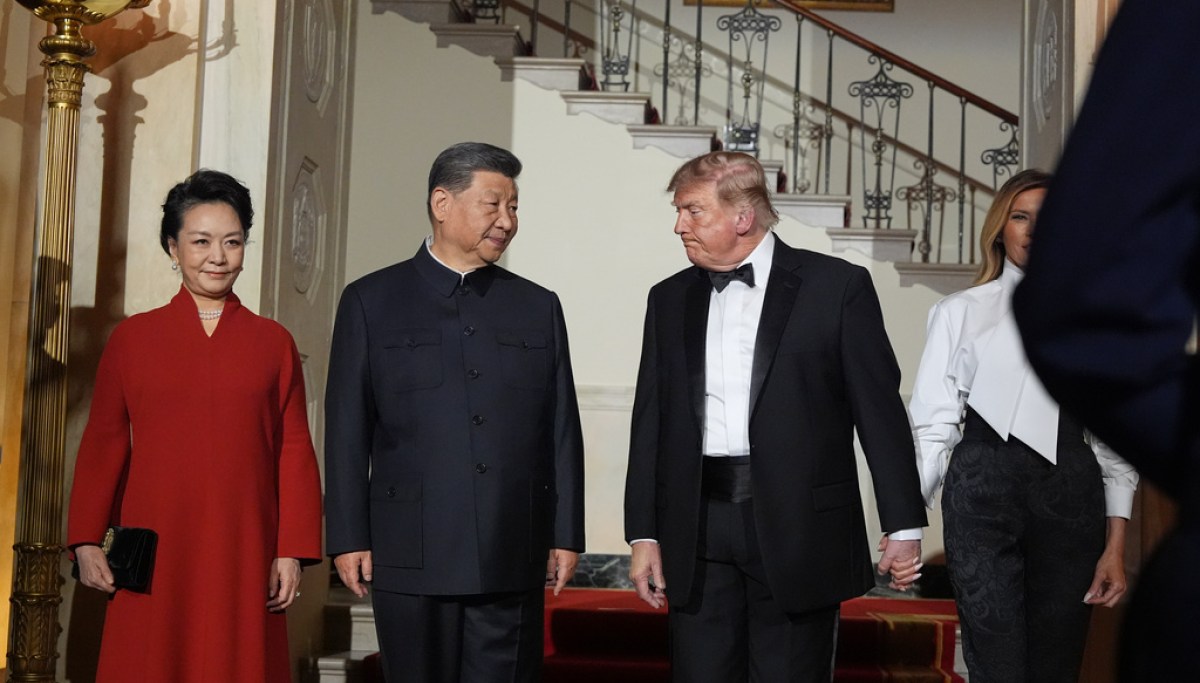
Photo via South China Morning Post

Does Hong Kong’s economy serve the people or profit?

Read the original at South China Morning Post ↗
Cite

Yeung, C. K. (2026, October 14). Does Hong Kong’s economy serve the people or profit? South China Morning Post. https://www.scmp.com/opinion/hong-kong-opinion/article/3370554/does-hong-kongs-economy-serve-people-or-profit?utm_source=rss_feed

Dated from the outlet's own feed. Check the original for its byline.

South China Morning Post · collected 2026-10-14 · by C. K. Yeung

Quick Summary

The article questions whether Hong Kong’s economy prioritizes people or profit, comparing it to mainland China's approach that has lifted millions out of poverty despite not producing Nobel Prize-winning economists. It contrasts this with the United States, which has generated about 75% of Nobel economics laureates but faces issues like public debt and fiscal deficits. The article suggests that Western and Chinese economic systems serve different purposes and recognize distinct types of achievements.
Written by AI on 2026-10-14, from this article's own text only (the story summary below draws on all the coverage).

AI analysis

Story summary

As of 2026-10-14, a South China Morning Post article by C. K. Yeung discusses how Hong Kong’s economy contrasts with those of China and the United States in terms of purpose and achievement. The piece notes that while the United States has produced about 75% of Nobel economics laureates, its economy faces challenges such as mounting public debt, chronic fiscal deficits, and recurring financial crises. In contrast, China is highlighted for lifting millions out of poverty despite not having a Nobel Prize-winning economist. Yeung argues that economic systems in the West and China aim to achieve different goals, with Western economies focusing more on intellectual recognition and Chinese economics emphasizing practical benefits like poverty reduction.

Written for “Hong Kong Economy Concerns” on 2026-11-02, grounded in this article and the 0 other(s) covering the same event.

Story

📰 Hong Kong Economy Concerns
Economy/Business · 1 article(s) covering the same event.

Compared with similar articles

This article reads leans strongly left and hedges 33% of its claims. Each row says how that neighbour differs.
South China Morning Post
⚖️ Leans right further right than this Hedges 0 of 3 claims Outlet record 63/100
“The articles discuss different topics related to Hong Kong's economy and its role in regional stability, but do not describe the same specific incident or occurrence.”
Washington Examiner
⚖️ Leans right further right than this Hedges 0 of 5 claims Outlet record 70/100
“The articles discuss different topics: Article A contrasts economic philosophies between China and Western economies, while Article B focuses on U.S. mischaracterization of Chinese foreign policy and ideological stance.”
How this article was measured signals, leaning charts, publisher record, byline, topics and claims

Signals How these are calculated →

Claims extracted
3
sentences that state something as happening or true
Uncertain
33%
1 of 3 hedged ("reportedly", "may", "according to")
Leaning
Leans strongly left
of the writing, not the subject · beta estimate
Publisher signals
63/100
South China Morning Post's corrections and hedging, across everything collected from it. Not a measure of accuracy.
Outlets on this story
1
Economy/Business
Same framing elsewhere
1
articles that frame the event the way this one does
Analyzed 2026-10-14 · how these are computed

How this is being covered How these are calculated →

Article leaning vs. publisher reliability
Source leaning vs. consistency

Publisher

South China Morning Post · 3600 article(s) · 7 correction(s) detected
Running correction rate · 7 correction(s)

Who wrote this

C. K. Yeung
1 article(s) here · 1 carrying a prediction
🔮 While mainland China might not have a Nobel Prize-winning economist, its lifting of millions out of poverty offers an example worth reflecting on Across the Pacific, the United States has produced about 75 per cent of Nobel economics laureates, even as its economy staggers under mounting public debt, chronic fiscal deficits, and recurring financial crises and government shutdowns.
The only article under this byline in the corpus.

Topics

China Hong Kong’s the United States

Subjects

China GPE · 2× Hong Kong’s GPE · 1× the United States GPE · 1×

Narrative

The short answer strikes at the heart of the matter: economics in the West and economics in China serve different purposes and recognise different kinds of achievements.
framing: mixed · carried by 1 article(s) · first seen 2026-10-14
🔮 While mainland China might not have a Nobel Prize-winning economist, its lifting of millions out of poverty offers an example worth reflecting on Across the Pacific, the United States has produced about 75 per cent of Nobel economics laureates, even as its economy staggers under mounting public debt, chronic fiscal deficits, and recurring financial crises and government shutdowns.
2026-10-14 · South China Morning Post
Does Hong Kong’s economy serve the people or profit? · mixed framing

Claims (3 extracted, 1 hedged)

Does Hong Kong’s economy serve the people or profit? asserted
economy → serve → people
While mainland China might not have a Nobel Prize-winning economist, its lifting of millions out of poverty offers an example worth reflecting on Across the Pacific, the United States has produced about 75 per cent of Nobel economics laureates, even as its economy staggers under mounting public debt, chronic fiscal deficits, and recurring financial crises and government shutdowns. uncertain
economy → have → debt
The short answer strikes at the heart of the matter: economics in the West and economics in China serve different purposes and recognise different kinds of achievements. asserted
economics → strike → achievements
💬Give feedback
🕘History 🎫Support