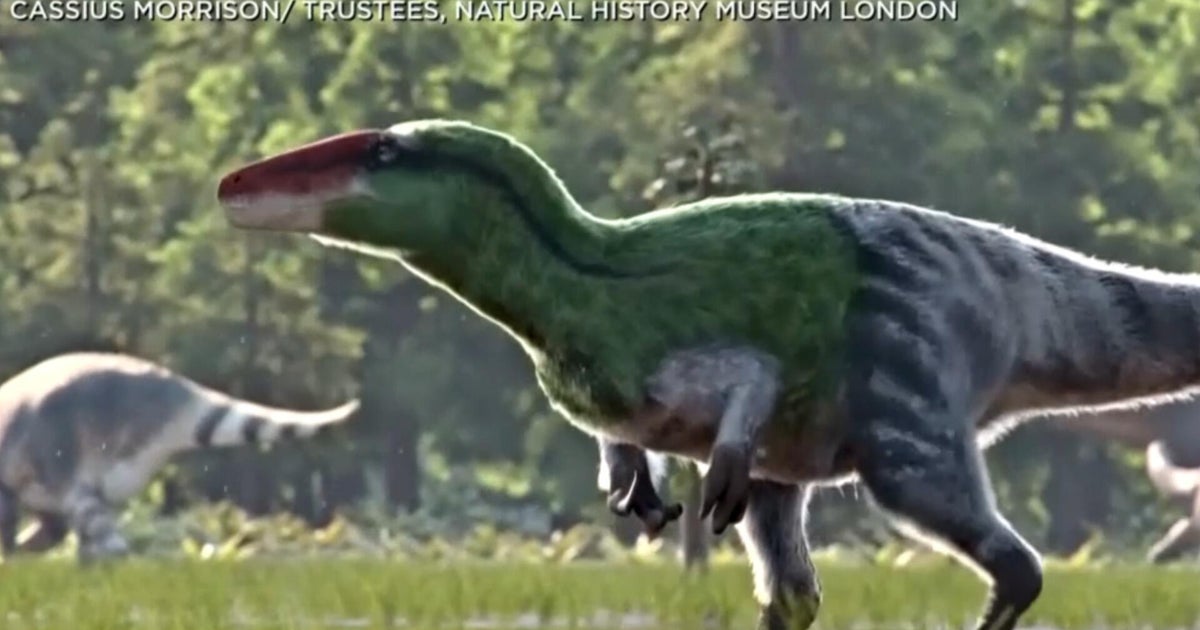
Photo via Evening Standard

New species of dinosaur discovered from fossil ‘overlooked’ for over 100 years

Read the original at Evening Standard ↗
Cite

Ng, E. (2026, October 14). New species of dinosaur discovered from fossil ‘overlooked’ for over 100 years. Evening Standard. https://www.standard.co.uk/news/science/isle-of-wight-europe-university-college-london-natural-history-museum-royal-society-b1300737.html

Dated from the outlet's own feed. Check the original for its byline.

Evening Standard · collected 2026-10-14 · by Ellie Ng

Quick Summary

Researchers from University College London discovered a new species of dinosaur on the Isle of Wight that had been overlooked for over 100 years. This long-clawed predator, named Invictibellatrix amberina, lived around 120 million years ago during the early Cretaceous period and is the first megaraptoran found in Europe. It was about three to four meters long with claws measuring between 10 and 20cm, making it more threatening to human-sized prey compared to larger predators like T. rex. The fossil was initially collected by an amateur palaeontologist over a century ago but only recently recognized as a unique species.
Written by AI on 2026-10-14, from this article's own text only (the story summary below draws on all the coverage).

AI analysis

Story summary

A new species of dinosaur, Invictibellatrix amberina, has been identified from a fossil found on the Isle of Wight over a century ago and overlooked until now. The fossil, a piece of skull, was originally discovered by amateur palaeontologist Reginald Walter Tooley in 1924 and acquired by the Natural History Museum. Described in Royal Society Open Science, Invictibellatrix is believed to be one of the earliest megaraptoran species, which are related to tyrannosaurs like T. rex but had slender heads and large curved claws for attacking prey. This dinosaur, named "unconquered female warrior," lived around 120 million years ago during the Early Cretaceous period and would have been about three to four metres long and just over a metre and a half tall. Lead author Dr Cassius Morrison from University College London notes that despite not being an apex predator, it could be more dangerous for humans due to its size relative to human prey.

Written for “New Dinosaur Species Discovered” on 2026-10-31, grounded in this article and the 2 other(s) covering the same event.

Story

📰 New Dinosaur Species Discovered
Science · 3 article(s) covering the same event. Compare every outlet's account →

Compared with similar articles

This article reads unscored and hedges 7% of its claims. Each row says how that neighbour differs.
BBC News
Hedges 3 of 19 claims Outlet record 68/100
Global News
Hedges 2 of 22 claims Outlet record 63/100
“The articles describe different discoveries involving distinct dinosaur species and time periods.”
CBS News
Hedges 0 of 2 claims Outlet record 66/100
How this article was measured signals, leaning charts, publisher record, byline, topics and claims

Signals How these are calculated →

Claims extracted
15
sentences that state something as happening or true
Uncertain
7%
1 of 15 hedged ("reportedly", "may", "according to")
Leaning
not political
takes no side on a contested political question
Publisher signals
65/100
Evening Standard's corrections and hedging, across everything collected from it. Not a measure of accuracy.
Outlets on this story
3
Science
Same framing elsewhere
1
articles that frame the event the way this one does
Analyzed 2026-10-14 · how these are computed

How this is being covered How these are calculated →

Article leaning vs. publisher reliability
Source leaning vs. consistency

Publisher

Evening Standard · 7906 article(s) · 65 correction(s) detected
Running correction rate · 65 correction(s)

Who wrote this

Ellie Ng
12 article(s) here · 1 carrying a prediction
🔮 A firearm has been recovered, and a heightened police presence will remain in the area.
🔮 Even the smallest bit of information could make all the difference to this investigation.”
🔮 She was pictured smiling during the presentation ceremony as jockey William Buick received his trophy for the win.
🔮 Dr Cassius Morrison, the lead author of the paper documenting the finding, published in the journal Royal Society Open Science, said: “It was not the apex predator of its time, but for humans this dinosaur would have been more dangerous than a T rex.
🔮 Tracey Connelly, now in her 40s, also told her parole hearing that she “hated every minute” of hearing about the “lifelong” pain and suffering of her victims, and that she would have pleaded guilty to historical neglect of her children if charges had been brought against her.
🔮 Asked whether she would accept descriptions of her as manipulative and opportunistic as she gave evidence on Tuesday, Connelly said: “The terminology is not nice.
🔮 He wrote an article about Sir Ranulph in the Telegraph last month, and said he sought to highlight the probability that there are many other vulnerable people, who are not famous, who may find themselves similarly isolated. “We’ve got an ageing population.
🔮 He could be seen slashing and stabbing the small boat after a member of a rescue crew had boarded to apparently take the vessel back to France.
🔮 And I think it’s natural that people so in the public eye are concerned how they will come across in the book.
Also by Ellie Ng
Nothing else under this byline is closely related to this article, so these are simply their most recent.
All 12 articles by Ellie Ng →

Topics

Royal Society Open Science UCL University College London the Isle of Wight the Palaeontographical Society

Subjects

the Isle of Wight GPE · 2× Cassius Morrison PERSON · 1× Reginald Walter Tooley PERSON · 1× Royal Society Open Science ORG · 1× UCL ORG · 1× UK Research and Innovation ORG · 1× University College London ORG · 1× the Palaeontographical Society ORG · 1× the Royal Society ORG · 1×

Narrative

Dr Cassius Morrison, the lead author of the paper documenting the finding, published in the journal Royal Society Open Science, said: “It was not the apex predator of its time, but for humans this dinosaur would have been more dangerous than a T rex.
framing: assertive · carried by 1 article(s) · first seen 2026-10-14
🔮 Dr Cassius Morrison, the lead author of the paper documenting the finding, published in the journal Royal Society Open Science, said: “It was not the apex predator of its time, but for humans this dinosaur would have been more dangerous than a T rex.

Claims (15 extracted, 1 hedged)

A new species of dinosaur has been discovered from a fossil found on the Isle of Wight which has been “overlooked” for study for more than a century, researchers said. asserted
researchers → discover → century
The dinosaur – a long-clawed predator the size of a large tiger – is the first of a group of two-legged carnivores called megaraptorans to be found in Europe, according to the research team led by University College London (UCL). uncertain
dinosaur → call → London
This new species of megaraptorans, which were closely related to tyrannosaurs including Tyrannosaurus rex, lived in the UK in the early cretaceous period around 120 million years ago. asserted
which → include → period
It has been named Invictibellatrix amberina, with the former meaning “unconquered female warrior”. asserted
former → name → meaning
Dr Cassius Morrison, the lead author of the paper documenting the finding, published in the journal Royal Society Open Science, said: “It was not the apex predator of its time, but for humans this dinosaur would have been more dangerous than a T rex. asserted
dinosaur → document → rex
“We would have been perfectly sized prey, about a third of their body weight. asserted
We → size → weight
They definitely would have chased us. asserted
They → chase → us
“A T rex would not have bothered, as we would have been too small. asserted
we → bother → ?
“It is a real mystery that this fossil was overlooked for so long, sitting in a drawer for nearly 100 years. asserted
fossil → overlook → years
“Lots of bones are found on the Isle of Wight – who knows what else is waiting to be discovered.” asserted
what → find → Wight
He said Invictibellatrix would have been three to four-metres long, just over a metre and a half in height, with feathers and claws between 10 and 20cm long. asserted
Invictibellatrix → say → feathers
It would have eaten small dinosaurs, lizards and mammals. asserted
It → eat → dinosaurs
The fossil was originally found at the foot of a cliff on the south-west coast of the Isle of Wight by amateur palaeontologist Reginald Walter Tooley. asserted
fossil → find → Tooley
Megaraptors are thought to have originated in Asia before migrating through Europe. asserted
Megaraptors → think → Europe
The research was funded by the Palaeontographical Society, the Royal Society and UK Research and Innovation. asserted
research → fund → Society
💬Give feedback
🕘History 🎫Support