Claims extracted
17
sentences that state something as happening or true
Uncertain
24%
4 of 17 hedged
("reportedly", "may", "according to")
Leaning
not political
takes no side on a contested political question
Publisher signals
66/100
New York Post's corrections and
hedging, across everything collected from it. Not a measure of accuracy.
Outlets on this story
4
Science
Same framing elsewhere
1
articles that frame the event the way this one does
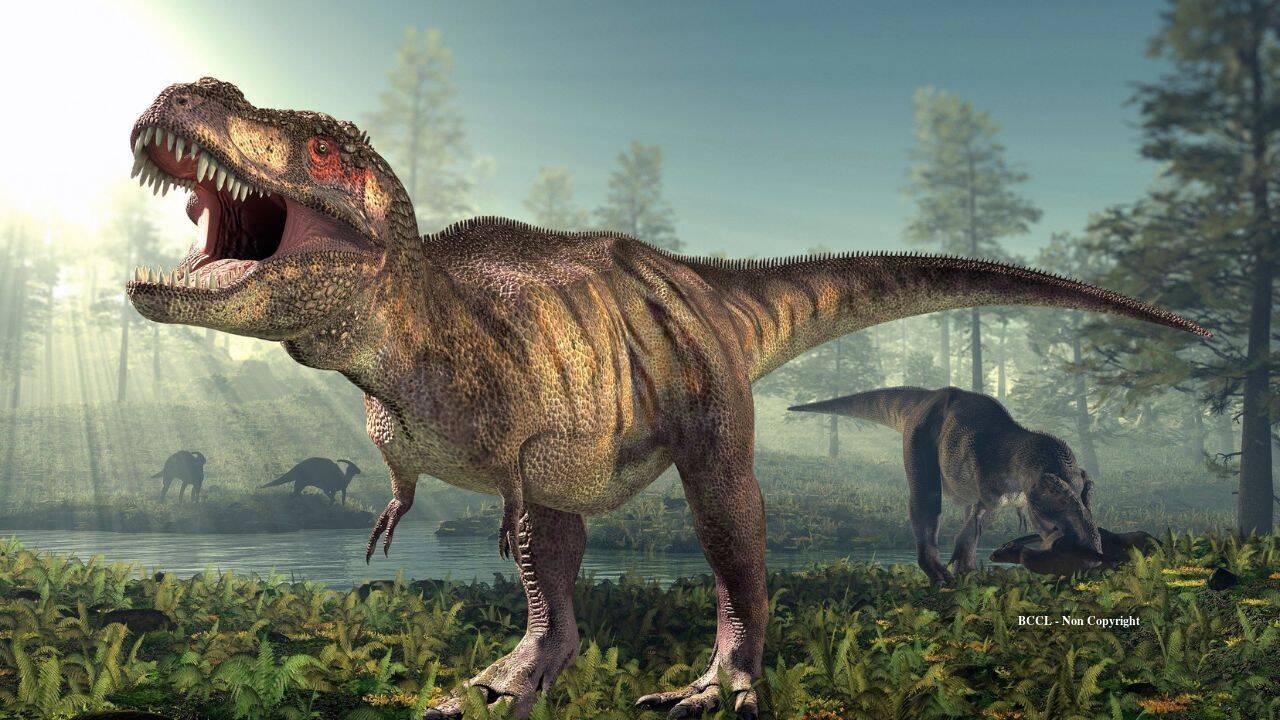
The first known trackway made by an adult Tyrannosaurus rex (T. rex) was recently discovered in southwestern North Dakota by a team of scientists.
asserted
trackway → know → scientists
Paleontologists from the Denver Museum of Nature & Science and Liverpool John Moores University in England, found four connected, large, three-toed footprints in the North Dakota badlands, not far from the Montana border.
asserted
Paleontologists → find → border
According to a paper published in the Journal of Vertebrate Paleontology, the trackway is roughly 23 feet long, with the toes measuring around 3.3 feet long.
uncertain
toes → accord → Paleontology
The spacing between the prints indicates the dinosaur had a stride of about 13 feet and was likely walking at a speed of approximately 3.5 to 4.5 mph.
asserted
dinosaur → indicate → mph
“Bones tell us an enormous amount about these animals, but footprints capture a moment of behavior,” Tyler Lyson, senior curator of vertebrate paleontology at the Denver Museum of Nature & Science said.
asserted
Lyson → tell → Nature
“With a trackway, we can actually follow an animal as it moved across the landscape.
asserted
it → follow → landscape
The trackway was found in 2025 on the Dakota Prairie Grasslands, which is managed by the US Forest Service, in Slope County.
asserted
which → find → County
The tracks are preserved as fine-grained sandstone concretions cemented with calcium carbonate, which nucleated around footprint depressions, according to the article.
uncertain
which → preserve → article
The researchers noted that, before the discovery, large theropod tracks were uncommon within the Hell Creek Formation, which is a division of mostly Upper Cretaceous and some Lower Paleocene rock in North America.
asserted
which → note → America
When the team first discovered the trackway, the site was scanned using a 3D scanner to further support their hypothesis.
“The technology we’re able to apply in the digital age means my colleagues could scan the tracks in the field and then send the 3D information over to me to visualize on my computer and in VR, enabling me to take as close a look as they did in person,” Peter Falkingham, a professor of paleobiology at Liverpool John Moores University and lead author of the study said.
uncertain
Falkingham → discover → study
The team also found T. rex skeletal elements and skeletons in the local area, further strengthening their belief that the tracks were made by T. rex.
asserted
tracks → find → rex
The tracks date to about 66.5 million years ago, near the very end of the Cretaceous Period, shortly before an asteroid impact wiped out the dinosaurs.
asserted
impact → date → dinosaurs
The footprints are expected to be recovered this fall and transported to the Denver Museum of Nature & Science.
asserted
footprints → expect → Science
The first-ever adult T. rex trackway discovered by scientists from the Denver Museum of Nature & Science and Liverpool John Moores University in England is pictured.
asserted
trackway → discover → England
The spacing between the prints indicates the dinosaur had a stride of about 13 feet and was likely walking at a speed of approximately 3.5 to 4.5 mph.
asserted
dinosaur → indicate → mph
The tracks are preserved as fine-grained sandstone concretions cemented with calcium carbonate, which nucleated around footprint depressions.
asserted
which → preserve → depressions
Until recently, tracks and trackways associated with non-Tyrannosaurus tyrannosaurids had not provided clear evidence that could be associated with an adult T. rex. Andrey Atuchin
uncertain
that → associate → Atuchin
 The Aporia