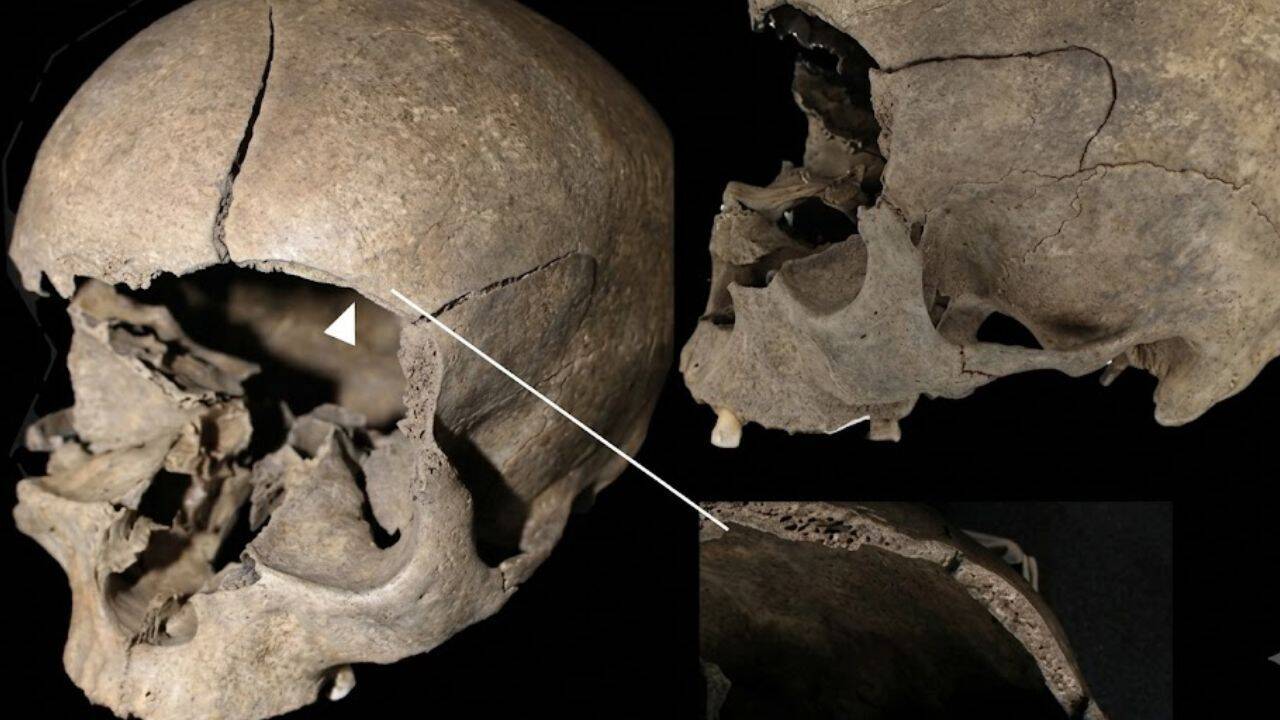
Photo via Times of India

Archaeologists find 19 injuries in 12 people buried in Iron and Viking Age Scandinavia

Read the original at Times of India ↗
Cite

TOI World Desk. (2026, October 15). Archaeologists find 19 injuries in 12 people buried in Iron and Viking Age Scandinavia. Times of India. https://timesofindia.indiatimes.com/world/rest-of-world/archaeologists-find-19-injuries-in-12-people-whose-remains-were-placed-in-houses-wells-and-pits-across-iron-and-viking-age-scandinavia/articleshow/134958228.cms

Dated from the outlet's own feed. Check the original for its byline.

Times of India · collected 2026-10-15 · by TOI World Desk

Quick Summary

Archaeologists studying human remains from Iron and Viking Age Scandinavia, spanning 500 BCE to 1050 CE, found evidence of 19 traumatic injuries in 12 individuals across various burial sites including houses, pits, wells, and postholes. Using osteological examination and digital imaging, the researchers identified a range of injuries such as sharp-force trauma, blunt-force trauma, and fractures. The study suggests that some individuals faced significant social vulnerability and violence during their lives, with unusual treatment after death, indicating potentially harsh living conditions and limited access to healthcare or protection from violence.
Written by AI on 2026-10-15, from this article's own text only (the story summary below draws on all the coverage).

AI analysis

Story summary

Archaeologists have discovered evidence of 19 traumatic injuries in the skeletal remains of 12 individuals buried in houses, pits, wells, and postholes in Iron and Viking Age Scandinavia. The study, published in the Journal of Archaeological Method and Theory, covers a period from approximately 500 BCE to 1050 CE. Researchers found that these unusual burial practices differ significantly from conventional cemetery burials, where remains are typically interred as complete bodies. Instead, the fragmented bones suggest that some individuals may have faced violence or social vulnerability during their lifetimes and received similarly unconventional treatment after death. The analysis of 192 people's remains across 197 depositional contexts revealed these injuries, pointing to atypical mortuary practices indicative of broader societal issues affecting marginalized groups.

Written for “Archaeological Discoveries In Scandinavia” on 2026-11-03, grounded in this article and the 0 other(s) covering the same event.

Story

📰 Archaeological Discoveries In Scandinavia
Science · 1 article(s) covering the same event.

Compared with similar articles

Nothing to compare against. No article is close enough to this one for the pipeline to have linked or judged the pair.
How this article was measured signals, leaning charts, publisher record, byline, topics and claims

Signals How these are calculated →

Claims extracted
28
sentences that state something as happening or true
Uncertain
25%
7 of 28 hedged ("reportedly", "may", "according to")
Leaning
not political
takes no side on a contested political question
Publisher signals
59/100
Times of India's corrections and hedging, across everything collected from it. Not a measure of accuracy.
Outlets on this story
1
Science
Same framing elsewhere
1
articles that frame the event the way this one does
Analyzed 2026-10-15 · how these are computed

How this is being covered How these are calculated →

Article leaning vs. publisher reliability
Source leaning vs. consistency

Publisher

Times of India · 4036 article(s) · 4 correction(s) detected
Running correction rate · 4 correction(s)

Who wrote this

TOI World Desk
1401 article(s) here · 1 carrying a prediction
🔮 "It is back to the way Abraham Lincoln would have wanted it."
🔮 As reported by The Salt Lake Tribune, he began considering whether similar infrastructure could work on his Utah property.
🔮 On 30 May 2024, the court held that the transactions qualified as donationes mortis causa, a legal term for gifts made in anticipation of death.
🔮 James Patterson is best known as one of the world’s most successful thriller writers, but his most consequential work may be happening far from the bestseller lists.
🔮 The money will benefit After-School All-Stars, a non-profit organisation that works with children and young people through free after-school programmes.
🔮 Why Richard would rather play outside than watch screens, and what his mother saw in kindergarten
🔮 Commercial Braille embossers can cost more than £1,000 and may be bulky, making them difficult to access for individuals and smaller organisations with limited budgets.
🔮 Mukhtar argued that she could still earn the same base salary as him if she returned to full-time work.
🔮 For someone passing through a cemetery, a lantern or a plant might appear to be an ordinary possession.
🔮 A British man’s handwritten will, drafted on the cardboard packaging of a frozen fish box and a mince pie packet, has been ruled valid by the High Court, clearing the way for a diabetes charity to inherit his estate worth approximately £180,000.
Wire or desk byline, not an individual reporter.
Also by TOI World Desk
Nothing else under this byline is closely related to this article, so these are simply their most recent.
All 1401 articles by TOI World Desk →

Topics

Journal of Archaeological Method and Theory PC: Scandinavian the Journal of Archaeological Method and Theory

Subjects

Denmark GPE · 1× Journal of Archaeological Method and Theory ORG · 1× PC: ORG · 1× Scandinavian NORP · 1× Sweden GPE · 1× the Journal of Archaeological Method and Theory ORG · 1×

Narrative

Human bones found in houses, wells, and pits point to unusual burial practices The remains differed from conventional burials because they were frequently deposited as individual bones or fragmented body parts rather than complete bodies in cemeteries.
framing: mixed · carried by 1 article(s) · first seen 2026-10-15
🔮 According to research published in the Journal of Archaeological Method and Theory titled ‘ Broken bodies in Domestic Spaces: Direct and Structural Violence in an Atypical Mortuary Dataset from Iron and Viking Age Scandinavia’, some people may have faced violence and social vulnerability during life before receiving unusual treatment after death.

Claims (28 extracted, 7 hedged)

Archaeologists have identified evidence of traumatic injuries in 12 people whose remains were deposited in houses, pits, wells, and postholes across Iron and Viking Age Scandinavia. asserted
remains → identify → Scandinavia
The individuals lived between approximately 500 BCE and 1050 CE, and their skeletal remains showed 19 injuries sustained before or around the time of death. asserted
remains → live → death
According to research published in the Journal of Archaeological Method and Theory titled ‘ Broken bodies in Domestic Spaces: Direct and Structural Violence in an Atypical Mortuary Dataset from Iron and Viking Age Scandinavia’, some people may have faced violence and social vulnerability during life before receiving unusual treatment after death. uncertain
people → accord → death
How did researchers identify signs of violence in ancient Scandinavian remains The study examined human remains recovered from domestic settings across southern and central Scandinavia. asserted
study → identify → Scandinavia
These included skeletal fragments and well-preserved remains found beneath house floors, in pits, wells, postholes, and other settlement features. asserted
These → include → pits
The researchers identified 19 traumatic injuries among 12 individuals from a wider dataset containing remains of an estimated 192 people across 197 depositional contexts. asserted
researchers → identify → contexts
The injuries included sharp-force trauma, blunt-force trauma, and fractures. asserted
injuries → include → trauma
Six individuals had head injuries, while seven had bone damage in other parts of the body. asserted
seven → have → body
Four had multiple injuries. asserted
Four → have → injuries
Eight, possibly nine, individuals showed evidence consistent with deliberate violence, although some injuries could have had other causes. uncertain
injuries → show → causes
The researchers used osteological examination, digital imaging, genetic analysis, and radiocarbon dating to investigate the remains and assess the injuries. asserted
researchers → use → injuries
PC: Journal of Archaeological Method and Theory What do skeletal injuries reveal about life in Iron Age communities Several individuals showed evidence of repeated injuries or health problems that may have affected their lives. uncertain
that → reveal → lives
One adult man had multiple injuries at different stages of healing, including fractures to his collarbone and forearm, alongside three blunt-force injuries to the forehead. asserted
man → have → forehead
One individual had a forearm fracture that had not healed properly. asserted
that → have → fracture
The injury may have occurred while trying to protect themselves during a violent encounter. uncertain
injury → occur → encounter
Other remains showed dental problems, joint degeneration, spinal changes, and signs of physiological stress during childhood. asserted
remains → show → childhood
Together, these findings point to potentially harsh living conditions, hazardous work, limited access to care, or repeated exposure to violence. asserted
findings → point → violence
Human bones found in houses, wells, and pits point to unusual burial practices The remains differed from conventional burials because they were frequently deposited as individual bones or fragmented body parts rather than complete bodies in cemeteries. asserted
they → find → cemeteries
Some were placed beneath house floors, while others were found in wells, pits, and postholes. asserted
others → place → wells
In several cases, the remains appeared to have been exposed to the elements before their final deposition. asserted
remains → appear → deposition
One example involved a child aged two to four whose frontal bone showed evidence of sharp-force trauma around the time of death. asserted
bone → involve → death
The bone was eventually placed between two floor layers inside a longhouse in Denmark. asserted
bone → place → Denmark
The researchers also found evidence of injuries in remains deposited at Uppåkra in Sweden, an important centre of ritual and political activity. asserted
researchers → find → activity
Researchers examine possible causes of violence in Iron Age communities The study explored several possible explanations for the injuries, including warfare, domestic and interpersonal violence, and ritualised violence. asserted
study → examine → warfare
Some injuries were consistent with weapons such as swords, spears or axes, while others may have resulted from attempts to defend against an attack. uncertain
others → result → attack
In certain cases, the evidence could not establish whether an injury occurred during life or during the processing of a body after death. uncertain
injury → establish → death
The researchers also considered structural violence, which refers to harm linked to social conditions and inequalities that restrict people's lives. asserted
that → consider → lives
Signs of physical stress, repeated injuries and unusual burial treatment may indicate that some individuals experienced greater vulnerability than others. uncertain
individuals → indicate → others

💬Give feedback
🕘History 🎫Support