Stanford physicists have recorded what they describe as the first direct observation of quantum jumps of sound in a mechanical resonator.
asserted
they → record → resonator
According to the Stanford Report, the team, led by Amir Safavi-Naeini, published its findings in the journal Science on 17 September 2026.
uncertain
team → accord → September
Quantum jumps were first demonstrated in trapped ions in 1986 and in photons in 2007.
asserted
jumps → demonstrate → 2007
The resonator can vibrate for two milliseconds, and the device took hundreds of readings within that time to pinpoint the moment a phonon moved from an energy state of 1 to 0.
asserted
phonon → vibrate → 0
The Science abstract reports 85% fidelity for heralded single-phonon states.
asserted
abstract → report → states
How did scientists observe a quantum jump in sound in real time
Quantum jumps have been theorised since the early 1900s.
asserted
jumps → observe → 1900s
Scientists first demonstrated them in trapped ions in 1986 and later in photons, the fundamental particles of light, in 2007.
asserted
Scientists → demonstrate → 2007
The report states that observing quantum jumps of sound had remained elusive until the team led by Safavi-Naeini recorded them.
asserted
team → state → them
It describes the result as completing an arc of scientific exploration that started over a hundred years ago.
asserted
that → describe → exploration
Stanford Report explains that the smallest possible discrete piece of light is a photon, while a quantum unit of sound, called a phonon, represents the coordinated movement of a large group of atoms.
asserted
unit → explain → atoms
The report notes that, to human senses, the vibration of a struck bell appears to decline gradually rather than stop abruptly.
asserted
vibration → note → bell
At the quantum level, it says, a resonator's vibrational energy changes in discrete steps, similar to the quantum behaviour of ions and photons.
asserted
energy → say → ions
Earlier experiments had found evidence of these jumps, but the Stanford Report says this study is the first to demonstrate individual phonons making quantum jumps in real time.
asserted
phonons → find → time
Microscopic mechanical resonator helps scientists detect quantum jumps in sound
The mechanical resonator was fabricated using chipmaking techniques.
asserted
resonator → help → techniques
The report says it is so small that many resonators could be packed onto a chip to perform complex functions.
uncertain
resonators → say → functions
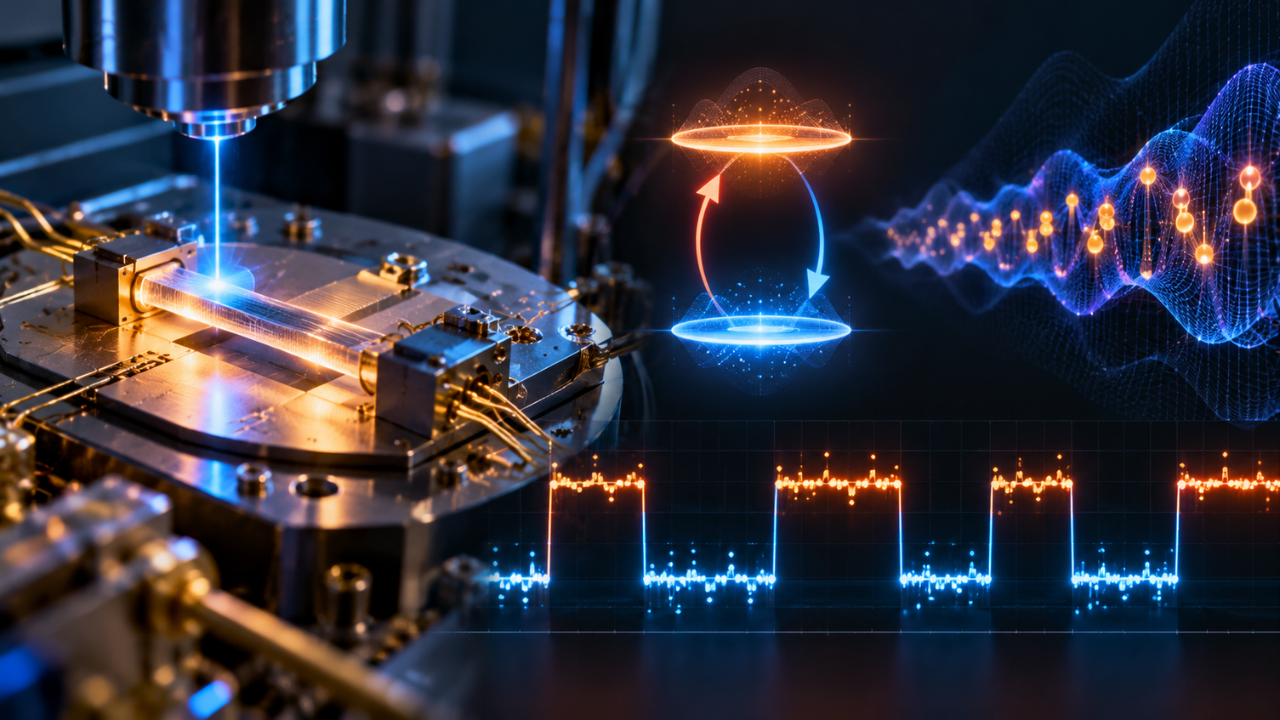
It describes the device as working like a microscopic tuning fork that can vibrate for two milliseconds.
asserted
that → describe → milliseconds
Stanford Report adds that if a regular-sized tuning fork had the same capability, it would ring for several hours.
asserted
it → add → hours
The length of time the resonator can ring is what made the breakthrough possible.
asserted
breakthrough → ring → time
This long "ringdown time" allowed hundreds of readings to be taken to determine the moment the vibration was no longer present and the sound jumped, moving from an energy state of 1 to 0.
asserted
sound → allow → 0
, the team coupled a lithium niobate mechanical resonator with a superconducting qubit and measured the predicted quantum jumps in phonon number.
asserted
team → couple → number
How did a superconducting qubit measure phonon energy levels in real time
asserted
qubit → superconducte → time
The researchers had to overcome an ongoing challenge in quantum engineering: how to get a signal out of a quantum system without disturbing its fragile state.
asserted
researchers → have → state
The qubit as an electrical circuit that can store quantum information and serve as a detector.
asserted
that → store → detector
Makihara, a recent Stanford doctoral graduate, said the team had to keep developing new processes to make the long-lived vibrating object and integrate it with the qubit without ruining either subsystem.
asserted
team → say → subsystem
The qubit reads out what is happening in the resonator, checking over and over during the two milliseconds of vibration whether the phonon inside is at an energy level of 1 or 0.
asserted
phonon → read → 1
This is how the researchers record the moment a quantum jump occurs.
asserted
jump → record → moment
The abstract in Science states that quantum mechanics predicts a vibrating object's energy comes in discrete packets, yet no measurement of its position reveals this.
asserted
measurement → state → this
It says that resolving individual energy levels requires a measurement coupled to the resonator's energy rather than its displacement.
asserted
resolving → say → energy
The team used a superconducting qubit dispersively coupled to a nanomechanical resonator to perform repeated quantum nondemolition measurements of the phonon number.
asserted
team → use → number
Researchers achieve 85% fidelity when creating single-phonon states
asserted
Researchers → achieve → states
An aligned transfer-print technique was used to integrate the qubit and the resonator.
asserted
technique → align → qubit
The researchers heralded single-phonon states with 85% fidelity and observed quantum jumps between the resonator's first excited state and ground state.
asserted
researchers → herald → state
Such behaviour could be of practical use in quantum information processing based on mechanical quantum systems.
uncertain
behaviour → base → systems
The ability to detect quantum jumps of sound could help with the error correction problem in quantum computing.
uncertain
ability → detect → computing
In many quantum computing architectures, a quantum jump represents an error, but identifying when these occur has been difficult.
asserted
these → represent → error
The report adds that Safavi-Naeini's team, working with physicist Michael Roukes' team at Caltech, is already pursuing use of the platform to detect and identify proteins within cells.
asserted
team → add → cells
Szakiel, a current doctoral student in Safavi-Naeini's lab, said the work shows "incredibly fine-tuned control of sound", which the report links to devices such as smartphones.
asserted
report → say → smartphones
Image AI generated
asserted
AI → generate → ?
 The Aporia