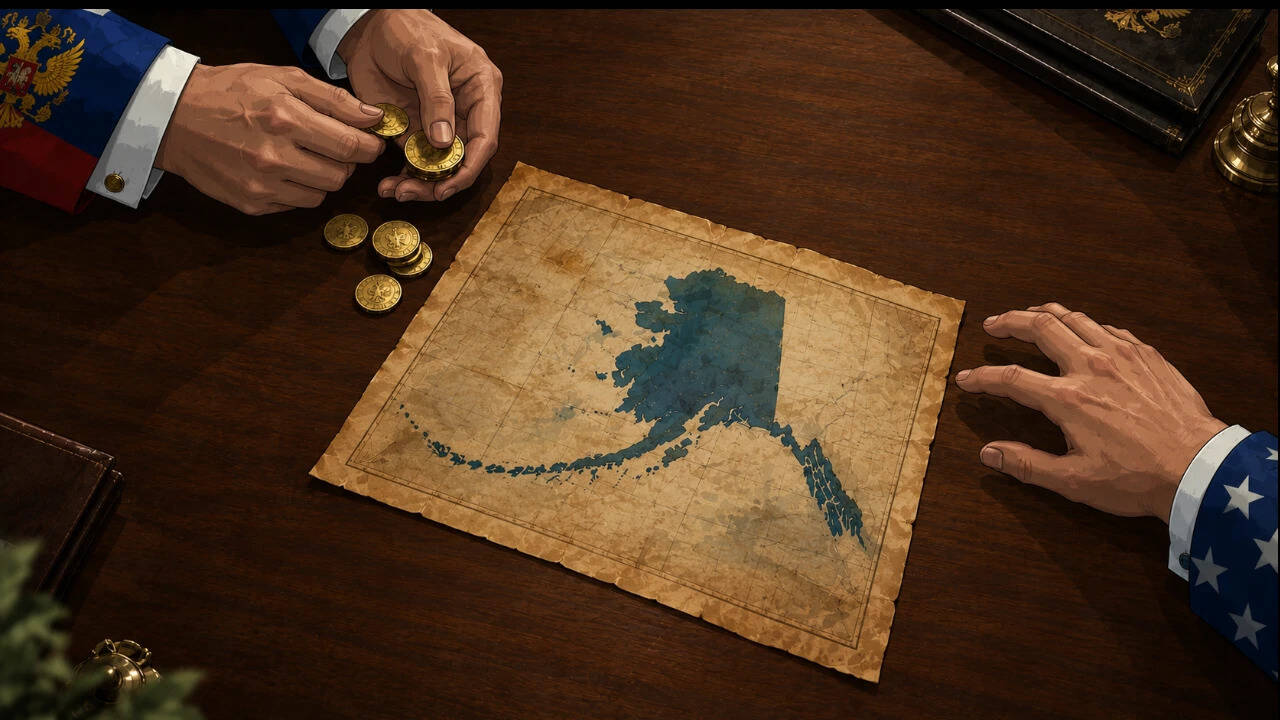
Photo via Times of India

Russia sold Alaska for peanuts. Now it guards America against Moscow

Read the original at Times of India ↗
Cite

Pandey, P. (2026, October 18). Russia sold Alaska for peanuts. Now it guards America against Moscow. Times of India. https://timesofindia.indiatimes.com/world/us/russia-sold-alaska-for-peanuts-now-it-guards-america-against-moscow/articleshow/135027872.cms

Dated from the outlet's own feed. Check the original for its byline.

Times of India · collected 2026-10-18 · by Pranjal Pandey

Quick Summary

Russia sold Alaska to the United States for $7.2 million in gold in 1867, equating to less than two cents per acre. This sale came after Russia’s exploration and colonization efforts began in 1741 but became increasingly costly due to distance from Russia's industrial centers and a declining fur trade. The decision was driven by strategic considerations, including the weakening of Russian military power following the Crimean War, making it difficult for Russia to defend such a remote territory effectively against foreign powers like Britain.
Written by AI on 2026-10-18, from this article's own text only (the story summary below draws on all the coverage).

AI analysis

Story summary

In July 2024, NORAD intercepted two Russian Tu-95 bombers and two Chinese H-6 bombers flying together in the Alaskan Air Defense Identification Zone, highlighting the strategic importance of Alaska today. Originally sold by Russia to the United States for $7.2 million in gold on July 16, 1867, Alaska was seen as a bargain at less than two cents an acre, covering nearly 600,000 square miles. For Russia, the territory was costly and difficult to defend; for the U.S., it represented a chance to expand its influence in the North Pacific. Over time, Alaska's economic and military significance has grown beyond what either nation could have predicted, demonstrating how historical decisions can shape geopolitical dynamics.

Written for “Russia And Alaska Deal Rearview” on 2026-11-03, grounded in this article and the 0 other(s) covering the same event.

Story

📰 Russia And Alaska Deal Rearview
Politics · 1 article(s) covering the same event.

Compared with similar articles

Nothing to compare against. No article is close enough to this one for the pipeline to have linked or judged the pair.
How this article was measured signals, leaning charts, publisher record, byline, topics and claims

Signals How these are calculated →

Claims extracted
111
sentences that state something as happening or true
Uncertain
16%
18 of 111 hedged ("reportedly", "may", "according to")
Leaning
not political
takes no side on a contested political question
Publisher signals
59/100
Times of India's corrections and hedging, across everything collected from it. Not a measure of accuracy.
Outlets on this story
1
Politics
Same framing elsewhere
1
articles that frame the event the way this one does
Analyzed 2026-10-18 · how these are computed

How this is being covered How these are calculated →

Article leaning vs. publisher reliability
Source leaning vs. consistency

Publisher

Times of India · 3982 article(s) · 3 correction(s) detected
Running correction rate · 3 correction(s)

Who wrote this

Pranjal Pandey
48 article(s) here · 1 carrying a prediction
🔮 They will travel onwards to Ukraine through a border crossing, Belarusian state news agency Belta reported, according to Reuters.
🔮 Lapid said the opposition bloc, headed by Yashar chair Gadi Eisenkot, would use every means available to form a government, though he admitted the process would be hard and success was not assured.
🔮 Earlier, Japan's defence ministry detected an object launch, calling it a possible ballistic missile. “An object that may be a ballistic missile has been launched from North Korea.
🔮 “We have been unable to continue carrying the resulting operating losses,” the company said, adding that it would seek to restructure and recapitalise over the next 60 days.
🔮 “An object that may be a ballistic missile has been launched from North Korea.
🔮 In the five-day nationwide poll, registered voters preferred Democrats to Republicans by 47 per cent to 36 per cent when asked which party they would back for Congress.
🔮 Katz said Israel had no intention of initiating an attack on Iran before the election but warned that any Iranian attack would prompt a forceful response.
🔮 Senior Saudi, Pakistani and Turkish officials will visit Tehran on Monday for a joint meeting with Iranian officials, the first planned talk since the re-escalated Houthi conflict.
🔮 Tan said the arrangement would strengthen the resilience of Saudi Arabia's crude oil supply chain in Southeast Asia while enhancing Singapore's energy security and preparedness for supply disruptions.
🔮 Addressing the victims and their families, he added, “We hurt with you, and we will continue to get you the answers you so desperately want.”
Also by Pranjal Pandey
Nothing else under this byline is closely related to this article, so these are simply their most recent.
All 48 articles by Pranjal Pandey →

Topics

Alaska Russia Russian the Russian-American Company the United States

Subjects

Alaska GPE · 11× Russia GPE · 10× Russian NORP · 6× the United States GPE · 5× Britain GPE · 2× Canada GPE · 2× the Russian-American Company ORG · 2× America GPE · 1× Americans NORP · 1× the Russian Empire GPE · 1×

Narrative

On July 24, 2024, the North American Aerospace Defense Command (NORAD) detected and intercepted two Russian Tu-95 bombers and two Chinese H-6 bombers flying together in the Alaskan Air Defence Identification Zone.
framing: assertive · carried by 1 article(s) · first seen 2026-10-18
🔮 Neither side could have foreseen how dramatically Alaska's economic and military importance would grow.
2026-10-18 · Times of India
Russia sold Alaska for peanuts. Now it guards America against Moscow · assertive framing

Claims (111 extracted, 18 hedged)

Look at a map of the world and Alaska seems out of place. asserted
Alaska → look → place
It belongs to the United States, yet sits apart from the rest of the country, separated by Canada and facing Russia across the narrow Bering Strait. asserted
It → belong → Strait
How did this vast territory become a part of America? asserted
territory → become → America
In 1867, the Russian Empire sold Alaska to the United States for $7.2 million in gold. asserted
Empire → sell → gold
Covering nearly 600,000 square miles, the territory cost the Americans less than two cents an acre. asserted
territory → cover → cents
In hindsight, it looks like one of the greatest real-estate bargains in history. asserted
it → look → history
For Russia, Alaska was a remote and expensive colony that had become increasingly difficult to defend. asserted
that → become → Russia
For the United States, it was an opportunity to expand its territory and influence in the North Pacific. asserted
it → expand → Pacific
Neither side could have foreseen how dramatically Alaska's economic and military importance would grow. uncertain
importance → foresee → ?
More than a century and a half later, the sale remains a striking example of how a decision shaped by the strategic calculations of one era can transform the balance of power in another. asserted
decision → remain → another
A colony that never paid its way Russia's story in Alaska began with exploration. asserted
story → pay → exploration
In 1741, expeditions led by Vitus Bering and Aleksei Chirikov reached the territory, paving the way for fur traders to venture across the North Pacific. asserted
traders → lead → Pacific
Their principal prize was the sea otter, whose valuable pelts fuelled a lucrative trade. asserted
pelts → fuel → trade
The business came at a heavy cost to Alaska's Indigenous peoples. asserted
business → come → peoples
According to the US National Park Service, Russian traders, known as promyshlenniki, often coerced Aleut and Alutiiq people into hunting sea otters and supplying provisions. uncertain
traders → accord → provisions
In 1799, Tsar Paul I consolidated Russian trading operations under the Russian-American Company, granting it a monopoly over trade in Russian North America and responsibility for administering the colony. asserted
I → consolidate → colony
Intensive hunting soon depleted sea-otter populations around the early settlements, forcing the company to seek resources elsewhere. asserted
hunting → deplete → resources
The declining fur trade, however, was only part of the problem. asserted
trade → decline → problem
Alaska lay thousands of miles from Russia's political and industrial centres. asserted
Alaska → lie → centres
Transporting food, supplies and people across such distances was expensive and difficult. asserted
Transporting → transport → distances
The US National Archives notes that the Russian-American Company depended on substantial subsidies from an imperial treasury already under strain. asserted
Company → note → strain
According to the US Department of State, the permanent Russian settler population never exceeded 400, with imperial authority concentrated in coastal settlements and trading posts. uncertain
authority → accord → settlements
Maintaining Alaska was costly. asserted
Maintaining → maintain → Alaska
Defending it against a determined foreign power could prove costlier still. uncertain
Defending → defend → power
The fear of losing it for nothing The decisive argument for selling Alaska was strategic. asserted
argument → lose → Alaska
The Crimean War of 1853–1856 exposed the limits of Russian military and naval power. asserted
War → expose → power
Britain, one of Russia's principal adversaries in the conflict, controlled neighbouring British North America, much of which would later become Canada. asserted
much → control → which
Russian officials feared that another war with Britain could leave Alaska vulnerable to seizure. uncertain
war → fear → seizure
If that happened, Russia might lose the colony without receiving a penny in compensation. uncertain
Russia → happen → compensation
The idea of selling the territory had been gaining support for years. asserted
idea → sell → years
In 1857, Grand Duke Konstantin Nikolayevich, the younger brother of Tsar Alexander II, argued that Russia should dispose of its North American possessions before the United States acquired them anyway. asserted
States → argue → them
The Library of Congress identifies him as a leading advocate of the sale within the imperial court. asserted
Library → identify → court
Russia offered Alaska to the United States in 1859, according to the US State Department, but the American Civil War put negotiations on hold. uncertain
War → offer → hold
Once the war ended, talks resumed, with Russia increasingly inclined to part with its distant colony. asserted
Russia → end → colony
The empire also had other priorities. asserted
empire → have → priorities
It was consolidating its position in mainland Asia, including the Amur region and the Pacific coast. asserted
It → consolidate → region
These territories were more closely connected to Siberia and offered greater opportunities for settlement, economic development and military expansion. asserted
territories → connect → settlement
In December 1866, Alexander II and his senior officials decided to proceed with the sale. asserted
II → decide → sale
The transaction promised immediate revenue, relieved Russia of the expense of defending an exposed possession and reduced the danger of Alaska falling into British hands. asserted
Alaska → promise → hands
Transferring it to the United States would also strengthen an emerging Pacific power whose interests could help counterbalance Britain. uncertain
interests → transfer → Britain
…and 71 more, not listed.

💬Give feedback
🕘History 🎫Support