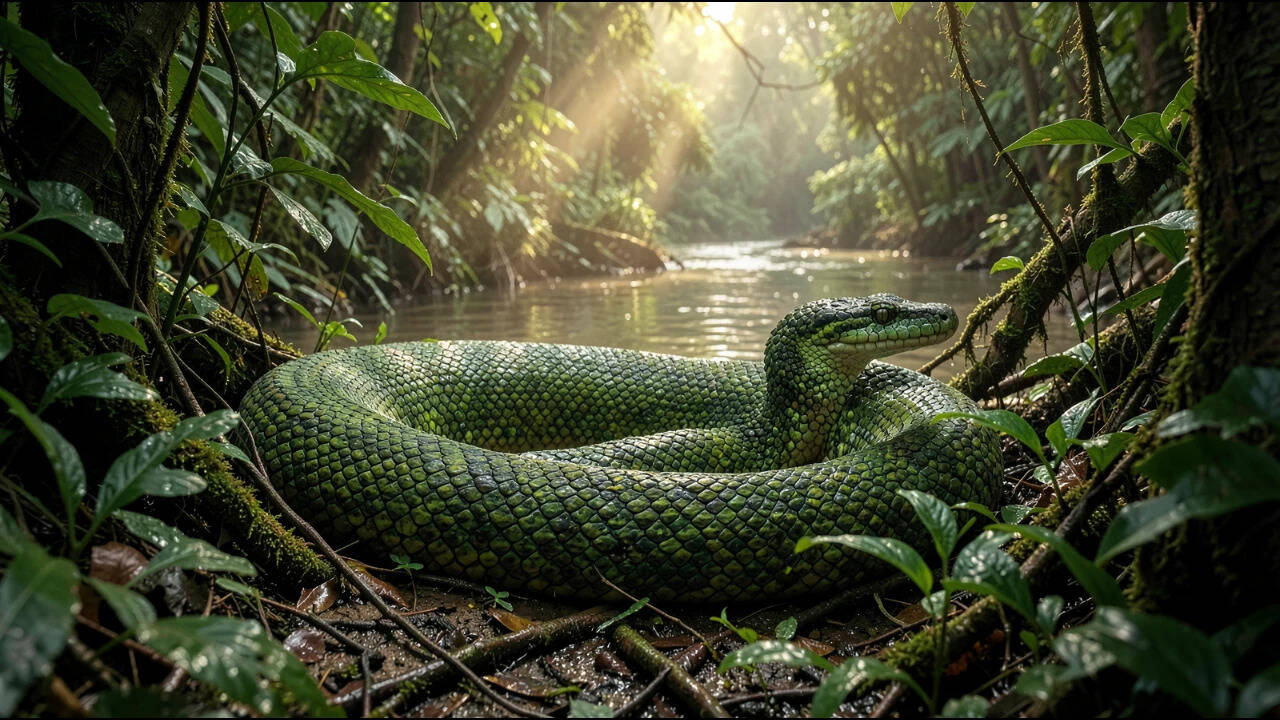
, finding a green anaconda can depend on more than knowing which river it inhabits.
asserted
it → find → river
Dense vegetation, submerged debris and concealed riverbanks can make the giant reptile difficult to observe, even when researchers are tracking its movements.
asserted
researchers → conceal → movements
A study published in the Journal of Natural History in 2025 has documented how the giant reptiles use waterways and surrounding vegetation in the western Amazon.
asserted
reptiles → publish → Amazon
In
Habitat use of cryptic Green Anaconda (Eunectes murinus) in the western Amazon, researchers compiled 180 observations involving at least 50 individual snakes in Peru’s Madre de Dios region.
asserted
researchers → compile → region
Four adults were fitted with very-high-frequency radio tags and tracked.
asserted
adults → fit → tags
At just 23 of their recorded radio locations, or 17.7%, were the snakes visible without disturbance.
asserted
snakes → record → disturbance
The findings show why the animals’ tendency to remain concealed, emerging into view mainly to bask, matters when researchers attempt to locate them and estimate their populations.
asserted
researchers → show → populations
How researchers tracked four green anacondas in Peru
The research brought together habitat records from several collaborating projects in the Madre de Dios region of southeastern Peru.
asserted
research → track → Peru
The observations came mainly from three methods: opportunistic encounters, intensive surveys and radio telemetry.
asserted
observations → come → methods
The study’s results and supplementary records also include a small number of observations from general fauna surveys.
asserted
results → include → surveys
The researchers recorded 180 observations involving at least 50 individual E. murinus, with telemetry tracking accounting for 130 records, or 72.2% of the total.
asserted
tracking → record → total
The fieldwork covered a variety of aquatic environments, including rivers, streams, oxbow lakes and aguajales.
asserted
fieldwork → cover → rivers
An aguajal is a wetland dominated by aguaje palms, known scientifically as Mauritia flexuosa.
asserted
aguajal → dominate → flexuosa
The tagged snakes were tracked along the Los Amigos, Las Piedras and Madre de Dios rivers.
asserted
snakes → tag → rivers
The wider dataset included observations from additional river systems and wetland habitats across the region.
asserted
dataset → include → region
Radio telemetry allowed researchers to locate tagged snakes even when vegetation, submerged logs or riverbanks obscured them from view.
asserted
vegetation → allow → view
Capturing the larger snakes required substantial personnel and experience.
asserted
Capturing → capture → personnel
The researchers described using a team of at least four people when handling particularly large individuals.
asserted
researchers → describe → individuals
Capture attempts depended on whether suitable personnel were available and whether the circumstances allowed the animal to be handled safely.
asserted
animal → depend → ?
The four tagged animals were adults.
asserted
animals → tag → ?
Their tracking records provided detailed information about where the snakes rested, basked and remained concealed across different habitats.
asserted
snakes → provide → habitats
However, the 180 observations were not all tracking records, and the results should be understood as a combination of telemetry data and other field observations.
asserted
results → understand → data
Where green anacondas bask and hide
The study found that green anacondas in the western Amazon were typically exposed when basking, while remaining partly or entirely concealed at most other tracked locations.
asserted
anacondas → bask → locations
Their hiding places included fallen logs, accumulated leaf litter and other detritus, submerged vegetation, fallen palm trunks and undercut riverbanks.
asserted
places → include → logs
On one occasion, a tracked snake was found inside a burrow of unknown origin.
asserted
snake → track → origin
Basking sites varied by habitat.
asserted
sites → bask → habitat
Along rivers, log jams appeared to be the preferred places for basking.
asserted
jams → appear → basking
In aguajales and oxbow lakes, the snakes used well-vegetated embankments and fixed or floating mats of vegetation.
asserted
snakes → use → vegetation
The researchers also found that the animals rarely occupied streams, although they sometimes used connecting waterways and seasonally flooded areas.
asserted
they → find → waterways
Individual tracking records illustrate how much these habitats can vary.
asserted
habitats → illustrate → ?
One female weighed 100 kg and had a snout-to-vent length of 486 cm, with a further 77 cm measured along her tail.
asserted
female → weigh → tail
Her records placed her most often in closed-canopy aguajal habitat, while the remaining observations were from grass mats in open water.
asserted
observations → place → water
These records show that the tracked snake used more than one type of aquatic environment.
asserted
snake → show → environment
A tracked male was also found in temporarily flooded forest, where he was nearly invisible in shallow pools beneath dense vegetation.
asserted
he → track → vegetation
In one observation, he was concealed beneath leaf litter and shallow water, with only his nostrils exposed.
asserted
nostrils → conceal → litter
Such records help explain why a snake’s location may be known through telemetry even when a researcher cannot readily see the animal.
uncertain
researcher → help → animal
The findings also fit with earlier research on anacondas and mineral licks.
asserted
findings → fit → anacondas
A separate 2024 study,
Does the Southern Green Anaconda, Eunectes murinus, seek areas of high prey concentration in southeastern Peru?,
asserted
Does → seek → Peru
Its authors suggested that anacondas may target such sites because prey can congregate there.
uncertain
prey → suggest → sites
This is related evidence about hunting behaviour, rather than a result that should be attributed solely to the 2025 habitat study.
asserted
that → relate → study
…and 12 more, not listed.
 The Aporia