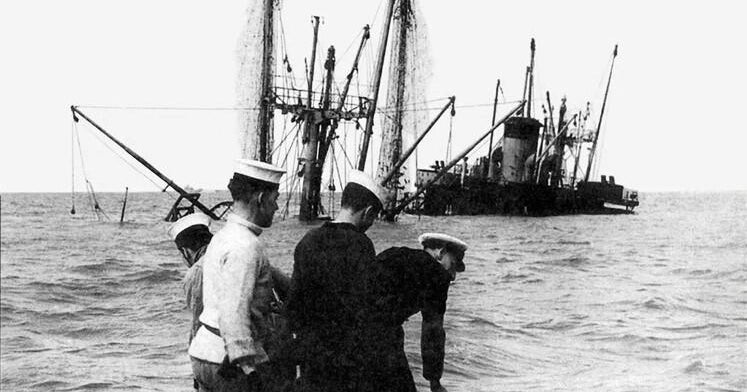
Photo via The Guardian

Masts removed from bomb-laden WWII ship in Thames in bid to avoid explosion

Read the original at The Guardian ↗
Cite

correspondent, G. T. T. (2026, October 19). Masts removed from bomb-laden WWII ship in Thames in bid to avoid explosion. The Guardian. https://www.theguardian.com/uk-news/2026/oct/19/us-wwii-ship-richard-montgomery-thames-bombs-prevent-explosion

Dated from the outlet's own feed. Check the original for its byline.

The Guardian · collected 2026-10-19 · by Gwyn Topham Transport correspondent

Quick Summary

Engineers removed the masts from the sunken World War II ship SS Richard Montgomery in the Thames estuary without triggering an explosion. The ship carries approximately 1,400 tonnes of unexploded bombs and has been under constant guard due to safety concerns. Maritime minister Keir Mather announced that removing the masts reduced structural load on the wreck and was completed ahead of schedule at a cost of £9.5 million. The masts are now at the Historic Dockyard Chatham, while monitoring around the ship will continue.
Written by AI on 2026-10-19, from this article's own text only (the story summary below draws on all the coverage).

AI analysis

Story summary

Engineers have removed the masts from the SS Richard Montgomery, a World War II cargo ship sunk off Sheerness in 1944 with approximately 1,400 tonnes of unexploded bombs onboard, to reduce the risk of an accidental explosion. The operation was conducted due to fears that deteriorating conditions could cause the masts to collapse into the deadly cargo and trigger a major blast. While some experts predict a potential tsunami, debris up to 3km in the air, and destruction of Sheerness, others are cautious about the exact impact of such an event after over eight decades underwater. The salvaged masts have been moved to Historic Dockyard Chatham for display, acknowledging the ship's historical importance during World War II. Despite this work, the explosives remain in the wreck on the riverbed, continuing to pose a potential risk.

Written for “WWII Ship Removal Operation” on 2026-11-04, grounded in this article and the 1 other(s) covering the same event.

Story

📰 WWII Ship Removal Operation
Environment · 2 article(s) covering the same event. See how they differ ↓

Compared with similar articles

This article reads unscored and hedges 21% of its claims. Each row says how that neighbour differs.
CBS News
Hedges 6 of 24 claims Outlet record 65/100
How this article was measured signals, leaning charts, publisher record, byline, topics and claims

Signals How these are calculated →

Claims extracted
14
sentences that state something as happening or true
Uncertain
21%
3 of 14 hedged ("reportedly", "may", "according to")
Leaning
not political
takes no side on a contested political question
Publisher signals
66/100
The Guardian's corrections and hedging, across everything collected from it. Not a measure of accuracy.
Outlets on this story
2
Environment
Same framing elsewhere
1
articles that frame the event the way this one does
Analyzed 2026-10-19 · how these are computed

How this is being covered How these are calculated →

Article leaning vs. publisher reliability
Source leaning vs. consistency

Publisher

The Guardian · 2944 article(s) · 6 correction(s) detected
Running correction rate · 6 correction(s)

Who wrote this

Gwyn Topham Transport correspondent
16 article(s) here · 1 carrying a prediction
🔮 London’s mayor has called for a cap on the numbers of robotaxis on its streets, with the UK government poised to allow fully driverless vehicles to operate in the capital.
🔮 Work will close London’s Paddington station – affecting intercity trains to the west of England and Wales until January – as well as Birmingham New Street, the UK’s busiest station outside the capital, for five days over the holiday period.
🔮 Under the contracts that replaced the franchising system since the pandemic, train operators’ income comes from fees paid by the DfT instead of depending on fare revenue, with the taxpayer instead taking any profit or loss from ticketing income or refunds. Avanti, which is due to be taken into public ownership next year as part of Great British Railways, paid out more than £50m in 2025-26, and is expected to pay out more than £70m this financial year.
🔮 How could this happen?
🔮 A new railway station will be built in Bradford to “transform how people travel across the north”, the government has announced.
🔮 The work was carried out because of concerns that the masts, which had remained visible above the water near Sheerness, could collapse in on the deadly cargo and blow up the ship.
🔮 Disabled passengers will have better safeguards when flying, the government has pledged, including protection from damaged wheelchairs and support from trained staff.
🔮 The GMB and ADCU unions have both said thousands of drivers jobs will be lost and have called for help for those affected.
2026-10-14 · assertive framing · Uber begins self-driving robotaxi trial in Manchester
🔮 Non-EU citizens, including UK travellers and those from other visa-exempt countries including the US, Australia and Canada, will soon need to pay €20 (£17) for an electronic waiver to enter the Schengen zone under the European travel information and authorisation system (Etias).
🔮 Flash interiors, fancy food and maybe even a bar: Virgin has unveiled a mock-up of its future cross-Channel train, with a pledge to create “something genuinely new”.
Also by Gwyn Topham Transport correspondent
Nothing else under this byline is closely related to this article, so these are simply their most recent.
All 16 articles by Gwyn Topham Transport correspondent →

Topics

Commons Kent London New Scientist the SS Richard Montgomery

Subjects

Boris Johnson’s PERSON · 1× Commons ORG · 1× Keir Mather PERSON · 1× Kent GPE · 1× London GPE · 1× Mather PERSON · 1× New Scientist ORG · 1×

Narrative

Although the risk of an accidental major explosion is now deemed remote, local people have been alarmed by incidents in recent years, including the occasional close proximity of cargo shipping, and a paddleboarder who uploaded pictures to social media of himself leaning on the protruding masts.
framing: mixed · carried by 1 article(s) · first seen 2026-10-19
🔮 The work was carried out because of concerns that the masts, which had remained visible above the water near Sheerness, could collapse in on the deadly cargo and blow up the ship.

Claims (14 extracted, 3 hedged)

A sunken US wartime ship in the Thames estuary holding enough unexploded bombs to devastate a Kent coastal town and send a tidal wave through London has been made slightly safer, ministers have announced. asserted
ministers → hold → London
Engineers have removed the masts of the SS Richard Montgomery – a second world war cargo ship that sank in 1944 with approximately 1,400 tonnes of munitions onboard – without triggering the kind of feared explosion that has kept the wreck under constant guard for decades. asserted
that → remove → decades
The work was carried out because of concerns that the masts, which had remained visible above the water near Sheerness, could collapse in on the deadly cargo and blow up the ship. uncertain
which → carry → ship
The potential effects of an explosion after 82 years under water have divided expert opinion. asserted
effects → divide → opinion
Some believe it could cause a small tsunami, throw debris 3km into the air, and “level Sheerness”, according to a New Scientist report in 2004. uncertain
it → believe → 2004
A government report in 2000 said it was widely accepted it would “put property and the local population at risk”. asserted
it → say → risk
The exact contents of the ship’s three holds are unknown but a defence agency report estimated there were almost 300 2,000lb (900kg) blockbuster bombs and more than 2,000 cluster bombs. asserted
report → estimate → holds
Keir Mather, the maritime minister, told the Commons on Monday that work had now been completed, with all three masts successfully removed in “complex project requiring specialist programme, engineering and risk management expertise”. asserted
masts → tell → expertise
Mather said that the masts had put “significant load on the structure and their removal has reduced that risk and supports the long-term safe management of the site.” asserted
removal → say → site
He said work was completed ahead of schedule and below forecast costs, an estimated £9.5m. asserted
work → say → costs
The masts have now been delivered to a maritime museum, the Historic Dockyard Chatham, “in recognition of the historic significance of the SS Richard Montgomery and its role in supporting the allied forces’ efforts during world war two”. asserted
masts → deliver → war
The wreck would “continue to be subject to continuous monitoring and control via the established exclusion zone”, he said. asserted
he → continue → zone
A shipping exclusion zone has long been in place around the SS Montgomery, and since 2025 a no-fly zone has been in place – a development that could have been awkward had Boris Johnson’s proposed Thames estuary airport gone ahead. uncertain
airport → propose → place
Although the risk of an accidental major explosion is now deemed remote, local people have been alarmed by incidents in recent years, including the occasional close proximity of cargo shipping, and a paddleboarder who uploaded pictures to social media of himself leaning on the protruding masts. asserted
himself → deem → masts

💬Give feedback · no sign-in needed

No sign-in needed for now. Your note is sent without a name, so it cannot be answered.

🕘History 🎫Support