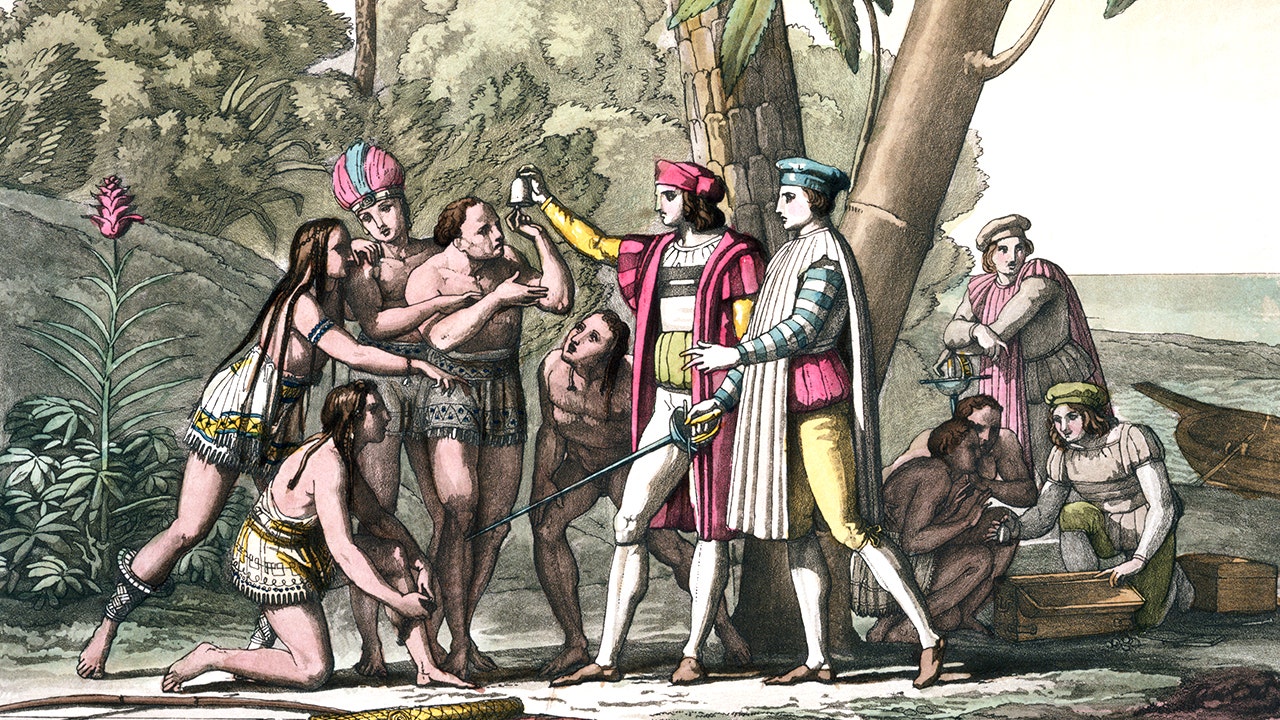
Photo via New York Post

Ancient DNA discovery adjusts timeline of first North American humans: new study

Read the original at New York Post ↗
Cite

Fox News. (2026, October 19). Ancient DNA discovery adjusts timeline of first North American humans: new study. New York Post. https://nypost.com/2026/10/19/lifestyle/humans-migrated-to-north-america-earlier-than-thought-study/

Dated from the outlet's own feed. Check the original for its byline.

New York Post · collected 2026-10-19 · by Fox News

Quick Summary

Researchers studying ancient DNA have revised the timeline for when humans first arrived in North America, suggesting that early migration likely occurred between 14,000 and 20,000 years ago, earlier than previously thought at around 13,500 years. The study, led by Bethany Potter and Savannah Hay from the University of Kansas, incorporates genetic evidence as well as archaeological findings such as 23,000-year-old footprints in New Mexico, which hint that humans may have inhabited North America earlier than indicated by current genetic records.
Written by AI on 2026-10-19, from this article's own text only (the story summary below draws on all the coverage).

AI analysis

Story summary

Researchers examining ancient DNA have revised the timeline for when humans first arrived in North America. A study published online ahead of its appearance in the December 2026 issue of *Current Opinion in Genetics & Development* suggests that genetic evidence strongly supports a human arrival between 14,000 and 20,000 years ago, with an arrival before 15,000 years ago considered likely. This contradicts the previously accepted "Clovis First" theory which estimated the first humans arrived around 13,500 years ago. The study, led by Bethany Potter and Savannah Hay of the University of Kansas, reviewed existing ancient DNA and archaeological evidence, including 23,000-year-old human footprints found at White Sands National Park in New Mexico, challenging earlier theories about early human migration into North America.

Written for “Ancient DNA Challenges Human Migration Timeline” on 2026-11-04, grounded in this article and the 1 other(s) covering the same event.

Story

📰 Ancient DNA Challenges Human Migration Timeline
Science · 2 article(s) covering the same event. See how they differ ↓

Compared with similar articles

This article reads unscored and hedges 28% of its claims. Each row says how that neighbour differs.
Fox News
Hedges 5 of 17 claims Outlet record 68/100
How this article was measured signals, leaning charts, publisher record, byline, topics and claims

Signals How these are calculated →

Claims extracted
18
sentences that state something as happening or true
Uncertain
28%
5 of 18 hedged ("reportedly", "may", "according to")
Leaning
not political
takes no side on a contested political question
Publisher signals
66/100
New York Post's corrections and hedging, across everything collected from it. Not a measure of accuracy.
Outlets on this story
2
Science
Same framing elsewhere
2
articles that frame the event the way this one does
Analyzed 2026-10-19 · how these are computed

How this is being covered How these are calculated →

Article leaning vs. publisher reliability
Source leaning vs. consistency

Publisher

New York Post · 16794 article(s) · 36 correction(s) detected
Running correction rate · 36 correction(s)

Who wrote this

Fox News
418 article(s) here · 1 carrying a prediction
🔮 Continue reading … ‘WILL NOT DISSUADE ME’ — Conservative Jewish activist vows not to be silenced after attack on Michigan campus.
🔮 President Donald Trump sought to reassure voters the day before the midterm elections that Iran is not a “forever war,” but a “soft war” that the United States could end at any time.
🔮 “Campaigning with Hasan Piker, you could not put enough room between me and that man.
🔮 I will always stand with you,” Democratic nominee Angie Nixon, a state lawmaker from Jacksonville whose platform is considered DSA-aligned, wrote on X. O’Brien also caught heat for voting in Florida, which appeared to signal a move from his hometown of Boston. “Be union leader — move to a famously anti-union state — vote for a famously anti-union candidate — Brag about it — really cool stuff man,” a top commenter on O’Brien’s post said.
🔮 Continue reading … VERDICT NIGHT — Nine states could decide whether Donald Trump's second term sinks or soars.
🔮 “I want them to understand their dad and maybe in understanding their dad and why he made the choices he did, maybe they’ll understand themselves better,” he said.
🔮 5 things older Americans should do to stay out of nursing homes, according to a doctor By Melissa Rudy, Fox News Published Nov. 2, 2026, 6:51 a.m. ET Three in four Americans aged 50 and older would like to remain in their homes as they age, according to the AARP — and preserving that independence starts with daily habits.
🔮 Turning to her own campaign, Collins portrayed herself as a bipartisan lawmaker willing to work across party lines, arguing that the Senate needs more centrists as moderates increasingly leave Washington.
🔮 “However, sometimes they do have to use military force and this would be incredibly high risk on far more volatile cargo such as LPG.”
🔮 “I never imagined that joining OnlyFans would have such an emotional impact on me,” she admitted.
Wire or desk byline, not an individual reporter.
Also by Fox News
Nothing else under this byline is closely related to this article, so these are simply their most recent.
All 418 articles by Fox News →

Topics

Current Opinion in Genetics & Development Fox News New Mexico North American the University of Kansas

Subjects

Andrea Margolis PERSON · 1× Bethany Potter PERSON · 1× Current Opinion in Genetics & Development ORG · 1× Fox News ORG · 1× Indigenous NORP · 1× Native American NORP · 1× New Mexico GPE · 1× North American NORP · 1× Savannah Hay PERSON · 1× the University of Kansas ORG · 1×

Narrative

The study, published online ahead of its appearance in the December 2026 issue of the journal Current Opinion in Genetics & Development, looked at previously published genetic and archaeological evidence to better understand when humans first arrived in the Americas.
framing: mixed · carried by 2 article(s) · first seen 2026-10-19
🔮 Later archaeological discoveries have challenged that timeline, suggesting humans may have reached North America thousands of years earlier.

Claims (18 extracted, 5 hedged)

Ancient DNA discovery adjusts timeline of first North American humans: new study asserted
discovery → adjust → humans
Researchers examining ancient DNA have narrowed down the timeline of early human migration into North America — shedding light on a question that’s puzzled scientists for decades. asserted
that → examine → decades
The study, published online ahead of its appearance in the December 2026 issue of the journal Current Opinion in Genetics & Development, looked at previously published genetic and archaeological evidence to better understand when humans first arrived in the Americas. asserted
humans → publish → Americas
Genetic evidence most strongly supports humans reaching the Americas between 14,000 and 20,000 years ago, the study suggests — with an arrival before 15,000 years ago considered likely. uncertain
arrival → support → Americas
Previously, scientists thought the first humans arrived in North America roughly 13,500 years ago, a theory known as “Clovis First.” asserted
humans → think → Clovis
Later archaeological discoveries have challenged that timeline, suggesting humans may have reached North America thousands of years earlier. uncertain
humans → challenge → America
The researchers, led by Bethany Potter and Savannah Hay of the University of Kansas, reviewed existing ancient DNA and archaeological evidence, including 23,000-year-old human footprints found at White Sands National Park in New Mexico. asserted
researchers → lead → Mexico
The footprints suggest humans may have inhabited North America earlier than the timeline supported by currently available genetic evidence. uncertain
humans → suggest → evidence
Such early populations could have belonged to genetic lineages that have not yet been sampled or that left no surviving descendants, the researchers said. uncertain
researchers → belong → descendants
By comparing previously published genetic data from ancient human remains in Asia and the Americas, researchers examined shared ancestry to trace how early Indigenous populations split into distinct groups. asserted
populations → compare → groups
Some ancestral lineages diverged roughly 21,000 years ago, according to the review. uncertain
lineages → diverge → review
The researchers also highlighted evidence that ancestral Native American populations split into northern and southern groups roughly 15,500 years ago, likely south of the massive ice sheets that once covered much of North America. asserted
that → highlight → America
That would mean their ancestors had already reached the continent before the split occurred. asserted
split → mean → continent
“Genomic data show us that the dynamics of the peopling of the Americas were quite different — at one point, a small group of people must have entered the American continents completely devoid of other humans,” the researchers wrote. asserted
researchers → show → humans
Still, the researchers acknowledged that questions remain about exactly when and where early populations diverged. “The timing and geographic location of key divergence events mentioned above remain uncertain,” the authors wrote. asserted
authors → acknowledge → events
Ancient DNA has also played a key role in other recent archaeological discoveries. asserted
DNA → play → discoveries
Earlier this summer, researchers announced the discovery of ancient sheep pox virus DNA in the York Gospels, a 1,000-year-old manuscript written in England. asserted
researchers → announce → England
In Chile, researchers recently discovered ancient smallpox DNA in two centuries-old mummies, providing the first genetic evidence of the disease in that region of South America. asserted
researchers → discover → America

💬Give feedback · no sign-in needed

No sign-in needed for now. Your note is sent without a name, so it cannot be answered.

🕘History 🎫Support