Photo via The Sydney Morning Herald

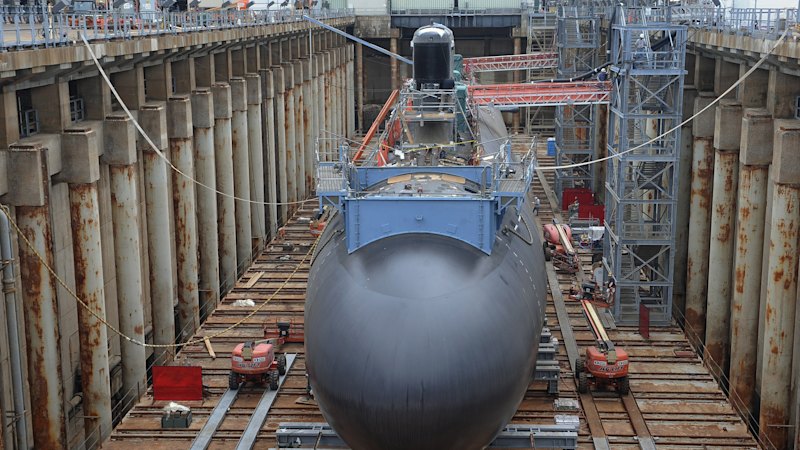
Australia war-gaming use of nuclear-powered subs in conflict with China

Read the original at The Sydney Morning Herald ↗
Cite

Koziol, M. (2026, October 19). Australia war-gaming use of nuclear-powered subs in conflict with China. The Sydney Morning Herald. https://www.smh.com.au/world/north-america/australia-war-gaming-use-of-nuclear-powered-subs-in-conflict-with-china-20261020-p616qj.html?ref=rss&utm_medium=rss&utm_source=rss_feed

Dated from the outlet's own feed. Check the original for its byline.

The Sydney Morning Herald · collected 2026-10-19 · by Michael Koziol

Quick Summary

The Australian Defence Force is currently participating in war games organized by the Hudson Institute and the United States Studies Centre, simulating potential conflicts with China. These exercises involve modeling how US nuclear-powered submarines and those to be acquired through AUKUS would be used. The event includes participation from military personnel and civilian experts, highlighting the practical application of the AUKUS agreement as Australia prepares to host US nuclear subs near Perth starting in 2024.
Written by AI on 2026-10-19, from this article's own text only (the story summary below draws on all the coverage).

AI analysis

Story summary

The Australian Defence Force (ADF) is participating in war games this week in Canberra, simulating a regional conflict with China. These exercises are being run by the Washington-based Hudson Institute and involve US nuclear-powered submarines that will be based near Perth starting next year as part of the AUKUS agreement. Bryan Clark, director at the Hudson Institute, noted half the participants are from the ADF, with US and Japanese military personnel making up another quarter. The war games aim to demonstrate how these submarines would be used in a conflict scenario and underscore Australia's commitment to the AUKUS pact amid growing tensions with China.

Written for “Australia Nuclear Submarine Strategy” on 2026-11-06, grounded in this article and the 0 other(s) covering the same event.

Story

📰 Australia Nuclear Submarine Strategy
Politics · 1 article(s) covering the same event.

Compared with similar articles

This article reads unscored and hedges 5% of its claims. Each row says how that neighbour differs.
South China Morning Post
⚖️ Leans right Hedges 1 of 5 claims Outlet record 62/100
“Article A describes war games simulating conflict scenarios, while Article B discusses strategic competition and security deals in the Pacific.”
How this article was measured signals, leaning charts, publisher record, byline, topics and claims

Signals How these are calculated →

Claims extracted
21
sentences that state something as happening or true
Uncertain
5%
1 of 21 hedged ("reportedly", "may", "according to")
Leaning
not political
takes no side on a contested political question
Publisher signals
61/100
The Sydney Morning Herald's corrections and hedging, across everything collected from it. Not a measure of accuracy.
Outlets on this story
1
Politics
Same framing elsewhere
1
articles that frame the event the way this one does
Analyzed 2026-10-19 · how these are computed

How this is being covered How these are calculated →

Article leaning vs. publisher reliability
Source leaning vs. consistency

Publisher

The Sydney Morning Herald · 6336 article(s) · 15 correction(s) detected
Running correction rate · 15 correction(s)

Who wrote this

Michael Koziol
56 article(s) here · 1 carrying a prediction
🔮 The Democrats, Trump said, will use their newfound power “every single day for the next two years”.
🔮 And his election autopsy tried to position him as the movement’s future standard-bearer – one who would really put America first, rather than paying lip service to the idea.
🔮 Democrats could end up with as many as 56 seats in the Senate – a gain of nine – with races in Alaska and deep red Mississippi still too close to call.
🔮 And if it’s a massive win for the Democrats, it is a massive defeat for the Republicans – one which will subject Trump and his party to investigations and possibly impeachment proceedings in Congress.
🔮 The Democrats, who only needed three more seats to gain control of the House, were projected to gain upwards of 20, as Americans rebelled against an unpopular president and his war in Iran, as well as higher petrol and grocery prices caused in part by that conflict.
🔮 The temptation after a Democratic victory at today’s midterm elections – if that is indeed what transpires – will be to parse the results as Americans turning the page on Donald Trump and his Make America Great Again (MAGA) movement.
🔮 What began as a consensus that Republicans would lose their slim majority in the House of Representatives but likely retain the Senate has become a growing expectation that Democrats will win control of both chambers. However, some pollsters are nervous about the accuracy of those surveys, and reluctant to predict a “blue wave” will eventuate.
🔮 “We have a lot of great things planned for Washington – and I could get into the nation, but for that, you don’t have enough time,” he said.
🔮 Foreign Minister Penny Wong has urged the United States not to resume strikes on Iran after the midterm elections, warning it would worsen economic pressures that are driving the protests and social instability in France, Spain and elsewhere around the world.
🔮 Trump will travel to the Midwest states of Kansas and Iowa for in-person rallies on Sunday (US time), where Republicans are fighting to hold seats in the US Senate.
Also by Michael Koziol
Nothing else under this byline is closely related to this article, so these are simply their most recent.
All 56 articles by Michael Koziol →

Topics

ADF AUKUS Australia Canberra Washington

Subjects

ADF ORG · 6× AUKUS ORG · 5× Australia GPE · 4× Clark PERSON · 4× Washington GPE · 3× Canberra GPE · 2× the Hudson Institute ORG · 2× China GPE · 1× Hudson Institute ORG · 1× The Australian Defence Force ORG · 1×

Narrative

But the new focus on nuclear-powered submarines, which will soon be based in Western Australia, demonstrates the AUKUS agreement progressing from theory into military practice, and underlines the seriousness with which the militaries regard a potential conflict. Clark, speaking in Washington this month, worried Australia was yet to convince the public of the utility of AUKUS and the nuclear-powered submarines it will spend tens of billions acquiring. “I feel like the ADF, the Australian government, hasn’t made the case for how they would use them and why it’s important to buy them,” Clark said.
framing: assertive · carried by 1 article(s) · first seen 2026-10-19
🔮 The Australian Defence Force is participating in war games this week that simulate a regional conflict with China and how US submarines, as well as those to be acquired under AUKUS, would be utilised.
2026-10-19 · The Sydney Morning Herald
Australia war-gaming use of nuclear-powered subs in conflict with China · assertive framing

Claims (21 extracted, 1 hedged)

The Australian Defence Force is participating in war games this week that simulate a regional conflict with China and how US submarines, as well as those to be acquired under AUKUS, would be utilised. asserted
submarines → participate → AUKUS
The war games are being run in Canberra over three days by the Washington-based Hudson Institute, a conservative think tank that regularly models the likely permutations of military conflicts and contingencies, along with the United States Studies Centre. asserted
that → run → Centre
Bryan Clark, director of the Centre for Defence Concepts and Technology at the Hudson Institute, said half the participants came from the ADF, while US and Japanese military personnel made up a quarter, and the rest were civilian experts. asserted
rest → say → quarter
“We’re paying for it, we’re sponsoring it, they’re participating,” Clark said. asserted
Clark → pay → it
“We give them the entire ADF to play with”, as well as the US nuclear-powered submarines that are due to rotate through Submarine Rotational Force (West) near Perth from next year. asserted
that → give → year
“If Australia comes under attack, these SRF submarines are going to be pressed into service to defend Australia because they’re already there, and we have an alliance relationship, obviously,” he said. asserted
he → come → relationship
“What we want to see is how do the teams use these submarines along with the rest of the resource, and what’s the most valuable mission they could be doing.” uncertain
they → want → resource
Countries routinely conduct or participate in war-gaming exercises, and in the United States, it is common for think tanks to lead them. asserted
tanks → conduct → them
The Hudson Institute has run war games in Canberra previously, such as a 2024 activity focused on uncrewed systems, held at the government’s Joint Experimentation and Wargaming Laboratory. asserted
Institute → run → Laboratory
But the new focus on nuclear-powered submarines, which will soon be based in Western Australia, demonstrates the AUKUS agreement progressing from theory into military practice, and underlines the seriousness with which the militaries regard a potential conflict. Clark, speaking in Washington this month, worried Australia was yet to convince the public of the utility of AUKUS and the nuclear-powered submarines it will spend tens of billions acquiring. “I feel like the ADF, the Australian government, hasn’t made the case for how they would use them and why it’s important to buy them,” Clark said. asserted
Clark → power → them
“I think that will be important as we get further down the line, and it actually gets to the point where you are actually spending the money on buying them. asserted
you → think → them
Under AUKUS, Australia is due to acquire three nuclear-powered submarines from the US, starting in the year 2032, before building a new AUKUS-class nuclear-powered submarine with the United Kingdom. asserted
Australia → acquire → Kingdom
Defence and security expert Jennifer Parker, an adjunct professor at the University of Western Australia, noted the Defence Force always conducted war games. asserted
Force → note → games
“They would be regularly war-gaming the most dangerous scenario for our region ... this would likely include the prospect of regional conflict,” she said. asserted
she → game → conflict
Parker shared Clark’s concerns about the likelihood of a conflict in the near term. asserted
Parker → share → term
“My impression is that the ADF senior leadership is deeply concerned about the prospect of a major conflict in the coming years. asserted
leadership → concern → years
“There is a deep disconnect between the thinking in the ADF, I would say, and the public understanding of the risk.” asserted
I → be → risk
A Department of Defence spokesperson said a small cohort of ADF personnel were taking part in the tabletop exercise, titled Defending Australia in a Post-Dominance World. asserted
cohort → say → World
“Defence routinely engages in simulated tabletop exercises, aiming to enhance operational understanding and capabilities with our partners,” they said. asserted
they → engage → partners
The war games come exactly a year after US President Donald Trump affirmed AUKUS was “full steam ahead” during Prime Minister Anthony Albanese’s official visit to the White House. asserted
AUKUS → come → House
Get a note directly from our foreign correspondents on what’s making headlines around the world. asserted
what → get → world

💬Give feedback · no sign-in needed

No sign-in needed for now. Your note is sent without a name, so it cannot be answered.

🕘History 🎫Support