Photo via Times of India

In 2016, a Montana researcher found a rock; scans later revealed a dinosaur's finest feather

Read the original at Times of India ↗
Cite

TOI Science Desk. (2026, September 14). In 2016, a Montana researcher found a rock; scans later revealed a dinosaur's finest feather. Times of India. https://timesofindia.indiatimes.com/science/archaeology/in-2016-a-montana-researcher-picked-up-a-rock-half-the-size-of-a-golf-ball-10-years-later-scans-showed-dinosaur-dung-holding-the-finest-feather-yet-found-from-the-age-of-dinosaurs/articleshow/134239200.cms

Dated when The Aporia collected the article, usually within hours of publication. Check the original for its exact date and byline.

Times of India · collected 2026-09-14 · by TOI Science Desk

Quick Summary

In 2016, David DeMar Jr., a researcher from the University of Washington’s Burke Museum, discovered a small reddish-brown rock in Montana's Hell Creek Formation. Initial scans revealed it was fossilized dinosaur dung containing preserved feathers, bones, and scales from an aquatic bird called hesperornithiform, dating back 66 million years. Advanced micro-CT scanning later uncovered what researchers describe as the finest feather specimen yet found from the age of dinosaurs, providing insights into ancient predator-prey relationships and the survival strategies of early birds during a catastrophic asteroid impact.
Written by AI on 2026-09-14, from this article's own text only (the story summary below draws on all the coverage).

AI analysis

Story summary

In 2016, a researcher in Montana found a small reddish-brown rock while searching for fossils. Initially unremarkable, it was about half the size of a golf ball. However, closer examination revealed traces of fossilized dinosaur dung containing feathers, bones, and scales. Advanced scans conducted around 2026 showed that the specimen included what researchers describe as the finest feather from the age of dinosaurs. This 66-million-year-old coprolite, or fossilized feces, dates back to near the end of the Cretaceous Period and contains remains of hesperornithiform birds along with fish scales and leg bones. The discovery provides an intimate look into the diet of large dinosaurs like T. rex or Nanotyrannus.

Written for “Dinosaur Feather Discovery” on 2026-10-30, grounded in this article and the 0 other(s) covering the same event.

Story

📰 Dinosaur Feather Discovery
Science · 1 article(s) covering the same event.

Compared with similar articles

This article reads unscored and hedges 17% of its claims. Each row says how that neighbour differs.
Times of India
Hedges 12 of 54 claims Outlet record 59/100
“The articles describe discoveries of ancient feathers in different contexts and times (one found in coprolite in 2026, another in a rock in 2016), indicating separate events.”
How this article was measured signals, leaning charts, publisher record, byline, topics and claims

Signals How these are calculated →

Claims extracted
23
sentences that state something as happening or true
Uncertain
17%
4 of 23 hedged ("reportedly", "may", "according to")
Leaning
not political
takes no side on a contested political question
Publisher signals
59/100
Times of India's corrections and hedging, across everything collected from it. Not a measure of accuracy.
Outlets on this story
1
Science
Same framing elsewhere
1
articles that frame the event the way this one does
Analyzed 2026-09-14 · how these are computed

How this is being covered How these are calculated →

Article leaning vs. publisher reliability
Source leaning vs. consistency

Publisher

Times of India · 3722 article(s) · 2 correction(s) detected
Running correction rate · 2 correction(s)

Who wrote this

TOI Science Desk
295 article(s) here · 1 carrying a prediction
🔮 She explored whether an inexpensive device could capture airborne genetic material and support the detection of bacterial pathogens.
🔮 This control may help it maintain its orientation and move along a narrow path without losing its bearings.
🔮 The university says the sculpture will subsequently go on permanent display at its Turner Museum of Glass.
🔮 By bringing together nature, wellness facilities and educational spaces, Winter Garden aimed to create a setting where visitors could exercise, learn about nutrition and gardening, and spend time outdoors.
🔮 Also discovered was a 4,500-year-old humanoid idol, which archaeologists hope will help shed light on the cultural traditions of the region.
🔮 When garlic mustard spreads across the forest floor, other plants may struggle to obtain the resources they need to survive.
🔮 The train delay that could not have happened in 1841 The mystery originated in an account published anonymously in the scientific journal Nature on October 5, 1871.
🔮 A late-night snack may do more than add extra calories to your day.
🔮 The work offers a glimpse of such a future, where living organisms could become an active part of the robotic systems.
🔮 A centuries-old archaeological puzzle at Westminster Abbey in London may finally be nearing a resolution, with new research suggesting that a skeleton discovered inside a Roman stone coffin belonged to a medieval abbot rather than the Roman-era man named on its inscription.
Wire or desk byline, not an individual reporter.
Also by TOI Science Desk
Nothing else under this byline is closely related to this article, so these are simply their most recent.
All 295 articles by TOI Science Desk →

Topics

Burke Museum Chicago Montana Science Daily the University of Washington's

Subjects

Montana GPE · 2× Burke Museum ORG · 1× Chicago GPE · 1× David DeMar Jr. PERSON · 1× Field Museum ORG · 1× Jingmai O'Connor PERSON · 1× Science Daily ORG · 1× istock ORG · 1× the University of Washington's ORG · 1×

Narrative

A decade later, advanced scans showed that the rock held a much bigger story: it was fossilized dinosaur dung containing remarkably preserved feathers, bones and scales, including what researchers describe as the finest feather specimen yet discovered from the age of dinosaurs.
framing: assertive · carried by 1 article(s) · first seen 2026-09-14
🔮 It was about half the size of a golf ball, hardly the kind of object that would seem destined for a major scientific discovery, states a study published by Science Daily.

Claims (23 extracted, 4 hedged)

Sometimes, the most extraordinary discoveries are hiding in things that look utterly ordinary. asserted
that → hide → things
In 2016, a researcher working in Montana spotted a small, reddish-brown rock while searching for fossils. asserted
researcher → work → fossils
It was about half the size of a golf ball, hardly the kind of object that would seem destined for a major scientific discovery, states a study published by Science Daily. asserted
study → seem → Daily
But a closer look revealed a tiny fossil feather on its surface. asserted
look → reveal → surface
A decade later, advanced scans showed that the rock held a much bigger story: it was fossilized dinosaur dung containing remarkably preserved feathers, bones and scales, including what researchers describe as the finest feather specimen yet discovered from the age of dinosaurs. asserted
researchers → show → dinosaurs
The coprolite, or fossilized feces, dates to roughly 66 million years ago, near the end of the Cretaceous Period. asserted
coprolite → fossilize → Period
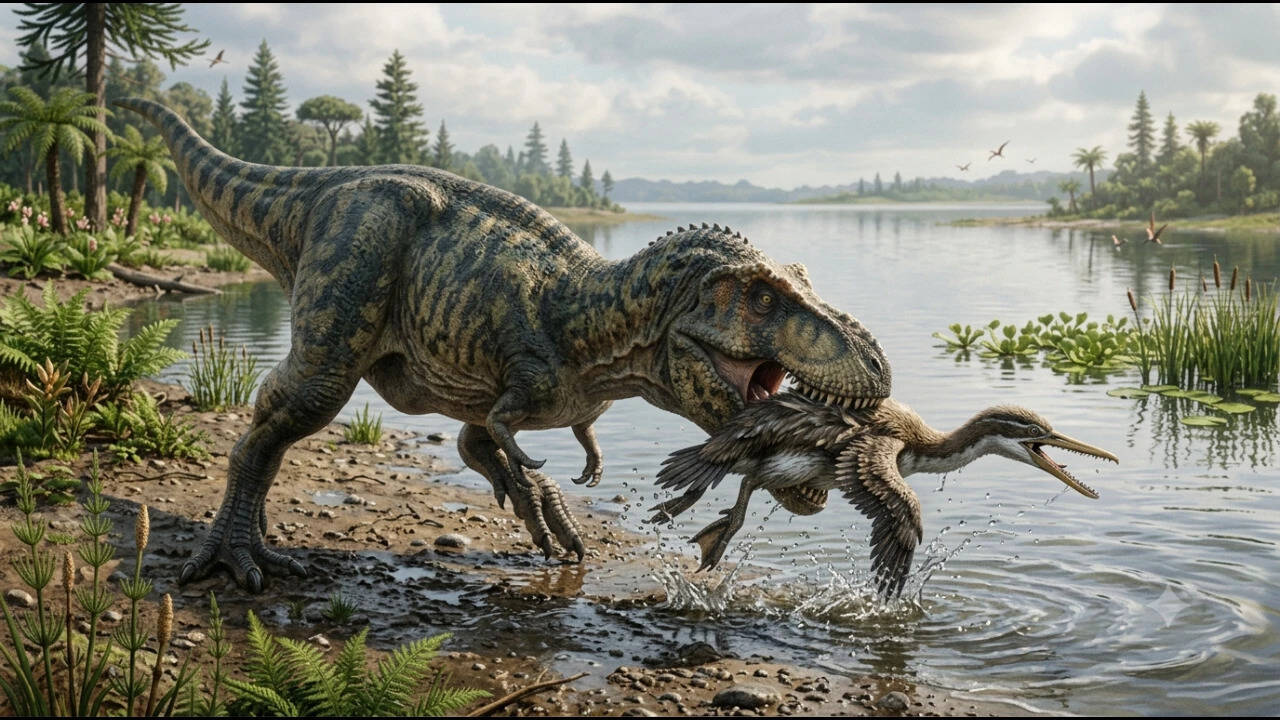
Inside, researchers found several feathers along with tiny fish scales and leg bones belonging to a hesperornithiform, an extinct group of aquatic birds. asserted
researchers → find → birds
The evidence suggests that a large dinosaur, potentially a T. rex or Nanotyrannus, had eaten the bird. uncertain
dinosaur → suggest → bird
The discovery offers an unusually intimate glimpse into an ancient food chain. asserted
discovery → offer → chain
Instead of reconstructing predator and prey relationships from separate fossils, scientists can see evidence of one animal's final meal preserved in a single specimen. asserted
scientists → reconstruct → specimen
The feather that survived David DeMar Jr., a researcher with the University of Washington's Burke Museum, discovered the unusual nodule while conducting fieldwork in northeastern Montana's Hell Creek Formation. asserted
Jr. → survive → Formation
Researchers later suspected that the rock might be a coprolite, but its real significance became clear only after it was examined using micro-CT scanning. uncertain
it → suspect → scanning
The technology allowed scientists to look inside the specimen without breaking it apart. asserted
scientists → allow → it
The scans revealed a remarkable collection of remains — including feathers, bones and scales preserved in three dimensions. asserted
scans → reveal → dimensions
For lead author Jingmai O'Connor of Chicago's Field Museum, the discovery could help answer one of paleontology's biggest questions: why did some birds survive the asteroid impact that wiped out nearly all other dinosaurs? uncertain
that → help → dinosaurs
Why did some birds survive? asserted
birds → survive → ?
When the asteroid struck Earth 66 million years ago, most dinosaur lineages disappeared. asserted
lineages → strike → Earth
Among the birds, only the group known as Neornithes survived, eventually giving rise to every bird alive today. asserted
group → know → bird
Scientists have proposed several explanations, including the possibility that aquatic habitats helped some birds withstand the environmental chaos that followed the impact. asserted
that → propose → impact
But the newly studied hesperornithiform complicates that theory. asserted
hesperornithiform → study → theory
These birds were also closely associated with water, yet they went extinct. asserted
they → associate → water
Instead, researchers believe their feathers may offer an important clue. uncertain
feathers → believe → clue
The fossil shows a mixture of relatively modern-looking, waterproof feathers and smaller, primitive body feathers. asserted
fossil → show → feathers
💬Give feedback
🕘History 🎫Support