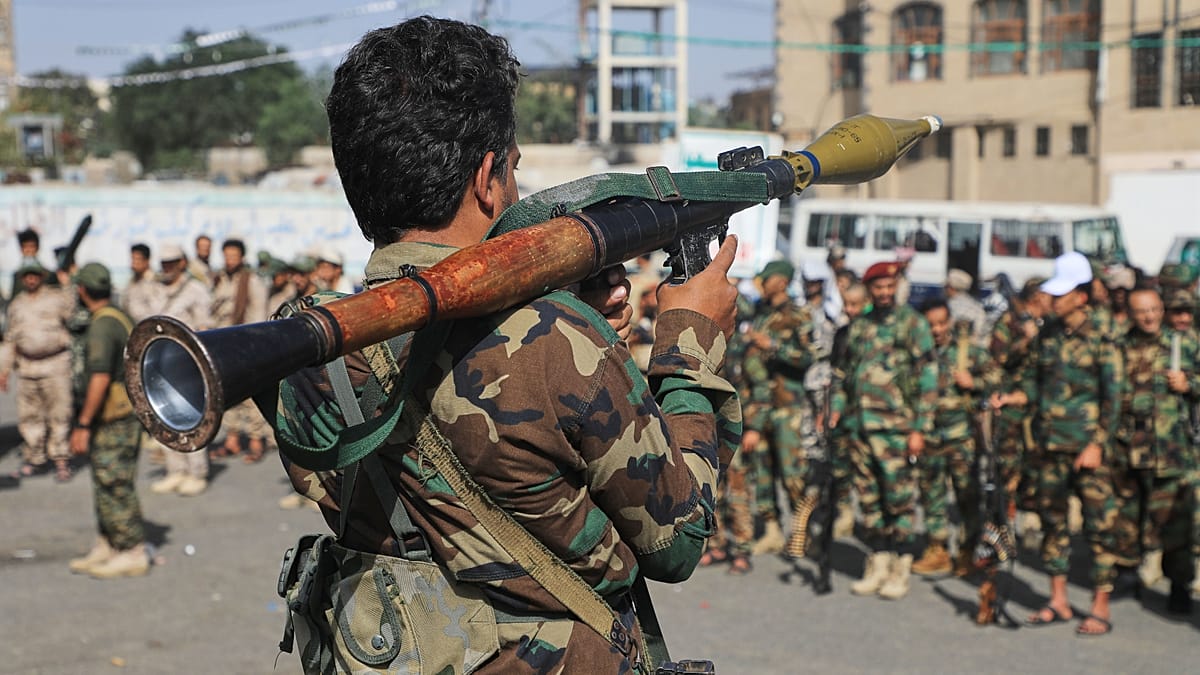
Photo via Al Jazeera

Inside the Houthis’ expanding war economy in Yemen

Read the original at Al Jazeera ↗
Cite

Mansour, M. (2026, September 14). Inside the Houthis’ expanding war economy in Yemen. Al Jazeera. https://www.aljazeera.com/economy/2026/9/14/inside-the-houthis-expanding-war-economy-in-yemen?traffic_source=rss

Dated when The Aporia collected the article, usually within hours of publication. Check the original for its exact date and byline.

Al Jazeera · collected 2026-09-14 · by Mohammad Mansour

Quick Summary

Yemen’s Houthi rebels have expanded their control along the Red Sea coast, raising questions about whether they can leverage new territories for financial gain. However, despite these territorial gains, economic benefits remain limited due to international sanctions that restrict the group's ability to operate commercially through formal channels. The Houthis already control significant parts of Yemen’s northwest and have established a parallel economy generating an estimated $2.5 billion annually through taxes, customs duties, and other levies. Additionally, they have revoked licenses of 4,225 commercial agencies to potentially replace them with businesses affiliated with the group.
Written by AI on 2026-09-15, from this article's own text only (the story summary below draws on all the coverage).

AI analysis

Story summary

The rapid advancement of Yemen’s Houthi rebels along the Red Sea coast has raised questions about whether these territorial gains could translate into additional revenue. The group already controls major ports like Hodeidah and now extends down to the Bab al-Mandab Strait, a strategically important waterway at the southern entrance to the Red Sea. Despite this expansion, international sanctions still severely limit the Houthis' ability to exploit these territories commercially through formal channels. Al Jazeera’s Yemeni affairs editor Ahmed al-Shalafi warns that control over coastal areas won’t be accepted without challenge and predicts there will either be confrontation or conflict to resolve the issue. This situation underscores the complex interplay between military gains, economic potential, and international pressure in Yemen's ongoing conflict.

Written for “Houthis War Economy Yemen” on 2026-10-30, grounded in this article and the 0 other(s) covering the same event.

Story

📰 Houthis War Economy Yemen
Politics · 1 article(s) covering the same event.

Compared with similar articles

This article reads unscored and hedges 8% of its claims. Each row says how that neighbour differs.
Al Jazeera
⚖️ Leans right Hedges 1 of 63 claims Outlet record 60/100
“Article A describes a specific series of Houthi missile and drone attacks on Saudi Arabian cities, while Article B discusses the Houthis' war economy in Yemen without mentioning any specific recent attack.”
Euronews
⚖️ Leans right Hedges 2 of 28 claims Outlet record 60/100
“Article A describes a specific capture of Mokha on September 10, while Article B discusses broader economic implications and territorial gains over time without focusing on one single incident.”
South China Morning Post
Hedges 0 of 7 claims Outlet record 64/100
“Article A reports on a specific seizure of Mocha port city, while Article B discusses broader economic implications and territorial gains over time.”
Euronews
⚖️ Leans right Hedges 8 of 41 claims Outlet record 60/100
“Article A reports on a specific incident where Houthi fighters seized Perim Island and took control of the Bab el-Mandeb strait, while Article B discusses broader questions about how the Houthis can profit from their territorial gains, referencing general advances but not focusing on the same specific event.”
South China Morning Post
⚖️ Leans left Hedges 1 of 5 claims Outlet record 64/100
“Article A reports on a specific incident where Houthis reach Perim Island, while Article B discusses broader economic impacts and territorial gains over a longer period without mentioning this particular island.”
NBC News
⚖️ Leans right Hedges 5 of 26 claims Outlet record 60/100
“Article A describes a specific military advance and capture of coastal areas on September 11, while Article B discusses broader economic implications of Houthi territorial gains over a longer period.”
CBC News
Hedges 4 of 35 claims Outlet record 60/100
“The articles discuss different aspects of the Houthis' activities and influence, with Article A focusing on their threat to control a key chokepoint affecting oil prices, while Article B examines their expanding war economy in Yemen.”
BBC News
Hedges 3 of 34 claims Outlet record 69/100
“While both articles discuss Houthi territorial gains in Yemen, Article A specifically covers a recent military advance and capture of coastal areas, while Article B focuses on the financial implications of already established control over certain regions.”
Al Jazeera
Hedges 2 of 17 claims Outlet record 60/100
“The articles discuss different aspects of the conflict in Yemen and do not describe the same specific incident.”
Al Jazeera
Hedges 5 of 89 claims Outlet record 60/100
“The articles discuss different aspects of the ongoing conflict in Yemen, with Article A focusing on recent fighting and air attacks near Mocha, while Article B discusses the Houthis' war economy and territorial gains over a longer timeframe.”
How this article was measured signals, leaning charts, publisher record, byline, topics and claims

Signals How these are calculated →

Claims extracted
48
sentences that state something as happening or true
Uncertain
8%
4 of 48 hedged ("reportedly", "may", "according to")
Leaning
withheld
no quote in the article backed the model's score
Publisher signals
60/100
Al Jazeera's corrections and hedging, across everything collected from it. Not a measure of accuracy.
Outlets on this story
1
Politics
Same framing elsewhere
1
articles that frame the event the way this one does
Analyzed 2026-09-15 · how these are computed

How this is being covered How these are calculated →

Article leaning vs. publisher reliability
Source leaning vs. consistency

Publisher

Al Jazeera · 4452 article(s) · 2 correction(s) detected
Running correction rate · 2 correction(s)

Who wrote this

Mohammad Mansour
7 article(s) here · 1 carrying a prediction
🔮 Lior’s ruling claims that Palestinian landowners who could not access their olives during the harvest season due to Israeli restrictions have been sufficiently compensated in the years they had access to the fruit.
🔮 “When I was in Iran, I would see advertisements on social media seeking analysts or people to work in security, sometimes offering high salaries and inviting interested applicants to visit a particular page.
🔮 Saudi-backed government forces claimed on Tuesday to have seized the strategic Mount Qarafan in southern Taiz’s al-Shamayatayn district.
🔮 Recommended Stories list of 4 items- list 1 of 4Israel arrests 100 Palestinians in a week as West Bank pogroms continue - list 2 of 4UK charities, protest groups: Israeli ban threat ‘will not intimidate us’ - list 3 of 4Israel rejects Trump’s 15-point plan for Gaza, stoking tensions with US - list 4 of 4Palestine weekly: Global outcry fails to break West Bank siege On Thursday, National Security Minister Itamar Ben-Gvir and others again stormed the Al-Aqsa Mosque compound for Yom Kippur.
🔮 The rapid advance by Yemen’s Houthis down the country’s Red Sea coast has raised questions over whether the group could turn its territorial gains into new sources of revenue, adding to an already extensive war economy.
2026-09-14 · assertive framing · Inside the Houthis’ expanding war economy in Yemen
🔮 The Defence Ministry indicated the police would establish a dedicated force to handle these civilian matters.
Also by Mohammad Mansour
Nothing else under this byline is closely related to this article, so these are simply their most recent.
All 7 articles by Mohammad Mansour →

Topics

3Syria Hodeidah Houthi Houthis Yemen

Subjects

Houthis NORP · 7× Houthi NORP · 4× Yemen GPE · 3× Al Jazeera ORG · 2× al-Saeedi PERSON · 2× 3Syria GPE · 1× Hodeidah GPE · 1× Iran GPE · 1× Marib GPE · 1× Taiz GPE · 1×

Narrative

The question now is whether control of the coastline, ports, and territory around the Bab al-Mandab Strait, at the southern entrance to the Red Sea, will substantially expand the group’s financial power – or primarily increase its military leverage. “[Houthi] control over the Mocha coast and Bab al-Mandab will not be met by a world standing idly by or paying royalties and levies to the Houthis; there will be a confrontation or conflict of some kind to settle this issue,” al-Shalafi said.
framing: assertive · carried by 1 article(s) · first seen 2026-09-15
🔮 The rapid advance by Yemen’s Houthis down the country’s Red Sea coast has raised questions over whether the group could turn its territorial gains into new sources of revenue, adding to an already extensive war economy.
2026-09-15 · Al Jazeera
Inside the Houthis’ expanding war economy in Yemen · assertive framing

Claims (48 extracted, 4 hedged)

The rapid advance by Yemen’s Houthis down the country’s Red Sea coast has raised questions over whether the group could turn its territorial gains into new sources of revenue, adding to an already extensive war economy. uncertain
group → raise → economy
But the Houthis already had control of large sections of the Red Sea coast, including the major port city of Hodeidah, and the financial benefits associated with that. asserted
Houthis → have → that
Their military gains over the past week do not necessarily change the restrictions they have to deal with as an internationally unrecognised governing authority. asserted
they → change → authority
Recommended Stories list of 3 items- list 1 of 3Syria fuel price hikes test public patience with economic recovery - list 2 of 3Why asserted
hikes → test → recovery
the Houthi advance towards Yemen’s Marib, Taiz matters - list 3 of 3Temporary Hormuz solution deferred as Iran-Arab summit falls through asserted
summit → defer → matters
Ahmed al-Shalafi, Al Jazeera’s Yemeni affairs editor, said that the advance has been a “geographical and military gain” but not an economic one, as it doesn’t remove the international sanctions that have been placed on it, which severely restrict their ability to commercially exploit the new territory under its control through formal international channels. asserted
which → say → channels
But the Houthis already enjoy significant financial benefits from their long-time control of northwestern Yemen, the most populous part of the country. asserted
Houthis → enjoy → country
Since the Houthis’ capture of the capital Sanaa in September 2014, the group has developed a centralised financial system to collect revenues through taxes, customs duties, zakat (religious alms), and other levies. asserted
group → develop → taxes
A July report by the Mokha Center for Strategic Studies described this as a “parallel economy”, estimating that the system generated direct and indirect financial resources and costs worth approximately $2.5bn annually. asserted
system → describe → resources
Of that total, the report estimated that around $800m came from taxes and customs, $600m from additional feeds and levies, and $300m from cash and in-kind contributions to the war effort. asserted
m → estimate → effort
It also counted about $100m linked to mobilisation events and another $700m in indirect costs borne by businesses through higher transport, service, and fee-related expenses. asserted
It → count → transport
The Houthi authorities have also revoked the licenses of 4,225 established commercial agencies – the legal local representatives for foreign companies – according to a July report by Sana’a Center for Strategic Studies, which said the move could pave the way for businesses affiliated with the group to take their place. uncertain
businesses → revoke → place
For their part, the Houthis defended the move, claiming that the agencies had not renewed their registrations for three years. asserted
agencies → defend → years
But Houssam al-Saeedi, an economic researcher and the head of the Economic Studies Program at the Yemen and Gulf Center for Studies, told Al Jazeera that he viewed the restructuring as deliberate. asserted
he → tell → restructuring
“It seizes companies belonging to existing merchants and manages them in favour of the [Houthis],” al-Saeedi noted. asserted
Saeedi → seize → Houthis
“What is happening is a network aimed primarily at bringing about a change or replacement of capital; so that even in the event of reaching a political settlement or a military victory, this group retains financial sources in the future. asserted
group → happen → future
The Houthis reject the characterisation of their economic policies as simply an effort to tighten control over the private sector, saying measures introduced in recent years are intended to encourage domestic production, investment and small businesses, and simplify commercial regulation. asserted
measures → reject → regulation
Reshaping the private sector Houthi commercial activity has increasingly shifted towards sectors that offer the greatest potential for revenue collection and control. asserted
that → reshape → collection
The Mokha Center data showed that 26 percent of the nearly 68,000 commercial records analysed by the study were in general trade and imports, followed by food commodities at 18 percent. asserted
percent → show → percent
“The Houthi group established a completely separate system, based on creating an internal economy parallel to the actual available economy first,” al-Saeedi explained to Al Jazeera. asserted
Saeedi → establish → Jazeera
He said the group uses state mechanisms to collect official taxes while simultaneously extracting non-state levies. asserted
group → say → levies
“There are various, long, and large collection operations under the name of ‘supporting the war effort’ and others, and these are not taken through government mechanisms.” asserted
these → be → mechanisms
Beyond revenues raised inside Yemen, the US government says illicit oil trading has become one of the Houthis’ most important sources of external financing. asserted
trading → raise → financing
The US Treasury Department alleged in January that the Houthis generate more than $2bn annually through illicit oil sales. asserted
Houthis → allege → sales
It said Iran sells and provides oil to the group, including free monthly shipments, using Iranian-owned or affiliated companies based in Dubai. asserted
Iran → say → Dubai
Al-Saeedi said that the group has long prioritised the energy sector. asserted
group → say → sector
“These companies work primarily as a front for money laundering for the group,” he stated, adding that smuggled oil could provide direct income through domestic sales and monopoly pricing. uncertain
oil → work → sales
Al-Saeedi said that the Houthis used a range of illicit channels to move weapons, oil, and money, including smuggling networks and financial laundering. asserted
Houthis → say → networks
Another source of Houthi financing, he said, came from Iranian oil sold to third parties, with the proceeds transferred to the group through complex financial networks, including cryptocurrency transactions and local exchange houses. asserted
proceeds → say → transactions
The networks operate under extensive international sanctions. asserted
networks → operate → sanctions
The US designates the Houthis as both a “Foreign Terrorist Organisation” and a “Specially Designated Global Terrorist” group. asserted
US → designate → Organisation
The United Nations Security Council separately lists the Houthis under its Yemen sanctions regime, subjecting the group to a targeted arms embargo. asserted
Council → list → embargo
“Cutting off external funding to the Houthis may lead to suffocating them, but they have other sources of income, of course,” al-Shalafi said. uncertain
Shalafi → cut → course
The Houthis have previously denied using Iranian fuel to finance their operations. asserted
Houthis → deny → operations
A domestic economic crisis The Houthis’ extensive revenue-raising network exists alongside a deepening economic and humanitarian crisis in the areas it controls and across Yemen more broadly. asserted
it → raise → Yemen
The UN estimated in March that 22.3 million people in Yemen require humanitarian assistance and protection. asserted
people → estimate → assistance
In Houthi-controlled areas the crisis is compounded by the fact that public sector employees have not received salary payments for years. asserted
employees → control → years
The economic misery has led to increasing public criticism of the Houthis in the areas under their control, despite the group’s intolerance for dissent. asserted
misery → lead → dissent
Al-Shalafi pointed out that the group’s regional actions are deeply tied to this domestic reality, seeking an escape from crises over unpaid salaries and high prices. asserted
actions → point → salaries
“They transformed these economic crises into a combat priority, turning them into war, confrontation, and mobilisation,” al-Shalafi said. asserted
Shalafi → transform → war
…and 8 more, not listed.

💬Give feedback
🕘History 🎫Support