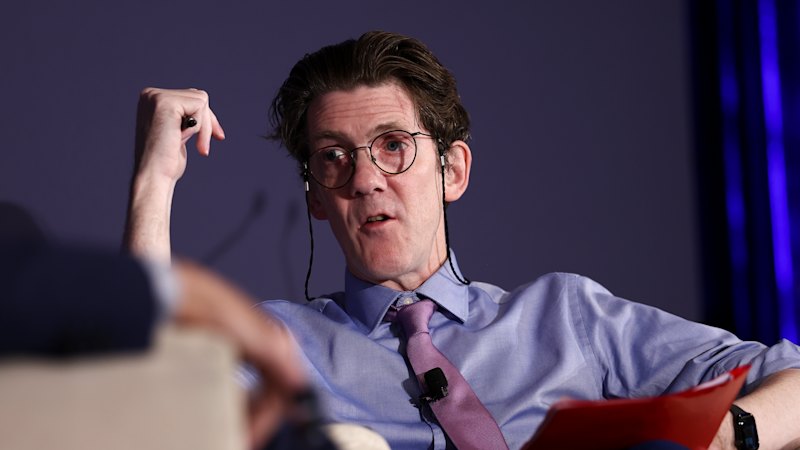
Photo via Evening Standard

Interest rate hike ‘firmly on table’ after inflation rises to 11-month high

Read the original at Evening Standard ↗
Cite

Wise, A. (2026, October 21). Interest rate hike ‘firmly on table’ after inflation rises to 11-month high. Evening Standard. https://www.standard.co.uk/business/business-news/inflation-office-for-national-statistics-john-healey-experts-b1301762.html

Dated from the outlet's own feed. Check the original for its byline.

Evening Standard · collected 2026-10-21 · by Anna Wise

Quick Summary

Inflation in the UK rose to 3.5% in September, up from 3.1% in August, marking an eleven-month high and surpassing economists' forecasts. This increase is largely attributed to a significant rise in motor fuel prices, which grew by 30% year-over-year. Economists predict that the Bank of England will likely raise interest rates next month to combat inflation and prevent further economic pressures such as higher wage demands. Martin Sartorius from the Confederation of British Industry (CBI) stated that an interest rate hike is "firmly on the table" for November, reflecting concerns about persistent high inflation influencing future pricing behaviors.
Written by AI on 2026-10-21, from this article's own text only (the story summary below draws on all the coverage).

AI analysis

Story summary

The UK inflation rate rose to 3.5% in September 2026, up from 3.1% in August, according to figures released by the Office for National Statistics (ONS). This marks the highest rate since October 2025 and exceeds economists' expectations of around 3.4%. The surge was primarily driven by higher fuel prices, with diesel surpassing £2 per litre for the first time ever at the start of September, according to RAC figures. Fuel inflation spiked to 26.5% year-over-year, reflecting ongoing conflicts in Iran and Ukraine that have disrupted global oil supplies. This increase is expected to put pressure on Chancellor John Healey ahead of his upcoming Budget statement next week.

Written for “UK Inflation Surges Due To Fuel Prices” on 2026-10-30, grounded in this article and the 5 other(s) covering the same event.

Story

📰 UK Inflation Surges Due To Fuel Prices
Economy/Business · 6 article(s) covering the same event. Compare every outlet's account →

Compared with similar articles

This article reads unscored and hedges 7% of its claims. Each row says how that neighbour differs.
New York Post
Hedges 5 of 23 claims Outlet record 66/100
“The articles describe different economic situations in distinct countries with varying inflation data and central bank policies.”
The Guardian
Hedges 2 of 17 claims Outlet record 66/100
“The articles discuss different central banks (RBA in Australia and Bank of England) and refer to distinct economic scenarios and inflation data.”
Daily Mail
Hedges 1 of 15 claims Outlet record 68/100
“The articles discuss different central banks (RBA in Australia vs. Bank of England) and refer to distinct economic contexts and inflation rates.”
The Sydney Morning Herald
Hedges 3 of 29 claims Outlet record 61/100
“The articles describe different central banks (Reserve Bank of Australia vs. Bank of England) considering interest rate hikes due to rising inflation, but do not clearly reference the exact same specific incident.”
BBC News
Hedges 1 of 4 claims Outlet record 69/100
“Both articles discuss an increase in UK inflation to 3.5%, but describe different aspects of the economic situation and potential responses, rather than a single identical incident.”
Evening Standard
Hedges 3 of 23 claims Outlet record 65/100
Evening Standard
Hedges 0 of 17 claims Outlet record 65/100
“The articles discuss related economic trends but describe different aspects: one focuses on factors that lifted inflation in September, while the other reports on the potential interest rate hike due to the rise in inflation.”
The Guardian
Hedges 6 of 28 claims Outlet record 66/100
“The articles discuss different aspects of interest rate predictions and inflation levels over time, not a single specific event.”
ABC News (AU)
Hedges 1 of 21 claims Outlet record 68/100
“The articles discuss similar themes but refer to different central banks (RBA vs. Bank of England) and inflation rates for separate countries.”
How this article was measured signals, leaning charts, publisher record, byline, topics and claims

Signals How these are calculated →

Claims extracted
27
sentences that state something as happening or true
Uncertain
7%
2 of 27 hedged ("reportedly", "may", "according to")
Leaning
not political
takes no side on a contested political question
Publisher signals
65/100
Evening Standard's corrections and hedging, across everything collected from it. Not a measure of accuracy.
Outlets on this story
6
Economy/Business
Same framing elsewhere
1
articles that frame the event the way this one does
Analyzed 2026-10-21 · how these are computed

How this is being covered How these are calculated →

Article leaning vs. publisher reliability
Source leaning vs. consistency

Publisher

Evening Standard · 7829 article(s) · 62 correction(s) detected
Running correction rate · 62 correction(s)

Who wrote this

Anna Wise
68 article(s) here · 1 carrying a prediction
🔮 Bank taxes are set to rise by less than some in the industry had feared, as the Chancellor said he was asking “a bit more” from banks to help fund support on energy bills.
🔮 But this was set against bigger AI spending ambitions, he said, adding: “The four biggest hyperscalers are projected to spend over five trillion US dollars (£3.76 trillion) on AI-related capital expenditure between 2025 and 2030.
🔮 The costs were partly offset by TSB’s contribution to profits of £96 million from May to September, while customer deposits and the mortgage loan book also increased following the acquisition. Santander said it was still integrating the smaller rival after nearly 1,000 of its staff moved over at the beginning of the month. But it is also expecting to find cost “synergies” worth around £400 million by the end of 2028 from the merger. UK chief executive Mahesh Aditya also said the bank was targeting further cost efficiency savings this year “driven by simplification and automation”. “We also continued to deliver against our wider strategic priorities to deepen customer relationships and enhance operational efficiency, while leveraging Banco Santander’s global technology platforms and AI capabilities to provide the support our customers need,” he said.
🔮 Claude chatbot maker Anthropic has kicked off plans to launch its shares on the US’s stock market, proclaiming artificial intelligence could help cure diseases such as cancer and grow economies around the world.
🔮 Banks set to report stronger profits as they face prospect of tax hike Banks are widely speculated to be a target with Mr Healey thought to be considering increasing the surcharge on profits from 3% to 8% – reversing a tax cut for the sector introduced by former Conservative chancellor Jeremy Hunt.
🔮 The closures were expected to help offset an expected increase in betting taxes of up to £135 million a year from 2027 due to changes affecting online gambling firms introduced by former chancellor Rachel Reeves.
🔮 “AI has an important role to play and may have a more important role to play in the future.
🔮 Inflation rising to the highest rate in almost a year makes it more likely that the Bank of England will hike interest rates next month, with living costs set to rise further this winter, economists think.
🔮 But he said the Government’s decision on Wednesday to begin drilling in the Jackdaw gas field in the North Sea was investment “in our clean energy future and supporting British workers”. “Maintaining our fiscal discipline and drive for growth in every postcode, while giving businesses and families some breathing space.” Experts said the latest figures could put more pressure on Mr Healey to unveil new cost-of-living support measures in his autumn Budget statement next week.
Also by Anna Wise
Nothing else under this byline is closely related to this article, so these are simply their most recent.
All 68 articles by Anna Wise →

Topics

CBI Iran ONS the Bank of England the Confederation of British Industry

Subjects

the Bank of England ORG · 3× Budget ORG · 2× Government ORG · 2× ONS ORG · 2× Bank ORG · 1× CBI ORG · 1× Iran GPE · 1× Martin Sartorius PERSON · 1× Sanjay Raja PERSON · 1× the Confederation of British Industry ORG · 1×

Narrative

“We’re a week away from the Budget, and I think if people look at what we did in the first week of the Government – £2 cap on bus fares, we cut VAT off electricity bills, we reduced business rates for pubs, clubs, and venues. “And I will look to do more, as I can, to give a bit of breathing space on the costs of living and the costs of business at the Budget.” Meanwhile, the September inflation rate is typically used to decide the level of increase for many benefits, such as universal credit, tax credits and disability benefits. This rate is also a key part of the pension triple lock, which is used to decide how much pensions will increase by in the following April.
framing: assertive · carried by 1 article(s) · first seen 2026-10-21
🔮 Inflation rising to the highest rate in almost a year makes it more likely that the Bank of England will hike interest rates next month, with living costs set to rise further this winter, economists think.
2026-10-21 · Evening Standard
Interest rate hike ‘firmly on table’ after inflation rises to 11-month high · assertive framing

Claims (27 extracted, 2 hedged)

Interest rate hike ‘firmly on table’ after inflation rises to 11-month high asserted
inflation → rise → high
Inflation rising to the highest rate in almost a year makes it more likely that the Bank of England will hike interest rates next month, with living costs set to rise further this winter, economists think. asserted
economists → rise → rates
The ONS said Consumer Prices Index (CPI) inflation was 3.5% in September, up from 3.1% in August. asserted
inflation → say → August
This was the highest rate in 11 months and above the level that economists had been forecasting for the month. asserted
economists → forecast → month
It means the price of goods and services across the economy are rising at a faster rate than they were before, and inflation is drifting further away from the Bank of England’s 2% target rate. asserted
inflation → mean → rate
Read More A major driving force of higher inflation last month was motor fuel prices, which rocketed by 30% in the year to September, the latest figures showed. asserted
figures → read → September
Petrol and diesel prices have been surging since the start of the US-Israeli war with Iran which has squeezed global oil and gas supplies and driven up wholesale prices. asserted
which → surge → prices
Living costs are expected to rise further in the months ahead as households face higher energy bills this winter. asserted
households → expect → bills
Many economists are therefore expecting the Bank of England to hike interest rates next month to keep a lid on inflation and stem the risk of so-called “second-round effects” emerging, meaning things such as higher wage demands. asserted
effects → expect → demands
Martin Sartorius, lead economist for the Confederation of British Industry (CBI), said September’s inflation rise means an interest rate hike was “firmly on the table” at the Bank’s next meeting in November. asserted
hike → say → November
He said the rate-setting committee will likely want to “guard against the risk of persistently higher headline inflation becoming embedded in future wage and price-setting behaviour”. asserted
committee → say → behaviour
Sanjay Raja, chief UK economist for Deutsche Bank, said further rises in energy prices were “inevitable” and that ongoing tensions in the Middle East were delaying the likelihood of inflation coming down. asserted
inflation → say → likelihood
He is expecting rates to rise in November and then again in the months ahead. asserted
rates → expect → months
Nevertheless, Danni Hewson, head of financial analysis for AJ Bell, pointed to a “silver lining for households” in that food prices were “relatively stable” last month. asserted
prices → point → households
Food and drink inflation remained the same, at 1.3% in the year to September, and prices fell by 0.2% between August and September. asserted
prices → remain → August
But the ONS pointed to some experts who say competition between supermarkets to attract shoppers and resist increasing prices is keeping a lid on inflation, but this could be harder to maintain in the future. uncertain
this → point → future
“The knowledge that funding our lives is only going to get harder in the coming months will impact consumer confidence,” Ms Hewson said. asserted
Hewson → fund → confidence
“If they can, people will look to pad out savings, but they’ll also postpone big ticket purchases and will be looking to the Government to step in when times get tough.” asserted
times → look → Government
He said: “People can see prices rising. asserted
prices → say → ?
They see it at the pumps. asserted
They → see → pumps
They see it in their bills. asserted
They → see → bills
“They see it with monthly mortgage costs, and they can see it’s driven by the conflict in the Middle East. asserted
it → see → East
“We’re a week away from the Budget, and I think if people look at what we did in the first week of the Government – £2 cap on bus fares, we cut VAT off electricity bills, we reduced business rates for pubs, clubs, and venues. “And I will look to do more, as I can, to give a bit of breathing space on the costs of living and the costs of business at the Budget.” Meanwhile, the September inflation rate is typically used to decide the level of increase for many benefits, such as universal credit, tax credits and disability benefits. This rate is also a key part of the pension triple lock, which is used to decide how much pensions will increase by in the following April. asserted
pensions → ’re → April
But the increase is based on either this inflation rate, average earnings growth between May and July, or 2.5%. uncertain
increase → base → May
State pensions are, therefore, widely expected to increase by 3.9% next year based on wage growth figures which is the highest of the three. asserted
which → expect → three
The data also showed that Consumer Prices Index including Housing (CPIH), the ONS’s preferred measure of inflation, rose to 3.6% in September from 3.3% last month. asserted
Index → show → %
Retail Prices Index (RPI) inflation rose to 3.9% from 3.4% in August. asserted
inflation → rise → August

💬Give feedback
🕘History 🎫Support