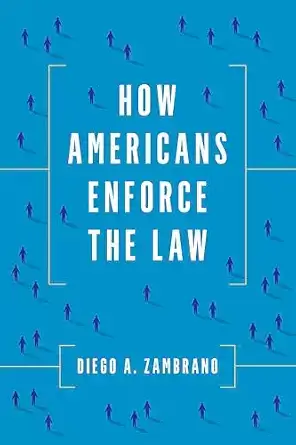
Photo via Reason

"The Three Words That Explain American Government: 'Right to Sue,'" by Stanford Law Prof. Diego Zambrano

Read the original at Reason ↗
Cite

Volokh, E. (2026, October 21). "The Three Words That Explain American Government: 'Right to Sue,'" by Stanford Law Prof. Diego Zambrano. Reason. https://reason.com/volokh/2026/10/21/the-three-words-that-explain-american-government-right-to-sue-by-stanford-law-prof-diego-zambrano/

Dated from the outlet's own feed. Check the original for its byline.

Reason · collected 2026-10-21 · by Eugene Volokh

Quick Summary

Stanford Law Professor Diego Zambrano argues in his book "How Americans Enforce the Law" that private citizens play a critical role in enforcing U.S. laws through rights to sue alongside government officials. This system, unique compared to other countries like France and Germany where enforcement relies mainly on bureaucrats, includes provisions called "private rights of action" allowing employees, consumers, and competitors to act as co-enforcers in areas such as environmental regulation and securities fraud.
Written by AI on 2026-10-21, from this article's own text only (the story summary below draws on all the coverage).

AI analysis

Story summary

Americans' ability to enforce laws through private lawsuits is highlighted by Stanford Law Professor Diego Zambrano in a Reason Magazine article published on October 21, 2026. Despite concerns over federal agencies like the EEOC and SEC reducing enforcement actions under current policies, Zambrano argues that individual citizens can sue to uphold legal standards. Examples include Maryland residents and a local country club suing to delay the Purple Line light-rail project due to environmental worries about a microscopic organism, while the Sierra Club filed a lawsuit against a Mojave solar energy project over its impact on a desert turtle species. This private enforcement mechanism means that even if federal agencies scale back their oversight, citizens can still ensure legal compliance through the judicial system.

Written for “Right To Sue Explained” on 2026-11-04, grounded in this article and the 0 other(s) covering the same event.

Story

📰 Right To Sue Explained
Politics · 1 article(s) covering the same event.

Compared with similar articles

Nothing to compare against. No article is close enough to this one for the pipeline to have linked or judged the pair.
How this article was measured signals, leaning charts, publisher record, byline, topics and claims

Signals How these are calculated →

Claims extracted
53
sentences that state something as happening or true
Uncertain
8%
4 of 53 hedged ("reportedly", "may", "according to")
Leaning
Leans right
of the writing, not the subject · beta estimate
Publisher signals
67/100
Reason's corrections and hedging, across everything collected from it. Not a measure of accuracy.
Outlets on this story
1
Politics
Same framing elsewhere
1
articles that frame the event the way this one does
Analyzed 2026-10-21 · how these are computed

How this is being covered How these are calculated →

Article leaning vs. publisher reliability
Source leaning vs. consistency

Publisher

Reason · 1127 article(s) · 4 correction(s) detected
Running correction rate · 4 correction(s)

Who wrote this

Eugene Volokh
192 article(s) here · 1 carrying a prediction
🔮 In May 2025, Harvard revoked Plaintiff's tenure and terminated her appointment with HBS.
🔮 The requirement would hold DSPs liable for their failure to adhere to state-set publication standards, not only "treat[ing] [them] as … publisher[s] or speaker[s]," but treating them as publishers subject to sweeping state controls.
🔮 From Sanchez v. Almond, decided Wednesday by Judge John McConnell (D.R.I.): Mr. Sanchez began working at the office of Rhode Island Governor Daniel J. McKee in May 2021 as a "constituent services" staffer.
🔮 Beauchamp believed that the post appeared to condone murder based on the victim's political viewpoints and statements and became concerned that this post and perception would reflect on GCAO in the public's eyes and thereby undermine the public's trust in GCAO's official duty to prosecute homicides without bias and without regard to a victim's views, statements, or affiliations.
2026-11-02 · assertive framing · Firing for "Rot in Hell Charlie Kirk" Post Upheld
🔮 After Judge Covington announced that she would be denying McClain's suppression motion, Outlaw stood up and said "the judge is a cocksucker" loud enough for Judge Covington to hear.
🔮 According to the Complaint, in August 2024, Plaintiffs and other District community members learned that then-member of the Board of School Directors of Souderton Area School District (the "Board") William Formica posted lewd comments on social media about Vice President Kamala Harris, disparaging teachers and non-English speakers, and deriding diversity programs.
🔮 Some excerpts from the long First Superseding Indictment in U.S. v. Hakim (E.D. Mich.), filed Oct. 21, alleging conspiracy to transmit threats in interstate commerce as well as, for two defendants, witness intimidation and destruction of property to prevent seizure (8 of the 12 defendants had originally been indicted in May); the targets included UM officials and businesses connected with them, as well as the Jewish Federation of Metropolitan Detroit:
🔮 Because "[t]he costs and efforts required to defend a lawsuit through [discovery] could chill free speech nearly as effectively as the absence of the actual malice standard altogether[,]" a public figure plaintiff must plausibly allege actual malice at the outset of the litigation.
🔮 The First Amendment forbids a State from using its investigative power that way, and I will not allow it while this case is pending.
🔮 The same logic could apply to nuns who had felt religious pressure to do the educational or nursing work that their order was known for, or to monks who had felt religious pressure to do agricultural work that supports the monastery.
2026-10-30 · assertive framing · Amicus Brief in OneTaste Criminal Prosecution
Also by Eugene Volokh
Open Thread
2026-11-03 · Reason
Nothing else under this byline is closely related to this article, so these are simply their most recent.
All 192 articles by Eugene Volokh →

Topics

American Americans France Stanford the United States

Subjects

Americans NORP · 4× France GPE · 4× American NORP · 3× the United States GPE · 3× CFPB ORG · 1× Diego Zambrano PERSON · 1× EEOC ORG · 1× SEC ORG · 1× Stanford ORG · 1× the Department of Justice's ORG · 1×

Narrative

Neighbors in a Maryland suburb—backed for years by a nearby country club—sued to delay the Purple Line light-rail project over concerns for a microscopic organism, while the Sierra Club sued to stop a major Mojave solar energy project over the potential impact to a desert turtle.
framing: assertive · carried by 1 article(s) · first seen 2026-10-21
🔮 Critics fear that the Department of Justice's antitrust division will overlook mergers when it is convenient for the administration.

Claims (53 extracted, 4 hedged)

I read and much enjoyed—and highly recommend—my Stanford colleague Diego Zambrano's book, How Americans Enforce the Law. asserted
Americans → read → Law
He was kind enough to write up for us this post that captures the core of his argument, and I'm delighted to pass it along (though I encourage people to read the whole book): asserted
I → write → book
The headlines are full of stories about a federal government retreating from enforcement. asserted
government → retreat → enforcement
Agencies are dropping investigations, abandoning regulations, shrinking staffs and changing enforcement priorities. asserted
Agencies → drop → priorities
The next week, the SEC and CFPB wind down investigations into securities fraud and wrongdoing affecting consumers. asserted
SEC → wind → consumers
Critics fear that the Department of Justice's antitrust division will overlook mergers when it is convenient for the administration. asserted
it → fear → administration
And the DOJ has abruptly reduced enforcement of the Foreign Corrupt Practices Act. asserted
DOJ → reduce → Act
Facing these changes, Americans might worry that a wide range of laws will go unenforced. uncertain
range → face → laws
But that concern misses something unique about the American system of government. asserted
concern → miss → government
We have never relied only on bureaucrats to enforce our laws. asserted
We → rely → laws
All the way back to the colonial period, American legislators have repeatedly done something unusual: they have given ordinary people the right to sue alongside government officials. asserted
they → do → officials
In almost every regulatory area that most Americans care about—be it regulation of wages and hours, environmental pollution, consumer protection, or securities fraud—statutes allow both government officials and private parties to file suit to enforce the law. asserted
officials → care → law
All of this happens through little-known provisions called "private rights of action," which is just a technical name for a right to sue. asserted
which → happen → right
Thousands of these provisions build a second enforcement system alongside the bureaucracy, turning employees, consumers, competitors and their lawyers into co-enforcers of public law. asserted
Thousands → build → law
In much of the rest of the world, whenever a government faces a regulatory problem, it typically empowers government officials and bureaucrats to police legal violations. asserted
it → face → violations
In France, Germany, Japan, and even the UK, legislators are far less likely to let anyone sue over, say, environmental pollution or employment discrimination. asserted
anyone → let → pollution
In 1989, the United States faced the Exxon Valdez oil spill off the pristine waters of Alaska. asserted
States → face → Alaska
Millions of gallons of oil laid waste to coasts, waters, and fisheries for hundreds of miles. asserted
Millions → lay → miles
What most Americans don't know is that a decade later, France also faced a catastrophic oil spill, caused by a ship called the Erika. asserted
France → know → ship
So how did governments react? asserted
governments → react → ?
In the United States, private plaintiffs sued Exxon directly under existing tort and maritime law, eventually winning substantial damages. asserted
plaintiffs → sue → damages
Congress, meanwhile, enacted a statute called the Oil Pollution Act with a new right-to-sue those responsible for oil spills. asserted
Congress → enact → spills
By contrast, in France, the oil spill led primarily to a major criminal prosecution and, eventually, to new national and European regulatory measures (including a new bureaucracy called the European Maritime Safety Agency). asserted
spill → lead → bureaucracy
When France finally adopted a right to sue in 2016, it paled in comparison to the American version. asserted
it → adopt → version
Part of the answer, as I argue in a new book, is that Americans have always done this. asserted
Americans → argue → this
Back in the colonial period, state legislatures adopted what they called "penal statutes," that empowered any person to enforce regulatory statutes and collect a bounty. asserted
that → adopt → bounty
So when Massachusetts wanted to regulate the storage of gunpowder, it allowed private informers to sue neighbors who stored it improperly. asserted
who → want → it
And this model applied across many areas of colonial life: alcohol consumption, trade, taxation, public morals, church attendance, and more. asserted
model → apply → life
The Founders used the same tool across the board: Thomas Jefferson and James Madison co-wrote Virginia statutes full of penal statutes, and John Adams handled these suits routinely as a colonial lawyer. asserted
Adams → use → lawyer
The key feature of this system is that even though private parties file suit for their own aims—the employee wants their full wages paid or the consumer wants a refund for a shoddy product—they inevitably enforce the law. asserted
they → file → law
And those lawsuits benefit everyone else because employers and manufacturers may change their behavior with respect to other employees and consumers. uncertain
employers → benefit → employees
In that sense, every single plaintiff is a little bureaucrat or, as some courts call them, a "private attorney general." asserted
courts → call → them
This system has the added benefit of reducing political disruptions in enforcement. asserted
system → have → enforcement
Even though any single administration can change the enforcement priorities of the EEOC, SEC, CFPB, or Department of Justice, the president cannot control thousands of lawyers and their clients. asserted
president → change → lawyers
Private enforcement, then, makes enforcement less dependent on what the bureaucracy and president want. asserted
bureaucracy → make → what
So you might think that when the bureaucracy won't pursue wrongdoing, the obvious solution should always be new rights to sue. uncertain
solution → think → wrongdoing
Indeed, many news stories decrying a lack of government enforcement immediately call for more private lawsuits. asserted
stories → decry → lawsuits
Private enforcement is not tailor-made for every regulatory area. asserted
enforcement → make → area
It makes the most sense to empower private parties when the bureaucracy is truly faulty, under-resourced, politically vulnerable, or likely to be captured by regulated entities. asserted
bureaucracy → make → entities
When this isn't the case, private enforcement can cause more problems than it solves. asserted
it → cause → problems
…and 13 more, not listed.

💬Give feedback · no sign-in needed

No sign-in needed for now. Your note is sent without a name, so it cannot be answered.

🕘History 🎫Support