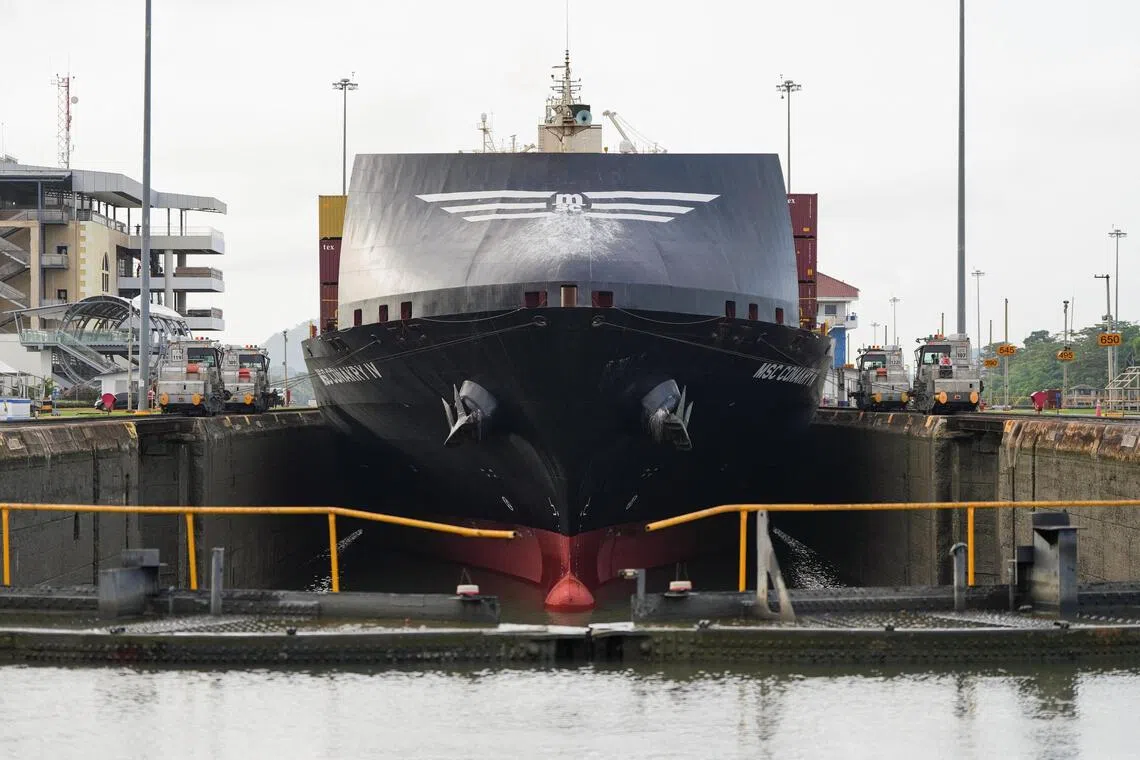
Photo via The Guardian

Panama canal traffic to be cut again as drought from El Niño worsens

Read the original at The Guardian ↗
Cite

France-Presse, M. S. w. A. (2026, September 15). Panama canal traffic to be cut again as drought from El Niño worsens. The Guardian. https://www.theguardian.com/world/2026/sep/15/panama-canal-traffic-cut-trade-drought-el-nino

Dated when The Aporia collected the article, usually within hours of publication. Check the original for its exact date and byline.

The Guardian · collected 2026-09-15 · by Mark Saunokonoko with Agence France-Presse

Quick Summary

The Panama Canal plans to further reduce maritime traffic due to drought exacerbated by El Niño, cutting daily transits from an average of 36 in August to 29.5 starting October, marking a 18% decrease. The canal, which handles about 40% of US container traffic and 5% of global maritime trade, faces significant congestion; vessels are waiting up to ten days for transit slots, with some companies paying around $4 million to bypass the queue through daily auctions. This reduction in capacity is expected to escalate as El Niño continues to intensify later this year, potentially leading to more severe shipping disruptions and increased costs for maritime businesses relying on the canal's services.
Written by AI on 2026-09-15, from this article's own text only (the story summary below draws on all the coverage).

AI analysis

Story summary

Panama's canal plans to further reduce maritime traffic from 32 vessels per day in September to an average of 29.5 daily transits starting October, due to worsening drought caused by the El Niño climate phenomenon. The canal handles about 5% of global maritime trade and around 40% of US container traffic, making it a crucial shipping route that typically reduces costs and transit times for companies trading between China, Asia, and the US. In September, officials had already cut daily transits from 36 to 32, and now the reduction will be 18% lower than August's figure of 36 vessels per day. The drought has led to longer waiting times; in August, some ships waited up to 10 days for passage, with one reportedly paying about $4 million (£3 million) to jump the queue. Panama declared a nationwide emergency over El Niño, which is affecting worldwide weather patterns and causing severe droughts in Central America, posing significant challenges to the canal's operations.

Written for “Panama Canal Drought Restrictions” on 2026-11-03, grounded in this article and the 1 other(s) covering the same event.

Story

📰 Panama Canal Drought Restrictions
World · 2 article(s) covering the same event. See how they differ ↓

Compared with similar articles

This article reads unscored and hedges 22% of its claims. Each row says how that neighbour differs.
The Straits Times
⚖️ Centre Hedges 1 of 10 claims Outlet record 66/100
How this article was measured signals, leaning charts, publisher record, byline, topics and claims

Signals How these are calculated →

Claims extracted
18
sentences that state something as happening or true
Uncertain
22%
4 of 18 hedged ("reportedly", "may", "according to")
Leaning
not political
takes no side on a contested political question
Publisher signals
66/100
The Guardian's corrections and hedging, across everything collected from it. Not a measure of accuracy.
Outlets on this story
2
World
Same framing elsewhere
1
articles that frame the event the way this one does
Analyzed 2026-09-15 · how these are computed

How this is being covered How these are calculated →

Article leaning vs. publisher reliability
Source leaning vs. consistency

Publisher

The Guardian · 2862 article(s) · 6 correction(s) detected
Running correction rate · 6 correction(s)

Who wrote this

Mark Saunokonoko with Agence France-Presse
1 article(s) here · 1 carrying a prediction
🔮 From October, an average of 29.5 vessels will be allowed to transit daily – down 18% from 36 in August, according to a draft plan submitted to Panama’s parliament.
The only article under this byline in the corpus.

Topics

China El Niño Iran Israel Panama

Subjects

Panama GPE · 2× African NORP · 1× Agence France-Presse ORG · 1× China GPE · 1× European Copernicus ORG · 1× Indonesia GPE · 1× Iran GPE · 1× Israel GPE · 1× Sudan GPE · 1× the Panama Canal Authority ORG · 1×

Narrative

The canal handles 5% of global maritime trade and about 40% of US container traffic; it is favoured by shippers because it usually reduces cost and transit times, especially for companies trading between China, Asia and the US.
framing: mixed · carried by 1 article(s) · first seen 2026-09-15
🔮 From October, an average of 29.5 vessels will be allowed to transit daily – down 18% from 36 in August, according to a draft plan submitted to Panama’s parliament.
2026-09-15 · The Guardian
Panama canal traffic to be cut again as drought from El Niño worsens · mixed framing

Claims (18 extracted, 4 hedged)

The Panama canal plans to again cut maritime traffic due to worsening drought caused by the El Niño climate phenomenon, further choking up one of the world’s most important shipping lanes. asserted
canal → plan → lanes
The canal handles 5% of global maritime trade and about 40% of US container traffic; it is favoured by shippers because it usually reduces cost and transit times, especially for companies trading between China, Asia and the US. asserted
it → handle → China
From October, an average of 29.5 vessels will be allowed to transit daily – down 18% from 36 in August, according to a draft plan submitted to Panama’s parliament. uncertain
average → allow → parliament
In September, officials cut daily transits from 36 to 32 because of the drought. asserted
officials → cut → drought
The US and Israel’s war on Iran, and its disruption to the strait of Hormuz, has complicated logistics and added costs for shipping companies using the canal. asserted
war → complicate → canal
In August, with vessels waiting 10 days to enter the canal – the longest since May – a container ship reportedly paid about $4m (£3m) to jump the queue. uncertain
ship → wait → queue
Maritime companies usually pay a flat fee to reserve a slot to transit the canal, but a daily auction allows shipowners to place bids to skip the queue. asserted
shipowners → pay → queue
Bid prices generally rise during high demand. asserted
prices → rise → demand
Shipping restrictions on the canal could yet worsen, with El Niño expected to peak later this year. uncertain
Niño → worsen → canal
The natural weather pattern that brings worldwide changes in winds, air pressure and rainfall patterns is forecast to be the strongest in four decades. asserted
that → bring → decades
The 82km-long canal, connecting the Caribbean Sea to the Pacific Ocean, relies on fresh water from rivers pouring into Lake Gatun to operate its system of locks. asserted
canal → connect → locks
In September, officials said the watershed had received lower than forecast rainfall. asserted
watershed → say → rainfall
The canal’s locks act like elevators, each filling with water to lift ships 26 metres (85 feet) from sea level to Lake Gatun and then back down to sea level on the other side. asserted
each → act → side
If lake levels are no longer safe for the largest ships to pass, the Panama Canal Authority imposes restrictions for safety and to preserve water. asserted
Authority → pass → water
In 2023 the water level in the lakes feeding the canal was so low authorities cut daily transits from 38 to 22. asserted
authorities → feed → 22
Those restrictions led to a bottleneck of ships and sent companies scrambling to find alternative routes. El Niño has severely affected Central America and northern parts of South America, where nine countries have experienced their hottest June-August period on record this year. Fifty-two countries across all continents broke their seasonal temperature records for that period, according to an Agence France-Presse analysis of meteorological data from the European Copernicus programme. The extreme heat has taken many forms, from unprecedented heatwaves in Europe to devastating drought in Sudan and toxic smoke in Indonesia. uncertain
heat → lead → Indonesia
More than a third of people experiencing the hottest northern summer months on record were in Africa, particularly in the Sahel and areas south of it. asserted
third → experience → it
Eighteen African countries broke their seasonal records for the June-August period, from Mauritania and Sierra Leone in the west to Eritrea and Ethiopia in the east. asserted
countries → break → east

💬Give feedback
🕘History 🎫Support