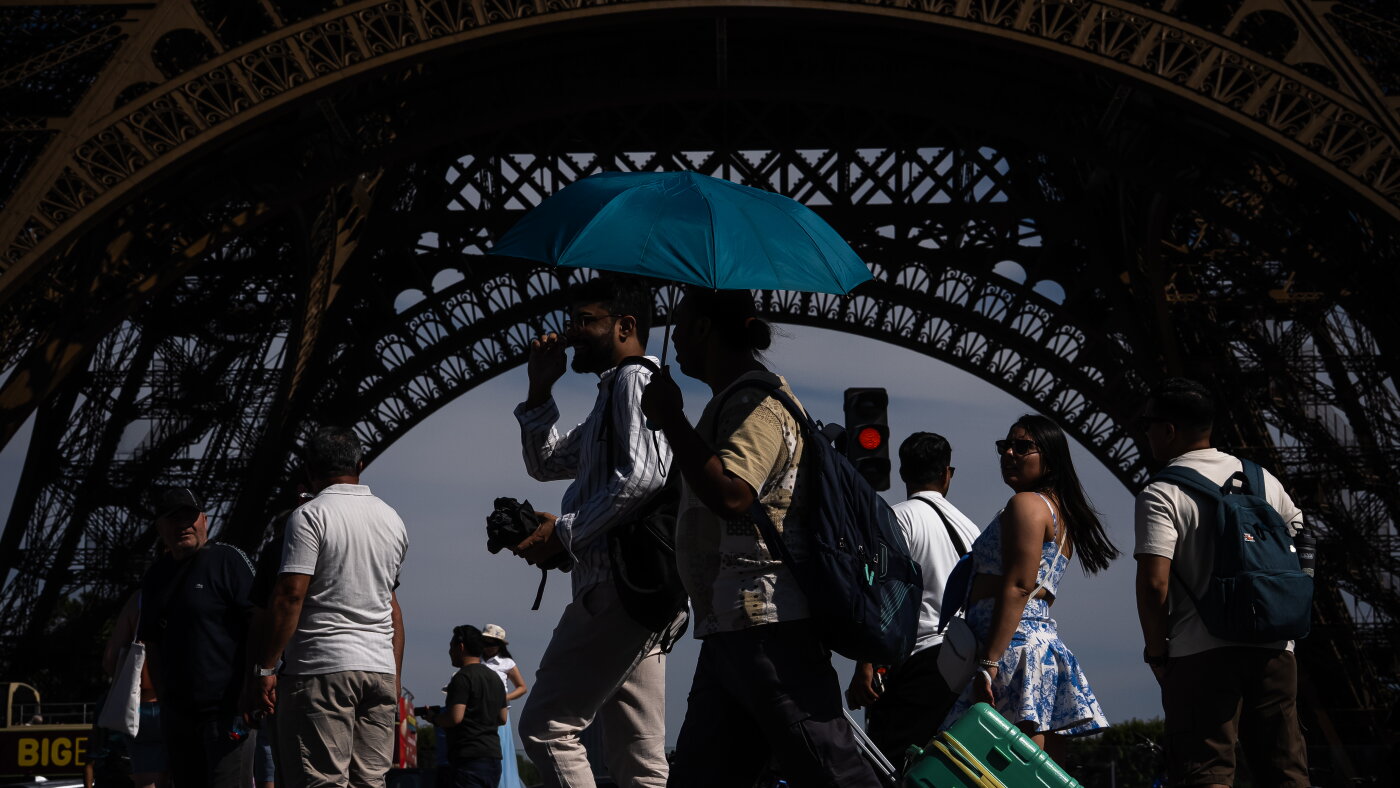
Photo via The Straits Times

Summer heat’s toll on Europe: 50,000 deaths and a $24.3b GDP hit

Read the original at The Straits Times ↗
Cite

The Straits Times. (2026, October 23). Summer heat’s toll on Europe: 50,000 deaths and a $24.3b GDP hit. The Straits Times. https://www.straitstimes.com/world/europe/summer-heats-toll-on-europe-50000-deaths-and-a-24-3b-gdp-hit

Dated from the outlet's own feed. Check the original for its byline.

The Straits Times · collected 2026-10-23 · by The Straits Times

Quick Summary

Extreme heat during Europe's summer caused an estimated 50,000 deaths and a €17 billion (S$24.36 billion) reduction in EU GDP between April and September, according to two recent studies. Scientists at Imperial College London attribute almost two-thirds of these deaths to climate change-induced temperatures, marking the highest mortality rate on record compared to previous years. The economic impact was nearly three times higher than the average loss over the past decade, affecting vital infrastructure across Europe with increased wildfire activity and overheating in critical facilities.
Written by AI on 2026-10-23, from this article's own text only (the story summary below draws on all the coverage).
See how they differ ↓

AI analysis

Story summary

Summer 2026 was Europe's deadliest on record, with over 50,000 people dying in urban areas across 30 countries due to extreme heatwaves. Researchers from Imperial College London and the London School of Hygiene & Tropical Medicine estimate that climate change contributed to about two-thirds of these deaths. Southern and western Europe experienced the highest death rates, while cooler regions like the UK also saw 4,500 fatalities. The study covered 854 cities, representing approximately 40% of Europe's population, indicating the overall toll could be even higher. Additionally, the economic impact was severe, with a €17 billion ($24.3b) reduction in European Union GDP from April through September, marking a significant hit compared to previous years.

Written for “Summer Heat Deaths In Europe” on 2026-11-21, grounded in this article and the 3 other(s) covering the same event.

How they differ

4 outlets covered “Summer Heat Deaths In Europe”.

What each outlet says

One AI summary per outlet of its latest article on this story, written from that article alone and checked against it. Open the article for the outlet's own words.

The Straits TimesThis outlet23 Oct

Extreme heat during Europe's summer caused an estimated 50,000 deaths and a €17 billion (S$24.36 billion) reduction in EU GDP between April and September, according to two recent studies. Scientists at Imperial College London attribute almost two-thirds of these deaths to climate change-induced temperatures, marking the highest mortality rate on record compared to previous years. The economic impact was nearly three…

Summer heat’s toll on Europe: 50,000 deaths and a $24.3b GDP hit (this article)
Daily Mail23 Oct

Summer 2026 in Europe saw over 50,000 urban residents die due to extreme heatwaves across 30 countries, according to a study by Imperial College London. Scientists predict that climate change was responsible for about two-thirds of these deaths, with southern and western Europe experiencing the highest death rates. The summer of 2026 surpassed previous record years in terms of heat-related mortality, particularly…

Summer 2026 was Europe's deadliest on record: Over 50,000 people died in urban areas - with climate change responsible for two thirds of deaths, study estimates →
The Guardian23 Oct

Scientists report that heat killed an estimated 50,000 people in European cities this summer, marking a record high. Using data from 854 cities, researchers attribute two-thirds of these deaths to climate change caused by human activity. Countries with the highest absolute death tolls include Italy, France, Spain, Germany, and the UK, while Malta, Italy, and Hungary saw the highest rates per capita. The study…

Heat killed ‘staggering’ 50,000 people in Europe’s cities this summer, scientists warn →
NPR23 Oct

Blistering record heat in Europe this summer contributed to over 50,000 deaths, with climate change caused by human activities blamed for nearly two-thirds of those fatalities, according to a study published in Nature Health. Researchers from Imperial College London found that 32,619 deaths were directly linked to the additional warmth brought about by burning fossil fuels, marking a significant increase from…

Europe's heat claims 50,000 lives. Climate change blamed for two-thirds of deaths →

Where they agree and split

Framing

How the first headlines put it

A claim to check1
Stated as fact3
The headlines (4)

Europe's heat claims 50,000 lives. Climate change blamed for two-thirds of deaths NPR · a claim to check

Summer heat’s toll on Europe: 50,000 deaths and a $24.3b GDP hit The Straits Times · stated as fact

Summer 2026 was Europe's deadliest on record: Over 50,000 people died in urban areas - with climate change responsible for two thirds of deaths, study estimates Daily Mail · stated as fact

Heat killed ‘staggering’ 50,000 people in Europe’s cities this summer, scientists warn The Guardian · stated as fact

The full story: what happened, how it changed, and all 4 articles →

Compared with similar articles

This article reads leans strongly left and hedges 15% of its claims. Each row says how that neighbour differs.
NPR
Leans strongly left Hedges 6 of 37 claims Outlet record 60/100
The Guardian
Leans strongly left Hedges 4 of 30 claims Outlet record 64/100

Story

Summer Heat Deaths In Europe
Health · 4 article(s) covering the same event. Compare every outlet's account →
How this article was measured signals, leaning charts, publisher record, byline, topics and claims

Signals How these are calculated →

Claims extracted
27
sentences that state something as happening or true
Uncertain
15%
4 of 27 hedged ("reportedly", "may", "according to")
Leaning
Leans strongly left
of the writing, not the subject · beta estimate
Publisher signals
64/100
The Straits Times's corrections and hedging, across everything collected from it. Not a measure of accuracy.
Outlets on this story
4
Health
Same framing elsewhere
1
articles that frame the event the way this one does
Analyzed 2026-10-23 · how these are computed

How this is being covered How these are calculated →

Article leaning vs. publisher reliability
Source leaning vs. consistency

Publisher

The Straits Times · 5634 article(s) · 7 correction(s) detected
Running correction rate · 7 correction(s)

Who wrote this

The Straits Times
3888 article(s) here · 1 carrying a prediction
He told groups of subordinates that they had become so rich that he couldn’t motivate them simply with money, according to three people who spoke on the condition of anonymity to discuss confidential conversations.
The closed freeway lanes recall stems from unusual circumstances where a Waymo vehicle may enter and continue driving in a closed freeway lane, the company said, adding it is still working on the recall remedy.
Araqchi says Iran wants diplomacy to end war; Trump says terms unacceptable Nov 20 - Iran's Foreign Minister Abbas Araqchi said Tehran still hoped diplomacy could end its war with the United States, while US President Donald Trump said Iran wanted a deal but one that was not acceptable to him.
While You Were Sleeping: 5 stories you might have missed, Nov 21, 2026 Trump, Xi agree military AI decisions should involve humans US President Donald Trump and Chinese President Xi Jinping agreed humans should always be involved in military decisions that use artificial intelligence technologies, even as the two countries compete for AI supremacy, Treasury Secretary Scott Bessent said on Nov 20.
US Vice President Vance declines to say he would have ordered Iran strikes WASHINGTON, Nov 20 - US Vice President JD Vance on Friday declined to say whether he would have authorized strikes on Iran to prevent the country from developing a nuclear weapon, sidestepping President Donald Trump's calls for him to say the attacks were necessary and that he would carry them out again.
Some would blame Ottawa for the trade conflict while others pointed the finger at Washington.
Whoever wins will have to tackle multiple crises, including several wars, cutbacks in US contributions to the UN, and the 193-member body's declining political relevance as Washington has pulled out of dozens of its agencies.
I don’t think any human was about to find this,” Conrey said, adding that he believed “there will be simpler ways to do it.” The Riemann Hypothesis is one of seven Millennium Prize Problems selected by the Clay Mathematics Institute in 2000, which offers US$1 million (S$1.28 million) for a solution to each. Under the institute’s rules, a solution must be published in a peer-reviewed journal and withstand two years of scrutiny.
If the hearing proceeds as planned, it would mark Huang's first public testimony since stepping down as Nvidia's chief executive on November 12.
Denmark’s foreign minister on Nov 20 said Moscow’s defence attache in Copenhagen would be expelled after Russia was suspected of being behind an attempted assassination of a Ukrainian rapper.
Also by The Straits Times
Nothing else under this byline is closely related to this article, so these are simply their most recent.
All 3888 articles by The Straits Times →

Topics

Bloomberg Economics European Union Imperial Imperial College London Nature Health

Subjects

Imperial ORG · 3× Bloomberg Economics ORG · 2× Clair Barnes PERSON · 1× European NORP · 1× European Union ORG · 1× French NORP · 1× Germany GPE · 1× Imperial College London ORG · 1× Nature Health ORG · 1× Ulrich Eberle PERSON · 1×

Narrative

The study by Imperial and the London School of Hygiene & Tropical Medicine covered 854 cities in 30 countries across the EU, Britain, Switzerland and Norway, accounting for about 40% of the countries’ total population. The number of heat-related deaths linked to climate change has risen over time, the study found, as fossil fuel emissions have pushed temperatures higher.
framing: assertive · carried by 1 article(s) · first seen 2026-10-23
The estimated mortality toll comes from a study released on Oct 23, led by scientists at Imperial College London, which determined that almost two-thirds of the deaths linked to high summer temperatures would not have happened without climate change.
2026-10-23 · The Straits Times
Summer heat’s toll on Europe: 50,000 deaths and a $24.3b GDP hit · assertive framing

Claims (27 extracted, 4 hedged)

Europe’s summer of extreme heat caused an estimated 50,000 deaths in cities across the region – the highest number on record – and wiped roughly 0.17% from European Union GDP from April through September, or close to €17 billion (S$24.36 billion). asserted
summer → cause → September
Those findings, from two separate studies, reveal the extent of Europe’s vulnerability to rising temperatures in what is likely to be one of the hottest years in modern history. asserted
what → reveal → history
The estimated mortality toll comes from a study released on Oct 23, led by scientists at Imperial College London, which determined that almost two-thirds of the deaths linked to high summer temperatures would not have happened without climate change. asserted
thirds → come → change
A recent study from Bloomberg Economics, meanwhile, measured the hit to Europe’s GDP at two-and-a-half times the average loss for the period over the previous decade. asserted
study → measure → decade
The overall mortality level, triggered by a series of record-breaking heatwaves, was far higher than those in the next most deadly years. asserted
level → trigger → years
The figure compares to about 29,000 heat-related deaths in cities in 2022 and about 28,000 in 2003, according to the research, which is due to be published in Nature Health next week. uncertain
which → compare → Health
“We had these repeated heat events that – even without the extra heat from anthropogenic warming – would’ve been dangerous, but with that extra boost from anthropogenic warming became really, really dangerous,” said Clair Barnes, extreme weather and climate change researcher at Imperial and the study’s lead author, in an interview. asserted
Barnes → have → interview
European countries experienced extreme temperatures throughout the summer. asserted
countries → experience → summer
Heatwaves began in May and continued into September, with temperature records broken by significant margins in many countries. uncertain
records → begin → countries
Across the continent, vital infrastructure suffered. asserted
infrastructure → suffer → continent
Wildfires destroyed homes, hospitals overheated, transport broke down and cooling systems in fridges and air conditioners failed. asserted
systems → destroy → fridges
French GDP was 0.2 percentage points smaller in the second quarter due to extreme heat, according to Ulrich Eberle, author of the Bloomberg Economics report. uncertain
GDP → accord → report
Germany’s economy was 0.1% smaller over the same period, while Spain saw a 0.05% heat-related GDP dent. asserted
Spain → see → dent
The study by Imperial and the London School of Hygiene & Tropical Medicine covered 854 cities in 30 countries across the EU, Britain, Switzerland and Norway, accounting for about 40% of the countries’ total population. The number of heat-related deaths linked to climate change has risen over time, the study found, as fossil fuel emissions have pushed temperatures higher. asserted
emissions → cover → temperatures
Climate change accounted for nearly two-thirds of this summer’s excess mortality toll, up from about 40% in 2003. asserted
change → account → 2003
Calculating heat deaths is challenging because people rarely die directly from heat exposure. asserted
people → calculate → exposure
Instead, high temperatures typically put extra stress on the body and exacerbate existing conditions, especially those affecting the heart or respiratory systems. asserted
temperatures → put → heart
Measuring a person’s core temperature accurately can also be difficult outside of hospital settings. asserted
Measuring → measure → settings
If someone has died alone at home, it is not always clear how or if heat played a role. asserted
heat → die → role
As a result, heat-related deaths are not always recorded as such. asserted
deaths → relate → result
“We often see elderly patients become confused or have strokes or have cardiac-type events where heat may have made a significant contributing factor to the death,” said Andrew Hartle, an intensive-care consultant at Imperial College Healthcare NHS Trust, in a press briefing on Oct 21. uncertain
Hartle → see → Oct
“A post-mortem won’t tell you whether somebody was hot or not.” asserted
somebody → tell → you
The Imperial study combines temperature records with previous findings that calculate the impact of heat levels on mortality, to estimate a death toll linked to the heat. asserted
that → combine → heat
This method has previously been consistent with official statistics, many of which have not yet been released by government health authorities for the full 2026 summer season, the authors said. asserted
authors → release → season
“Clearly we need to support those most at risk, including the elderly, the unwell and those from poorer backgrounds, and to act to prevent the collapse of infrastructure that keeps vulnerable people safe in the heat,” said Toby Perkins, chair of Britain’s Environmental Audit Committee. asserted
Perkins → need → Committee
The year 2027 is expected to be even hotter than 2026. asserted
year → expect → 2026
Global warming is now virtually guaranteed to exceed 1.5 deg C versus pre-industrial levels and the world must now focus on minimising its overshoot, the United Nations said on Oct 21. asserted
Nations → guarantee → Oct
Give feedback · no sign-in needed

No sign-in needed for now. Your note is sent without a name, so it cannot be answered.

History Support