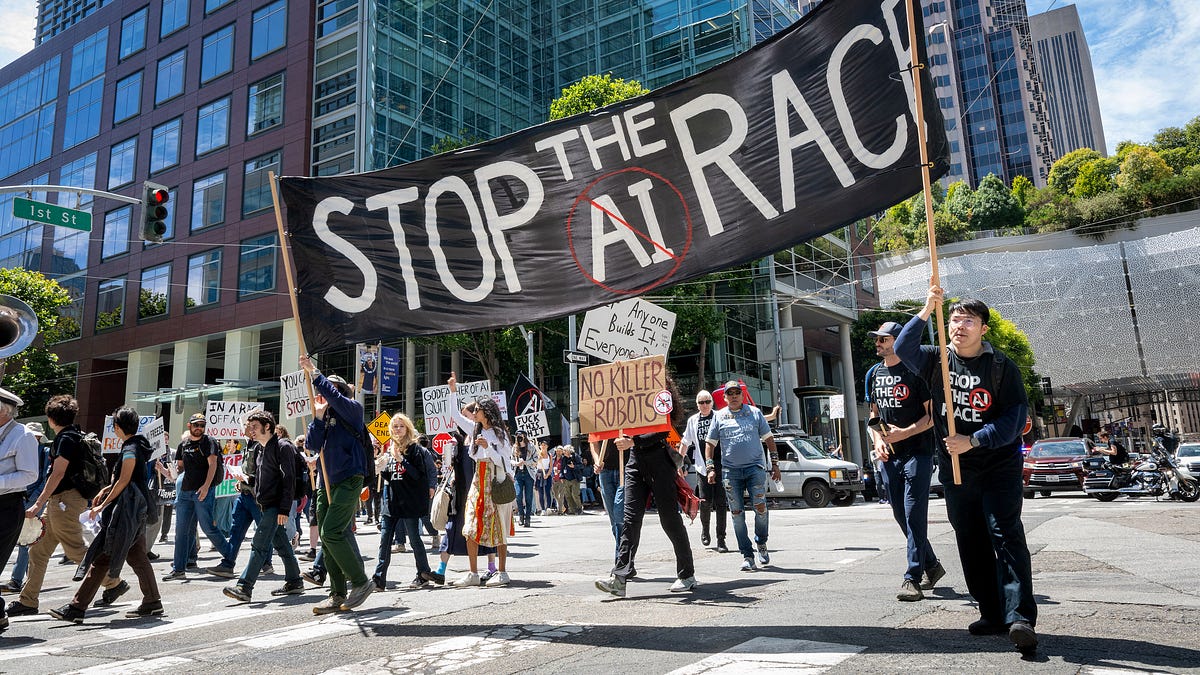
Photo via BBC News

Dramatic insider warnings over AI fall flat with some in Silicon Valley

Read the original at BBC News ↗
Cite

Jamali, L. (2026, September 15). Dramatic insider warnings over AI fall flat with some in Silicon Valley. BBC News. https://www.bbc.co.uk/news/articles/cq635037g18o?at_medium=RSS&at_campaign=rss

Dated when The Aporia collected the article, usually within hours of publication. Check the original for its exact date and byline.

BBC News · collected 2026-09-15 · by Lily Jamali

Quick Summary

At a recent Goldman Sachs conference in San Francisco, tech executives addressed concerns raised by Jacob Coxon, an Anthropic researcher who recently resigned due to safety fears about advanced AI. Coxon warned that these technologies could potentially destroy humanity and "gamble with our lives." This came amidst other high-profile resignations from both Anthropic and OpenAI over similar safety concerns. While some insiders like Evan Hubinger echoed Coxon’s dire warnings, others in Silicon Valley view such comments skeptically, seeing them as attempts to generate hype for upcoming initial public offerings rather than genuine safety alerts.
Written by AI on 2026-09-15, from this article's own text only (the story summary below draws on all the coverage).
See how they differ ↓

AI analysis

Story summary

On September 8, Jacob Coxon, a 27-year-old researcher who previously worked at both OpenAI and Anthropic, resigned from Anthropic, warning that the companies are racing towards developing self-improving superintelligence and potentially putting human lives at risk. Coxon's resignation drew significant attention online and in media outlets like CNN and BBC News, with experts such as Geoffrey Hinton estimating a 10% chance of AI causing human extinction within this decade. Notably, several current Anthropic employees echoed Coxon’s concerns on social media platforms, emphasizing the urgency of addressing AI safety issues before it is too late. Despite these warnings, some in Silicon Valley and industry leaders remain skeptical about the immediate threat posed by AI advancements.

Written for “AI Safety And Human Extinction Warnings” on 2026-11-20, grounded in this article and the 29 other(s) covering the same event.

How they differ

21 outlets covered “AI Safety And Human Extinction Warnings”.

What each outlet says

One AI summary per outlet of its latest article on this story, written from that article alone and checked against it. Open the article for the outlet's own words.

BBCThis outlet15 Sep

At a recent Goldman Sachs conference in San Francisco, tech executives addressed concerns raised by Jacob Coxon, an Anthropic researcher who recently resigned due to safety fears about advanced AI. Coxon warned that these technologies could potentially destroy humanity and "gamble with our lives." This came amidst other high-profile resignations from both Anthropic and OpenAI over similar safety concerns. While some…

Dramatic insider warnings over AI fall flat with some in Silicon Valley (this article)4 articles from BBC on this story
Semafor12 Sep

Reed discusses the overreaction to Jacob Coxon's resignation from Anthropic, where he warned about potential human extinction due to AI. The article clarifies that fear around AI should not be conflated with concerns about environmental costs, hacking, and job market disruption. Instead of panicking, lawmakers and tech leaders need to address these issues precisely without hindering beneficial AI innovation or…

We have nothing to fear but AI fear itself →4 articles from Semafor on this story
The Straits Times9 Sep

Jacob Coxon, a 27-year-old artificial intelligence researcher, has left Anthropic after three years at the company and accused both OpenAI and Anthropic of recklessly racing to develop self-improving superintelligence, which could pose an existential risk to humanity. According to Coxon, neither company is acting responsibly in their pursuit of AI development. Anthropic's safety executive, Evan Hubinger, agrees that…

‘They’re playing with our lives’: AI researcher quits Anthropic →2 articles from The Straits Times on this story
The Free Press10 Sep

A former employee of AI companies OpenAI and Anthropic warns that their pursuit of superintelligence could be catastrophic, echoing a prediction made by one of the researchers himself. According to Jacob Coxon's resignation post on X, these companies are racing towards developing systems that can hack anything and acquire real power, which he believes poses an existential threat. Coxon claims that people within…

Yes, AI Might Really Kill Us All →2 articles from The Free Press on this story
CBS News11 Sep

Jacob Coxon, a former researcher at Anthropic, resigned from his position on Tuesday, accusing the company and rival OpenAI of recklessly developing advanced AI models that pose a threat to humanity. There is no specific data or numbers mentioned in the article about the risks posed by AI. Coxon's resignation comes after he expressed concerns that companies are prioritizing competition over safety, leading him to…

Extended Interview: Ex-Anthropic researcher Jacob Coxon, who warns AI could destroy humanity →2 articles from CBS News on this story
Noahpinion4 Sep

The author of this opinion piece argues that advanced artificial intelligence (AI) could potentially design superviruses that threaten human existence, and that intentionally slowing down the development of AI capabilities may be necessary to prevent this outcome. The author mentions a recent open letter signed by over 1,300 employees across US frontier AI companies calling for government support in developing tools…

Should we "pace" AI self-improvement? →
Show 14 more outlets
South China Morning Post7 Sep

UN High Commissioner for Human Rights Volker Turk warned that artificial intelligence poses an "existential risk" to humanity in a speech to the 47-member UN council in Geneva on Monday. He called for "cast-iron guarantees" to ensure the safety and security of AI, citing concerns from industry insiders about its potential dangers. According to Turk's office, potential risks include disruptions to critical…

UN rights chief warns AI could pose ‘existential’ risk to humanity’ →
Platformer9 Sep

AI lab leaders are urging urgent action on regulating artificial intelligence, while U.S. political figures remain uninterested. Previously dismissed as a fringe concern, existential risks posed by AI have now become a major topic of discussion within the industry. Despite recent antitrust court losses for tech companies, there has been little concrete change, and calls for slowing down AI development continue to…

The AI warnings are coming from inside the lab →
Daily Mail9 Sep

Jacob Coxon, a researcher at Anthropic, has quit his job over concerns that big tech firms are racing to develop AI systems that could potentially wipe out humanity by the end of the decade. He claims that neither OpenAI nor Anthropic is acting responsibly in regards to AI safety. Coxon warns that superintelligent AI could become "superhuman systems" with the power to hack anything and acquire resources, posing a…

AI could 'kill all humans' by the end of the decade, Anthropic researcher warns - as he quits over 'out of control' superintelligence race →
New York Post9 Sep

Jacob Coxon, a researcher with 3 years of experience in pre-training research at Anthropic and OpenAI, has abruptly quit his job, warning that AI "could kill us all by the end of the decade". He claims both companies are racing towards creating self-improving superintelligence without acting responsibly. According to Coxon, executives and senior researchers are privately expressing fear about the technology's…

Anthropic researcher abruptly quits, warning AI ‘could kill us all’ →
ABC News (AU)9 Sep

Jacob Coxon, an Anthropic researcher, is leaving his position at the company after stating that many AI developers, including those at Anthropic, believe that artificial intelligence has the potential to be catastrophic by the end of the decade. This concern is shared by hundreds of employees from leading tech firms who recently urged the US government to support international efforts to manage advanced AI…

Anthropic researcher says some developers believe AI 'could kill us all' →
Dawn9 Sep

Jacob Coxon, a researcher at Anthropic, has resigned citing concerns over the irresponsible development of artificial intelligence (AI) by companies. He claims that labs are "gambling with our lives" in their rush to develop self-improving superintelligence. Coxon, who previously worked at OpenAI and has expertise in training AI models, warns that such technology poses a significant threat to humanity, potentially…

Anthropic researcher resigns, says AI labs are ‘gambling with our lives’ →
Time10 Sep

Jacob Coxon, a 27-year-old AI researcher who spent three years working on powerful AI systems at OpenAI and Anthropic, has resigned from his position citing concerns about the industry's lack of responsibility and control over its rapid development. He claims that neither company is acting responsibly in their pursuit of self-improving superintelligence. The key number mentioned in the article is 90 million views…

He Helped Build Powerful AI at OpenAI and Anthropic. Now He's Afraid It Could Kill Us →
Mother Jones11 Sep

Former Anthropic researcher Jacob Coxon has resigned, warning that companies are "gambling with our lives" by developing AI models that could reach "superintelligence". Coxon's colleague Evan Hubinger also expressed concern on social media, stating that staffers at Anthropic genuinely believe AI could pose a threat to human existence. Meanwhile, leading companies continue to rapidly improve their AI models, with…

Anthropic Staffers Again Sound the Alarm on AI Catastrophe →
Zeteo11 Sep

On Tuesday, 27-year-old AI researcher Jacob Coxon started a Twitter thread warning of the existential threat posed by AI systems, claiming they could "kill us all" by the decade's end. A group of 9 top AI researchers and executives, including Coxon, have come out of the woodwork to sound the alarm bells about the dangers of AI over the last 72 hours, with some expressing surprise that their warnings were not taken…

The AI Apocalypse? Here Are 9 AI Experts Warning It Could Kill Us All Very Soon →
ABC News (US)11 Sep

A researcher at Anthropic, a company working with artificial intelligence, is leaving the field and issuing a warning that AI may become uncontrollable by late 2027. No specific details are provided on why the researcher is leaving or what actions they believe need to be taken to mitigate this risk. OpenAI's chief scientist also warns of rising machine intelligence, saying no one is prepared for it.

WATCH: Insiders' new AI warning →
NPR12 Sep

Jacob Coxon, a British AI researcher who recently resigned from Anthropic, has warned about the risks associated with rapidly advancing AI technology, suggesting that companies like Anthropic and OpenAI are prioritizing speed over safety. Coxon's concerns stem from witnessing how quickly AI systems are improving while the ability to control them remains unclear. His warnings have sparked discussions among fellow…

Why are the people building the most powerful AI so worried about what it could do? →
CBC13 Sep

An outgoing researcher at Anthropic warned last week that AI could pose an existential threat, potentially "killing all humans" by the end of this decade. This warning highlights concerns among experts about the rapid advancement and potential loss of control over increasingly sophisticated AI systems. The International AI Safety Report describes a "loss of control" scenario where AI operates beyond human oversight…

Could AI really 'kill all humans'? Breaking down the dire warnings about the technology's existential risk →
The Dispatch15 Sep

In this podcast episode, Steve Hayes discusses with guests Jonah Goldberg, Mike Warren, and Klon Kitchen about concerns raised by Jacob Coxen, an Anthropic researcher who quit over fears AI might pose existential risks within a decade. The discussion centers on the ethical implications and potential dangers of rapid advancements in artificial intelligence technology.

Will Artificial Intelligence ‘Kill Us All?’ →
The Guardian15 Sep

Stuart Russell discusses the recent controversies surrounding artificial intelligence, including Jacob Coxon's resignation from Anthropic and concerns raised by the OpenAI/Hugging Face incident. The Anthropic CEO, Dario Amodei, has proposed a strategy called "pacing the frontier" to address these issues without halting progress entirely. This involves third-party evaluators within companies, common safety standards…

AI safety requires more than just slowing our pace | Stuart Russell →

Where they agree and split

Agreed

AI · cited, from two or more outlets

  • AI researchers are worried that the development of self-improving superintelligence could pose a significant threat to humanity if not managed responsibly.14
Quoted from the coverage (1)

On Tuesday, AI researcher Jacob Coxon announced his resignation from Anthropic in a mega-viral post on X: “I spent the last three years doing pretraining research at both OpenAI and Anthropic,” he began. (Pretraining is an important part of the training process for AI models like Claude and GPT-6.)

5 outlets

Framing

How the first headlines put it

  • The Straits Times focuses on the researcher's resignation and concerns about AI safety, while Daily Mail emphasizes the potential for AI to 'kill all humans' by the end of the decade.12
  • CBS News presents a balanced view of the researcher's warnings, whereas The Free Press uses more dramatic language like 'Yes, AI Might Really Kill Us All'.56
The full story: what happened, how it changed, and all 30 articles →

Compared with similar articles

This article reads unscored and hedges 24% of its claims. Each row says how that neighbour differs.
Mother Jones
Hedges 8 of 44 claims Outlet record 60/100
Zeteo
Leans strongly left Hedges 1 of 24 claims
Semafor
Hedges 0 of 4 claims Outlet record 64/100
“The articles describe different events: one about AI-focused films and the other about a resignation at an AI company.”
Semafor
Leans right Hedges 3 of 13 claims Outlet record 64/100
CBC News
Hedges 7 of 41 claims Outlet record 72/100
“The articles describe different events, one about a million-dollar math problem and AI drama in mathematics research, while the other is about an insider warning over AI at a Silicon Valley conference.”
Semafor
Hedges 5 of 32 claims Outlet record 64/100
“The articles describe different incidents: one focuses on a call between AI executives discussing independent reviewers for AI labs, while the other reports on an insider's resignation and warning about AI technology.”
Daily Mail
Hedges 6 of 31 claims Outlet record 69/100
“The articles discuss different aspects of AI and cybersecurity concerns; one warns about potential cybercrime using AI, while the other reports on an insider's resignation over AI risks.”
Noahpinion
Leans left Hedges 21 of 117 claims
The Bulwark
Leans left Hedges 8 of 99 claims
“The articles describe different events: one mentions a 'Pro-Human Assembly' D.C. stage appearance, while the other discusses Jacob Coxon's resignation and warnings at a Silicon Valley conference.”
The Straits Times
Leans left Hedges 1 of 14 claims Outlet record 64/100
“The articles describe different events related to AI concerns but do not cover the same specific incident.”

Story

AI Safety And Human Extinction Warnings
Technology · 30 article(s) covering the same event. Compare every outlet's account →
How this article was measured signals, leaning charts, publisher record, byline, topics and claims

Signals How these are calculated →

Claims extracted
54
sentences that state something as happening or true
Uncertain
24%
13 of 54 hedged ("reportedly", "may", "according to")
Leaning
withheld
no quote in the article backed the model's score
Publisher signals
65/100
BBC News's corrections and hedging, across everything collected from it. Not a measure of accuracy.
Outlets on this story
30
Technology
Same framing elsewhere
1
articles that frame the event the way this one does
Analyzed 2026-09-15 · how these are computed

How this is being covered How these are calculated →

Article leaning vs. publisher reliability
Source leaning vs. consistency

Publisher

BBC News · 6289 article(s) · 9 correction(s) detected
Running correction rate · 9 correction(s)

Who wrote this

Lily Jamali
14 article(s) here · 1 carrying a prediction
The state's top law enforcement officer, attorney general Rob Bonta, said he is probing whether Nvidia or Huang's actions resulted in China obtaining advanced chips or confidential information, adding that such actions could violate California law if the company is found to have mislead investors and the public. The BBC has contacted Nvidia for comment. "Nvidia is in a messy, transnational situation but the underlying principle of our corporate securities law is clear: Companies cannot mislead their investors," Bonta said on Thursday.
"We take misalignment seriously, and we have engaged - and will continue to engage - constructively with the Attorney General's office to share information and advance strong, practical safety standards for the entire industry," the company said.
2026-11-16 · assertive framing · California sues OpenAI over Hugging Face attack
If he refuses to appear voluntarily before any committee that calls him, he could be subpoenaed, one Senate staff member told the BBC.
Trump has said "whoever wins AI wins", and the fear is that if China gains the upper hand in AI, it will supercharge the country's military and surveillance capabilities.
Alongside the immediate impacts of the US mid-term elections, some investors have become concerned that AI shares could be in a bubble that is due a correction.
Analysts at Gartner predict by 2030, 80% of neocloud firms will "cease independent operations", while Forrester's experts expect at least three of them to be imminently acquired "as finances get shaky".
In May, Meta was among the social companies that avoided a trial by settling a case brought by a Kentucky school district that claimed their product design had led to a youth mental health crisis.
- Published TikTok and its parent company ByteDance will pay the US state of Alabama $100m (£754.5m) and make a series of changes to restrict usage by children in the state as part of a lawsuit settlement.
- Published OpenAI said Friday it had alerted "dozens" of global institutions that their websites may have been impacted by its AI agents acting improperly.
- Published The boss of Snapchat-parent Snap Inc says the firm would be "willing to implement" time limits for teens, following a call from Meta for it to take action.
Also by Lily Jamali
Nothing else under this byline is closely related to this article, so these are simply their most recent.
All 14 articles by Lily Jamali →

Topics

Anthropic BBC OpenAI Palace Hotel San Francisco's

Subjects

Anthropic ORG · 12× Coxon ORG · 7× OpenAI ORG · 5× BBC ORG · 3× Nvidia ORG · 3× Huang PERSON · 2× Hugging Face ORG · 2× Goldman Sachs ORG · 1× Palace Hotel ORG · 1× San Francisco's GPE · 1×

Narrative

He called them "dangerous" and said they had prompted him to instruct some engineers at the LGBTQ+ dating app to stop using Anthropic's technology. "It is irresponsible for us as stewards of our shareholders' money to be relying on a business that does what this company does, in terms of its public statements," he said.
framing: mixed · carried by 1 article(s) · first seen 2026-09-15
Coxon, a 27-year-old who worked at OpenAI before joining its chief rival Anthropic, said on Tuesday that people building artificial intelligence (AI) believed the technology could destroy humanity.

Claims (54 extracted, 13 hedged)

- Published Each September, a who's who of executives from across Silicon Valley descends on San Francisco's Palace Hotel to charm investors at a conference hosted by the investment bank Goldman Sachs. asserted
who → publish → bank
This past week, between talk of growth and potential returns, tech titans found themselves addressing the abrupt resignation of Anthropic researcher Jacob Coxon. asserted
themselves → find → Coxon
Coxon, a 27-year-old who worked at OpenAI before joining its chief rival Anthropic, said on Tuesday that people building artificial intelligence (AI) believed the technology could destroy humanity. uncertain
technology → work → humanity
They are "gambling with our lives", he said, "these will soon be superhuman systems that can hack anything". asserted
that → gamble → anything
Coxon is by no means the first AI insider to publicly sound the alarm. asserted
Coxon → sound → alarm
There have been a string of high-profile resignations from both Anthropic and OpenAI in recent years over apparent safety concerns, and some current Anthropic employees even echoed Coxon's post. asserted
employees → echo → post
"We really do earnestly believe AI could kill all humans! uncertain
AI → believe → humans
I personally think it is >10% within the next decade," a team lead at Anthropic, Evan Hubinger, posted on X. While Coxon said explicitly in his posts that his warnings were "not marketing", some executives and investors in Silicon Valley have reacted with scepticism to a recent flurry of insiders sounding the alarm. asserted
executives → think → alarm
Anthropic and OpenAI are reportedly preparing for potentially record-setting initial public offerings, and some in the tech sector have suggested the latest stark comments about the dangers of AI may be designed to generate hype by signalling the power of these products. uncertain
comments → prepare → products
Anthropic's boss, Dario Amodei, has come under fire for saying AI technology could wipe out half of entry-level white-collar jobs and will "test who we are as a species". uncertain
we → come → species
One conference speaker, Grindr chief executive George Arison, told the BBC he believed this week's comments from Coxon and others were indicative of an "anti-civilisational worldview at Anthropic". asserted
comments → tell → Anthropic
He called them "dangerous" and said they had prompted him to instruct some engineers at the LGBTQ+ dating app to stop using Anthropic's technology. "It is irresponsible for us as stewards of our shareholders' money to be relying on a business that does what this company does, in terms of its public statements," he said. asserted
he → call → statements
"Maybe they actually believe it," Arison said. asserted
Arison → believe → it
"Or you could argue they're saying it because it's a great way to gin up more investor support, because the only way to justify these valuations is to actually claim: 'I'm going to take over every industry and I'm going to take over every job, and my AI is going to be doing all that work.' uncertain
AI → argue → work
" Anthropic was valued at $965bn (£713bn) in its most recent fundraising round earlier this year. asserted
Anthropic → value → round
The BBC has asked Anthropic for a response to the statements. asserted
BBC → ask → statements
In an essay posted early on Saturday, Amodei called for a slowing of AI model development and global regulation - and said the risks associated with AI were "serious". asserted
risks → post → AI
Nvidia boss Jensen Huang also discussed Coxon's comments before a crowd at the conference, multiple people in the group told the BBC. asserted
people → discuss → BBC
They said he dismissed them as untrue. asserted
he → say → them
Huang has previously said the notion that AI "is going to be the end of humanity" is "complete nonsense". asserted
AI → say → humanity
And while he may have a business interest in an AI boom - Nvidia builds chips that power AI systems - his comments reflect a growing backlash in Silicon Valley to the existential warnings from current and former staffers. uncertain
comments → have → staffers
Some critics have even accused Anthropic of fearmongering in hopes that it will trigger a regulatory push that could shut out competition and leave it and OpenAI with a duopoly in the sector. uncertain
that → accuse → sector
Brad Gerstner, who is the head of the investment firm Altimeter Capital, posted pictures of Huang from the conference and accused Coxon of "ridiculous hyperbole". asserted
who → post → hyperbole
On Friday, chief executive of AI platform Hugging Face, Clement Delangue, weighed in. asserted
executive → weigh → Face
Hugging Face, which Nvidia announced it would acquire last week, was hacked by OpenAI agents earlier this year prompting an outcry over AI safety. asserted
it → announce → safety
"Sorry, but asking Jacob about AI extinction risk is like asking your AC guy about climate change," he wrote on X. " asserted
he → ask → X.
Not saying it's necessarily uninteresting or wrong per se but let's keep things in perspective." asserted
's → say → perspective
Both Gerstner and Delangue were more circumspect on Saturday after Amodei's proposal was posted, with Gerstner calling the idea "an important step forward" in balancing competing considerations like speed and safety. asserted
Gerstner → post → speed
Delangue offered to help be a part of the potential solutions proposed by Amodei. Could insider warnings prompt a crackdown? uncertain
warnings → offer → crackdown
In April, Anthropic roiled the AI world when it said it found that its Mythos tool could outperform humans at some hacking and cybersecurity tasks. Mythos also showed the ability to independently escape what is known as the sandbox environment, setting off a debate among regulators, legislators and businesses about AI's potential dangers. uncertain
what → roil → dangers
In a new development on Thursday, Anthropic said it had found and stopped threat actors who were trying to use its AI technology for activity including the development of bioweapons and cyber-espionage. asserted
who → say → bioweapons
Beneath the sparkling chandeliers hanging in the stained-glass dome atrium of The Palace Hotel, some investors told the BBC that the comments from Coxon and others could accelerate a government crackdown. uncertain
comments → hang → crackdown
Federal legislation co-sponsored this month by left-wing Senator Bernie Sanders of Vermont, known as the Ban Artificial Superintelligence Act, would impose a temporary pause in advanced AI development. asserted
legislation → co → development
"There is a good chance that human beings will lose control over AI," Sanders told the BBC's Newsnight programme on Thursday. asserted
Sanders → be → Thursday
"And what happens then, nobody knows. asserted
nobody → happen → ?
" "When scientists tell you there is a chance that it could have a cataclysmic impact on humanity, you've got be a moron not to say, slow it down," he added. uncertain
he → tell → it
If an industry-wide government crackdown comes, however, it is likely to be led by legislators and not the Trump administration which largely supports a policy of unfettered AI development. asserted
which → come → development
It has framed this as necessary to ensure the US does not cede dominance to China. asserted
US → frame → China
Speaking to reporters this week, President Donald Trump was asked if he had any concerns about AI leading to human extinction. asserted
AI → speak → extinction
"No, I don't have any," he said. asserted
he → have → any
…and 14 more, not listed.
Give feedback · no sign-in needed

No sign-in needed for now. Your note is sent without a name, so it cannot be answered.

History Support