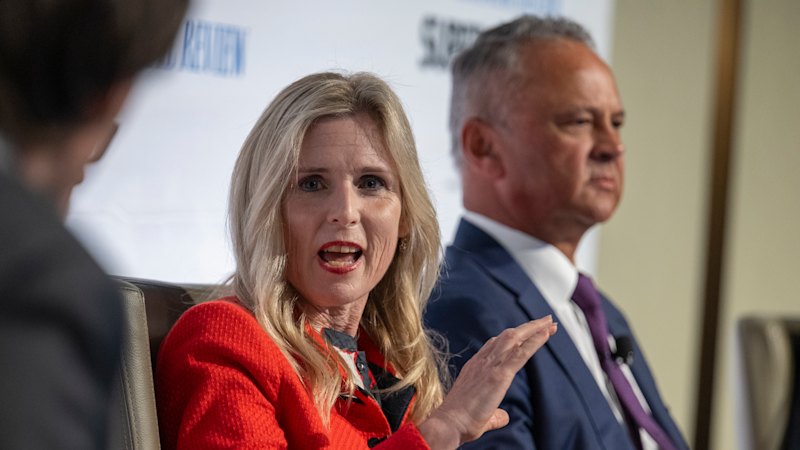
Photo via The Sydney Morning Herald

RBA board split but majority backed raising interest rates to 18-year high

Read the original at The Sydney Morning Herald ↗
Cite

Wright, S., & Muroi, M. (2026, November 3). RBA board split but majority backed raising interest rates to 18-year high. The Sydney Morning Herald. https://www.smh.com.au/politics/federal/rba-raises-interest-rates-to-18-year-high-20261103-p61av6.html?ref=rss&utm_medium=rss&utm_source=rss_feed

Dated from the outlet's own feed. Check the original for its byline.

The Sydney Morning Herald · collected 2026-11-03 · by Shane Wright, Millie Muroi

Quick Summary

The Reserve Bank increased Australia’s official interest rate to 4.85%, its highest since November 2008, despite a slowing housing market and rising unemployment. The decision was made by a 6-3 majority amidst concerns about inflation driven by the Middle East conflict and the AI boom, which also affected oil prices and business investment forecasts. This hike adds approximately $100 to monthly mortgage repayments for a 30-year $600,000 loan.
Written by AI on 2026-11-03, from this article's own text only (the story summary below draws on all the coverage).
See how they differ ↓

AI analysis

Story summary

On November 3, 2026, the Reserve Bank of Australia (RBA) increased interest rates from 4.60% to 4.85%, marking an 18-year high and the fifth hike this year. The decision aims to combat inflation, which has risen above the RBA's target band of 2-3%. Despite Prime Minister Anthony Albanese calling interest rates a "blunt instrument," Governor Michele Bullock defended the move as necessary to prevent more severe economic consequences. However, economists warn that further hikes could push Australia into recession and exacerbate financial stress for households, particularly in New South Wales (NSW), where mortgage repayments are already among the highest nationally.

Written for “RBA Lifts Interest Rates For Fifth Time This Year” on 2026-11-20, grounded in this article and the 19 other(s) covering the same event.

How they differ

5 outlets covered “RBA Lifts Interest Rates For Fifth Time This Year”.

What each outlet says

One AI summary per outlet of its latest article on this story, written from that article alone and checked against it. Open the article for the outlet's own words.

Sydney Morning HeraldThis outlet3 Nov

The Reserve Bank increased Australia’s official interest rate to 4.85%, its highest since November 2008, despite a slowing housing market and rising unemployment. The decision was made by a 6-3 majority amidst concerns about inflation driven by the Middle East conflict and the AI boom, which also affected oil prices and business investment forecasts. This hike adds approximately $100 to monthly mortgage repayments…

RBA board split but majority backed raising interest rates to 18-year high (this article)8 articles from Sydney Morning Herald on this story
ABC News (AU)3 Nov

The Reserve Bank of Australia (RBA) has raised interest rates to their highest level in 18 years, aiming to reduce inflation from its current rate of 4.3% annually back down to the RBA’s 2 to 3 percent target range. The article explores why this specific range was chosen and delves into the history of the RBA's adoption of an inflation target in the early 1990s, which it adapted from New Zealand's model but with…

'No need to sack the governor' and other reasons for the RBA's inflation target →6 articles from ABC News (AU) on this story
The Guardian3 Nov

The Reserve Bank of Australia raised its cash rate for the fifth time this year, increasing it from 4.6% to 4.85%, amid efforts to control high inflation driven by global oil price shocks due to the Middle East conflict. The decision split the monetary policy board, with six members voting for a hike and three against. This latest increase will add $107 monthly to the interest payments on a $700,000 home loan…

RBA interest rates: Reserve Bank hikes cash rate for fifth time this year in blow to mortgage holders →3 articles from The Guardian on this story
Daily Mail3 Nov

The Reserve Bank of Australia raised interest rates by 25 basis points to 4.85%, marking the fifth increase this year in response to high inflation. This move is particularly challenging for households already strained by rising costs, while businesses face higher financing expenses alongside reduced customer spending. Critics argue that although rate hikes are necessary to combat inflation, the government could be…

The worst of inflation is 'well and truly behind us', Jim Chalmers said last year. That feels especially enraging right now: PVO →2 articles from Daily Mail on this story
The Independent3 Nov

Australia’s central bank raised its benchmark interest rate from 4.60% to 4.85%, marking the highest level since 18 years ago and the fifth increase this year. Reserve Bank of Australia Governor Michele Bullock defended the decision, emphasizing the need to reduce inflation despite financial pressure on mortgage holders. The RBA’s statement suggests a potential pause in further hikes over summer to assess impacts…

Australia increases interest rates to highest level in 18 years →

Where they agree and split

Framing

How the first headlines put it

Stated as fact2
The headlines (2)

It is the RBA’s job to fight inflation, but governments must do more to help Sydney Morning Herald · stated as fact

‘Sharper, longer slowdown’ predicted for economy as fifth interest rate hike looms The Guardian · stated as fact

The full story: what happened, how it changed, and all 20 articles →

Compared with similar articles

This article reads unscored and hedges 18% of its claims. Each row says how that neighbour differs.
The Guardian
Leans left Hedges 2 of 21 claims Outlet record 64/100
ABC News (AU)
Hedges 0 of 3 claims Outlet record 67/100
Daily Mail
Leans strongly left Hedges 0 of 32 claims Outlet record 69/100
ABC News (AU)
Hedges 10 of 69 claims Outlet record 67/100
The Sydney Morning Herald
Leans left Hedges 1 of 29 claims Outlet record 61/100
The Independent
Leans right Hedges 3 of 17 claims Outlet record 59/100
ABC News (AU)
Hedges 3 of 38 claims Outlet record 67/100
ABC News (AU)
Hedges 4 of 40 claims Outlet record 67/100
The Sydney Morning Herald
Outlet record 61/100

Story

RBA Lifts Interest Rates For Fifth Time This Year
Economy/Business · 20 article(s) covering the same event. Compare every outlet's account →
How this article was measured signals, leaning charts, publisher record, byline, topics and claims

Signals How these are calculated →

Claims extracted
28
sentences that state something as happening or true
Uncertain
18%
5 of 28 hedged ("reportedly", "may", "according to")
Leaning
not political
takes no side on a contested political question
Publisher signals
61/100
The Sydney Morning Herald's corrections and hedging, across everything collected from it. Not a measure of accuracy.
Outlets on this story
20
Economy/Business
Same framing elsewhere
1
articles that frame the event the way this one does
Analyzed 2026-11-03 · how these are computed

How this is being covered How these are calculated →

Article leaning vs. publisher reliability
Source leaning vs. consistency

Publisher

The Sydney Morning Herald · 7728 article(s) · 16 correction(s) detected
Running correction rate · 16 correction(s)

Who wrote this

Shane Wright
30 article(s) here · 1 carrying a prediction
Treasurer Jim Chalmers is promising a “Goldilocks” mid-year budget update that will be focused on savings large enough ease inflation pressures but which will not hurt the overall economy.
The Greens could get in the way of Treasurer Jim Chalmers’ plans to overhaul capital gains tax by the end of the year, backing an inquiry into a separate proposal from independent MP Allegra Spender.
The CEOs of two of the nation’s largest banks have backed cuts in government spending to bring down inflation and make housing more affordable amid warnings the AI building boom could push up the cost of suburban homes as they compete for electricians and plumbers.
The federal government’s budget overhaul of negative gearing and capital gains tax has been blamed for the biggest fall in home loans taken out by investors on record, with warnings the property market will struggle well into next year.
The AI building boom that is powering the global economy could force interest rates to remain higher, the Reserve Bank’s chief economist has warned, while revealing there are few signs the new technology will eat into the job prospects of young Australians.
But it wasn’t accompanied by a surge in unemployment which would peak at 7.4 per cent.
It may not be an official recession, but the Reserve Bank knows it may feel like one for plenty of Australians after it delivered another dose of monetary policy punishment to the country.
The last time the RBA board split was in May when 8 voted in favour of a rate hike with one holding out.
The Reserve Bank is being warned it could drive Australia into a recession and leave tens of thousands of people out of work with a Melbourne Cup Day interest rate rise that will lift pressure on Treasurer Jim Chalmers to cut deeper into government spending.
The nationwide slump in house values has spread to Brisbane and Perth with no signs the property downturn is close to ending, amid fears it could get worse if the Reserve Bank pushes ahead with another interest rate hike this week.
Also by Shane Wright
Chalmers reveals plan for ‘Goldilocks’ budget update
2026-11-16 · The Sydney Morning Herald
Nothing else under this byline is closely related to this article, so these are simply their most recent.
All 30 articles by Shane Wright →
Millie Muroi
12 article(s) here · 1 carrying a prediction
Between December 1, 2021 and September 9, 2022, Macquarie had described its welcome rate on the Macquarie Savings Account as a “welcome variable rate” and a “bonus” which the commission alleged could lead customers to believe it was paid on top of the standard variable rate.
In May, Tamburella was called into a meeting to address performance concerns.
The last time the RBA board split was in May when 8 voted in favour of a rate hike with one holding out.
The bank will pay a final dividend of 77 cents a share, taking the full-year dividend to $1.54, up 1 per cent from the previous year.
Leaving complaints unresolved could mean problems snowball into larger failures, she said, exposing customers to harm and erode trust in the multi-trillion dollar superannuation system.
A Coles worker who tried to stop two suspected thieves at a neighbouring Liquorland store will receive $6500 in compensation from the supermarket chain after he was unfairly dismissed for breaching its workplace rules.
I didn’t understand why people voluntarily spent hundreds – or thousands – of dollars to put themselves through pain, and I couldn’t believe they actually enjoyed it.
A chef who consumed alcohol while working at a high-end Sydney restaurant will receive more than $11,000 in compensation after the national fair work umpire ruled his dismissal was harsh, unjust and unreasonable.
Dentist Sen Le says he is not afraid of losing his job to AI: a technology he has helped to develop, and one which he says can detect problems in a patient’s mouth that most human dentists would miss.
On Thursday, Commonwealth Bank announced it would extend its regional banking moratorium – which was due to end in July next year – for a further three years.
Also by Millie Muroi
Nothing else under this byline is closely related to this article, so these are simply their most recent.
All 12 articles by Millie Muroi →

Topics

RBA the Reserve Bank the Reserve Bank of New Zealand the US Federal Reserve

Subjects

RBA ORG · 3× the Reserve Bank ORG · 1× the Reserve Bank of New Zealand ORG · 1× the US Federal Reserve ORG · 1×

Narrative

The bank noted that public demand, effectively government spending, was weaker than expected through the first half of this year. “An easing in public consumption reflected the ending of some temporary cost-of-living measures alongside some moderation in some categories of government spending such as defence and disability and aged care services,” it said.
framing: assertive · carried by 1 article(s) · first seen 2026-11-03
The last time the RBA board split was in May when 8 voted in favour of a rate hike with one holding out.
2026-11-03 · The Sydney Morning Herald
RBA board split but majority backed raising interest rates to 18-year high · assertive framing

Claims (28 extracted, 5 hedged)

The Middle East conflict and AI boom have intensified the fight to slow price growth, pushing the Reserve Bank to hike interest rates to their highest level since the global financial crisis. asserted
conflict → intensify → crisis
On Tuesday, the bank increased the country’s official interest rate to 4.85 per cent, adding about $100 in repayments a month to a 30-year $600,000 mortgage despite a sharper-than-expected slowdown in the housing market and worsening unemployment. asserted
bank → increase → market
In a major surprise, the vote was 6-3 in favour of the hike, suggesting there is a split in parts of the bank about the direction of interest rates. asserted
vote → suggest → rates
In the past week, the Reserve Bank of New Zealand and the US Federal Reserve split on rate decisions with concerns in both the trade-off between higher interest rates and their impact. asserted
Bank → split → rates
There have also been splits on other central banks as they struggle with the inflationary pulse created by the war in the Middle East and the AI construction boom. asserted
they → struggle → East
The last time the RBA board split was in May when 8 voted in favour of a rate hike with one holding out. uncertain
one → split → hike
In its latest forecasts, the bank revealed it did not expect trimmed mean inflation – the bank’s preferred gauge of price pressures – to reach the middle of its 2 to 3 per cent target until June 2028, and that headline inflation would peak at 4.5 per cent by Christmas before beginning to fall. asserted
inflation → reveal → Christmas
The bank’s previous forecasts in August predicted inflation to fall steadily over the next two years, with trimmed mean inflation hitting 2.6 per cent by December 2027. asserted
inflation → predict → December
A key issue fuelling higher inflation is the price of oil. asserted
issue → fuel → oil
In August, the RBA expected Brent to be down around $US76 a barrel. asserted
Brent → expect → August
Today, it is $US104 a barrel and has averaged above $US110 for the past two months. asserted
it → average → months
The bank’s forecasts on oil still expect oil to cost around $US80 a barrel by the end of 2028. asserted
oil → expect → 2028
Business investment, largely in data centres and computer servers, is expecting to grow by 12 per cent this year. asserted
investment → expect → cent
In August, it had expected investment to grow by 4.3 per cent. asserted
investment → expect → cent
AI and computer component companies around the world are pushing through large price rises which are then showing up in higher inflation figures. asserted
which → push → figures
The bank warned that the AI construction boom could hurt the home construction sector. uncertain
boom → warn → sector
“The ramp-up of investment in data centres may also contribute to capacity and pricing pressures domestically, particularly by drawing on resources in the construction industry,” it said. uncertain
it → contribute → industry
While several of the cost pressures are driven by international factors, the bank noted capacity constraints in the domestic economy were worse than it had previously thought. asserted
it → drive → economy
The bank waned that a combination of higher interest rates, higher inflation and the fall in property prices could hit domestic economic activity harder than expected. uncertain
combination → wan → activity
It estimates that if consumers start pulling back on discretionary spending faster than forecast, the overall economy could be a full percentage point - or about $28 billion - smaller by the end of 2028 than anticipated. uncertain
economy → estimate → 2028
Unemployment would then likely approach 5.5 per cent, a full half percentage point higher than the RBA is forecasting. asserted
RBA → approach → cent
The bank noted that public demand, effectively government spending, was weaker than expected through the first half of this year. “An easing in public consumption reflected the ending of some temporary cost-of-living measures alongside some moderation in some categories of government spending such as defence and disability and aged care services,” it said. asserted
it → note → defence
In August, the bank expected public demand to grow by 3.2 per cent this year. asserted
demand → expect → cent
It now expects growth of 2.1 per cent. asserted
It → expect → cent
But some of that slowdown is likely due to spending being pushed into 2027. asserted
spending → push → 2027
In the 12 months to June next year, public demand is expected to grow by 3.8 per cent after previously being forecast to grow by 3.1 per cent. asserted
demand → expect → cent
The bank also said there had been a sharper downturn in the housing market than it had been anticipating, partly driven by government tax changes brought in earlier this year. asserted
it → say → changes
Subscribers can sign up to our weekly Inside Politics newsletter. asserted
Subscribers → sign → newsletter
Give feedback · no sign-in needed

No sign-in needed for now. Your note is sent without a name, so it cannot be answered.

History Support