Photo via ABC News (AU)

Research could reverse peanut allergy diagnosis for some infants

Read the original at ABC News (AU) ↗
Cite

Callanan, T. (2026, November 5). Research could reverse peanut allergy diagnosis for some infants. ABC News (AU). https://www.abc.net.au/news/2026-11-05/infants-diagnosed-with-peanut-allergy-may-not-be-study-shows/107348650

Dated from the outlet's own feed. Check the original for its byline.

ABC News (AU) · collected 2026-11-05 · by Tim Callanan

Quick Summary

Murdoch Children's Research Institute research reveals that over one third of infants previously diagnosed with peanut allergies may not actually have an allergy, based on results from oral food challenges. The study involved 1,275 infants across five Australian states and found that many children who had a history of reactions to peanuts and positive allergy tests did not react during supervised challenges. Researchers recommend conducting these challenges before diagnosing a peanut allergy or beginning oral immunotherapy treatments.
Written by AI on 2026-11-05, from this article's own text only (the story summary below draws on all the coverage).
See how they differ ↓

AI analysis

Story summary

A landmark study led by the Murdoch Children’s Research Institute and the National Allergy Centre of Excellence in Australia found that more than one-third of infants thought to have a peanut allergy can safely eat peanuts without reacting. The research, published in The Journal of Allergy and Clinical Immunology, involved 10 paediatric hospitals across Australia and showed that 35% of babies who had previously reacted to peanuts and tested positive through skin prick or blood tests did not react during supervised oral food challenges. This paradigm-shifting discovery could lead to changes in how peanut allergies are diagnosed, potentially removing many children’s allergy diagnoses. The study highlights the importance of using oral food challenges more routinely for infants suspected of having a peanut allergy.

Written for “Peanut Allergy Study Clears Babies” on 2026-11-21, grounded in this article and the 3 other(s) covering the same event.

How they differ

2 outlets covered “Peanut Allergy Study Clears Babies”.

What each outlet says

One AI summary per outlet of its latest article on this story, written from that article alone and checked against it. Open the article for the outlet's own words.

ABC News (AU)This outlet5 Nov

Murdoch Children's Research Institute research reveals that over one third of infants previously diagnosed with peanut allergies may not actually have an allergy, based on results from oral food challenges. The study involved 1,275 infants across five Australian states and found that many children who had a history of reactions to peanuts and positive allergy tests did not react during supervised challenges…

Research could reverse peanut allergy diagnosis for some infants (this article)
Sydney Morning Herald4 Nov

A new study from Australia reveals that one in three babies suspected of having a peanut allergy do not actually have it, challenging current diagnostic methods. Conducted by the Murdoch Children’s Research Institute and the National Allergy Centre of Excellence with ten pediatric hospitals, the research involved medically supervised oral food challenges for 778 babies who had previously shown allergic reactions to…

One in three babies with suspected peanut allergies cleared of the condition in landmark study →2 articles from Sydney Morning Herald on this story

Compared with similar articles

This article reads unscored and hedges 17% of its claims. Each row says how that neighbour differs.
The Sydney Morning Herald
Hedges 5 of 39 claims Outlet record 61/100
CBS News
Hedges 5 of 15 claims Outlet record 66/100
The Sydney Morning Herald
Outlet record 61/100

Story

Peanut Allergy Study Clears Babies
Health · 4 article(s) covering the same event. See how they differ ↑
How this article was measured signals, leaning charts, publisher record, byline, topics and claims

Signals How these are calculated →

Claims extracted
30
sentences that state something as happening or true
Uncertain
17%
5 of 30 hedged ("reportedly", "may", "according to")
Leaning
not political
takes no side on a contested political question
Publisher signals
67/100
ABC News (AU)'s corrections and hedging, across everything collected from it. Not a measure of accuracy.
Outlets on this story
4
Health
Same framing elsewhere
1
articles that frame the event the way this one does
Analyzed 2026-11-05 · how these are computed

How this is being covered How these are calculated →

Article leaning vs. publisher reliability
Source leaning vs. consistency

Publisher

ABC News (AU) · 6163 article(s) · 11 correction(s) detected
Running correction rate · 11 correction(s)

Who wrote this

Tim Callanan
5 article(s) here · 1 carrying a prediction
Samaras says both parties left their campaign launches late and it will be tough to make an impact on voters this late in the game.
In short: Indigenous Victorians have welcomed the Liberal Party's decision to disendorse its candidate for Williamstown after his racist social media posts were unearthed.
In short: Research from the Murdoch Children's Research Institute has found more than a third of infants diagnosed with a peanut allergy may be able to safely eat peanuts.
The Court of Appeal judges said they would only grant leave to appeal for the first two, and dismissed the other five (things like the lead prosecutor being unfair with her questioning) outright.
A separate appeal by the prosecution to impose a harsher sentence was upheld and Patterson will be re-sentenced.
Also by Tim Callanan
Nothing else under this byline is closely related to this article, so these are simply their most recent.

Topics

ABC News Breakfast Australia NACE the Murdoch Children's Research Institute the National Allergy Centre of Excellence

Subjects

Leah PERSON · 3× the Murdoch Children's Research Institute ORG · 3× Arthur PERSON · 2× Jake PERSON · 2× NACE ORG · 2× Perrett PERSON · 2× ABC News Breakfast ORG · 1× Australia GPE · 1× Kirsten Perrett PERSON · 1× the National Allergy Centre of Excellence ORG · 1×

Narrative

They said the reaction was instant, with his face turning red and hives appearing on his shoulders and under his nose. The boy was referred to the ADAPT program but then tolerated the supervised oral food challenge and had his allergy diagnosis removed. "
framing: assertive · carried by 1 article(s) · first seen 2026-11-05
In short: Research from the Murdoch Children's Research Institute has found more than a third of infants diagnosed with a peanut allergy may be able to safely eat peanuts.
2026-11-05 · ABC News (AU)
Research could reverse peanut allergy diagnosis for some infants · assertive framing

Claims (30 extracted, 5 hedged)

In short: Research from the Murdoch Children's Research Institute has found more than a third of infants diagnosed with a peanut allergy may be able to safely eat peanuts. uncertain
third → find → peanuts
The study found some infants with a previous reaction to peanut and a positive allergy test did not react to an oral food challenge. asserted
infants → find → challenge
Researchers say it could lead to a change in the way peanut allergies are diagnosed. uncertain
allergies → say → way
More than one third of babies thought to have a peanut allergy may actually be able to safely eat nuts, according to a new study. uncertain
third → think → study
Researchers say the study could change the way the healthcare system approaches infant food allergies and lead to many children having their allergy diagnosis removed. uncertain
diagnosis → say → allergies
The research was led by the Murdoch Children's Research Institute and the National Allergy Centre of Excellence (NACE) in partnership with 10 paediatric public hospitals across Australia. asserted
research → lead → Australia
Researchers found 35 per cent of infants with a previous reaction to peanut and a positive allergy test did not react to an oral food challenge. asserted
cent → find → challenge
NACE Director Kirsten Perrett said the number of children who did not react to peanut during a supervised food challenge was "surprising". asserted
who → say → challenge
"These were children that had had a history of reactions when they were introduced to peanuts and they'd had a positive test, be it a skin prick test or a blood test," Professor Perrett told ABC News Breakfast. asserted
Perrett → have → Breakfast
"Our results show that clinical history and allergy testing alone were not enough to accurately diagnose peanut allergy in many cases. asserted
history → show → cases
"A supervised oral food challenge should be routinely considered to confirm the diagnosis before an infant starts oral immunotherapy." asserted
infant → consider → immunotherapy
Melbourne School of Public Health biostatistics professor Lyle Gurrin, who was not involved in the research, said he was not surprised that the figure reported in the research was so high. asserted
figure → involve → research
"A lot of people think their children are allergic when they're probably not, so I think this paper is good from that point of view that it's encouraging people to seek proper advice," he said. asserted
he → think → advice
"I'm not surprised that a large proportion of these infants didn't return a positive result in an oral food challenge." asserted
proportion → return → challenge
The study involved 1,275 infants under 18 months of age at hospitals in Victoria, New South Wales, Queensland, South Australia and Western Australia. asserted
study → involve → Victoria
The findings emerged from the ADAPT Peanut Oral Immunotherapy Program hosted by the Murdoch Children's Research Institute, which required infants to undergo a food challenge before starting treatment. asserted
which → emerge → treatment
The program exposed children to small, daily doses of peanut to build tolerance. asserted
program → expose → tolerance
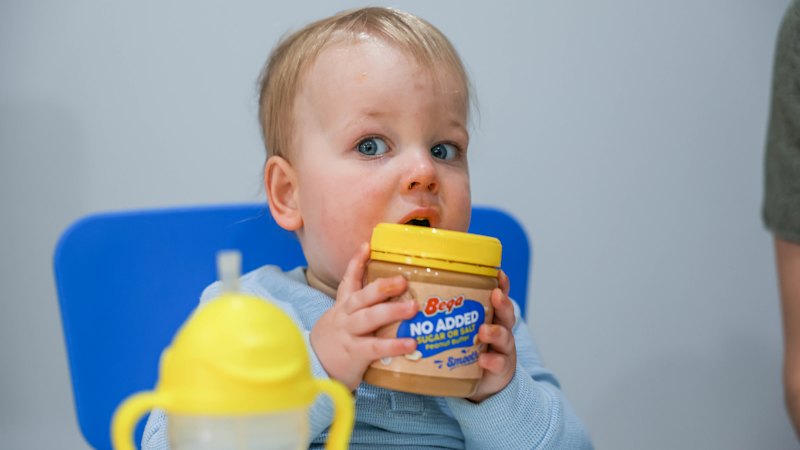
Victorian couple Leah and Jake introduced their infant son Arthur to peanuts when he was five months old. asserted
he → introduce → peanuts
They said the reaction was instant, with his face turning red and hives appearing on his shoulders and under his nose. The boy was referred to the ADAPT program but then tolerated the supervised oral food challenge and had his allergy diagnosis removed. " asserted
diagnosis → say → challenge
It's a huge relief knowing Arthur can tolerate peanut and we can move forward without the uncertainty of managing a suspected allergy," Leah said. asserted
Leah → know → allergy
"Having the opportunity to find out he could tolerate peanuts has made a real difference to our family." uncertain
he → have → family
Professor Perrett said it was hoped the research would make the process of identifying food allergies more accurate for parents like Leah and Jake. asserted
process → say → Leah
"With peanut allergy one of the most common childhood food allergies, it's particularly important that we have an accurate diagnosis when a baby first shows signs of a possible peanut allergy," she said. asserted
she → have → allergy
"We want to reduce the burden of food allergy for children and their families, and the ADAPT Program is a step in this direction." asserted
Program → want → direction
Professor Gurrin said the research did not necessarily mean it would become easier for GPs to better diagnose a child with a peanut allergy. asserted
GPs → say → allergy
He said oral food challenges still need to be carried out under appropriate conditions. asserted
challenges → say → conditions
"You can't really do that in a GP surgery or a child maternal health clinic," he said. asserted
he → do → surgery
"You need all the material and the broader understanding to be able to assist the child who is having a reaction, whether it be mild or right through to anaphylaxis." asserted
it → need → anaphylaxis
Professor Perrett said NACE was hoping to expand the ADAPT program to cover cashew allergy, which was almost as prevalent as peanut allergy. asserted
which → say → allergy
However, Professor Perrett advised parents not to conduct an oral food challenge at home, warning that 12 per cent of infants with a peanut allergy had a potentially-life threatening anaphylactic response. asserted
cent → advise → response

Give feedback · no sign-in needed

No sign-in needed for now. Your note is sent without a name, so it cannot be answered.

History Support