Photo via The Hub

‘An unsustainable trajectory’: The Hub reacts to Budget 2026

Read the original at The Hub ↗
Cite

The Hub Staff. (2026, November 6). ‘An unsustainable trajectory’: The Hub reacts to Budget 2026. The Hub. https://thehub.ca/2026/11/06/an-unsustainable-trajectory-the-hub-reacts-to-budget-2026/

Dated from the outlet's own feed. Check the original for its byline.

The Hub · collected 2026-11-08 · by The Hub Staff commentary

Quick Summary

Mark Carney's government has released Budget 2026, which includes nearly $142 billion in new spending over five years. Joseph Steinberg criticizes the budget for missing an opportunity to address trade tensions and make substantial tax reforms, while Trevor Tombe argues that the projected deficits are largely a result of policy choices rather than economic weakness. Tombe estimates that without these policies, this year’s deficit would be $28.1 billion instead of the projected $62.3 billion.
Written by AI on 2026-11-08, from this article's own text only (the story summary below draws on all the coverage).
See how they differ ↓

AI analysis

Story summary

The Canadian government under Prime Minister Mark Carney officially unveiled its 2026 federal budget on November 5, 2026, focusing on a plan to change the nation's growth model and reduce economic reliance on the United States. Finance Minister Francois-Philippe Champagne stated that the budget prioritizes building domestic commerce, diversifying trade, and increasing Canadian sovereignty in response to shifting global trade dynamics and a U.S. trade war involving President Donald Trump. To achieve these goals, the government is utilizing a federal balance sheet bolstered by high energy prices and corporate profits to fund a long-term investment agenda, including financial guarantees for AI infrastructure and tax cuts for small businesses. Despite these measures, the budget has resulted in increased deficits and debt, with critics like former deputy finance minister Kevin Lynch warning that the government has spent its revenue windfall on new programs rather than reducing the deficit. Furthermore, the budget includes immigration targets that have faced criticism from Conservative Party leader Pierre Poilievre, who suggested the measures are part of a plan to increase the population to 100 million. While the government argues these investments will deliver future economic gains, some reports highlight that interest payments on existing debt are rising and that the federal borrowing rate remains a significant concern for taxpayers.

Written for “Canada's Budget 2026” on 2026-11-21, grounded in this article and the 55 other(s) covering the same event.

How they differ

9 outlets covered “Canada's Budget 2026”.

What each outlet says

One AI summary per outlet of its latest article on this story, written from that article alone and checked against it. Open the article for the outlet's own words.

The HubThis outlet8 Nov

Mark Carney's government has released Budget 2026, which includes nearly $142 billion in new spending over five years. Joseph Steinberg criticizes the budget for missing an opportunity to address trade tensions and make substantial tax reforms, while Trevor Tombe argues that the projected deficits are largely a result of policy choices rather than economic weakness. Tombe estimates that without these policies, this…

‘An unsustainable trajectory’: The Hub reacts to Budget 2026 (this article)5 articles from The Hub on this story
Toronto Star6 Nov

The federal budget for 2026 in Canada did not introduce any new measures to address student affordability issues or funding shortfalls in post-secondary education. Despite recognizing the importance of universities and colleges as key contributors to economic growth, the budget failed to provide additional support for students facing financial hardships or academic staff experiencing program cuts and job losses…

Federal budget 2026 silent on student affordability and public funding shortfall in post-secondary education →14 articles from Toronto Star on this story
Global News6 Nov

Budget 2026 proposes several tax changes aimed at reducing the administrative burden on Canadians. Key among these is changing the tax filing deadline from April 30 to May 15 for all taxpayers and self-employed individuals, eliminating the previous June 15 deadline for self-employed workers. This change aims to simplify tax filings and could save Canadians $230 million in interest and penalty payments over five…

These are all the key tax changes and credits impacting you from the budget →12 articles from Global News on this story
CBC6 Nov

Prime Minister Mark Carney defended Canada's new immigration levels plan, which expects almost 660,000 new permanent residents in 2027, while Conservative Leader Pierre Poilievre criticized the numbers as unsustainable. The federal government plans to grant a combined total of more than one million people either permanent or temporary residency next year, with regular intakes set at 380,000 permanent and 370,000…

Carney says new immigration levels plan is 'sustainable' as it draws ire of Conservatives →11 articles from CBC on this story
The Globe and Mail9 Nov

Prime Minister Mark Carney’s federal budget proposes a $30-billion plan to end homelessness in Canada by 2036. The initiative includes funding for 25,000 supportive and transitional homes, rental assistance, and health facilities addressing social needs. Housing experts welcome the pledge but emphasize the need for additional details and provincial cooperation to ensure success.

Housing experts welcome Ottawa’s plan to eradicate homelessness, but call for more details, funding →7 articles from The Globe and Mail on this story
Toronto Sun12 Nov

This editorial criticizes Prime Minister Mark Carney’s government for misclassifying hundreds of billions of dollars in borrowing to finance government programs as investments rather than liabilities, thus obscuring the true extent of federal debt. Parliamentary Budget Officer Annette Ryan warns that federal borrowing is growing at more than double the rate of deficits, reaching $732.9 billion over the next five…

EDITORIAL: Beware Carney’s borrowing bomb →4 articles from Toronto Sun on this story
Show 3 more outlets
The Straits Times5 Nov

Canadian Prime Minister Mark Carney’s government presented its second budget on November 5 aimed at reducing reliance on the United States. Finance Minister Francois-Philippe Champagne emphasized diversifying trade and boosting domestic commerce within Canada as key priorities. The budget includes funding for national projects such as infrastructure for energy production and critical mineral mining, while also…

Canada unveils budget to curb reliance on US →
South China Morning Post6 Nov

Canada has unveiled a new budget titled “Masters of our Destiny,” which emphasizes economic independence from the United States. The plan acknowledges the ongoing shift away from traditional reliance on the U.S., noting it will take time but is underway. Presented two days after President Trump’s midterm election losses, the budget outlines Canada's intention to reduce its dependence on the U.S. market despite…

Canada budget charts ‘economic independence’ in decisive shift from US →
The Blaze9 Nov

Prime Minister Mark Carney’s Liberal government announced plans to increase immigration to Canada, aiming to grant permanent residency to approximately 380,000 migrants and admit another 370,000 temporary residents each year from 2027 to 2029. This includes additional one-time measures that could boost the number of permanent residents in 2027 to about 660,000. Conservative Party leader Pierre Poilievre and other…

'This is insane': Mark Carney slammed for overloading Canada with immigrants →

Where they agree and split

Framing

How the first headlines put it

Attributed to a source2
Stated as fact1
The headlines (3)

Budget 2026 is about ‘us,’ not the U.S. trade war, finance minister says Global News · attributed to a source

Federal budget is about 'changing Canada's growth model,' finance minister says Toronto Star · attributed to a source

Canada's next budget to be unveiled this week amid U.S. trade war, economic uncertainty CBC · stated as fact

Words to watch (1)

'This is insane': Mark Carney slammed for overloading Canada with immigrants The Blaze

The full story: what happened, how it changed, and all 56 articles →

Compared with similar articles

This article reads unscored and hedges 6% of its claims. Each row says how that neighbour differs.
Toronto Sun
Hedges 0 of 27 claims Outlet record 96/100
The Hub
Hedges 3 of 25 claims
The Straits Times
Leans left Hedges 0 of 18 claims Outlet record 64/100
Toronto Star
Leans left Hedges 1 of 35 claims Outlet record 64/100
Toronto Star
Leans right Hedges 0 of 2 claims Outlet record 64/100
“Article A describes a cabinet meeting ahead of budget unveiling, while Article B discusses reactions to the actual released budget document.”
Toronto Star
Hedges 0 of 1 claims Outlet record 64/100
“The articles discuss different aspects of budget day in Ottawa; Article A mentions it's budget day, while Article B provides a reaction to the released budget document 'Masters of our destiny', which occurred after the initial announcement.”
CBC News
Hedges 2 of 18 claims Outlet record 72/100
“The articles refer to different time points: Article A is reporting on the day the budget will be tabled, while Article B discusses reactions and analysis after the budget has been presented.”
Toronto Star
Leans right Hedges 0 of 2 claims Outlet record 64/100
“Article A describes a direct exchange between Carney and Poilievre in the House of Commons about debt and immigration, while Article B discusses reactions to Budget 2026 three days later.”
CBC News
Leans left Hedges 3 of 38 claims Outlet record 72/100
The Globe and Mail
Leans left Hedges 5 of 66 claims Outlet record 51/100

Story

Canada's Budget 2026
Economy/Business · 56 article(s) covering the same event. Compare every outlet's account →
How this article was measured signals, leaning charts, publisher record, byline, topics and claims

Signals How these are calculated →

Claims extracted
65
sentences that state something as happening or true
Uncertain
6%
4 of 65 hedged ("reportedly", "may", "according to")
Leaning
withheld
no quote in the article backed the model's score
Publisher signals
not measured
these signals count newsroom corrections; Commentary has none to count
Outlets on this story
56
Economy/Business
Same framing elsewhere
1
articles that frame the event the way this one does
Analyzed 2026-11-08 · how these are computed

How this is being covered How these are calculated →

Article leaning vs. publisher reliability
Source leaning vs. consistency

Publisher

The Hub · 88 article(s) · 0 correction(s) detected
No corrections detected for this publisher. That may mean careful reporting, or simply that nothing has been checked.

Who wrote this

The Hub Staff
31 article(s) here · 1 carrying a prediction
Statistics Canada’s early reading has sales dropping 1.5 percent that month, though the agency cautioned that the unofficial figure will be revised.
Secondly, it would be interesting to know if Mr. Shimooka thinks any of the blame can be assigned to Canada’s military leadership.
- The budget debate in the House of Commons is concluding with a final vote expected to pass.
2026-11-19 · assertive framing · Parliament Today: Budget debate reaches its final day
Slade found it in thinkers whose reputations might put them in different camps.
That is not because the economy is booming: real growth is expected to slow to 1 percent this year.
How could they spend so much to achieve so little?” — Pierre Poilievre, Conservative MP for Battle River—Crowfoot Government defends budget as investment “They can laugh as much as they want, but Canadians know that confident countries invest in themselves.
2026-11-17 · assertive framing · Lines that landed: Question Period for November 17
Called the Alberta Growth Connector, the 48-inch line would run west to east, linking growing Western Canadian gas supply with oilsands operations in the province’s northeast.
The amendment on the table Monday would have added the parliamentary secretary to the minister of finance.
The reading came in a tick below the 3.2 percent economists had expected, and below the 3.4 percent the Bank of Canada projected for the fourth quarter.
The first, No. 13, would amend the Income Tax Act and the Income Tax Regulations.
Wire or desk byline, not an individual reporter.
Also by The Hub Staff
Nothing else under this byline is closely related to this article, so these are simply their most recent.
All 31 articles by The Hub Staff →

Topics

Budget 2026 Canada Ottawa The Hub the University of Toronto

Subjects

Canada GPE · 3× Ottawa GPE · 3× Mark Carney PERSON · 2× The Hub ORG · 2× Barrhaven GPE · 1× Joseph Steinberg PERSON · 1× Keito Newman PERSON · 1× The Canadian Press ORG · 1× U.S. GPE · 1× the University of Toronto ORG · 1×

Narrative

Ottawa wants to sustain Justin Trudeau’s social spending, roughly $21 billion a year across pharmacare, dental care, child care and doubled spending on Indigenous services, add $15 billion of Mark Carney’s new social spending, pour in $31 billion a year of “capital investments,” and increase defence spending by around $65 billion by 2030–31.
framing: assertive · carried by 1 article(s) · first seen 2026-11-08
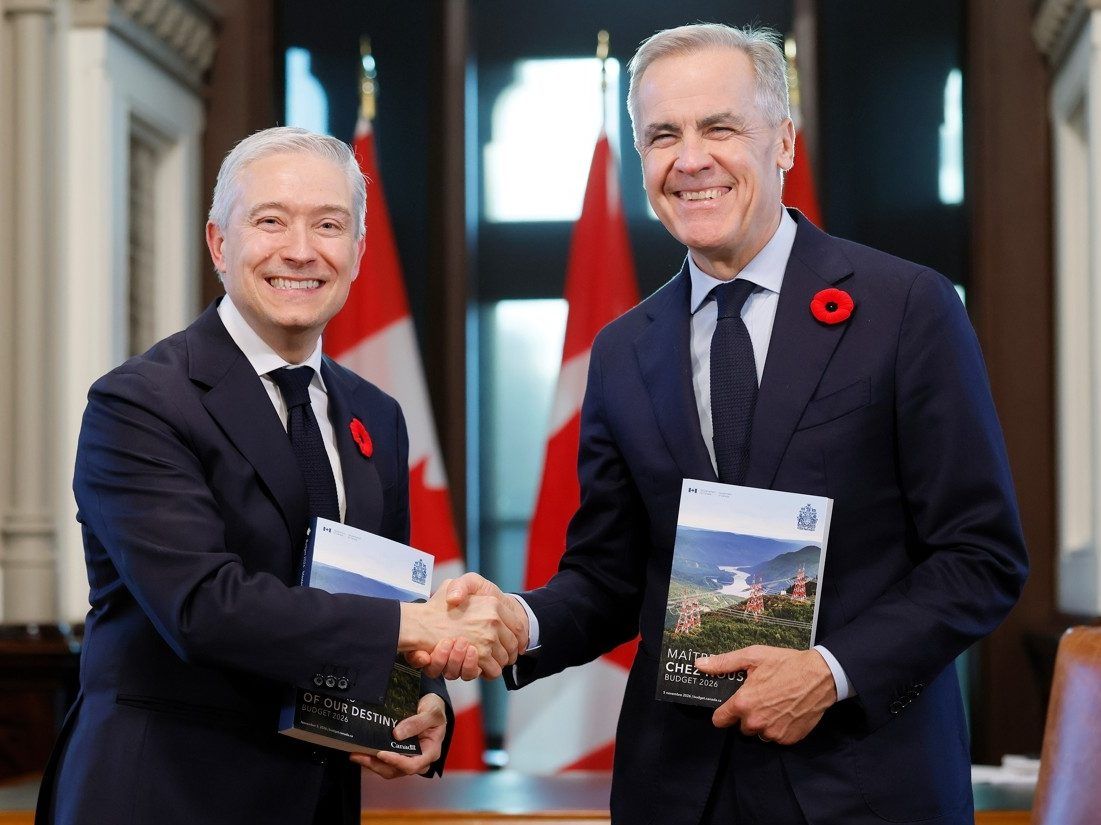
Those hoping for a big-splash budget will be disappointed by what Mark Carney and co. have delivered in “Masters of our destiny,” the new fiscal plan outlining the government’s priorities and policy direction.
2026-11-08 · The Hub
‘An unsustainable trajectory’: The Hub reacts to Budget 2026 · assertive framing

Claims (65 extracted, 4 hedged)

Those hoping for a big-splash budget will be disappointed by what Mark Carney and co. have delivered in “Masters of our destiny,” the new fiscal plan outlining the government’s priorities and policy direction. asserted
Carney → hop → priorities
With nearly $142 billion in new spending over five years and rapidly growing debt charges, the document is not exactly a model of fiscal restraint, but nor is it as transformative as might have been expected by those claiming Canada is facing an unprecedented moment of existential threat. uncertain
Canada → grow → threat
As for the big-picture takeaways, we’ve once again gathered some of the best and brightest at The Hub to dig into the details and offer their immediate reactions to Budget 2026. asserted
we → gather → Budget
Trade tensions have given Ottawa leeway to make tough, forward-looking trade-offs and fundamentally rethink the country’s economic priorities. asserted
tensions → give → priorities
Beyond the previously announced megadeduction (of which I am very supportive), this budget largely squanders that opportunity. asserted
budget → announce → opportunity
I was particularly disappointed to see how little the income tax system changed. asserted
system → disappoint → little
Broad-based tax relief is the most effective way to make life more affordable; preventing brain drain and attracting foreign talent requires top brackets that are competitive with the U.S. And Old Age Security, which places an increasingly unfair load on younger taxpayers, remains on an unsustainable trajectory. asserted
which → base → trajectory
Earlier this week, I wrote in The Hub that Ottawa’s underlying fiscal position had improved remarkably. asserted
position → write → Hub
That opened the door to much smaller deficits. asserted
That → open → deficits
But instead of borrowing less, the government opted to move into all of that fiscal space. asserted
government → borrow → space
On their own, stronger economic and fiscal conditions would have shrunk projected deficits dramatically. asserted
conditions → shrink → deficits
The chart below shows what the federal budget balance would be if the government had taken no new policy actions since Budget 2025. asserted
government → show → Budget
By my estimate, this year’s deficit would be $28.1 billion, not the $62.3 billion the budget projects. asserted
budget → project → estimate
Next year, it would fall below $15 billion. asserted
it → fall → billion
Instead, the government projects $62.5 billion. asserted
government → project → billion
By 2030–31, choices account for about three-quarters of the projected $53 billion shortfall. asserted
choices → account → shortfall
It is not a sign of underlying economic or fiscal weakness. asserted
It → underlie → weakness
That doesn’t mean those choices lack merit. asserted
choices → mean → merit
By far the largest contributor over the next five years is letting businesses immediately and fully expense most of their capital investments. asserted
businesses → let → investments
That’s a very welcome policy change that will very likely help boost Canada’s economy. asserted
that → ’ → economy
Others include a boost to the GST credit, a suspension of the gas tax, and higher military spending. asserted
Others → include → tax
But the large deficits ahead come from choices, not circumstances. asserted
deficits → come → choices
That’s a key point worth keeping in mind. asserted
That → ’ → mind
It would be too much to say “meet the new boss, same as the old boss” in response to the newly released budget—the emphasis on growth is an important shift, and revenues are buoyed by high global energy prices thanks to the Iran War. asserted
revenues → say → War
But a closer read reveals worrisome continuity on fundamental policy issues. asserted
read → reveal → issues
To name just two, the government still anticipates the arrival of hundreds of thousands of new temporary and permanent residents in the coming year, while the largest single expense item will be for OAS payments. asserted
item → name → payments
Reflecting on the connection between the two may give some clue to how this government really sees the future of Canada. uncertain
government → reflect → Canada
View reader comments (3) The debt and mastery of our fiscal fate By Livio Di Matteo, professor of economics at Lakehead University The 2026 federal budget is as noteworthy for what it does as for what it fails to do. asserted
it → view → what
It promotes an ambitious investment super cycle with a productivity mega deduction, an entrepreneurship capital gains reinvestment incentive, and a billion-dollar strategic response fund for large-scale research and development projects. asserted
It → promote → projects
At the same time, there is no comprehensive tax reform proposal that would broaden the base and lower rates for all Canadians and businesses to kick-start economic activity. asserted
that → be → activity
The Income Tax Act is being amended to increase the installment threshold from $3,000, set in 2008, to $7,500, reducing the compliance burden. asserted
Act → amend → burden
Is it any wonder that self-employed and small business numbers have declined in recent years? asserted
numbers → employ → years
All things given, Canada’s employment and GDP growth are doing better than anyone might have expected two years into a trade war with our largest trade partner. uncertain
anyone → give → partner
At the same time, part of the reason is a surge in deficit-financed government operating spending along with assorted capital spending initiatives amounting to $37.4 billion in 2025–26, $58.8 billion in 2026–27, and over $70 billion each year after to 2030–31. asserted
part → finance → 2030–31
The operating deficit for 2026–27 is $62.2 billion, and by 2030–31 it is projected to improve to $52.9 billion. asserted
it → project → billion
The accumulated deficit from 2025–26 to 2030–31 will be $327.9 billion, but the increase in the net debt will be $524 billion, bringing that figure to $1.92 trillion by 2030–31. asserted
increase → accumulate → 2030–31
It remains that the splitting of the budget into capital and operating components, combined with hundreds of billions in massive capital project spending, has meant that the net debt will increase by much more than the operating deficits might suggest. uncertain
deficits → remain → more
Graphic credit: Janice Nelson A growing debt means growing debt charges and an increase in the share of revenues going to service the debt. asserted
debt → grow → debt
A 1990s fiscal crisis it is not, and yet, as the accompanying figure illustrates, debt charges were $20.4 billion in 2020–21 and are projected to quadruple to $85.5 billion by 2030–31, while the proportion of revenues going to debt service will double from 6.4 percent to 13.6 percent. asserted
proportion → illustrate → percent
The 2026 federal budget purports to make us masters of our own destiny but crucially glosses over the fact that growing debt and rising debt-service costs are not necessarily the best long-term approach for either individuals or countries seeking to pave their own path forward in the world. asserted
debt → purport → world
…and 25 more, not listed.
Give feedback · no sign-in needed

No sign-in needed for now. Your note is sent without a name, so it cannot be answered.

History Support