Photo via The Guardian

Senate votes on bill to speed up projects from gas pipelines to clean energy

Read the original at The Guardian ↗
Cite

Beaumont, H. (2026, November 9). Senate votes on bill to speed up projects from gas pipelines to clean energy. The Guardian. https://www.theguardian.com/us-news/2026/nov/09/senate-energy-infrastructure-bill-vote

Dated from the outlet's own feed. Check the original for its byline.

The Guardian · collected 2026-11-09 · by Hilary Beaumont

Quick Summary

The Senate is scheduled to vote on Monday for the Bipartisan American Affordability and Jobs Act (Baaja), a bill aiming to streamline large infrastructure projects by rolling back environmental protections. The bill faces opposition from climate advocates, Indigenous groups, and some Democrats who argue it weakens laws like the National Environmental Policy Act and accelerates construction of gas pipelines and ICE detention centers. However, Democratic sponsors Senators Martin Heinrich and Sheldon Whitehouse assert that last-minute changes have been made to ensure tribal consultation and that the bill favors clean energy over fossil fuels.
Written by AI on 2026-11-09, from this article's own text only (the story summary below draws on all the coverage).
See how they differ ↓

AI analysis

Story summary

The U.S. Senate advanced a bipartisan permitting reform bill known as the Bipartisan American Affordability and Jobs Act with a procedural vote of 73–25 on November 10, 2026, shortly after midterm elections. The legislation aims to expedite federal approval processes for major energy and infrastructure projects, including data centers and power plants. Democrats argue it will benefit the climate and consumers' wallets, while Republicans support it as a way to lower energy costs and create jobs. President Trump endorsed the bill on November 8, stating it aligns with his "America First Energy Agenda." The bill faces opposition from environmental groups who fear it could lead to harmful projects that violate health and environmental rights.

Written for “Senate Advances Energy Permitting Bill” on 2026-11-21, grounded in this article and the 18 other(s) covering the same event.

How they differ

12 outlets covered “Senate Advances Energy Permitting Bill”.

What each outlet says

One AI summary per outlet of its latest article on this story, written from that article alone and checked against it. Open the article for the outlet's own words.

The GuardianThis outlet9 Nov

The Senate is scheduled to vote on Monday for the Bipartisan American Affordability and Jobs Act (Baaja), a bill aiming to streamline large infrastructure projects by rolling back environmental protections. The bill faces opposition from climate advocates, Indigenous groups, and some Democrats who argue it weakens laws like the National Environmental Policy Act and accelerates construction of gas pipelines and ICE…

Senate votes on bill to speed up projects from gas pipelines to clean energy (this article)2 articles from The Guardian on this story
Daily Caller10 Nov

At a Daily Caller Live event, public policy experts discussed the Bipartisan American Affordability and Jobs Act, which aims to streamline the U.S. construction project permitting process by setting time limits for objections to be filed against these projects. Ben Lieberman of the American Enterprise Institute proposed implementing a "shot clock" similar to basketball's 24-second rule to expedite permits, while Ted…

Landmark Bill Will Create ’24-Second Shot Clock’ To Unleash American Industry, Experts Say →5 articles from Daily Caller on this story
The Straits Times10 Nov

On November 9, the US Senate voted 73-25 to advance debate on a bipartisan energy permitting bill aimed at speeding up approvals for infrastructure projects while adding new requirements for consultation with tribes and expanded state roles in transmission planning. Senators Martin Heinrich and Sheldon Whitehouse, who co-authored the Bill with Republicans Shelley Moore Capito and Mike Lee, argue that the recent…

US Senate advances energy permitting Bill opposed by some Democrats, tribes →2 articles from The Straits Times on this story
Just the News10 Nov

The Senate has advanced a bipartisan permitting reform bill called the Bipartisan American Affordability and Jobs Act with a vote of 73-25 shortly after returning from its midterm recess. Democrats support the bill, arguing it will benefit climate action and consumer finances; Rhode Island Senator Sheldon Whitehouse claims it will save Americans $60 to $80 monthly while preventing up to 1.8 gigatons of greenhouse…

Senate advances bipartisan permitting reform bill in return from midterms recess →2 articles from Just the News on this story
Mother Jones9 Nov

The Senate is set to vote on the Bipartisan American Affordability and Jobs Act (BAAJA), which aims to streamline regulatory processes for energy infrastructure development. Introduced by Senators Sheldon Whitehouse, Martin Heinrich, Mike Lee, and Shelley Moore Capito in September, this bill would ease federal environmental regulations to expedite projects like transmission lines and power plants. However, it faces…

This Bipartisan Energy Deal Could Clear the Way for Trump’s Arch →
The Independent9 Nov

A bipartisan energy bill, known as the Bipartisan American Affordability and Jobs Act (BAAJA), is set for debate in the Senate on Monday, aiming to address voter concerns over data centers and electricity costs. The legislation would expedite approvals for new power plants and lines while requiring major data center operators to contribute more to grid upgrades. Despite support from some Democrats like Senator…

Permitting bill emerges as Congress' first test of how to tackle data center fury →
Show 6 more outlets
Toronto Star9 Nov

The Senate is scheduled to vote on bipartisan legislation aimed at accelerating permitting reviews for infrastructure projects, including data centers and energy facilities, in response to growing demand for electricity and other forms of energy. President Trump has endorsed the bill, which would expedite the approval process for both clean energy and fossil fuel projects, while industry groups support it and…

Senate weighs sweeping energy legislation in first major action since midterm elections →
Washington Examiner10 Nov

The Senate successfully moved past a key procedural step by voting 73-25 to limit debate on a bipartisan bill that aims to streamline processes for energy and infrastructure projects. This action advances the nearly 500-page Bipartisan American Affordability and Jobs Act towards its final approval in the chamber.

Major bill to cut red tape for energy projects clears Senate hurdle →
Time10 Nov

The Senate recently advanced a bipartisan infrastructure bill, BAAJA, which aims to ease construction of new energy projects and includes provisions beneficial to AI data center development. Critics, including environmental groups like the Sierra Club and the Natural Resources Defense Council, argue that the bill weakens environmental protections and could lead to more gas-powered data centers built on public lands…

Congress’s Permitting Bill Is a ‘Massive Giveaway’ to the AI Data Center Industry, Critics Warn →
Semafor10 Nov

The US Senate has moved forward with a permitting bill designed to accelerate construction of energy infrastructure projects such as power plants, data centers, and distribution grids. While Democrats view this as crucial for speeding up America's transition to cleaner energy, there is internal division among environmental groups over the overhaul of major environmental laws required by the bill. The legislation…

US Senate backs permitting bill aimed at accelerating energy construction →
Al Jazeera10 Nov

The United States Senate voted 73-25 to advance a bipartisan bill aimed at speeding up the construction of new data centers and energy infrastructure, including both clean and fossil fuel projects. The Bipartisan American Affordability and Jobs Act would reduce environmental review deadlines and limit legal challenges for major energy projects, while also requiring data center operators to contribute $55 billion…

US Senate advances major bill boosting energy infrastructure →
Reason10 Nov

The Senate voted 73–25 to advance a bipartisan bill called the Bipartisan American Affordability and Jobs Act (BAAJA), aimed at streamlining federal permitting processes. Sponsored by Sen. Shelley Moore Capito, the bill seeks to limit environmental reviews under NEPA and accelerate project approvals for energy, housing, and transportation industries. Key provisions include expanding categorical exclusions for…

Senate Advances Bipartisan Permitting Bill That Could Unleash Energy Development With Major Caveats →

Where they agree and split

Framing

How the first headlines put it

Attributed to a source1
Stated as fact3
The headlines (4)

Trump says he backs energy permitting Bill on eve of Senate vote The Straits Times · attributed to a source

Voters Most Worried About Power Bills Backed Democrats 2-To-1. Here is What Their Win Means For Energy Daily Caller · stated as fact

This Bipartisan Energy Deal Could Clear the Way for Trump’s Arch Mother Jones · stated as fact

Permitting bill emerges as Congress' first test of how to tackle data center fury The Independent · stated as fact

The full story: what happened, how it changed, and all 19 articles →

Compared with similar articles

This article reads leans left and hedges 10% of its claims. Each row says how that neighbour differs.
Mother Jones
Leans left Hedges 6 of 42 claims Outlet record 60/100
Toronto Star
Leans right further right than this Hedges 3 of 27 claims Outlet record 64/100
The Daily Caller
Hedges 3 of 39 claims Outlet record 92/100
Washington Examiner
Hedges 0 of 2 claims Outlet record 67/100
The Straits Times
Leans right further right than this Hedges 1 of 20 claims Outlet record 64/100
The Guardian
Leans right further right than this Hedges 4 of 23 claims Outlet record 64/100
TIME
Leans left Hedges 5 of 45 claims Outlet record 60/100
Al Jazeera
Hedges 3 of 19 claims Outlet record 60/100
Just The News
Hedges 1 of 7 claims Outlet record 59/100
The Daily Caller
Hedges 3 of 18 claims Outlet record 92/100
“The articles discuss the same proposed legislation, but Article A covers a Senate vote scheduled for Monday while Article B discusses an event on Tuesday where energy leaders argue about the bill.”

Story

Senate Advances Energy Permitting Bill
Politics · 19 article(s) covering the same event. Compare every outlet's account →
How this article was measured signals, leaning charts, publisher record, byline, topics and claims

Signals How these are calculated →

Claims extracted
67
sentences that state something as happening or true
Uncertain
10%
7 of 67 hedged ("reportedly", "may", "according to")
Leaning
Leans left
of the writing, not the subject · beta estimate
Publisher signals
64/100
The Guardian's corrections and hedging, across everything collected from it. Not a measure of accuracy.
Outlets on this story
19
Politics
Same framing elsewhere
1
articles that frame the event the way this one does
Analyzed 2026-11-09 · how these are computed

How this is being covered How these are calculated →

Article leaning vs. publisher reliability
Source leaning vs. consistency

Publisher

The Guardian · 2657 article(s) · 9 correction(s) detected
Running correction rate · 9 correction(s)

Who wrote this

Hilary Beaumont
6 article(s) here · 1 carrying a prediction
It’s a bill that would make it easier to build big infrastructure projects in America – everything from fossil fuel pipelines to transmission lines that would add more clean energy to the grid.
They may have even created a path for a “new climate politics”.
Avila is among several clean energy and consumer advocates who say soaring bills such as hers – along with broader questions about affordability – could help move votes in November, as Democrats across the country seek to retake control of Congress.
According to emails obtained by the EDF through Freedom of Information Act requests, companies expressed concern that the standards would cost them too much money.
1. If Democrats do well, they could gain leverage to oppose Trump’s anti-climate agendaA
If the supreme court justices side with Boulder or decide that the case is not in their jurisdiction, then it would continue in state court.
Also by Hilary Beaumont
Nothing else under this byline is closely related to this article, so these are simply their most recent.
All 6 articles by Hilary Beaumont →

Topics

Baaja Congress Democrats House Senate

Subjects

Senate ORG · 5× Congress ORG · 4× Democrats NORP · 4× House ORG · 4× America GPE · 2× Democratic NORP · 2× Heinrich PERSON · 2× Donald Trump PERSON · 1× Earthjustice ORG · 1× Republicans NORP · 1×

Narrative

It simplifies federal rules for building interstate transmission lines, it narrows what gets reviewed under the National Historic Preservation Act and limits tribal consultation, it limits the use of the Clean Water Act, shortens timelines for the Endangered Species Act, limits how the executive branch can interfere with federal permitting, and makes big changes to Nepa such as changing what requires Nepa review and who has standing to sue.
framing: assertive · carried by 1 article(s) · first seen 2026-11-09
It’s a bill that would make it easier to build big infrastructure projects in America – everything from fossil fuel pipelines to transmission lines that would add more clean energy to the grid.

Claims (67 extracted, 7 hedged)

It’s a bill that would make it easier to build big infrastructure projects in America – everything from fossil fuel pipelines to transmission lines that would add more clean energy to the grid. asserted
that → ’ → grid
And it would roll back environmental and social protections to achieve this goal. asserted
it → roll → goal
That is why climate advocates are torn over the Bipartisan American Affordability and Jobs act (Baaja), which is scheduled for an initial procedural Senate vote on Monday. asserted
which → tear → Monday
Donald Trump urged all senators to vote for the 417-page bill, which is sponsored by two Republicans and two Democrats in the Senate, but after last week’s historic “blue wave” elections, some environmental and tribal advocates called on Democratic leadership to pump the brakes. asserted
advocates → urge → brakes
Earthjustice, Sierra Club and the ACLU have come out against the bill because it would significantly weaken environmental laws including the National Environmental Policy Act (Nepa) and accelerate the construction of gas pipelines and ICE detention centers. asserted
it → come → pipelines
Indigenous groups held a press conference on Friday calling on senators to vote against Baaja because it would weaken the federal government’s legal obligation to consult tribes on projects that affect them. asserted
that → hold → them
“This is such an existential threat to Indian country,” said Mark Macarro, president of the National Congress of American Indians. asserted
Macarro → say → Indians
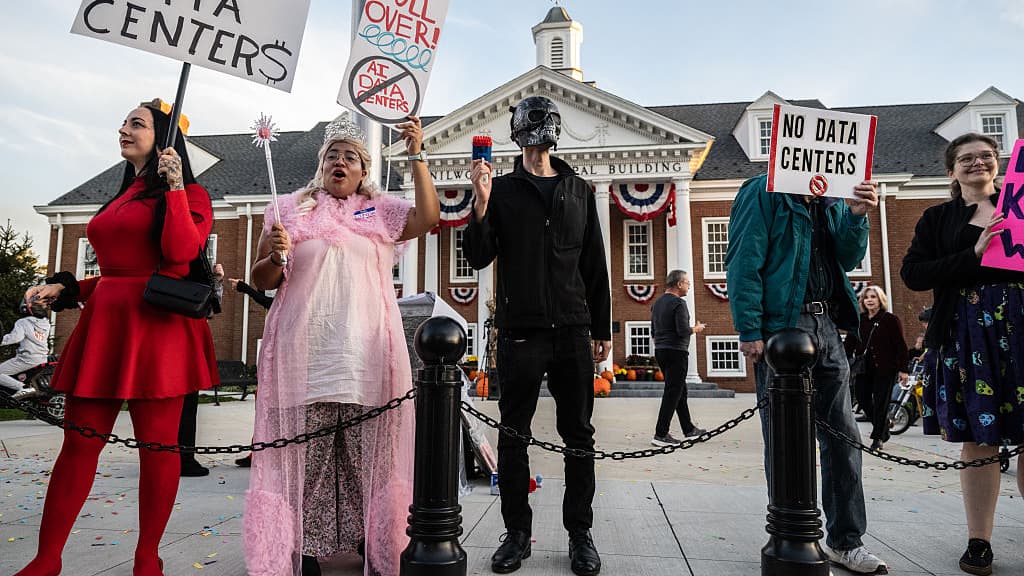
Protesters rallied outside Senate minority leader Chuck Schumer’s building on Friday over concerns that the bill could boost datacenters. uncertain
bill → rally → datacenters
“It would be highly ironic if, having won an election where datacenter opposition was at the front and center, the first act of Congress was to make it easier to build datacenters,” said Bill McKibben. asserted
McKibben → win → datacenters
Democrats elected in the blue wave will not take their seats until January, so the bill’s proponents still have time to rush it through the Senate, and technically there is time for it to pass in the House before new Congress and go to Trump. But the election success for the Democrats is dialing up the political friction. asserted
success → elect → friction
House minority leader Hakeem Jeffries, expected to be the House speaker in the new Congress, said the bill “falls short in several areas” including failing to protect tribal sovereignty, and he would not “rubber-stamp legislation without more constructive involvement with our caucus”. asserted
he → expect → caucus
On Monday, the bill’s Democratic sponsors, Senators Martin Heinrich and Sheldon Whitehouse, said they had the votes to pass the bill. asserted
they → say → bill
Heinrich said they had made last-minute changes to ensure tribal consultation, and they believed the bill would favor renewables over fossil fuels. asserted
bill → say → fuels
“If we can create an open, competitive level playing field, clean is cheap, and cheap wins in the marketplace,” Heinrich said. asserted
Heinrich → create → marketplace
Whitehouse, who wore a tie with wind turbines on it, argued that passing the bill would set the stage for Democrats to work on clean energy policies next year with majorities in the House and Senate. asserted
Democrats → wear → House
“People should just cool their jets and have a little faith that this is not the end of the story,” he said. asserted
he → cool → story
Proponents of Baaja say it is needed because it takes too long to build large projects in America and the bill shortens timelines. asserted
bill → say → timelines
It simplifies federal rules for building interstate transmission lines, it narrows what gets reviewed under the National Historic Preservation Act and limits tribal consultation, it limits the use of the Clean Water Act, shortens timelines for the Endangered Species Act, limits how the executive branch can interfere with federal permitting, and makes big changes to Nepa such as changing what requires Nepa review and who has standing to sue. asserted
who → simplify → standing
Baaja would expand fossil fuels asserted
Baaja → expand → fuels
The fossil fuel industry is backing Baaja. asserted
industry → back → Baaja
The American Petroleum Institute (API) hailed the bill as “a historic opportunity” and called on congress to “finish permitting reform this year”. asserted
Institute → hail → reform
“It creates a very accelerated fast track for gas pipelines,” said Earthjustice Action’s president, Abbie Dillen. asserted
president → create → pipelines
“The gas industry is extraordinarily excited about this because they are interested in expanding existing pipeline capacity to get more liquefied natural gas out for export, and to be feeding power-hungry datacenters with gas. asserted
they → expand → gas
The bill could help pave the way for the Constitution gas pipeline that Williams Companies is trying to build through New York. uncertain
Companies → pave → York
The state denied the project’s water quality permit in 2016, but the company has revived the project under the Trump administration. asserted
company → deny → administration
The proposed pipeline could benefit from the bill’s changes to the Clean Water Act. uncertain
pipeline → propose → Act
Baaja could also enable construction of gas pipelines in the west. uncertain
Baaja → enable → west
Fossil fuel advocacy group Western States and Tribal Nations wants to build gas pipelines to feed domestic datacenters and export LNG from the west coast. asserted
group → want → coast
During a 3 November election day meeting with New York’s Sweetwater county board of commissioners, the advocacy group’s president, Andrew Browning, said he was talking to lawmakers about the bill: asserted
he → say → bill
“The permitting bill’s a huge thing … asserted
bill → ’ → ?
We’re going to need that for everything we’re envisioning and building out.” asserted
we → go → everything
How the bill would increase clean energy asserted
bill → increase → energy
Some clean energy advocates want the bill to pass because it would connect renewables to the grid. asserted
it → want → grid
Wind, solar and battery storage are now cheap to build, but the country lacks the necessary transmission lines to bring clean energy where it’s needed. asserted
it → build → energy
Interstate transmission lines can take a decade to get built, and energy projects also face a bottleneck in connecting to the grid. asserted
projects → take → grid
At the end of 2025, 2,060 GW of total generation and storage capacity were waiting in a queue to connect to the grid. asserted
GW → wait → grid
Ben King, energy and climate director at Rhodium Group, said Baaja would reform the interconnection queue process and unlock the ability to build the transmission that is needed. asserted
that → say → transmission
“We’re at a pretty low point for policy support for clean [energy],” he said, referring to Trump’s repeal of clean energy tax credits. asserted
he → ’re → credits
“[Baaja] sets up the ability to build stuff more quickly for when the next wave of climate policy happens.” asserted
wave → set → policy
Many experts have modeled what the bill would do to emissions, but there is a lot of uncertainty on that question. asserted
bill → model → question
…and 27 more, not listed.
Give feedback · no sign-in needed

No sign-in needed for now. Your note is sent without a name, so it cannot be answered.

History Support