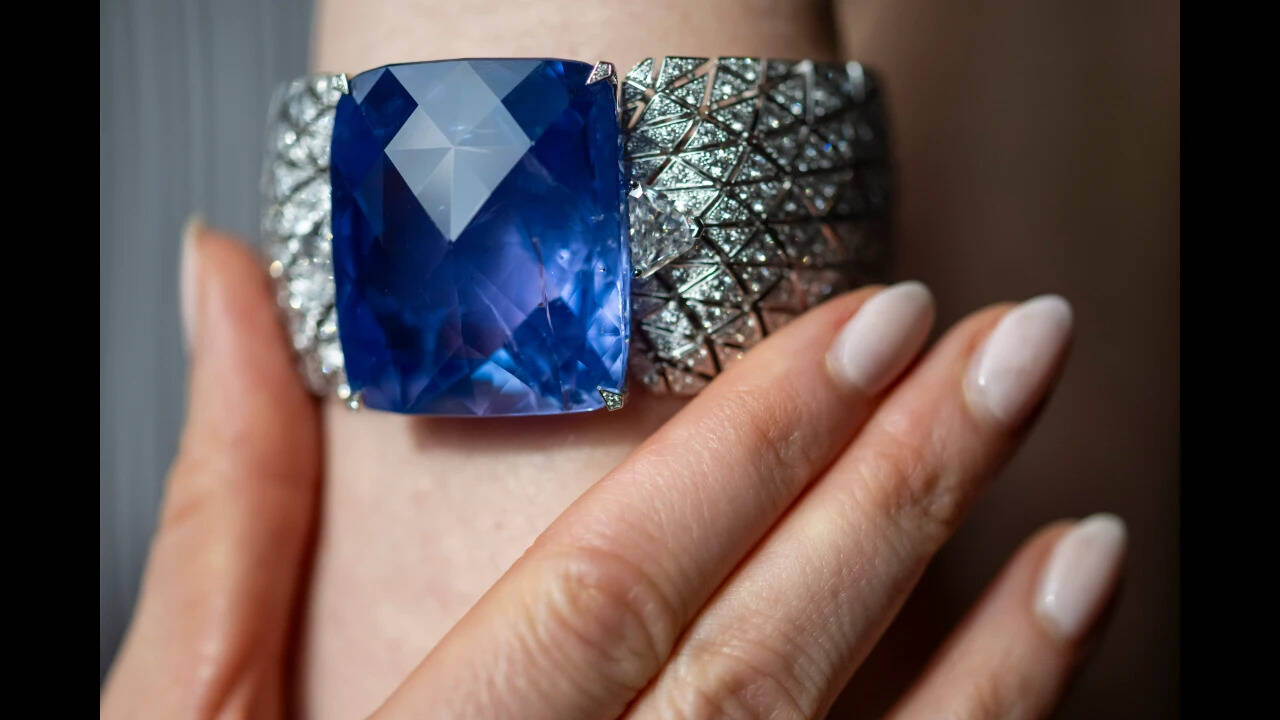
Photo via Times of India

Russian imperial family's 197-carat sapphire sells for $4.9 million, beating estimate

Read the original at Times of India ↗
Cite

TOI World Desk. (2026, November 12). Russian imperial family's 197-carat sapphire sells for $4.9 million, beating estimate. Times of India. https://timesofindia.indiatimes.com/world/rest-of-world/a-197-80-carat-sapphire-once-worn-by-russias-last-imperial-familys-dowager-empress-at-a-1903-royal-ball-has-sold-for-4-9-million-in-geneva-far-above-its-presale-estimate-of-up-to-2-million/articleshow/135774885.cms

Dated from the outlet's own feed. Check the original for its byline.

Times of India · collected 2026-11-12 · by TOI World Desk

Quick Summary

A 197.80-carat natural Ceylon sapphire from the Russian Crown Jewels sold for $4.9 million at a Sotheby’s auction in Geneva, significantly exceeding the original estimate of approximately $2 million. The stone, which was worn by Dowager Empress Maria Feodorovna at the 1903 Winter Palace Ball, features an unusual Mughal-era faceting style and was once paired with a 249.25-carat sapphire. This report focuses on the gem's transition from a symbol of Tsarist opulence to a modern auction success, highlighting how its imperial history drove its high final price.
Written by AI on 2026-11-14, from this article's own text only (the story summary below draws on all the coverage).
See how they differ ↓

AI analysis

Story summary

A Romanov sapphire bracelet sold for $4.9 million at a Sotheby’s auction in Geneva on November 9, 2026, significantly surpassing the expected price range of $1 million to $2 million. The cushion-shaped sapphire, weighing 197.80 carats, was once part of the Russian Crown Jewels and was worn by Dowager Empress Maria Feodorovna at the 1903 Winter Palace Ball. The stone's Mughal-era origin suggests it entered Russian imperial possession long before the Romanov dynasty's peak, making it a rare and historically significant gem. The buyer, a private collector, remains anonymous.

Written for “Russian imperial family's 197-carat sapphire sells for $4.9” on 2026-11-21, grounded in this article and the 2 other(s) covering the same event.

How they differ

3 outlets covered “Russian imperial family's 197-carat sapphire sells for $4.9”.

What each outlet says

One AI summary per outlet of its latest article on this story, written from that article alone and checked against it. Open the article for the outlet's own words.

Times of IndiaThis outlet12 Nov

A 197.80-carat natural Ceylon sapphire from the Russian Crown Jewels sold for $4.9 million at a Sotheby’s auction in Geneva, significantly exceeding the original estimate of approximately $2 million. The stone, which was worn by Dowager Empress Maria Feodorovna at the 1903 Winter Palace Ball, features an unusual Mughal-era faceting style and was once paired with a 249.25-carat sapphire. This report focuses on the…

Russian imperial family's 197-carat sapphire sells for $4.9 million, beating estimate (this article)
Toronto Star12 Nov

Sotheby’s in Geneva recently sold a Romanov sapphire bracelet that exceeded expectations by selling for over 4.1 million Swiss francs ($4.9 million). The bracelet, featuring a nearly 198-carat cushion-shaped sapphire once owned by Russia’s imperial family, was initially estimated to fetch between 850,000 and 1.7 million Swiss francs.

A Romanov sapphire bracelet sells for $4.9 million at a Geneva auction →
The Independent12 Nov

A private collector purchased a 197.80-carat cushion-shaped Ceylon sapphire for over 4.1 million Swiss francs (£3.7 million) at a Sotheby's auction in Geneva. The final sale price vastly exceeded the expected range of 850,000 to 1.7 million francs for the stone, which was famously worn by Dowager Empress Maria Feodorovna at the 1903 Winter Palace Ball. The report focuses on the gemstone's historical significance as…

Sapphire that once belonged to doomed Romanov family fetches nearly £4m at auction →

Compared with similar articles

This article reads unscored and hedges 7% of its claims. Each row says how that neighbour differs.
Toronto Star
Hedges 0 of 2 claims Outlet record 64/100
The Independent
Hedges 0 of 14 claims Outlet record 59/100

Story

Russian imperial family's 197-carat sapphire sells for $4.9
Entertainment · 3 article(s) covering the same event. See how they differ ↑
How this article was measured signals, leaning charts, publisher record, byline, topics and claims

Signals How these are calculated →

Claims extracted
43
sentences that state something as happening or true
Uncertain
7%
3 of 43 hedged ("reportedly", "may", "according to")
Leaning
not political
takes no side on a contested political question
Publisher signals
59/100
Times of India's corrections and hedging, across everything collected from it. Not a measure of accuracy.
Outlets on this story
3
Entertainment
Same framing elsewhere
1
articles that frame the event the way this one does
Analyzed 2026-11-14 · how these are computed

How this is being covered How these are calculated →

Article leaning vs. publisher reliability
Source leaning vs. consistency

Publisher

Times of India · 5474 article(s) · 6 correction(s) detected
Running correction rate · 6 correction(s)

Who wrote this

TOI World Desk
1562 article(s) here · 1 carrying a prediction
“I will make it a home again,” she said, recalling that her previous time there had been “very beautiful” and “very comfortable”.
The proposed Western Downs Digital Park, about 250 kilometres west of Brisbane, is expected to become one of Australia's largest computing facilities, with artificial intelligence company Anthropic signed as its anchor tenant.
He added that the FBI would hunt down anyone found responsible for malicious cyber activity.
He also warned that authorities would pursue not only those allegedly stealing the goods but also those knowingly making money by reselling stolen cargo.
Huang, who resigned as Nvidia's chief executive on November 12 following revelations about multiple extramarital relationships including with a suspected Chinese spy, allegedly used public humiliation as a management tool, because he believed that his employees became so rich that he could no more motivate them with money.
In an email sent to then pardon attorney Ed Martin in the fall of 2025, Mitchell argued that delaying the pardons would increase the financial and emotional burden on Trump supporters facing criminal cases in Georgia, Michigan, Arizona, Nevada and Wisconsin.
Trump supports bill to slash electricity prices President Donald Trump had pushed senators to vote for the measure, which he described as a critical step toward boosting American energy independence and reducing household costs. Trump called it a big win for U.S. energy production, saying that faster approvals would help the country build pipelines, mines and power plants without lengthy regulatory delays, the Associated Press reported.
The senator-elect also explained the motivation behind his suggestion, saying the shoes could encourage students to keep studying for the remainder of the academic year.
Stewart described the moment as one he would never forget.
New York City mayor Zohran Mamdani has announced a $290 million (£230 million) plan to close the troubled Rikers Island jail complex by 2032.
Wire or desk byline, not an individual reporter.
Also by TOI World Desk
Nothing else under this byline is closely related to this article, so these are simply their most recent.
All 1562 articles by TOI World Desk →

Topics

Cartier Geneva Russian Sotheby’s the Russian Crown Jewels

Subjects

Cartier ORG · 3× Ganna Walska PERSON · 3× Mughal NORP · 3× the Russian Crown Jewels ORG · 3× Geneva GPE · 2× Maria Feodorovna PERSON · 2× Moscovite NORP · 2× Russian NORP · 2× Sotheby’s ORG · 2× Soviet NORP · 2×

Narrative

The stone, once part of the Russian Crown Jewels and worn by Dowager Empress Maria Feodorovna at the 1903 Winter Palace Ball, was offered as the centrepiece of a Cartier bracelet and had a presale estimate of up to 1.7 million Swiss francs, or roughly $2 million, as per Sotheby’s website.
framing: assertive · carried by 1 article(s) · first seen 2026-11-14
Its unusual faceting style points to a Mughal-era origin, suggesting it may have entered the Russian Crown Jewels long before the Romanov dynasty reached its height.

Claims (43 extracted, 3 hedged)

A 197.80-carat sapphire with a direct link to Russia’s imperial past has sold for $4.9 million at Sotheby’s in Geneva, far exceeding expectations. asserted
sapphire → sell → expectations
The stone, once part of the Russian Crown Jewels and worn by Dowager Empress Maria Feodorovna at the 1903 Winter Palace Ball, was offered as the centrepiece of a Cartier bracelet and had a presale estimate of up to 1.7 million Swiss francs, or roughly $2 million, as per Sotheby’s website. asserted
stone → wear → website
The sapphire, known as the Romanov Sapphire, carries a history that stretches back centuries. asserted
that → know → history
Its journey from the Russian imperial court to a modern auction room is a story of revolution, exile and reinvention, and its final sale price reflects the enduring appeal of objects with a royal past. asserted
price → reflect → past
A sapphire from the Romanov era The Romanov Sapphire is a 197.80-carat natural, unheated Ceylon sapphire, according to certificates from SSEF and Gübelin. uncertain
Sapphire → accord → SSEF
Its unusual faceting style points to a Mughal-era origin, suggesting it may have entered the Russian Crown Jewels long before the Romanov dynasty reached its height. uncertain
dynasty → facete → height
The exact date the sapphire entered the Russian Crown Jewels is not recorded. asserted
sapphire → enter → Jewels
What is known is that it was part of a collection that included some of the most famous gemstones in history, many of which were acquired by Empresses Elizabeth and Catherine the Great in the 18th century. asserted
many → know → century
The stone was originally set in a diamond border by Fabergé and formed part of a pair of brooches or clasps, alongside a second sapphire weighing 249.25 metric carats. asserted
stone → set → carats
This pairing gave the sapphire a place in one of the most opulent royal collections ever assembled. asserted
pairing → give → collections
Worn at the 1903 Winter Palace Ball The sapphire was worn by Dowager Empress Maria Feodorovna, born Princess Dagmar of Denmark, at the 1903 Winter Palace Ball in St Petersburg. asserted
sapphire → wear → Petersburg
She wore it on the front panel of her skirt, alongside its pair, in a costume that reflected the grandeur of the Tsarist court. asserted
that → wear → court
The ball was a recreation of old Moscow, with the entire court dressed in 17th-century Moscovite style. asserted
court → dress → style
The costumes were embedded with jewels sewn into the costumes themselves, a visual spectacle that captured the extravagance of the era. asserted
that → embed → era
The image of the Dowager Empress in historicising Moscovite dress, adorned with large sapphires of old Mughal cutting style, became a lasting symbol of the Romanov court. asserted
image → adorn → court
It is this connection that gives the sapphire much of its historical weight today. asserted
that → give → weight
After the Russian Revolution, the Soviet government inventoried the Russian Crown Jewels in a lavishly illustrated catalogue known as the Fersman catalogue. asserted
government → inventorie → catalogue
The collection was divided into three categories, with the most historically valuable pieces preserved and others sold abroad. asserted
pieces → divide → categories
The Romanov Sapphire fell into the third category, deemed to have little historical or artistic value beyond its intrinsic worth. asserted
Sapphire → fall → worth
It was sold off anonymously as part of the Soviet disposal of the Crown Jewels in the 1920s. asserted
It → sell → 1920s
In 1927, the sapphire was acquired by Ganna Walska, a socialite and self-proclaimed coloratura soprano known for her extravagant lifestyle and love of bold jewellery. asserted
sapphire → acquire → jewellery
She purchased it from Cartier, where it was set as the central pendant on a sautoir. asserted
it → purchase → sautoir
Ganna Walska and the sapphire’s journey Ganna Walska was a larger-than-life figure who collected jewels with the same intensity she pursued marriages and artistic ambitions. asserted
she → collect → marriages
She had the sapphire remounted in 1929 on another sautoir necklace, alongside a carved Mughal emerald weighing 256.60 carats. asserted
sapphire → have → carats
The necklace was altered many times over the years. asserted
necklace → alter → years
By the time the sapphire appeared in Walska’s estate sale at Sotheby’s Parke Bernet in 1971, it was the centrepiece of a shorter necklace made of tumbled sapphire beads. asserted
it → appear → beads
The sapphire resurfaced again at Sotheby’s Geneva in 1992, this time set on an emerald and sapphire bead torsade necklace. asserted
sapphire → resurface → necklace
Each iteration reflected the changing tastes of its owners and the evolving styles of the jewellery world. asserted
iteration → reflect → world
In 2015, Cartier created the bracelet that now holds the Romanov Sapphire. asserted
that → create → Sapphire
The design echoes the Art Deco style that was in vogue when Cartier first mounted the sapphire for Walska in the 1920s. asserted
Cartier → echo → 1920s
The bracelet features brilliant-cut diamonds and modified shield step-cut diamonds, with an interchangeable engraved rock crystal centre embellished with triangular diamonds. asserted
bracelet → feature → diamonds
This design allows the sapphire to remain the focal point while adding a contemporary touch. asserted
sapphire → allow → touch
The bracelet is signed Cartier and comes with case, pouches and documentation, including Cartier information bundles and copies of the original design. asserted
bracelet → sign → design
These details add to the piece’s provenance and appeal to collectors. asserted
details → add → collectors
Why the price exceeded expectations asserted
price → exceed → expectations
This suggests that buyers saw more in the sapphire than just its size and quality. uncertain
buyers → suggest → size
The combination of imperial provenance, royal wear and a connection to one of the most dramatic periods in Russian history gave the stone a story that few modern gems can match. asserted
gems → give → that
Collectors are often willing to pay a premium for objects with a documented past. asserted
Collectors → pay → past
The story behind the sapphire adds layers of narrative too, the gem itself, of course, but also part of the Russian Crown Jewels, worn by a dowager empress and then owned by a famous socialite. asserted
story → add → socialite
Buyers are increasingly drawn to items with a clear provenance, particularly those linked to royalty, famous collections or significant historical events. asserted
Buyers → draw → royalty
…and 3 more, not listed.
Give feedback · no sign-in needed

No sign-in needed for now. Your note is sent without a name, so it cannot be answered.

History Support