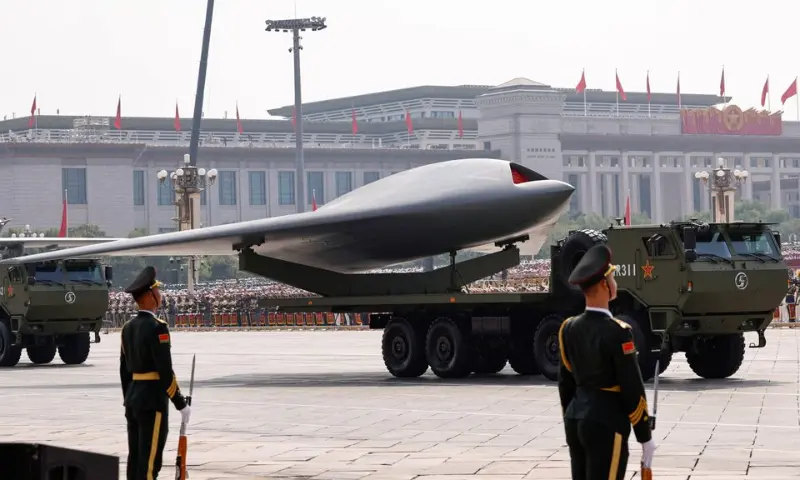
Photo via Dawn

‘A moral red line’? World on cusp of autonomous weapons revolution

Read the original at Dawn ↗
Cite

AFP. (2026, November 14). ‘A moral red line’? World on cusp of autonomous weapons revolution. Dawn. https://www.dawn.com/news/2044483/a-moral-red-line-world-on-cusp-of-autonomous-weapons-revolution

Dated from the outlet's own feed. Check the original for its byline.

Dawn · collected 2026-11-14 · by AFP

Quick Summary

Lethal autonomous weapons, or LAWS, are set to transform warfare, yet there is no established legal framework to regulate them. A United Nations conference in Geneva aims to discuss curbs and prohibitions on these weapons, known as killer robots, but some analysts doubt the discussions will match the rapid advancements in the technology. The conference will focus on defining human control in the use of these weapons, with differing stances from the US and France on the level of human involvement required. Ethical concerns are rising, with the UN Secretary General and the International Committee of the Red Cross warning about the moral implications of machines autonomously targeting humans. However, the scope of the Geneva discussions is limited, not covering the broader ethical issues of AI use in warfare, such as target generation and analysis.
Written by AI on 2026-11-15, from this article's own text only (the story summary below draws on all the coverage).
See how they differ ↓

AI analysis

Story summary

As of November 16, 2026, negotiations on rules for lethal autonomous weapons, or "killer robots," have hit a procedural impasse at the United Nations in Geneva. Russia objected to the agenda, bringing proceedings to a halt before noon and halting discussions on the Convention on Certain Conventional Weapons. The U.N. chief and advocacy groups like Human Rights Watch urge countries to impose strict, binding regulations on the use of such weapons, citing the risk to civilians. Despite calls for decisive action, nine countries, including Iran, Saudi Arabia, and China, abstained from immediate support for strict regulations. The talks aim to address the ethical and legal implications of autonomous weapons, with some experts expressing pessimism about achieving meaningful, binding regulations given the current international legal climate.

Written for “UN Talks on Killer Robots Impasse” on 2026-11-21, grounded in this article and the 9 other(s) covering the same event.

How they differ

6 outlets covered “UN Talks on Killer Robots Impasse”.

What each outlet says

One AI summary per outlet of its latest article on this story, written from that article alone and checked against it. Open the article for the outlet's own words.

DawnThis outlet14 Nov

Lethal autonomous weapons, or LAWS, are set to transform warfare, yet there is no established legal framework to regulate them. A United Nations conference in Geneva aims to discuss curbs and prohibitions on these weapons, known as killer robots, but some analysts doubt the discussions will match the rapid advancements in the technology. The conference will focus on defining human control in the use of these…

‘A moral red line’? World on cusp of autonomous weapons revolution (this article)2 articles from Dawn on this story
The Straits Times16 Nov

At a UN conference on November 16, Russia objected to the inclusion of observers and civil society groups, causing a procedural standstill that blocked the adoption of an agenda for discussions on lethal autonomous weapons systems, or “killer robots.” UN Secretary-General Antonio Guterres had called for strict regulations on these weapons to prevent harm to civilians, but Russia’s actions stalled progress…

Russia plunges UN killer robot talks into ‘procedural impasse’ →4 articles from The Straits Times on this story
CBC16 Nov

Diplomats from over 100 countries, including Canada, the U.S., Russia, and China, will discuss autonomous weapons at a UN Convention on Certain Conventional Weapons meeting in Geneva this week. However, experts like Paul Lushenko from Cornell University predict that meaningful, binding regulations are unlikely due to concerns over losing military advantages. The U.S. and China notably declined to sign a February…

What will it take for the world's superpowers to agree on AI regulations in war? →
Toronto Star16 Nov

Government envoys at the U.N. offices in Geneva are discussing whether to start negotiations for rules on lethal autonomous weapons, such as killer robots and armed drones. Seven countries, including Austria and New Zealand, have proposed initiating talks on a new legally binding agreement to regulate these weapons. The meeting follows concerns raised by advocacy groups and the U.N. Secretary-General Antonio…

UN-backed talks consider possible rules on lethal autonomous weapons →
The Hindu16 Nov

Government envoys are meeting at UN offices in Geneva to discuss potential regulations for lethal autonomous weapons, such as armed drones. Seven countries, including Austria and New Zealand, have proposed starting negotiations for a legally binding agreement to control these weapons. However, major military powers like the United States and Russia are hesitant to limit their development. The Pope, UN…

UN-backed talks consider possible rules on lethal autonomous weapons →
NPR16 Nov

At the United Nations in Geneva, negotiations are ongoing to establish rules for lethal autonomous weapons, or 'killer robots.' Humanitarian groups and the International Committee of the Red Cross are advocating for legally binding regulations, citing concerns that autonomous weapons cannot uphold the Geneva Conventions, particularly the ability to distinguish between combatants and non-combatants. Countries like…

U.N. talks seek to rein in 'killer robots' as fears over AI weapons grow →

Where they agree and split

The full story: what happened, how it changed, and all 10 articles →

Compared with similar articles

This article reads leans left and hedges 0% of its claims. Each row says how that neighbour differs.
The Straits Times
Leans right further right than this Hedges 1 of 19 claims Outlet record 64/100
“The articles describe different stages of the same broader topic, with Article A discussing the opposition to talks on limiting autonomous weapons, and Article B introducing the upcoming conference and its objectives.”
CBC News
Leans right further right than this Hedges 11 of 41 claims Outlet record 60/100
The Straits Times
Leans strongly left further left than this Hedges 1 of 16 claims Outlet record 64/100
“The articles refer to an upcoming conference about killer robots, but they describe the event at different times—one on the day it starts, the other before it begins—and discuss it with different focuses.”
NPR
Leans strongly left further left than this Hedges 2 of 30 claims Outlet record 60/100
“While both articles discuss the same topic of a UN conference on lethal autonomous weapons (killer robots) in Geneva, they are from different dates and describe the conference at different stages, suggesting they are not reporting on the exact same specific moment or occurrence.”
The Straits Times
Leans right further right than this Hedges 1 of 19 claims Outlet record 64/100
“The articles describe different stages of the same general topic (discussions on autonomous weapons regulations), but the specific events they cover are not the same: Article A is about the expected opposition from the US and Russia during the meeting, while Article B sets the stage for the upcoming conference and discusses the background and key questions.”
The Hindu
Leans left Hedges 3 of 23 claims Outlet record 78/100
“While both articles discuss the same topic of a conference at the UN on lethal autonomous weapons, the dates are different, suggesting they are not reporting on the exact same specific event.”
Toronto Star
Leans right further right than this Hedges 3 of 25 claims Outlet record 64/100
“While both articles discuss the same topic of lethal autonomous weapons at a UN conference, they report on different stages or aspects of the event, with Article A previewing the conference and Article B covering the ongoing discussions.”
Dawn
Hedges 2 of 21 claims Outlet record 67/100
“Article A discusses the upcoming conference on autonomous weapons, while Article B reports on the UN chief's call during the actual conference event, indicating different stages of the same broader topic.”
The Straits Times
Leans right further right than this Hedges 2 of 21 claims Outlet record 64/100
“Article A discusses the upcoming conference and the context around lethal autonomous weapons systems, while Article B reports on the actual procedural impasse that occurred during the conference.”

Story

UN Talks on Killer Robots Impasse
Politics · 10 article(s) covering the same event. Compare every outlet's account →
How this article was measured signals, leaning charts, publisher record, byline, topics and claims

Signals How these are calculated →

Claims extracted
27
sentences that state something as happening or true
Uncertain
0%
0 of 27 hedged ("reportedly", "may", "according to")
Leaning
Leans left
of the writing, not the subject · beta estimate
Publisher signals
67/100
Dawn's corrections and hedging, across everything collected from it. Not a measure of accuracy.
Outlets on this story
10
Politics
Same framing elsewhere
1
articles that frame the event the way this one does
Analyzed 2026-11-15 · how these are computed

How this is being covered How these are calculated →

Article leaning vs. publisher reliability
Source leaning vs. consistency

Publisher

Dawn · 3503 article(s) · 5 correction(s) detected
Running correction rate · 5 correction(s)

Who wrote this

AFP
1304 article(s) here · 1 carrying a prediction
“If they persist, the international majority must decide how it will achieve AI weapons controls.”
2026-11-21 · assertive framing · Talks on ‘killer robots’ in race against the clock
“I would love to see him be back.
A full written argument would be extremely long, he said, adding that he had not yet mastered all of the mathematics involved and planned to write it up properly.
US federal prosecutors alleged that an Indian intelligence officer, who remains at large, directed the plot and recruited Gupta in May 2023 to hire a hitman to carry out the murder.
Huang resigned as chief of the chip giant at the centre of the artificial intelligence (AI) revolution after revelations of extramarital affairs, including one with an alleged Chinese spy who may have funnelled restricted chips to that country.
Mr. Kobir said Dhaka would deal with attacks "very firmly".
They were referring to recursive self-improvement (RSI) — a term the industry uses to describe building advanced AI models that can autonomously create newer versions of themselves, which critics worry will hasten doomsday scenarios.
And Ukraine fears this winter could be the worst yet.
World champions Spain will face France while England will play Norway in the quarterfinals of the UEFA Nations League after the draw took place on Friday.
In March, South Korea’s then-prime minister Kim Min-seok said that Trump thought a meeting with Kim would be “good”.
Wire or desk byline, not an individual reporter.
Also by AFP
Nothing else under this byline is closely related to this article, so these are simply their most recent.
All 1304 articles by AFP →

Topics

AFP Geneva Iran Lethal Autonomous Weapons Systems the Convention on Certain Conventional Weapons

Subjects

Geneva GPE · 4× Iran GPE · 3× Rickli PERSON · 2× AFP ORG · 1× IFRI ORG · 1× Jean-Marc Rickli PERSON · 1× Laure de Roucy-Rochegonde PERSON · 1× the Centre for Geopolitics of Technology ORG · 1× the French Institute of International Relations ORG · 1× the Geneva Centre for Security Policy ORG · 1×

Narrative

“The human role is always ensured through what is termed ‘appropriate control’ by a military commander – a concept that varies in scope depending on the system’s criticality and the operational context,” said Rear Admiral Vincent Sebastien, deputy director of the French defence ministry’s Agency for Defence Artificial Intelligence (AMIAD).
framing: assertive · carried by 1 article(s) · first seen 2026-11-15
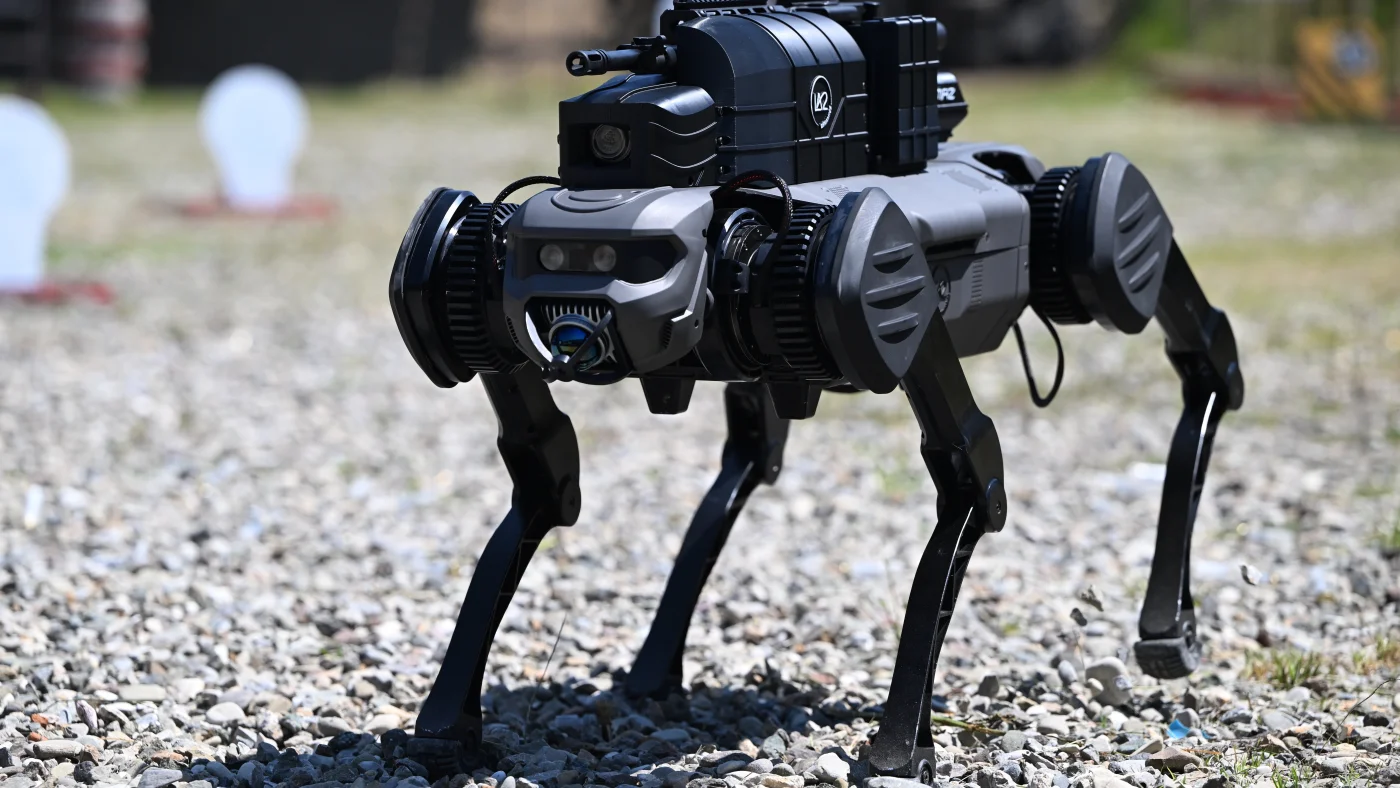
Lethal autonomous weapons powered by artificial intelligence are set to revolutionise warfare, but there is no proper regulatory or legal framework governing the new technology.

Claims (27 extracted, 0 hedged)

Lethal autonomous weapons powered by artificial intelligence are set to revolutionise warfare, but there is no proper regulatory or legal framework governing the new technology. asserted
weapons → power → technology
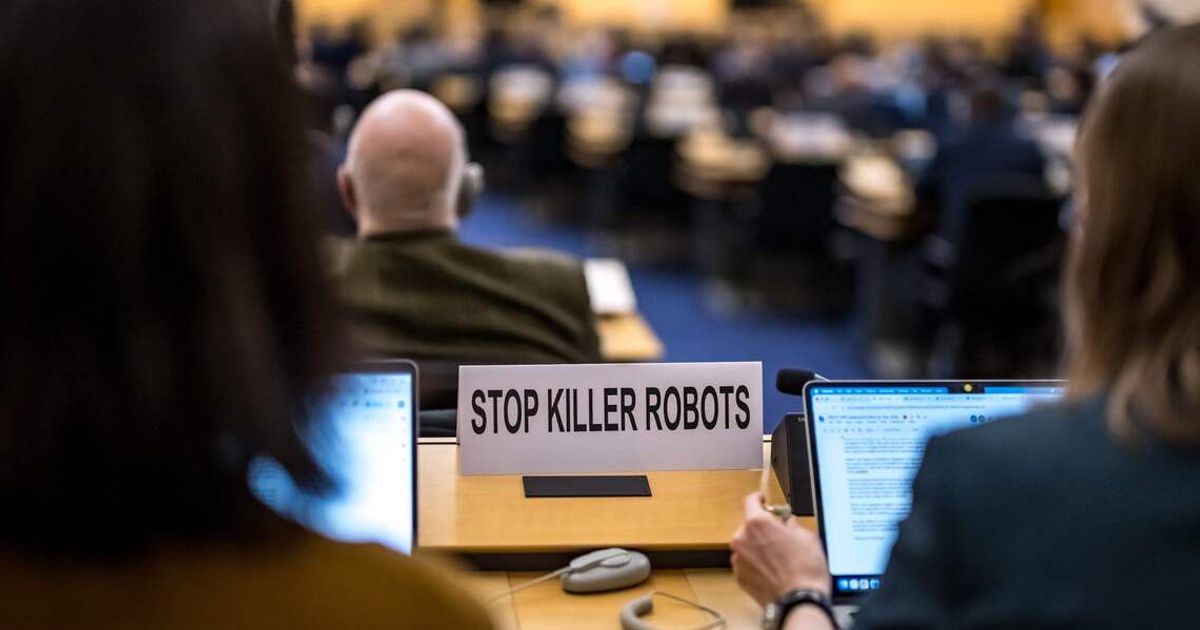
A conference starting Monday at the United Nations in Geneva will discuss how to establish curbs and prohibitions on such weapons, called killer robots by some. But some analysts doubt the discussions at the Convention on Certain Conventional Weapons (CCW) will keep pace with the fast-changing weapons. asserted
discussions → start → weapons
AFP looks at three key questions ahead of the conference. asserted
AFP → look → conference
Lethal Autonomous Weapons Systems (LAWS) “can identify, select, and engage a target without the intervention of a human operator in the execution of these tasks,” said Jean-Marc Rickli, head of global and emerging risks at the Geneva Centre for Security Policy. asserted
Rickli → identify → Policy
Autonomous weapons have long existed. asserted
weapons → exist → ?
An anti-personnel mine “is an autonomous weapon in the sense that it explodes when someone steps on it,” said Laure de Roucy-Rochegonde of the Centre for Geopolitics of Technology at the French Institute of International Relations (IFRI). asserted
Rochegonde → explode → Relations
But with the proliferation of AI-enhanced drones, such weapons are now “capable of selecting and engaging a target that was not predetermined, adapting to their environment without human intervention,” said Rickli. asserted
Rickli → enhance → intervention
So the critical issue for potential regulators lies in determining the level of human control over the decision to employ such a weapon. asserted
issue → lie → weapon
The United States refers to an “appropriate level of human judgement” in the use of autonomous weapons. asserted
States → refer → weapons
France maintains that a human must remain in the decision-making loop and bans “lethal autonomous weapons systems” (LAWS) but permits “partially autonomous” systems known as PLAWS. asserted
human → maintain → PLAWS
“The human role is always ensured through what is termed ‘appropriate control’ by a military commander – a concept that varies in scope depending on the system’s criticality and the operational context,” said Rear Admiral Vincent Sebastien, deputy director of the French defence ministry’s Agency for Defence Artificial Intelligence (AMIAD). asserted
Sebastien → ensure → Intelligence
“We are now dangerously close to crossing a moral red line: the autonomous targeting of humans by machines,” UN Secretary General Antonio Guterres and International Committee of the Red Cross president Mirjana Spoljaric warned in a joint statement in August. asserted
Guterres → cross → August
But analysts said the Geneva discussions, while important, will touch only part of the issue. asserted
discussions → say → issue
Today, the diminishing role of humans is being driven by the growing use of AI in analysis and targeting. asserted
role → diminish → analysis
Rickli said the scope of the agenda in Geneva is “very narrow”. “It fails to encompass the full range of issues surrounding AI on the battlefield” — an area where its use is expanding, particularly in target generation. asserted
use → say → generation
He said this was seen in the US-Israeli war against Iran this year “where the Americans engaged as many as 1,000 targets per day” inside Iran. asserted
Americans → say → Iran
“There are a host of problems and unacceptable risks associated with targeting and decision-support systems,” de Roucy-Rochegonde added. asserted
Rochegonde → be → systems
“Part of this debate concerns systems that are already widely deployed on the battlefield.” asserted
that → concern → battlefield
“What kind of human supervision is required to ensure that the operator is genuinely exercising their own judgement rather than simply providing a rubber stamp for the machine’s recommendations?” she asked. asserted
she → require → recommendations
How quickly is the situation changing? asserted
situation → change → ?
The autonomous weapons to be discussed in Geneva are not yet in widespread use, although analysts have noted that they have been deployed by Russia in its invasion of Ukraine as well as US attacks in Iran. asserted
they → discuss → Iran
“Autonomy will very quickly become a reality on the battlefield,” warned Rear Admiral Sebastien. asserted
Sebastien → become → battlefield
“Autonomous weapon systems are not part of a distant future — a race towards greater autonomy in weapons systems is already well underway,” Guterres and Spoljaric said in their statement. asserted
Guterres → say → statement
Yet significant doubts and dangers remain, Dario Amodei, head of the AI giant Anthropic, warned this year: “Today, frontier AI systems are simply not reliable enough to power fully autonomous weapons.” But ultimately, the incentive for major powers is too strong. asserted
incentive → remain → powers
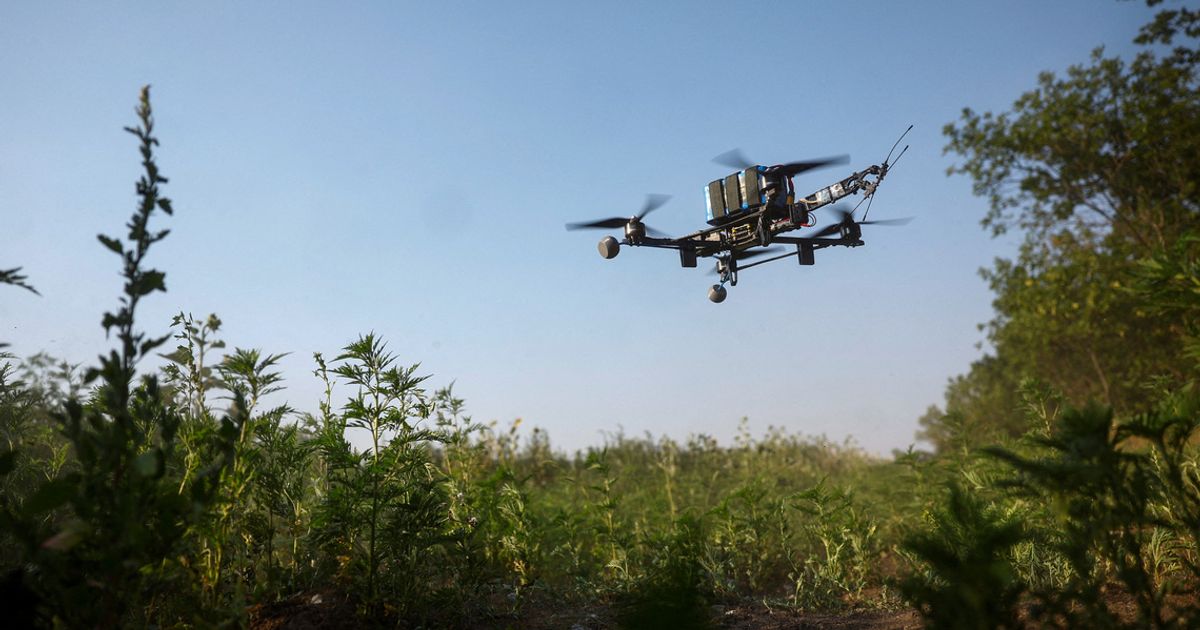
Swarms of autonomous drones — which “aim to neutralise an adversary through saturation” — would be highly effective, and some states view them as a crucial strategic advantage, said Rickli. asserted
Rickli → aim → advantage
In January, the Chinese defence ministry described swarms of autonomous drones as the “new face of warfare.” asserted
ministry → describe → warfare
“In an era of sharp military competition, the first state to normalise fully autonomous lethal strikes will reset expectations for everyone else,” said Gerald Mako, a research affiliate of Cambridge University in the Small Wars Journal. asserted
Mako → normalise → Journal
Give feedback · no sign-in needed

No sign-in needed for now. Your note is sent without a name, so it cannot be answered.

History Support