Islam will be the world’s largest religion in less than a decade, and by 2070, Muslims will outnumber Christians by more than 600 million adherents, a major new report from the Pew Research Center forecasts.
asserted
report → outnumber → Center
The report also projects changes in the U.S. "The United States will no longer have a Christian majority, though Christians will remain the biggest religious group in the country," the report says.
asserted
report → project → country
"By 2070, Christians are expected to decline to less than half of the U.S. population, while religiously unaffiliated people will rise to about 41%.
asserted
people → expect → %
And Jews – who were the country’s third-largest religious group in 2020 – will be outnumbered by both Muslims and Hindus in 2070 if recent demographic trends continue."
The forecasts, if they turn out to be accurate, will have vast political and cultural implications.
asserted
they → outnumber → implications
They are already visible in America, where New York City has a Muslim mayor and Michigan has a newly elected U.S. Senator who is being described as the first Muslim ever elected to the Senate.
asserted
who → have → Senate
The Halal Guys describes itself as one of the fastest growing restaurant chains in America, and the halal food carts have displaced alternatives on the street corners of New York City.
asserted
carts → describe → City
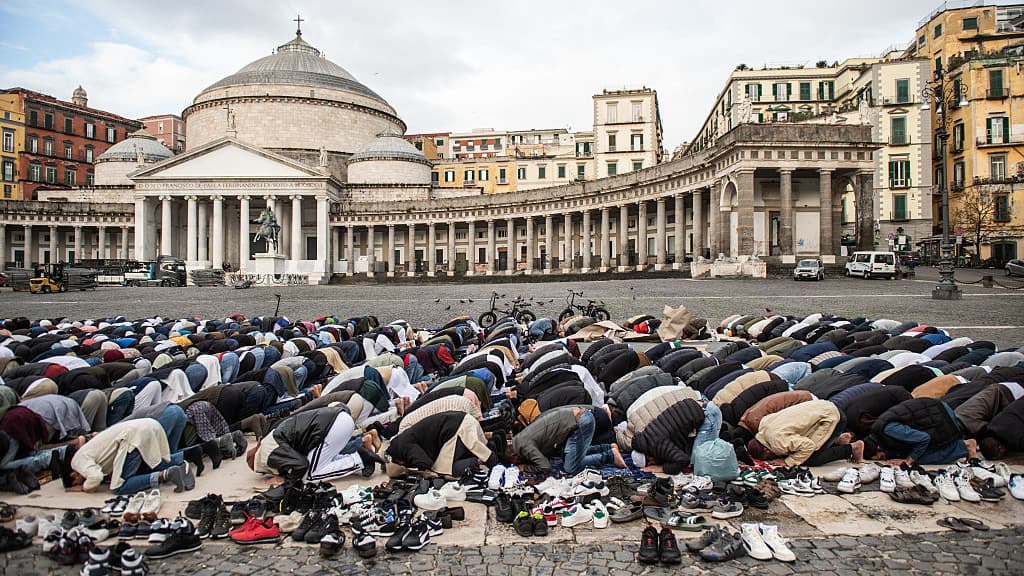
"Dozens of mosques have opened" in the Dallas-Fort Worth area of Texas, the New York Times recently reported.
asserted
Times → open → Texas
"In the four biggest Dallas-Fort Worth counties, the number of mosques nearly tripled to 76 by 2020, up from 28 two decades earlier, according to data from the Association of Religion Data Archives.
uncertain
number → triple → Archives
In Collin County, a fast-growing suburban area north of Dallas, the number quadrupled, to 12 from three."
The trends in Europe are even more advanced.
asserted
trends → grow → Europe
Pew predicts that France, 9.1 percent Muslim and 46.5 percent Christian in 2020, will be 20 percent Muslim and 24.7 percent Christian by 2070.
asserted
France → predict → 2070
Hackett has a doctorate in sociology from Princeton University and also has degrees from the Princeton Theological Seminary.
asserted
Hackett → have → Seminary
In a question and answer-format article posted on the Pew website, he explains that the two main drivers of the projections are fertility differences and religious switching.
asserted
drivers → post → projections
"Muslims have a total fertility rate of 3.1 children per woman, while Buddhists average 1.6 children per woman," Hackett says.
asserted
Hackett → have → woman
"The United States is one of the countries where the population of religious 'nones' is expected to increase, from 30% in 2020 to 41% in 2070.
asserted
population → expect → 2070
Christians made up 64% of the total U.S. population in 2020, but that share is expected to fall to 48% in 2070," Hackett says.
asserted
Hackett → make → 2070
"Currently, people who identify as Jewish when asked about their religion are the third-largest U.S. religious group, making up 1.7% of all Americans.
asserted
who → identify → Americans
By 2070, we project Muslims will be the third-largest group at nearly 4% of the population.
asserted
Muslims → project → population
He expresses a lot of confidence in the fertility-based assumptions, but less in the migration and switching patterns that dictate the country-based forecasts.
asserted
that → express → forecasts
"Generally, most 10-year-old Muslims will survive to be 15-year-old Muslims.
asserted
Muslims → survive → ?
Since we know that Muslims have the highest fertility and the youngest age distribution of all the groups we study, we can be quite confident that their share of the world’s population will increase," he says.
asserted
he → know → population
"It is impossible to know for certain what future migration and switching patterns will look like.
asserted
patterns → know → ?
In our main projection scenario, we assume that the recent migration and switching rates we’ve estimated will continue in the decades ahead.
asserted
we → assume → decades
However, if migration or switching patterns change, our projections could be off."
uncertain
projections → change → ?
Hackett says an earlier projection, from 2015, was "similar to what actually happened," though "in the United States and the United Kingdom, the shares of Christians dropped and the shares of religious ‘nones’ rose more than we anticipated."
asserted
we → say → nones
He also downplays the effect of changes to migration patterns.
asserted
He → downplay → patterns
"This could have a big impact on some local religious landscapes.
uncertain
This → have → landscapes
But about 96% of the world’s people currently live in the country where they were born.
asserted
they → live → country
And in the future, for the countries where most people live, we project that natural population change – the difference between births and deaths – will produce more religious change than migration."
asserted
change → live → migration
The research was funded in part by a $3,315,000 grant from the John Templeton Foundation to the Pew Charitable Trusts.
asserted
research → fund → Trusts
Templeton, founder of a mutual fund company, was a Presbyterian elder; the $3.6 billion foundation, based in Pennsylvania, backs a variety of research on religion, science, and human flourishing.
asserted
foundation → base → religion
The findings pose challenges to Jewish, Christian, and Hindu leaders.
asserted
findings → pose → leaders
Among the potential strategies already floated in response are:
— Trying to increase Jewish and Christian birth rates.
— Trying to reduce the converting-out rates.
— Adjusting immigration policies to reduce in-migration from Muslim countries.
— Doing what is possible to support and ally with more moderate rather than violent or extreme varieties of Islam.
asserted
what → float → Islam
None of those approaches is necessarily simple or easy, though there is ample precedent for religious and demographic trends to change trajectories.
asserted
trends → be → trajectories
The Battle of Vienna in 1683, when Christian forces turned back the Ottomans, is one example.
asserted
forces → turn → Ottomans
Yet at least in some quarters a kind of fatalism is taking hold.
asserted
kind → take → hold
One American Jewish leader and writer, Irit Mizrahi Tratt, recently reposted to social media a video of what was described as "TERRIFYING: An imam at a mosque in Austin, Texas, was recorded calling for the execution of all infidels (non-Muslims) during last Friday’s prayer.
asserted
imam → reposte → prayer
Said Tratt: "Jewish New Yorkers get asked all the time why we’re still here rather than move to friendlier states like Texas or Florida.
asserted
we → say → Texas
The truth is that we cannot outrun these destructive Islamist trend lines-
asserted
we → outrun → lines-
It’s happening across America."
asserted
It → happen → America

 The Aporia