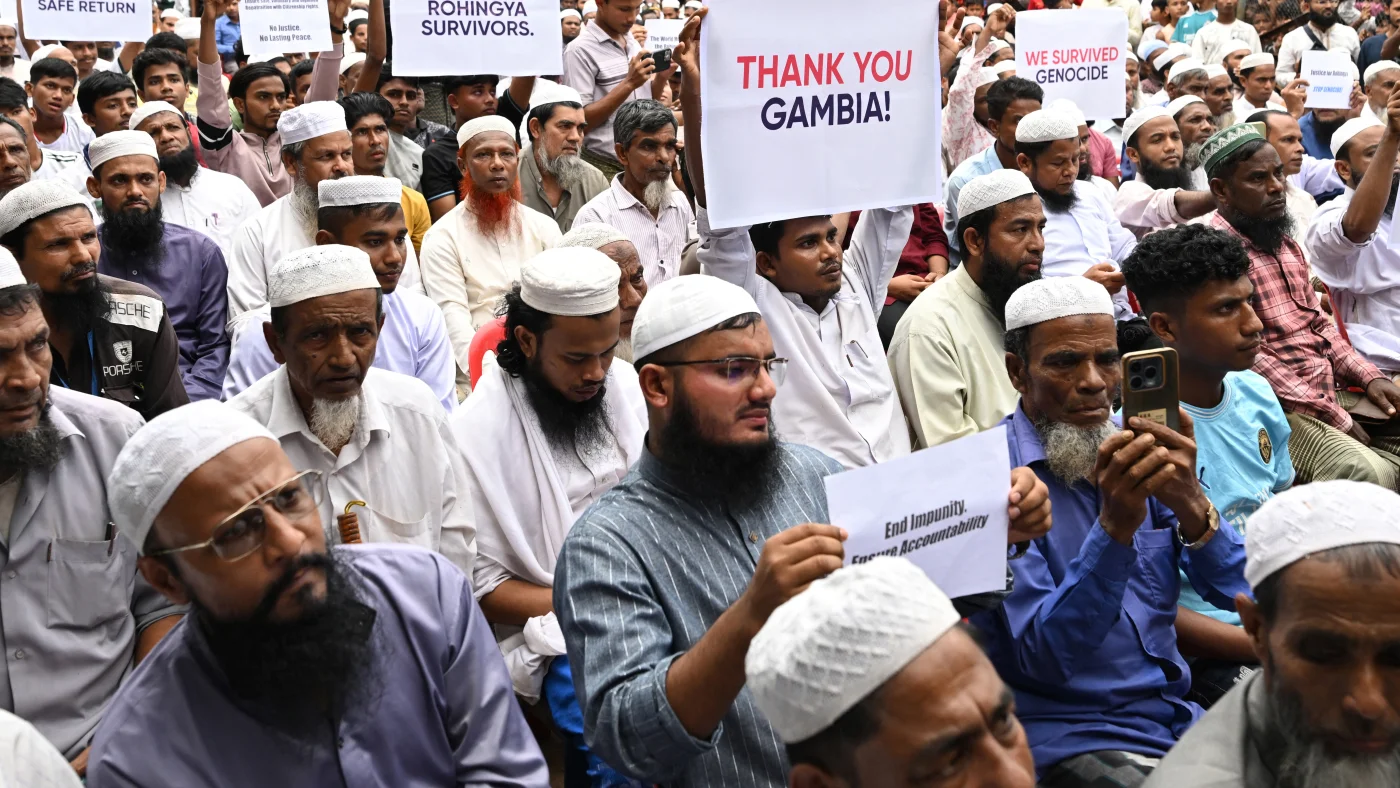
Photo via NPR

The U.N.'s top court rules Myanmar committed genocide against the Rohingya

Read the original at NPR ↗
Cite

Lovett, L. (2026, November 19). The U.N.'s top court rules Myanmar committed genocide against the Rohingya. NPR. https://www.npr.org/2026/11/19/g-s1-154340/un-court-myanmar-genocide-rohingya

Dated from the outlet's own feed. Check the original for its byline.

NPR · collected 2026-11-19 · by Lorcan Lovett
Content note This article describes sexual violence and violence described in detail.

Quick Summary

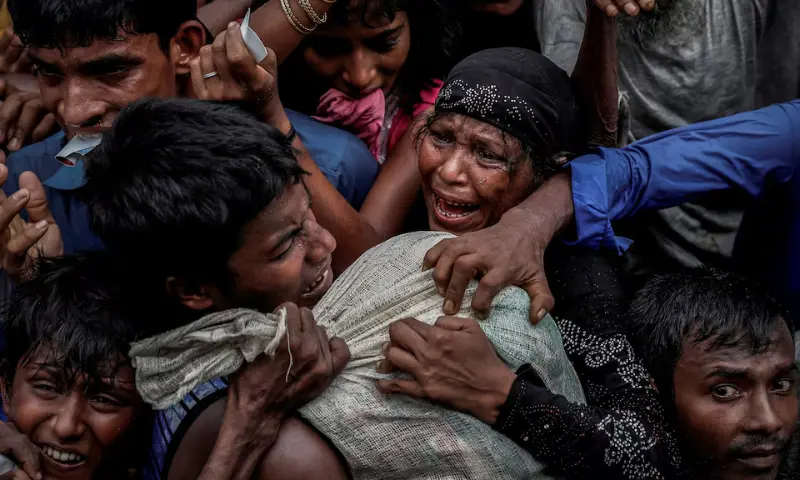
The International Court of Justice ruled that Myanmar committed genocide against the Rohingya minority, marking the first time a state has been held responsible for genocide by the U.N.'s top court. The decision, brought by Gambia under the 1948 Genocide Convention, found that Myanmar’s military campaign in 2017 was systematic and included the killing of around 10,000 Rohingya and the burning of 392 villages. The court rejected Myanmar’s defense that the military actions were counterinsurgency operations, highlighting the military’s failure to distinguish between civilians and insurgents.
Written by AI on 2026-11-20, from this article's own text only (the story summary below draws on all the coverage).
See how they differ ↓

AI analysis

Story summary

The International Court of Justice (ICJ) ruled on November 20, 2026, that Myanmar committed genocide against its Rohingya minority. This landmark judgment, seven years in the making, was brought by The Gambia in 2019. The ruling could intensify international pressure on Myanmar’s military leader, Min Aung Hlaing, who led the 2016-2017 attacks against the Rohingya and later overthrew the elected government of Aung San Suu Kyi in 2021, triggering a civil war that has left tens of thousands dead. The decision may also bolster other genocide cases, such as South Africa's case against Israel over the Gaza war.

Written for “Myanmar Genocide Ruling Implications” on 2026-11-21, grounded in this article and the 49 other(s) covering the same event.

How they differ

20 outlets covered “Myanmar Genocide Ruling Implications”.

What each outlet says

One AI summary per outlet of its latest article on this story, written from that article alone and checked against it. Open the article for the outlet's own words.

NPRThis outlet19 Nov

The International Court of Justice ruled that Myanmar committed genocide against the Rohingya minority, marking the first time a state has been held responsible for genocide by the U.N.'s top court. The decision, brought by Gambia under the 1948 Genocide Convention, found that Myanmar’s military campaign in 2017 was systematic and included the killing of around 10,000 Rohingya and the burning of 392 villages. The…

The U.N.'s top court rules Myanmar committed genocide against the Rohingya (this article)
Al Jazeera20 Nov

The International Court of Justice has ruled that Myanmar committed genocide against the Rohingya minority, a decision that followed a 2017 military crackdown which resulted in thousands of deaths and nearly a million Rohingya refugees fleeing to Bangladesh. The article explores the significance of this ruling and considers whether it could have implications for Israel’s actions in Gaza, as discussed by experts…

What are the implications of the ICJ Rohingya genocide ruling? →12 articles from Al Jazeera on this story
The Guardian20 Nov

The International Court of Justice (ICJ) ruled that Myanmar committed genocide against the Rohingya minority, a decision that has sparked mixed reactions from global powers. The EU praised the ruling as "landmark," while the US took a cautious stance, emphasizing the need to avoid politicizing the court. China, a supporter of Myanmar’s military regime, expressed concerns over judicial overreach and urged caution in…

US reacts cautiously to Myanmar genocide ruling as EU praises ‘critical’ role of UN’s top court →6 articles from The Guardian on this story
The Hindu20 Nov

On November 20, 2026, Myanmar's government spokesperson, Khaing Khaing Soe, dismissed a ruling by the International Court of Justice (ICJ) that Myanmar's security forces conducted State-sponsored genocide against the Rohingya Muslim minority as unfair. The ICJ ruling, which was the first of its kind, was based on a case filed by Gambia seven years earlier. Mr. Khaing Soe claimed that the decision was not unanimous…

Myanmar calls ICJ ruling on genocide 'unfair' →5 articles from The Hindu on this story
Deutsche Welle20 Nov

The International Court of Justice ruled that Myanmar committed genocide against the Rohingya community in 2016 and 2017, ordering Myanmar to prevent future crimes, provide legal protections, and offer reparations to victims. The ruling came after The Gambia filed a case with the ICJ in 2016, accusing Myanmar of a deliberate campaign of violence against the Rohingya. Rohingya activists like Lucky Karim and Wai Wai…

Myanmar genocide ruling: Rohingya say struggle for justice not over →3 articles from Deutsche Welle on this story
The Straits Times20 Nov

The International Court of Justice ruled that Myanmar committed genocide against the Rohingya, a decision that legal experts believe could strengthen South Africa’s genocide case against Israel over the Gaza conflict. The court’s judgment, which found Myanmar guilty of multiple violations of the 1948 Genocide Convention, establishes a legal precedent that genocidal intent can be established alongside military…

Myanmar genocide judgment may bolster Gaza case against Israel →3 articles from The Straits Times on this story
Show 14 more outlets
BBC19 Nov

The International Court of Justice (ICJ) ruled that Myanmar committed genocide against the Rohingya people, a verdict described as historic. The court found that Myanmar violated the 1948 Genocide Convention, with at least 10,000 Rohingya killed during attacks in 2017. The decision also impacts ongoing genocide cases, such as South Africa's case against Israel, by clarifying the standard of evidence needed to prove…

Bowen: Myanmar genocide verdict is historic and could have far-reaching implications →3 articles from BBC on this story
Zeteo19 Nov

This article is an opinion piece by Prem, discussing the perceived instability in the United States following recent system outages and breaches affecting major organizations and government bodies. The author argues that despite these crises, the U.S. society is barely held together not by competent leadership but in spite of it, due to the incompetence of the current cabinet. The piece critiques the responses given…

First Draft – Now We Know What Stands Between Trump’s U.S. and Total Collapse: A Cabinet of Idiots →2 articles from Zeteo on this story
CBC20 Nov

The International Court of Justice ruled that Myanmar committed genocide against the Rohingya Muslim minority, a decision celebrated as recognition of their suffering but criticized for its lack of practical impact due to Myanmar's disregard of international rulings. The ICJ ordered Myanmar to provide reparations and allow Rohingya refugees to return to their villages, but most Rohingya villages have been destroyed…

International court's ruling on Myanmar genocide means little for victims, but much for future cases →2 articles from CBC on this story
ABC News (AU)20 Nov

Myanmar has rejected the International Court of Justice's ruling that its security forces committed genocide against the Rohingya Muslim minority as "unfair." The court's decision, made yesterday, holds Myanmar responsible for the atrocities against the Rohingya. Meanwhile, Rohingya refugees in Bangladesh have welcomed the verdict, although it is uncertain when they will be able to return to their homes in Myanmar.

Myanmar calls international court ruling on Rohingya genocide 'unfair' →2 articles from ABC News (AU) on this story
Toronto Star20 Nov

Rights groups are pushing for military and economic sanctions against Myanmar following a decision by the International Court of Justice, which ruled that Myanmar committed genocide against the Rohingya minority in 2017. The court ordered Myanmar to allow Rohingya refugees to return safely, pay reparations, and prosecute those involved in genocide, but Myanmar’s government is unlikely to comply. The United Nations…

Rights groups urge sanctions after top UN court finds Myanmar committed genocide against Rohingya →2 articles from Toronto Star on this story
Daily Mail16 Nov

Legal and military experts warn that Britain could face genocide accusations under a looser definition of the term, which the International Court of Justice may endorse in its upcoming judgment on Myanmar. The Policy Exchange think tank report highlights potential risks for Britain regarding historical events like the Irish potato famine and the Mau Mau rebellion, and current concerns about Russia and Iran…

Britain at risk of Ireland or Kenya 'genocide' claims under looser definition, say experts - as they warn about Russia and Iran weaponising allegations →
Dawn19 Nov

The International Court of Justice ruled that Myanmar’s security forces committed genocide against the Rohingya Muslim minority in 2017, marking only the fourth genocide ruling since World War II. The court found that Myanmar’s military killed thousands of Rohingya civilians, engaged in widespread sexual violence, and burned villages, meeting the legal threshold for genocide. The decision, brought by Gambia, is…

Top UN court finds Myanmar committed state-sponsored genocide against Muslim Rohingya →
Sydney Morning Herald19 Nov

The International Court of Justice (ICJ) has ruled that Myanmar is guilty of genocide against Rohingya Muslims, marking the first time the court has convicted a state under the 1948 Genocide Convention. The ICJ ordered Myanmar to cease all ongoing violations, prosecute those responsible, and provide reparations. The court’s decision, handed down in a 9-6 vote, is significant given Myanmar’s likely non-compliance due…

‘Intention to purge’: Myanmar found guilty of genocide against Rohingya in landmark ruling →
Semafor19 Nov

The International Court of Justice has ruled that Myanmar is guilty of genocidal intent against the Rohingya, following atrocities that led to the killing of about 10,000 Rohingya nearly a decade ago and the displacement of up to 700,000 more to Bangladesh. The court’s decision notes that Myanmar’s military committed widespread violence including sexual assaults and attacks on children. This ruling could set a…

ICJ finds Myanmar guilty of 'genocidal intent' against Rohingya →
The Independent19 Nov

The International Court of Justice ruled that Myanmar committed genocide against the Rohingya people, marking the first time a state has been found guilty of genocide. Gambia brought the case in 2019, alleging that Myanmar’s military offensive, which forced over 730,000 Rohingya to flee to Bangladesh, constituted genocide. The court found that Myanmar’s security forces conducted mass killings, rape, and destruction…

Myanmar committed genocide against Rohingya people, UN’s top court rules →
Euronews20 Nov

The International Court of Justice (ICJ) ruled that Myanmar is guilty of genocide against the Rohingya minority, marking the first such ruling in the ICJ’s 80-year history. The court found Myanmar’s security forces responsible for widespread violence, including killings and sexual assaults, and the systematic destruction of Rohingya villages. The ICJ ordered Myanmar to provide compensation for damages and facilitate…

Myanmar guilty of genocide against Rohingya UN court rules →
Time20 Nov

The International Court of Justice ruled that Myanmar committed genocide against the Rohingya Muslim minority, marking the first time a state has been found responsible for genocide in the court's history. The court’s decision, issued Thursday, cites the murder of at least 10,000 people, including up to 2,109 children under five, and the displacement of over 700,000 Rohingya in 2017. Myanmar’s government has denied…

What Comes Next After Historic Myanmar Genocide Ruling →
Global News20 Nov

The International Court of Justice ruled that Myanmar committed genocide against the Rohingya Muslim minority during the military’s 2017 “clearance operations” in Rakhine state, with nine out of fifteen judges agreeing on the verdict. Myanmar’s government, now led by former military leader Min Aung Hlaing, dismissed the ruling as unfair, while Rohingya activists and the militant group ARSA hailed it as a critical…

UN court finds Myanmar guilty of Rohingya genocide in landmark judgement →
The Free Press20 Nov

The International Court of Justice recently ruled that Myanmar is guilty of genocide in a case initiated by The Gambia. However, the article argues that this ruling, focusing on Myanmar’s treatment of the Rohingya Muslims, may undermine the court’s legitimacy and set a precedent that could be used arbitrarily against other nations, including Israel. The author suggests that the ruling was less about the Rohingya…

How the Campaign Against Israel Rewrote the Law of Genocide →

Where they agree and split

Agreed

Reported by outlets on both sides of the middle

Myanmar must also allow the “safe and dignified return to their place of residence and the reunification of families for the Rohingya displaced as a result of Myanmar’s wrongful acts,” it said.

7 outlets
Show 3 more

The Myanmar military, in response to the attack by ARSA, launched “clearance operations” that led to widespread arson, civilian deaths, and reports of Rohingya youths being picked up for interrogation.

6 outlets

Immediately after Thursday's ICJ judgment, the UK said it was expelling Myanmar's defense attache in London and would call for a UN Security Council session to discuss the court's decision.

6 outlets

The court’s rulings are final and legally binding, but it has no way to enforce them beyond reporting noncompliance to the U.N. Security Council.

5 outlets
The full story: what happened, how it changed, and all 50 articles →

Compared with similar articles

This article reads unscored and hedges 4% of its claims. Each row says how that neighbour differs.
Dawn
Leans left Hedges 0 of 19 claims Outlet record 66/100
Deutsche Welle
Leans strongly left Hedges 4 of 47 claims Outlet record 95/100
The Guardian
Hedges 5 of 50 claims Outlet record 64/100
The Independent
Hedges 1 of 27 claims Outlet record 59/100
BBC News
Hedges 3 of 45 claims Outlet record 65/100
Euronews
Hedges 3 of 31 claims Outlet record 60/100
Al Jazeera
Hedges 0 of 21 claims Outlet record 60/100
The Hindu
Hedges 1 of 33 claims Outlet record 78/100
Global News
Leans left Hedges 0 of 34 claims Outlet record 63/100
Deutsche Welle
Leans left Hedges 1 of 38 claims Outlet record 95/100

Story

Myanmar Genocide Ruling Implications
World · 50 article(s) covering the same event. Compare every outlet's account →
How this article was measured signals, leaning charts, publisher record, byline, topics and claims

Signals How these are calculated →

Claims extracted
50
sentences that state something as happening or true
Uncertain
4%
2 of 50 hedged ("reportedly", "may", "according to")
Leaning
not political
takes no side on a contested political question
Publisher signals
60/100
NPR's corrections and hedging, across everything collected from it. Not a measure of accuracy.
Outlets on this story
50
World
Same framing elsewhere
1
articles that frame the event the way this one does
Analyzed 2026-11-20 · how these are computed

How this is being covered How these are calculated →

Article leaning vs. publisher reliability
Source leaning vs. consistency

Publisher

NPR · 1384 article(s) · 5 correction(s) detected
Running correction rate · 5 correction(s)

Who wrote this

Lorcan Lovett
1 article(s) here · 1 carrying a prediction
Brought by Gambia under the 1948 Genocide Convention, the ruling will have repercussions far beyond Myanmar, according to a legal expert.
The only article under this byline in the corpus.

Topics

Bangladesh Myanmar Rohingya The United Nations' U.N.

Subjects

Rohingya NORP · 12× Myanmar GPE · 10× Bangladesh GPE · 3× Ma Roga Bibi PERSON · 2× U.N. ORG · 2× Gambia GPE · 1× Maungdaw township GPE · 1× Muslim NORP · 1× The United Nations' ORG · 1× the International Court of Justice ORG · 1×

Narrative

U.N. Secretary-General António Guterres called it "a powerful recognition of the Rohingya victims of genocide" and said it reaffirms that "impunity for such horrific acts must not stand." The judgment does not order Myanmar to grant citizenship, saying such the issue fell outside the scope of the measures being considered to prevent future atrocities.
framing: assertive · carried by 1 article(s) · first seen 2026-11-20
Brought by Gambia under the 1948 Genocide Convention, the ruling will have repercussions far beyond Myanmar, according to a legal expert.

Claims (50 extracted, 2 hedged)

The U.N.'s top court rules Myanmar committed genocide against the Rohingya The United Nations' top court ruled Thursday that Myanmar committed genocide against its Rohingya minority, the first time in the court's 80-year history that it has held a state responsible for the crime. asserted
state → rule → crime
Judges of the International Court of Justice voted 9-6 that the military's 2017 crackdown was carried out with intent to destroy the long-persecuted Muslim minority. asserted
crackdown → vote → minority
Myanmar's military-backed government has not yet responded to the ruling at the time of writing. asserted
government → back → writing
Brought by Gambia under the 1948 Genocide Convention, the ruling will have repercussions far beyond Myanmar, according to a legal expert. uncertain
ruling → bring → expert
But for Ma Roga Bibi, a Rohingya who fled Maungdaw township in northern Rakhine state, the impact was immediate. asserted
impact → flee → state
"I feel wonderful and grateful," said the 18-year-old, who lives in the world's largest refugee settlement in Bangladesh. asserted
who → feel → Bangladesh
For several weeks in August and September 2017, the Myanmar military attacked and burned to the ground hundreds of Rohingya villages. asserted
military → attack → villages
Soldiers committed rapes and massacred women, men as well as children. asserted
Soldiers → commit → women
The court estimated that about 10,000 Rohingya were killed. asserted
Rohingya → estimate → ?
It cited estimates that up to 2,109 Rohingya children younger than 5 died, and found the violence was systematic, including the burning of all or parts of 392 villages. asserted
violence → cite → villages
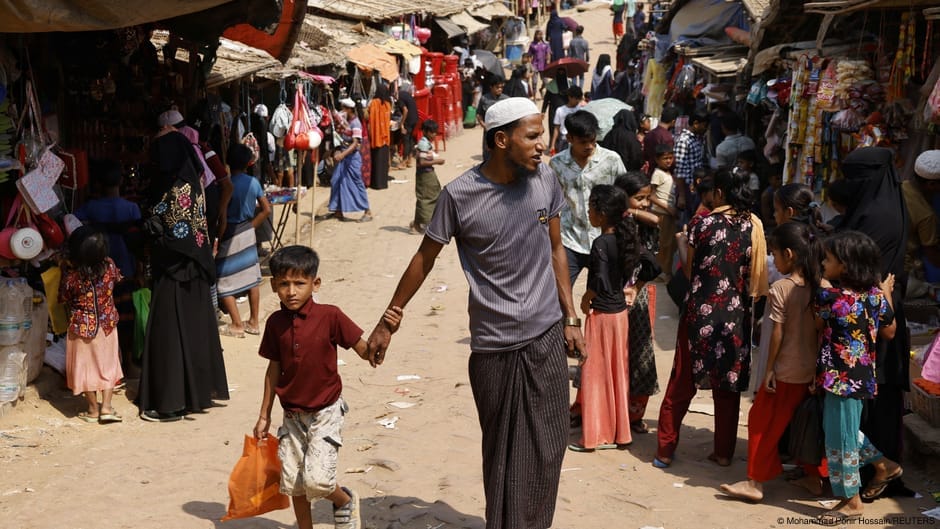
Ma Roga Bibi, then age 9, was one of about 700,000 people to flee to Bangladesh, joining earlier refugee waves. asserted
Bibi → flee → waves
The camps sprawl across a narrow coastal strip a few miles from Cox's Bazar, a busy beach town near Myanmar. asserted
camps → sprawl → Myanmar
Rohingya are denied citizenship on both sides of the border. asserted
Rohingya → deny → border
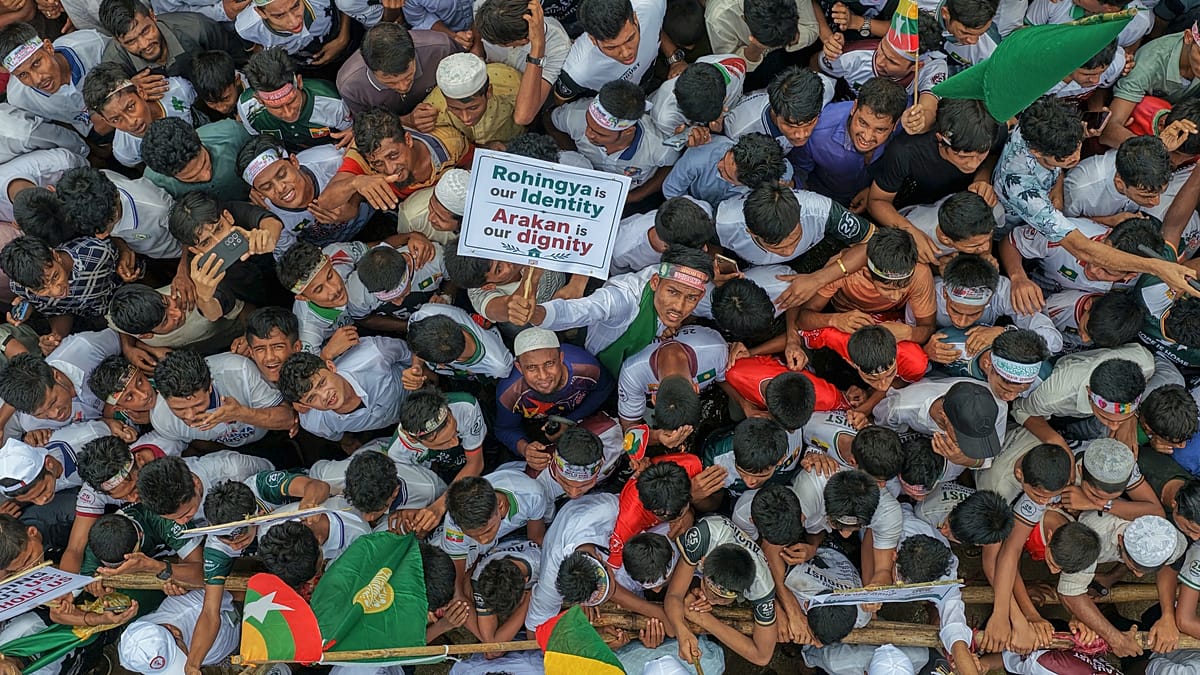
"Recognition alone is not enough," she said. asserted
she → say → ?
"We need justice, accountability, and the opportunity to return home with dignity." asserted
We → need → dignity
She wants to be a doctor, adding, "in our Rohingya community, there is no girl doctor." asserted
She → want → community
Khin Khin Myint, 18, a refugee leader in activist group Rohingya Youth Voice from Buthidaung Township, also in Camp 16, said Rohingya women and girls have experienced "unimaginable suffering." asserted
women → say → suffering
"We want the world to listen to survivors, recognize their courage, and include women in decisions about our future," she said. asserted
she → want → future
"We expect the international community to move beyond a statement of sympathy." asserted
community → expect → sympathy
Rejected defense Myanmar had argued its military was conducting counterinsurgency operations against an armed group, the Arakan Rohingya Salvation Army. asserted
military → reject → group
The court said the military failed to distinguish between civilians and alleged insurgents, and that the scale and nature of the violence could not be explained by counterterrorism. uncertain
scale → say → counterterrorism
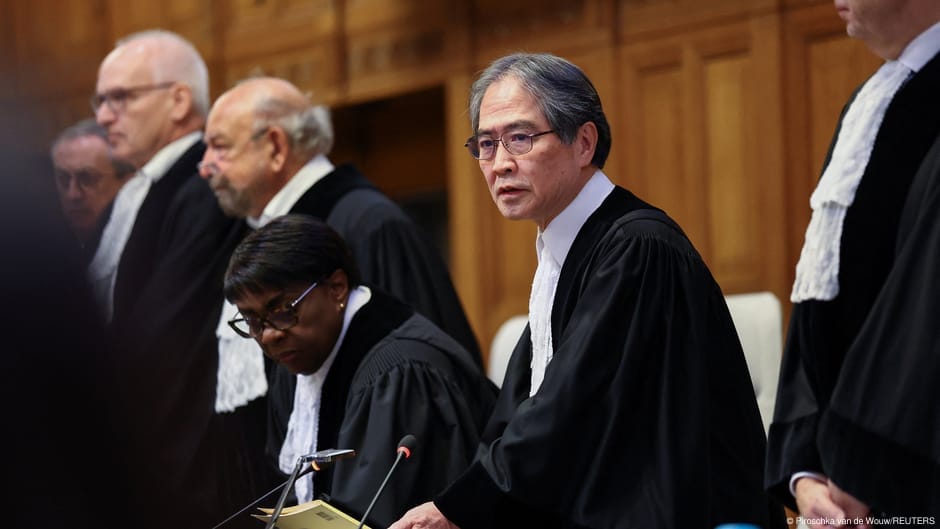
"The execution of Rohingya men and boys in some locations, the widespread sexual violence, the targeting of children and babies, the methodical burning of villages, and attacks on fleeing civilians are not consistent with an intent to conduct counterinsurgency operations," said ICJ president, Judge Yuji Iwasawa. asserted
president → flee → operations
Antonia Mulvey, executive director of Legal Action Worldwide, a human rights group based in Geneva, said the court found evidence from the U.N. and rights organizations credible, and that counterterrorism operations were not a defense to Myanmar's argument. asserted
operations → base → argument
She said the ruling will affect future genocide cases, including South Africa's case against Israel, on questions such as genocidal intent and state responsibility. asserted
ruling → say → intent
"Although every case must ultimately be decided on its own evidence," she said. asserted
she → decide → evidence
The judgment is binding on Myanmar and on all states that have ratified the Genocide Convention, she explained. asserted
she → bind → Convention
All countries should review trade agreements, including arms and jet fuel supplies, and financial and economic ties with the junta, she said, while supporting accountability and reparations for the Rohingya. asserted
she → review → Rohingya
But the court, which hears disputes between states, can't enforce its decisions. asserted
which → hear → decisions
A group long denied recognition In Myanmar, Rohingya are widely regarded as interlopers from Bangladesh, despite generations of roots in Myanmar. asserted
Rohingya → deny → Myanmar
Iwasawa, however, identified the Rohingya as a distinct ethnic group, saying their language and art set them apart, and that they self-identify as such. asserted
they → identify → them
He said they have been discriminated against by Myanmar "for decades" and qualify as a protected group. asserted
they → say → group
The United States had previously reached a similar conclusion. asserted
States → reach → conclusion
In 2022, the Biden administration formally determined that Myanmar's military had committed genocide and crimes against humanity against the Rohingya during its 2016 and 2017 operations. asserted
military → determine → operations
But tensions have mounted between the Trump administration and international justice bodies. asserted
tensions → mount → administration
In a statement to NPR on Thursday, the State Department expressed support for Rohingya refugees but raised doubts about the International Court of Justice. asserted
Department → express → Justice
"The proper interpretation of the Genocide Convention is of paramount importance, as is preventing politicization of the ICJ. asserted
interpretation → prevent → ICJ
We are studying the decision to fully assess its implications," the State Department said. asserted
Department → study → implications
In October, U.S. Ambassador to the U.N. Mike Waltz wrote online, "The ICJ must not be allowed to lower the legal threshold for proving genocide" so it can later be weaponized against U.S. and allied soldiers. asserted
it → write → soldiers
Yet international human rights organizations and the United Nations applauded the court's judgment. asserted
organizations → applaud → judgment
U.N. Secretary-General António Guterres called it "a powerful recognition of the Rohingya victims of genocide" and said it reaffirms that "impunity for such horrific acts must not stand." The judgment does not order Myanmar to grant citizenship, saying such the issue fell outside the scope of the measures being considered to prevent future atrocities. asserted
issue → call → atrocities
…and 10 more, not listed.
Give feedback · no sign-in needed

No sign-in needed for now. Your note is sent without a name, so it cannot be answered.

History Support