If the world was sceptical in 1954 that a small colonial outpost in the southern hemisphere could host the world’s biggest sporting event, they were not alone.
uncertain
they → host → event
There was the least doubt about whether Australia’s athletes were world class.
asserted
athletes → be → ?
It was the rest of Australia they worried about.
asserted
they → worry → Australia
In July that year, two years before the 1956 Olympics, the Melbourne lord mayor, Robert Solly, summoned a meeting of the city’s key women’s groups.
asserted
mayor → summon → groups
Representatives from the Country Women’s Association, the National Council of Women, the Girl Guides Association, the Young Women’s Christian Association and the Housewives Association (yes, you read that correctly) all gathered at the Town Hall.
asserted
you → read → Hall
Then-premier John Cain snr spoke, partly to urge the women to understand their role at the forthcoming Games would be to make visitors welcome, but also to assuage the fears of hordes of foreigners in the city.
asserted
visitors → speak → city
It was agreed a committee would be formed to co-ordinate the women’s groups of Melbourne during the Olympics.
asserted
committee → agree → Olympics
The Olympics Civics Committee was formed.
asserted
Committee → form → ?
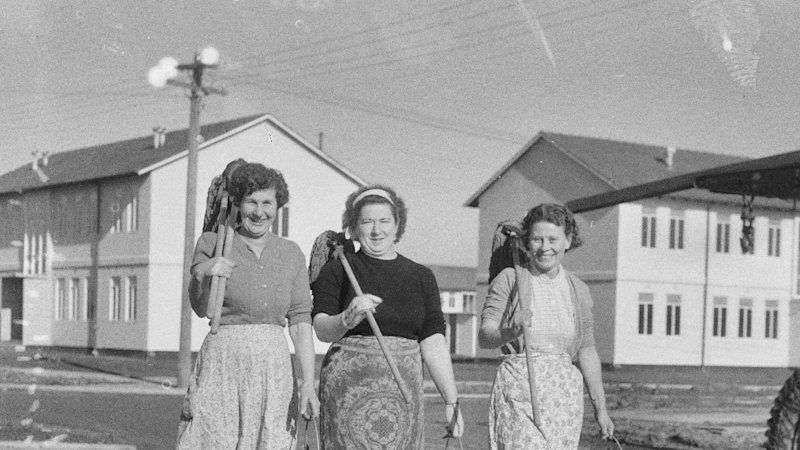
The volunteer Housewives Brigade (again, not a typo) was also created to help make 6000 beds and tidy the rooms in the athletes’ village in Heidelberg.
asserted
Brigade → create → Heidelberg
The organisers were further worried there would be too few hotel beds for visitors for the Olympics and the city would need to encourage households to be prepared to open their doors to foreign tourists.
asserted
city → worry → tourists
This was a discussion partly to assuage the fears of locals, but also to ascertain which houses might be suitable for visitors.
uncertain
houses → assuage → visitors
At the time, a quarter of houses in Melbourne had no refrigerator, two-thirds no hot running water in the bathroom and most had outside toilets.
asserted
most → have → toilets
(As it turned out, the distance to travel and the price of flights meant few international visitors came for the Games other than the athletes and teams.)
asserted
visitors → turn → athletes
Organisers had invited the world, but had precious little idea of what hosting an Olympics involved.
asserted
hosting → invite → Olympics
Two months from the Games, they didn’t have enough cooks – certainly not enough people who knew how to cook the food the foreign visitors needed.
asserted
visitors → have → food
The White Australia Policy was still 10 years from being scrapped.
asserted
Policy → scrap → ?
The early influx of European migrants after World War II had begun to alter the vegetables seen in shops, but it had not yet shifted the regular evening meal far from chops and three veg.
asserted
it → begin → chops
Roast lamb was as exotic as it got.
asserted
it → get → ?
It was August, barely more than two months before athletes were due to arrive, and the Olympic Organising Committee had still had not hired “Asiatic cooks” to prepare appropriate food.
asserted
Committee → arrive → food
At the last minute, 10 cooks arrived, provided by a shipping line.
asserted
cooks → arrive → line
It was emblematic of the Games being hastily cobbled together.
asserted
It → cobble → Games
Even Carlton’s No.1 ticket holder, prime minister Robert Menzies, saw the financial folly of that and agreed with Cain snr when he said it would be at the MCG or nowhere.
asserted
it → see → MCG
That still did not best please the Victorian Cricketers Association and the MCC, which were uncomfortable with ripping up the pitch where Donald Bradman had played.
asserted
Bradman → please → pitch
When they did rip it up and lay a track, it did not best please the visiting athletes.
asserted
it → rip → athletes
But they got a track built in time.
asserted
track → get → time
They had found a way.
asserted
They → find → way
As they did finding cooks.
asserted
they → find → cooks
As they did getting the Olympic torch to Melbourne, buying local maps from Shell service stations along the way to navigate a route from Cairns.
asserted
they → get → Cairns
As they did when the second-to-last torch relay runner was to enter Punt Road Oval to hand the torch to Ron Clarke – only to discover the gate padlocked (they had to shimmy through another turnstile).
asserted
they → do → turnstile
As they did cobbling together an equestrian event to be staged in Stockholm, Sweden, because quarantine laws would not allow the horses into Australia in time.
asserted
laws → cobble → time
Historian and journalist Dr Nick Richardson, author of the excellent book 1956, observed the city’s “naïveté was its greatest asset”.
asserted
naïveté → observe → book
Australia was barely more than 50 years from Federation when it invited the world to visit.
asserted
it → invite → world
Sport would be the enticement but also the vehicle to hesitantly seek the world’s approval for the fledgling city and federated country.
asserted
Sport → seek → city
An Olympic arts festival was opened before the Games began.
asserted
Games → open → ?
The Victorian governor, Sir Dallas Brooks, addressed the opening, saying: “Australia is only a young country and we are very proud of our achievements, but we are fully conscious of our shortcomings.
asserted
we → address → shortcomings
So we hope you will find something to enjoy and admire in the exhibitions, and we all look forward to learning something from your friendly criticisms.”
asserted
we → hope → criticisms
The journalist A.A. Phillips had coined the term “cultural cringe” in a Meanjin article six years earlier.
asserted
journalist → coin → article
Perhaps Sir Dallas considered it advice, not criticism.
asserted
it → consider → ?
“There was an attitude that they knew what we were not, but they wanted the world to come and tell us we were OK,” Richardson said.
asserted
Richardson → be → us
The grasping need for international approval partly missed a shift already occurring in Australia.
asserted
need → grasp → Australia
…and 48 more, not listed.
 The Aporia