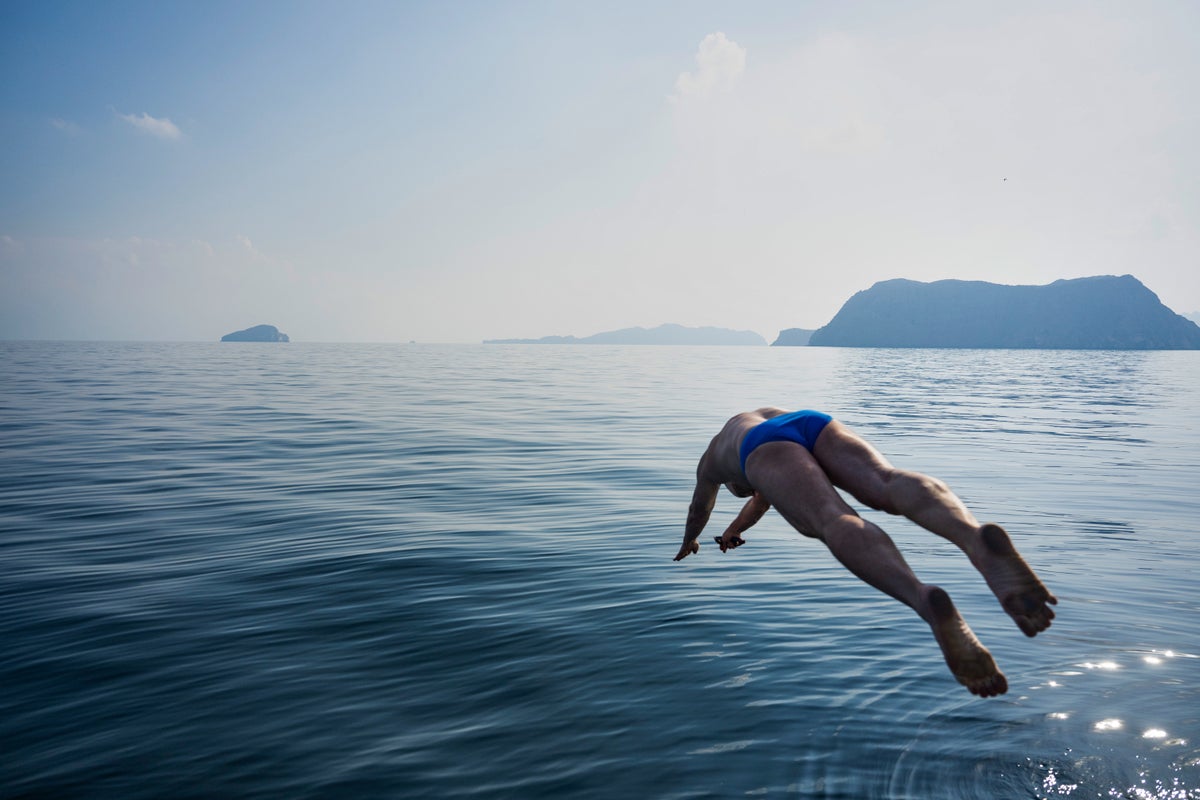
Photo via The Sydney Morning Herald

An endurance athlete swam the Strait of Hormuz to highlight Iran war’s impact on wildlife

Read the original at The Sydney Morning Herald ↗
Cite

Hui, S., & Ha, K. (2026, November 22). An endurance athlete swam the Strait of Hormuz to highlight Iran war’s impact on wildlife. The Sydney Morning Herald. https://www.smh.com.au/world/middle-east/an-endurance-athlete-swam-the-strait-of-hormuz-to-highlight-iran-war-s-impact-on-wildlife-20261122-p61g7k.html?ref=rss&utm_medium=rss&utm_source=rss_feed

Dated from the outlet's own feed. Check the original for its byline.

The Sydney Morning Herald · collected 2026-11-22 · by Sylvia Hui, Kwiyeon Ha

Quick Summary

Lewis Pugh, a British endurance swimmer and United Nations Patron of the Oceans, completed a 15-kilometer swim through the Strait of Hormuz, an area where attacks on oil tankers are frequent. Over three days, Pugh encountered several explosions and witnessed oil tankers being attacked, highlighting the threat to the region’s wildlife and environment. He emphasized the importance of the Strait of Hormuz not just as a shipping lane but as a biodiverse area rich in marine life, warning that the environmental damage from oil spills could persist for generations.
Written by AI on 2026-11-22, from this article's own text only (the story summary below draws on all the coverage).
See how they differ ↓

AI analysis

Story summary

British endurance swimmer Lewis Pugh completed a three-day swim in the Strait of Hormuz on November 21, 2026, to highlight the environmental damage caused by the ongoing war between Iran and the coalition of the U.S. and Israel. Pugh, a 56-year-old United Nations Patron of the Oceans, covered approximately 15 km in total, swimming while tanker attacks and explosions occurred nearby. He started his swim from the Musandam Peninsula in Oman and wore only swimming trunks, goggles, and a UN-branded cap. Pugh warned that pollution from damaged tankers could devastate marine ecosystems for decades. His goal was to draw attention to the environmental toll of the war and urge for the cleanup of the polluted waters.

Written for “British Swimmer Highlights War's Environmental Impact” on 2026-11-22, grounded in this article and the 13 other(s) covering the same event.
Why this leaning score
The model judged this article politically coded and scored it -0.65, but all 4 of its quote(s) are attributed speech - words the article quotes from someone, not the article's own narration, so the score is not published.
Written under an earlier scoring contract, which gave a paragraph rather than checkable quotes. Re-analysing this article replaces it.
Leaning score withheld for article 170994: attributed speech only · logged 2026-11-22

How they differ

11 outlets covered “British Swimmer Highlights War's Environmental Impact”.

What each outlet says

One AI summary per outlet of its latest article on this story, written from that article alone and checked against it. Open the article for the outlet's own words.

Sydney Morning HeraldThis outlet22 Nov

Lewis Pugh, a British endurance swimmer and United Nations Patron of the Oceans, completed a 15-kilometer swim through the Strait of Hormuz, an area where attacks on oil tankers are frequent. Over three days, Pugh encountered several explosions and witnessed oil tankers being attacked, highlighting the threat to the region’s wildlife and environment. He emphasized the importance of the Strait of Hormuz not just as a…

An endurance athlete swam the Strait of Hormuz to highlight Iran war’s impact on wildlife (this article)2 articles from Sydney Morning Herald on this story
Evening Standard21 Nov

A 56-year-old ocean activist, a UN patron of the oceans, swam 15km across the Strait of Hormuz over three days to highlight the environmental impact of the conflict between Iran and the US. Wearing only swimming trunks, goggles, and a UN cap, he began his swim from the Musandam Peninsula and concluded it near the Cape of Hormuz. During the swim, he witnessed attacks on oil tankers and documented smoke from burning…

Briton swims in Strait of Hormuz to highlight ‘environmental cost of war’ →3 articles from Evening Standard on this story
Toronto Star21 Nov

British endurance swimmer Lewis Pugh, a United Nations Patron of the Oceans, swam parts of the Strait of Hormuz over three days to highlight the environmental impact of the war with Iran. Wearing only swimming trunks, goggles, and a U.N. logo cap, Pugh completed about 15 kilometers, starting from the Musandam peninsula and ending at the Cape of Hormuz. During his swim, he witnessed two oil tankers being attacked and…

Endurance athlete swims in Strait of Hormuz to highlight Iran war's impact on wildlife →
The Independent21 Nov

Lewis Pugh, a British endurance swimmer and United Nations Patron of the Oceans, completed a 15-kilometer swim in the Strait of Hormuz to draw attention to the environmental impact of the ongoing conflict in the region. Pugh swam through the strait while oil tankers were being attacked nearby, experiencing firsthand the dangers posed to marine wildlife and ecosystems. He warned that the oil leaks from damaged…

British endurance swimmer Lewis Pugh swims in Strait of Hormuz to highlight Iran war’s impact on wildlife →
Al Jazeera21 Nov

Endurance swimmer Lewis Pugh entered the waters of the Strait of Hormuz despite ongoing tanker attacks and explosions to draw attention to marine pollution in the region. Pugh warns that the environmental damage, particularly oil contamination, could persist for decades, even if the conflict subsides. The article presents Pugh’s actions as a protest to highlight the ecological impact of tensions between the US…

Swimmer braves tanker attacks to expose Hormuz contamination →
Euronews21 Nov

Lewis Pugh, a 56-year-old ocean campaigner, swam through the Strait of Hormuz off Oman’s Musandam Peninsula to highlight the environmental impact of the conflict there. During his swim, he witnessed burning ships and oil spills, which could severely damage marine ecosystems for decades. Despite the dangers, Pugh saw dolphins, turtles, and ospreys, underscoring the area’s ecological importance. He emphasized the need…

Strait of Hormuz: Athlete swims through war zone to expose war's environmental toll →
Show 4 more outlets
Daily Mail21 Nov

Lewis Pugh, a 56-year-old British ocean campaigner and UN patron of the oceans, has become the first person to swim the Strait of Hormuz, a critical oil shipping route plagued by conflict. Over three days, Pugh swam approximately 15 kilometers (9.3 miles) to highlight the environmental damage caused by the ongoing war. Despite witnessing attacks on oil tankers and seeing smoke from burning ships, Pugh described the…

British ocean campaigner becomes first to swim the Strait of Hormuz - saying war-torn waterway is 'one of the most beautiful places I have ever visited' →
BBC21 Nov

Lewis Pugh, a British endurance swimmer and UN Patron of the Oceans, completed a three-day swim through the Strait of Hormuz to highlight the environmental impact of conflicts involving Iran. Over the course of 15km, Pugh drew attention to the damage caused by oil spills and fires from attacked ships, emphasizing the need for environmental protection alongside human rights concerns. He expressed particular concern…

British man swims through Strait of Hormuz to highlight environmental impact of war →
CBS News22 Nov

Lewis Pugh, a British endurance swimmer and United Nations Patron of the Oceans, completed a 9.3-mile swim in the Strait of Hormuz to highlight the environmental impact of the ongoing conflict there. Starting from the Musandam Peninsula, Pugh faced danger as he witnessed attacks on oil tankers and heard explosions during his swim. He emphasized the threat to the area’s wildlife and habitats due to oil spills and…

Athlete swims Strait of Hormuz to highlight Iran war's wildlife toll →
ABC News (AU)22 Nov

Lewis Pugh, a British endurance swimmer and UN Patron of the Oceans, completed a three-day swim in the Strait of Hormuz to raise awareness about environmental threats due to the ongoing conflict between Iran and the US/Israel. Pugh encountered several challenges, including the near-simultaneous attack on an oil tanker near him and seeing vessels explode, highlighting the severe threat to marine life and habitats…

Endurance athlete swims Strait of Hormuz despite Iran war →

Where they agree and split

Agreed

Reported by outlets on both sides of the middle

Wearing only swimming trunks, goggles and a cap bearing the U.N. logo, the athlete started from the Musandam peninsula, on the southern tip of the strait, and ended by rounding the Cape of Hormuz, completing about 15 kilometers (9.3 miles) in total.

4 outlets
Show 1 more

Pugh said oil spills and other contamination could have long-term consequences for marine ecosystems including coral reefs, seagrass meadows and mangrove forests.

4 outlets

Framing

How the first headlines put it

Stated as fact8
The headlines (8)

Endurance athlete swims in Strait of Hormuz to highlight Iran war's impact on wildlife Toronto Star · stated as fact

British endurance swimmer Lewis Pugh swims in Strait of Hormuz to highlight Iran war’s impact on wildlife The Independent · stated as fact

Swimmer braves tanker attacks to expose Hormuz contamination Al Jazeera · stated as fact

Strait of Hormuz: Athlete swims through war zone to expose war's environmental toll Euronews · stated as fact

Briton swims in Strait of Hormuz to highlight ‘environmental cost of war’ Evening Standard · stated as fact

British ocean campaigner becomes first to swim the Strait of Hormuz - saying war-torn waterway is 'one of the most beautiful places I have ever visited' Daily Mail · stated as fact

British man swims through Strait of Hormuz to highlight environmental impact of war BBC · stated as fact

British man swims in Strait of Hormuz to highlight environmental damage The Straits Times · stated as fact

The full story: what happened, how it changed, and all 14 articles →

Compared with similar articles

This article reads unscored and hedges 5% of its claims. Each row says how that neighbour differs.
Toronto Star
Leans left Hedges 2 of 35 claims Outlet record 65/100

Story

British Swimmer Highlights War's Environmental Impact
Environment · 14 article(s) covering the same event. Compare every outlet's account →
How this article was measured signals, leaning charts, publisher record, byline, topics and claims

Signals How these are calculated →

Claims extracted
37
sentences that state something as happening or true
Uncertain
5%
2 of 37 hedged ("reportedly", "may", "according to")
Leaning
withheld
no quote in the article backed the model's score
Publisher signals
61/100
The Sydney Morning Herald's corrections and hedging, across everything collected from it. Not a measure of accuracy.
Outlets on this story
14
Environment
Same framing elsewhere
1
articles that frame the event the way this one does
Analyzed 2026-11-22 · how these are computed

How this is being covered How these are calculated →

Article leaning vs. publisher reliability
Source leaning vs. consistency

Publisher

The Sydney Morning Herald · 7865 article(s) · 16 correction(s) detected
Running correction rate · 16 correction(s)

Who wrote this

Sylvia Hui
9 article(s) here · 1 carrying a prediction
“I looked up, and I could see that an oil tanker about four kilometres away had been hit,” he told the Associated Press after he returned to London.
“I looked up and I could see that an oil tanker about four kilometers away had been hit,” he told The Associated Press after he returned to London.
An Oxford University college faces a freedom of speech controversy for hosting an event featuring Nathan Cofnas, an academic widely criticized for his assertions that very few Black people would belong at the top of a merit-based society.
British actor-comedian Russell Brand may have been sent to prison for rape and sexual assault, but the wider soul-searching over celebrities getting away with sexual misconduct in the U.K. is far from over.
His lawyers claimed that publication of sexual misconduct allegations would lead him to take his own life.
About 20,000 died before the company’s monopoly on the English slave trade ended in 1698, when any Englishman could trade slaves.
In “Swan Song: Diana, My Sister,” Charles Spencer alleges that he argued with the then-Prince Charles over palace plans for Prince William and Prince Harry, then 15 and 12, to walk behind their mother’s coffin during her 1997 funeral procession.
Also by Sylvia Hui
Nothing else under this byline is closely related to this article, so these are simply their most recent.
All 9 articles by Sylvia Hui →
Kwiyeon Ha
3 article(s) here · 1 carrying a prediction
“I looked up, and I could see that an oil tanker about four kilometres away had been hit,” he told the Associated Press after he returned to London.
“I looked up and I could see that an oil tanker about four kilometers away had been hit,” he told The Associated Press after he returned to London.
Also by Kwiyeon Ha
Nothing else under this byline is closely related to this article, so these are simply their most recent.

Topics

British Iran London United Nations the Associated Press

Subjects

Pugh PERSON · 7× Iran GPE · 2× British NORP · 1× Israel GPE · 1× Lewis Pugh PERSON · 1× London GPE · 1× Tehran GPE · 1× United Nations ORG · 1× the Associated Press ORG · 1× the Islamic republic GPE · 1×

Narrative

“And to think of the impact which a casualty like this has on nature – it was very, very acute.” Using sport to lobby for green causes Pugh has spent much of the past 40 years swimming in places from Antarctica to the Red Sea and the English Channel to urge more action to protect marine environments from climate change, pollution and loss of biodiversity.
framing: assertive · carried by 1 article(s) · first seen 2026-11-22
“I looked up, and I could see that an oil tanker about four kilometres away had been hit,” he told the Associated Press after he returned to London.
2026-11-22 · The Sydney Morning Herald
An endurance athlete swam the Strait of Hormuz to highlight Iran war’s impact on wildlife · assertive framing

Claims (37 extracted, 2 hedged)

British endurance swimmer Lewis Pugh has swum in the North Pole and Antarctica to draw attention to environmental causes. asserted
Pugh → swim → causes
But battling freezing waters and extreme conditions hasn’t prepared him for his latest challenge: swimming the Strait of Hormuz while tankers are attacked and blown up nearby. asserted
tankers → battle → Hormuz
Pugh, who is a United Nations Patron of the Oceans, spent three days last week swimming parts of the dangerous waterway to highlight how the war with Iran threatens the area’s habitat and wildlife. asserted
war → spend → habitat
Wearing only swimming trunks, goggles and a cap bearing the UN logo, the athlete started from the Musandam peninsula, on the southern tip of the strait, and ended by rounding the Cape of Hormuz, for about 15 kilometres in total. asserted
athlete → wear → total
Pugh is believed to be the first person to undertake a long-distance swim there since the war started. asserted
war → believe → swim
The swimmer said that minutes after he entered the water on Monday, he heard two loud explosions that rocked the sea. asserted
that → say → sea
“I looked up, and I could see that an oil tanker about four kilometres away had been hit,” he told the Associated Press after he returned to London. uncertain
he → look → London
“The explosion was so loud, two booms, and then fighter jets coming in. asserted
jets → come → ?
And at that moment I realised we have to get out of here right now.” asserted
we → realise → moment
Pugh, 56, managed to finish his feat after more stops and starts, including passing another vessel that sent fireballs into the sky after it was attacked. asserted
it → manage → sky
“Most people, when they think about the Strait of Hormuz, they think of a shipping lane,” he said. asserted
he → think → lane
it’s one of the treasure troves of the natural world.” asserted
it → ’ → world
“With all these ships being sunk, this area is under severe threat. asserted
area → sink → threat
It’s going to take years, decades for this area to recover.” asserted
area → go → years
Oil pollution threatens dolphins and mangroves Iran has in recent weeks increased attacks on vessels that it claimed travelled along unauthorised routes in the strait, as the Islamic republic seeks to impose its control on the crucial waterway, where one-fifth of all oil traded passed through before the US and Israel launched the war on February 28. asserted
US → threaten → February
Several tankers have also struck sea mines laid by Tehran, and in some cases exploded and burst into flames. asserted
tankers → strike → flames
Among them was one last month that was carrying more than 2 million barrels of oil. asserted
carrying → carry → oil
Pugh warned of how oil leaking from the dozens of tankers damaged since February could create lasting problems for the region’s animals, as well as its coastlines, coral reefs and mangrove forests. uncertain
oil → warn → animals
He described seeing large numbers of dolphins following his boat as he sailed in, as well as turtles and ospreys. asserted
he → describe → turtles
He also marvelled at the hundreds of turtles he saw during a swim along the Omani coast before the war. asserted
he → marvel → war
“When oil gets in there, when chemical pollution gets in there, it becomes very, very difficult to clean up that type of mess,” he said. asserted
he → get → mess
“It lasts for generations.” asserted
It → last → generations
Swim challenge took place as vessels were attacked Pugh has had plenty of experience facing extreme temperatures and predators, including great white sharks. asserted
Pugh → take → sharks
But swimming in a conflict zone presented entirely new dangers. asserted
swimming → swim → dangers
To stay safe, the challenge was done in sections over three days, with a total of about 6½ hours of swimming. asserted
challenge → stay → swimming
The athlete recalled seeing a gas carrier being struck as he returned to the harbour on the second day. asserted
he → recall → day
“I’ll never ever forget going past that gas carrier, the smell of the chemicals and then the flames; they were literally like fireballs going up into the sky. asserted
they → forget → sky
Around the ship, the water was on fire,” Pugh said. asserted
Pugh → say → fire
“And to think of the impact which a casualty like this has on nature – it was very, very acute.” Using sport to lobby for green causes Pugh has spent much of the past 40 years swimming in places from Antarctica to the Red Sea and the English Channel to urge more action to protect marine environments from climate change, pollution and loss of biodiversity. asserted
Pugh → think → biodiversity
He was the first athlete to swim across the North Pole and complete a long-distance swim in every one of the world’s oceans. asserted
He → swim → oceans
In 2023, he swam all 507 kilometres of the Hudson River to highlight the importance of clean rivers. asserted
he → swim → rivers
His foundation says the challenges have helped secure official agreements to protect more than 3.5 million square kilometres of vulnerable ocean. asserted
challenges → say → ocean
Some have dubbed Pugh’s blend of epic swimming and political outreach as “Speedo diplomacy”. asserted
Some → dub → diplomacy
“Sport opens doors, it creates dialogue, it enables people to start thinking about these important issues,” Pugh said. asserted
Pugh → open → issues
We’ve got to stop the war. asserted
We → get → war
We’ve got to open the strait, and we’ve got to clean up the pollution.” asserted
we → get → pollution
AP Get a note directly from our foreign correspondents on what’s making headlines around the world. asserted
what → get → world
Give feedback · no sign-in needed

No sign-in needed for now. Your note is sent without a name, so it cannot be answered.

History Support