This article first appeared on our partner site, Independent Arabia
asserted
article → appear → site
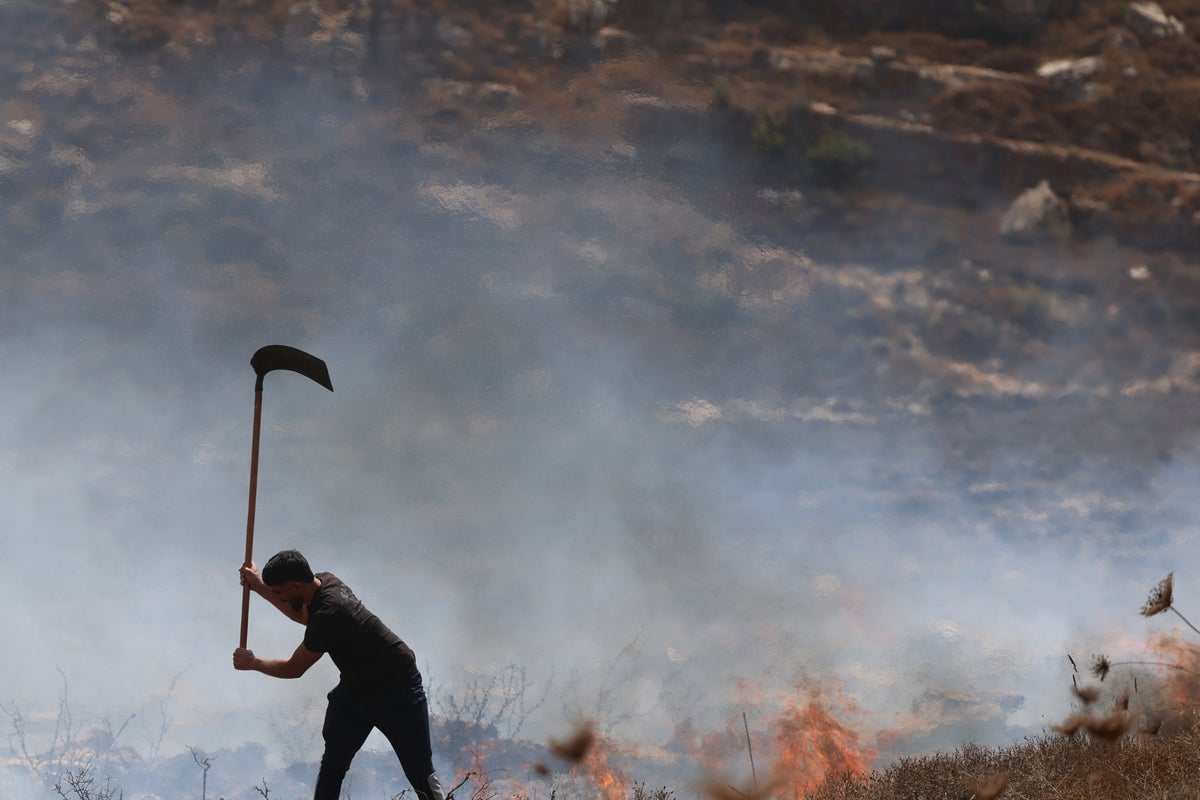
On a crowded street corner in the battered city of Gaza, Zaher Kashko stands over a pan of boiling oil, selling freshly flipped falafel patties to passers-by so he can put food on the table for his family.
asserted
he → stand → family
Before the war, October meant something different to Zaher.
asserted
October → mean → Zaher
He used to welcome the start of the month with the scent of fresh green oil flowing from his own olive oil press to the east of the city.
asserted
He → use → city
Now, however, Zaher’s land and oil press lie behind the ‘Red Zone’, which is under Israeli military control.
asserted
which → lie → control
The five dunam olive grove (a dunam is around 1,000 square metres) has been passed down Zaher’s family for nearly two centuries.
asserted
dunam → pass → centuries
The land was home to 40 mature olive trees, yielding between 10 and 12 tonnes of fruit in rainy seasons, and no less than six tonnes in leaner years.
asserted
land → yield → years
The war has claimed the lives of 150 members of the Kashko family and destroyed the orchard and olive press, forcing Zaher off his land to sell falafel on the pavement.
asserted
war → claim → pavement
A few kilometres to the south, farmer Haidar Abu Madin bends down to pick up a dried olive branch from the ground and tosses it onto the barren soil.
asserted
Madin → bend → soil
“Before the war, this land was one of the most fertile and thriving olive groves in Gaza,” he says.
asserted
he → say → Gaza
Before the war, Haidar and his brothers co-owned an expansive grove that stretched over 924 dunams.
asserted
that → co → dunams
Its trees yielded up to 1,500 tonnes of olives every year, producing nearly 900 barrels of pure olive oil once pressed.
asserted
trees → yield → oil
The ‘yellow line’ split his land in two: he is banned from accessing one half, which is now occupied by Israeli forces, while the other half has been levelled by bulldozers, leaving only 30 trees, which are not expected to yield more than two barrels.
asserted
which → split → barrels
Haidar mourns the loss of his land, telling Independent Arabia: “The harvest used to be enough to supply the entire central region, with both oil and olives.”
asserted
harvest → mourn → oil
For years, the olive tree has been known as the “crown jewel” of Gaza’s agriculture.
asserted
tree → know → agriculture
Its groves account for nearly 60 per cent of the total orchard area.
asserted
groves → account → area
They were the green lungs of Gaza’s densely populated cities, providing local self-sufficiency in oil and olives.
asserted
They → populate → oil
According to data from the Ministry of Agriculture in Gaza, analysed by value chain and food security specialist Mohammed Abu Odeh, the area planted with olive trees in the Strip has shrunk by 90 per cent as a result of military operations, falling from around 50,000 dunams before the war to just 5,000 dunams in the 2026 season.
uncertain
area → accord → season
The ministry’s statistics show that bulldozers uprooted and destroyed around 1.85 million trees, leaving only around 150,000 trees in Gaza out of the two million that existed before the war.
asserted
that → show → war
Consequently, the Strip has lost 92.5 per cent of its olive tree stock.
asserted
Strip → lose → stock
As a result of this bulldozing campaign, olive production has plummeted from 40,000 tonnes to 5,000 tonnes per year, while olive oil production has shrunk from 5,000 tonnes to just 700 tonnes.
asserted
production → plummet → tonnes
This has created a food deficit of 85 per cent of what Gazans need to feed their families.
asserted
Gazans → create → families
IDF ‘reorganising area for better visibility’
asserted
IDF → reorganise → visibility
The destruction of olive groves during the war appeared to be intentional.
asserted
destruction → appear → war
Last January, Israeli newspaper Yedioth Ahronoth revealed a rare internal dispute within the Israeli army’s Southern Command, after a military division borrowed heavy agricultural machinery from Israeli civilians and had soldiers operate it to clear land and vegetation in the Gaza Strip.
asserted
soldiers → reveal → Strip
At the time, an Israeli military official justified this by saying: “This type of equipment is normally used to remove vegetation and level the ground.
asserted
type → justify → ground
The forces are reorganising the area to allow for better visibility.”
asserted
forces → reorganise → visibility
However, agricultural researcher Nizar al-Wahidi tells Independent Arabia: “The Israeli army treats olive trees as an obstacle that obstructs visibility and must be cleared to secure firing lines.
asserted
that → tell → lines
But what the machinery clears in a matter of hours takes years to restore.
asserted
clears → clear → years
“Olive trees in Gaza, particularly the Al-Suri and Al-Nabali Baladi varieties, are not seasonal crops that are sown and harvested in the same year.
asserted
that → sow → year
These are perennial trees which, under natural conditions, take between five and nine years from the planting of the sapling until they begin to bear fruit, and only reach their peak production after many decades of care, pruning and irrigation.”
asserted
they → take → care
Al-Wahidi emphasises that uprooting such a vast number of trees would condemn the Gaza Strip to a food and agricultural deficit that would last for an entire generation.
asserted
that → emphasise → generation
‘I can hear gunfire’
asserted
I → hear → gunfire
Most of these were concentrated in the eastern and northern stretches along the border fence.
asserted
Most → concentrate → fence
This geographical location made the groves the first victims of the ground operations, as Israeli forces now control around two-thirds of the Gaza Strip’s territory and prevent residents from approaching the ‘yellow line’.
asserted
forces → make → line
In eastern Deir al-Balah, farmer Atiya al-Attar oversees five workers picking Chemlali olives from the 50 remaining trees on his four dunam plot.
asserted
Attar → oversee → plot
Al-Attar works under the watchful eye of an Israeli military crane, which monitors every movement in the open fields.
asserted
which → work → fields
Among the few remaining trees near Salah al-Din Street, harvester Ahmed Khader picks olives and reminisces about life before the war.
asserted
Khader → remain → war
“When times were good, I used to work on this land for two months.
asserted
I → use → months
This season, however, I’m working right next to the yellow line and I can hear gunfire.
asserted
I → work → gunfire
…and 52 more, not listed.
 The Aporia