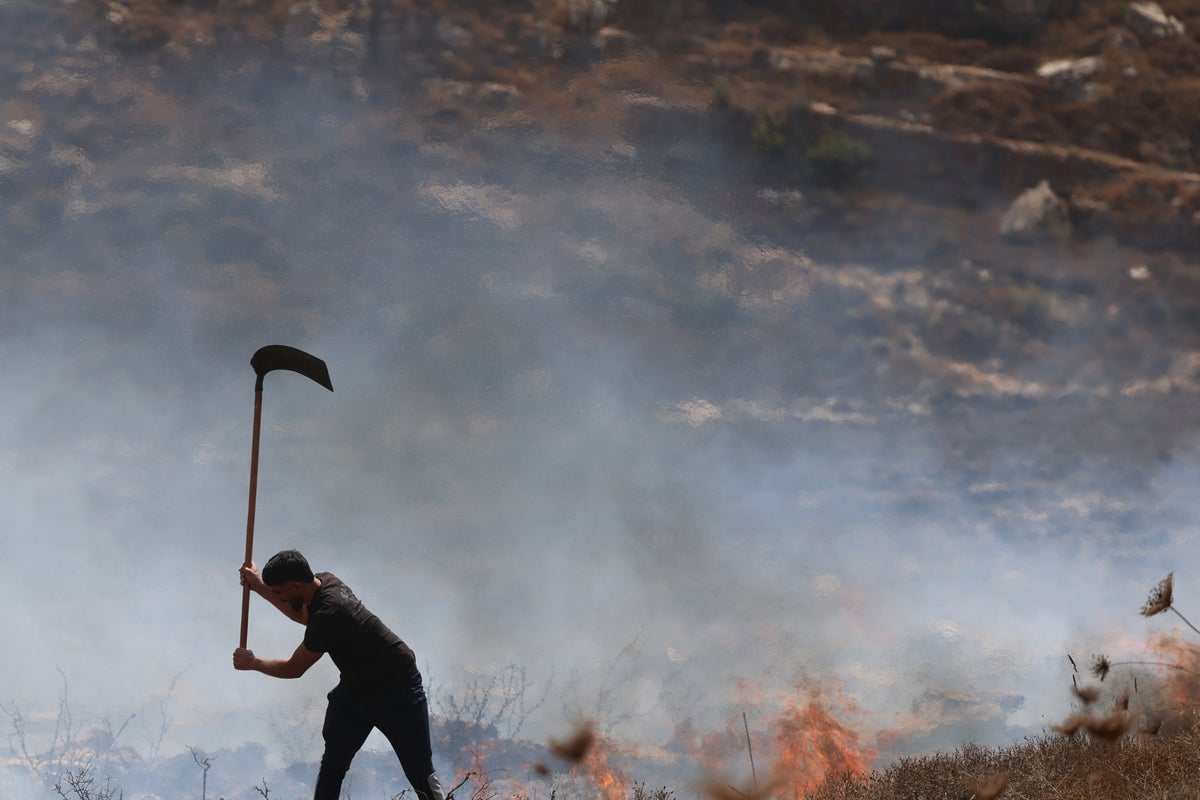
More than three years of Israel’s genocidal war has turned Gaza into “a toxic wasteland”, with poisoned water and contaminated soil threatening the survival of Palestinians in the enclave of 2.3 million people.
asserted
water → turn → people
Israel’s use of explosives and incendiary weapons has caused environmental contamination across more than 99 percent of Gaza, according to a new report by Oxfam and the Conflict and Environment Observatory (CEOBS).
uncertain
use → cause → Oxfam
Recommended Stories
list of 4 items- list 1 of 4Israeli settlers attack several Palestinian villages in occupied West Bank
- list 2 of 4Children in besieged Gaza struggle to find life-saving insulin for diabetes
- list 3 of 4Israeli
asserted
settlers → attack → diabetes
attacks on medics in occupied West Bank surge by 350%: Rights group
- list 4 of
asserted
attacks → surge → %
“Israel’s ongoing genocide in Gaza includes military assaults on its environment, which are environmental war crimes threatening life now and for generations to come,” said Amitabh Behar, Oxfam’s international executive director.
asserted
Behar → include → generations
“The destruction and contamination of Gaza will have fundamentally degraded the environmental conditions necessary for human safety and survival.
asserted
destruction → degrade → safety
This would breach Israel’s legal obligations under international humanitarian and human rights law,” he said in a statement.
asserted
he → breach → statement
“Palestinians living in Gaza are being exposed to toxins in multiple ways through air, food, water and via direct contact with contaminated soils and debris.”
asserted
Palestinians → live → soils
The report shows how Israel’s destruction of buildings and the environment has contaminated the air, soil, food and water in the enclave.
asserted
destruction → show → enclave
It also emphasises the urgent need for a full independent investigation to identify and reduce the risks to Palestinian lives.
asserted
investigation → emphasise → lives
Pollutants from bombardment, fires, rubble and untreated sewage can reach Palestinians through the air they breathe, the water they drink and the food they eat.
asserted
they → reach → air
Oxfam’s report, which uses satellite imagery, remote sensing, scientific analysis and other open-source data, gives a comprehensive picture to date of the impact of the Israeli assault on Gaza, which has killed more than 74,000 Palestinians.
asserted
which → use → Palestinians
More than 1,500 Palestinians have been killed since the so-called “ceasefire” was signed in October 2025.
asserted
ceasefire → kill → October
In September 2025, a UN international commission of inquiry said Israel had committed genocide in Gaza.
asserted
Israel → say → Gaza
And the International Court of Justice is hearing a case of genocide against Israel.
asserted
Court → hear → Israel
In January, the ICJ said it was plausible that Israel had committed genocide in Gaza.
asserted
Israel → say → Gaza
The report came a day after world leaders failed to reach a consensus on climate change at the 31st Climate Change Conference (COP31) of the United Nations.
asserted
leaders → come → Nations
Air pollution
Explosions, fires and the destruction of buildings and infrastructure release pollutants that settle on rubble and soil.
asserted
that → release → rubble
Wind, traffic and debris clearance send them back into the air.
asserted
Wind → send → air
Oxfam’s analysis points to the highest concentrations in Gaza City, Jabalia and the North Gaza governorate.
asserted
analysis → point → City
Israel’s continuous bombardment has also generated substantial greenhouse gas emissions, with further emissions expected from clearing debris and rebuilding.
asserted
emissions → generate → debris
A study cited in the report estimated direct conflict emissions at more than 1.3 million tonnes of carbon dioxide equivalent (CO2e) by January 2025.
61 million tonnes of rubble across Gaza
By October 11, 2025, Israeli ground operations directly affected about 283sq km (109sq miles) of Gaza’s 365sq km (141sq miles), or 78 percent of the area, Oxfam estimates.
asserted
Oxfam → cite → area
The UN Environment Programme estimates that the assault since October 7, 2023, generated 61 million tonnes of debris, which is about 29 tonnes of rubble per person living in Gaza now.
asserted
which → estimate → Gaza
More than 90 percent of Palestinians have been forcibly displaced, most of them multiple times.
asserted
percent → displace → them
Oxfam estimates that the mountains of rubble would require 2.1 million dump truckloads to clear them, equivalent to 736 trips around the circumference of the entire planet.
asserted
mountains → estimate → planet
The amount of rubble that needs to be cleared is about eight times the 7.65 million tonnes estimated in Iraq’s Mosul during the 2017 conflict.
asserted
that → need → conflict
The report identifies at least one potential contamination source across more than 99 percent of Gaza.
asserted
report → identify → Gaza
Gaza City, Khan Younis, Rafah, Jabalia and the Salah al-Din Street corridor showed the greatest overlap of potential hazards.
asserted
City → show → hazards
Unexploded munitions can leach contaminants into soil and groundwater as their casings corrode.
asserted
casings → leach → soil
Damaged vehicles, batteries and fuel stores add to the risks along military routes and former positions.
asserted
vehicles → add → routes
A study cited by Oxfam estimated emissions across the wider conflict cycle at 33.2 million tonnes of CO2e, including an estimate of 31.4 million tonnes of carbon emissions that will occur from reconstruction.
asserted
that → cite → reconstruction
According to a report by Palestinian Water Authority cited by Oxfam, Gaza’s daily water supply fell from 334,107 cubic metres before October 2023 to 54,747 cubic metres in June 2024, a drop of about 84 percent.
uncertain
supply → accord → percent
By April 2026, emergency repairs had brought it back to 130,315 cubic metres a day, still 61 percent below pre-assault levels.
asserted
repairs → bring → levels
Nine of 61 reservoirs were operational, with combined storage sufficient to provide 18 litres per person for one day.
asserted
reservoirs → combine → day
Gaza’s Coastal Aquifer historically supplied 81 percent of the territory’s water.
asserted
Aquifer → supply → water
Oxfam says 97 percent of the aquifer was already chemically polluted before October 2023.
asserted
percent → say → October
Decades of overpumping amid Israel’s air, land and sea blockade of Gaza allowed seawater to seep in.
asserted
seawater → allow → Gaza
Untreated sewage, farm runoff and waste disposal added to the pollution.
asserted
sewage → add → pollution
In July 2026, Gaza’s Ministry of Health detected faecal coliforms in 15 of 79 groundwater wells (19 percent) tested.
asserted
Ministry → detect → wells
Oxfam identified North Gaza, Gaza City and Deir el-Balah as the areas most at risk from contaminated drinking water.
asserted
Oxfam → identify → water
…and 35 more, not listed.

 The Aporia