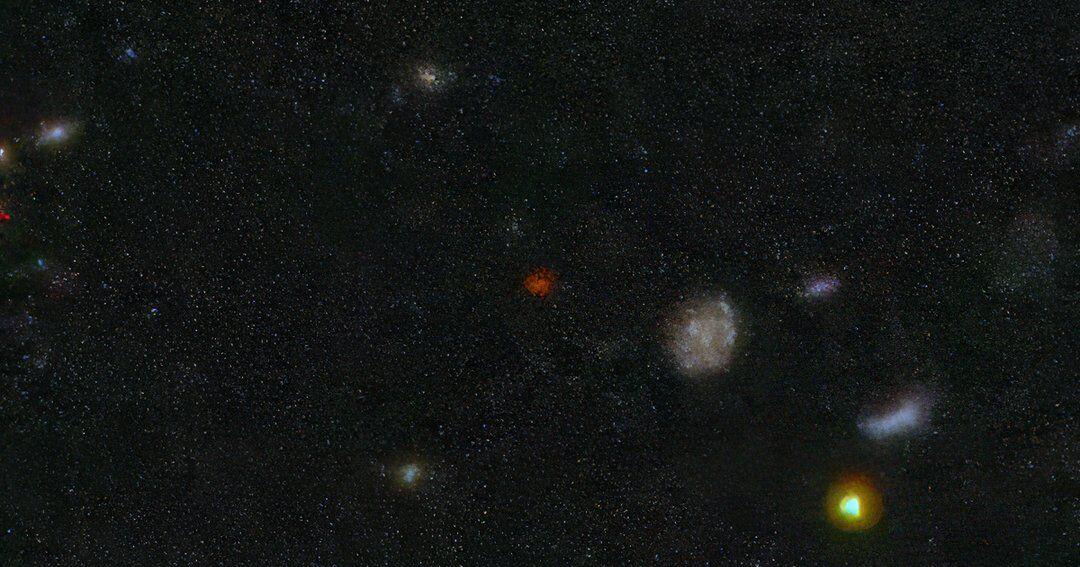
Photo via CBS News

Newly found farthest quasar from Earth is also oldest known to man

Read the original at CBS News ↗
Cite

Newly found farthest quasar from Earth is also oldest known to man. (2026, November 24). CBS News. https://www.cbsnews.com/news/quasar-farthest-oldest-found/

Dated from the outlet's own feed. Check the original for its byline.

CBS News · collected 2026-11-24

Quick Summary

Scientists have discovered the most distant quasar, dating back to 630 million years after the Big Bang, making it the oldest known quasar. This find, led by Julien Wolf from the European Southern Observatory, breaks previous records by nearly 40 million years. The quasar, named Dun Aonghasa, was identified using data from the Euclid telescope and confirmed by the Hubble and Webb space telescopes. Its central black hole has a mass equivalent to 360 million suns, an unprecedented size for such an early time in the universe's history.
Written by AI on 2026-11-24, from this article's own text only (the story summary below draws on all the coverage).
See how they differ ↓

AI analysis

Story summary

Scientists have discovered the most distant quasar yet, located within 630 million years of the Big Bang, setting a new record. This quasar, the core of a galaxy with a black hole at its center, is the earliest known quasar, pushing back the cosmic timeline by nearly 40 million years compared to previous records. Led by a German team and using observations from the European Space Agency’s Euclid telescope, the discovery provides insights into the early universe and its development. Launched in 2023, Euclid aims to study dark matter and dark energy, helping scientists understand the expansion of the universe. This significant leap in cosmic time is a major breakthrough in the study of the universe's early history.

Written for “Newly Found Farthest Quasar” on 2026-11-24, grounded in this article and the 4 other(s) covering the same event.

How they differ

5 outlets covered “Newly Found Farthest Quasar”.

What each outlet says

One AI summary per outlet of its latest article on this story, written from that article alone and checked against it. Open the article for the outlet's own words.

CBS NewsThis outlet24 Nov

Scientists have discovered the most distant quasar, dating back to 630 million years after the Big Bang, making it the oldest known quasar. This find, led by Julien Wolf from the European Southern Observatory, breaks previous records by nearly 40 million years. The quasar, named Dun Aonghasa, was identified using data from the Euclid telescope and confirmed by the Hubble and Webb space telescopes. Its central black…

Newly found farthest quasar from Earth is also oldest known to man (this article)
Toronto Star24 Nov

Scientists have identified the most distant quasar, located just 630 million years after the Big Bang, according to a report by a German-led team. This discovery sets a new record for the earliest known formation of a quasar, which consists of a supermassive black hole at the center of a galaxy. The finding is significant in the context of the 13.8 billion-year history of the universe, as it indicates the rapid…

Scientists discover quasar formed within a mere 630 million years of the Big Bang, setting a record →
New York Post24 Nov

Scientists have discovered a quasar that formed just 630 million years after the Big Bang, setting a new record. Led by Julien Wolf from the European Southern Observatory, the team identified this quasar using data from the Euclid telescope, which is mapping galaxies to understand dark matter and dark energy. The black hole at the center of this quasar has a mass equivalent to 360 million suns, making it…

Scientists discover quasar formed within a mere 630 million years of the Big Bang, setting a record →
The Straits Times24 Nov

Astronomers have discovered the oldest-known quasar, dating back 13.1 billion years, when the universe was less than 5% of its current age, about 630 million years after the Big Bang. This quasar, named Dún Aonghasa, is powered by a supermassive black hole 360 million times the mass of the sun, setting a new record by 40 million years over the previous oldest quasar. The discovery, published in Astronomy and…

Astronomers spot record-setting quasar in the early universe →
The Globe and Mail24 Nov

Astronomers have discovered the oldest known quasar, which dates back to more than 13.1 billion years ago, shortly after the Big Bang. The quasar, named Dún Aonghasa, was identified using the European Space Agency’s Euclid telescope and confirmed with additional observations from ground-based and space telescopes. This quasar, located about 40 million years earlier than the previous record holder, provides evidence…

Astronomers spot record-setting quasar in the early universe →

Compared with similar articles

This article reads unscored and hedges 10% of its claims. Each row says how that neighbour differs.
Toronto Star
Hedges 0 of 3 claims Outlet record 65/100
The Globe and Mail
Hedges 3 of 26 claims Outlet record 51/100
New York Post
Hedges 2 of 21 claims Outlet record 66/100

Story

Newly Found Farthest Quasar
Science · 5 article(s) covering the same event. See how they differ ↑
How this article was measured signals, leaning charts, publisher record, byline, topics and claims

Signals How these are calculated →

Claims extracted
20
sentences that state something as happening or true
Uncertain
10%
2 of 20 hedged ("reportedly", "may", "according to")
Leaning
not political
takes no side on a contested political question
Publisher signals
66/100
CBS News's corrections and hedging, across everything collected from it. Not a measure of accuracy.
Outlets on this story
5
Science
Same framing elsewhere
1
articles that frame the event the way this one does
Analyzed 2026-11-24 · how these are computed

How this is being covered How these are calculated →

Article leaning vs. publisher reliability
Source leaning vs. consistency

Publisher

CBS News · 6206 article(s) · 12 correction(s) detected
Running correction rate · 12 correction(s)

Who wrote this

No reporter is named on this article.

Topics

Cape Canaveral Fla. German the European Southern Observatory's the European Space Agency's

Subjects

Wolf PERSON · 5× Webb PERSON · 2× Cape Canaveral GPE · 1× Fla. GPE · 1× German NORP · 1× Ireland GPE · 1× Irish NORP · 1× Julien Wolf PERSON · 1× the European Southern Observatory's ORG · 1× the European Space Agency's ORG · 1×

Narrative

His wife and daughter are Irish, and he was awestruck when they visited the fort - a frontier holding "the promise of a vast horizon still to explore," just like this quasar.
framing: assertive · carried by 1 article(s) · first seen 2026-11-24
"Honestly, the record could fall again in a few months or it could stand for years," Wolf said.
2026-11-24 · CBS News
Newly found farthest quasar from Earth is also oldest known to man · assertive framing

Claims (20 extracted, 2 hedged)

Scientists have discovered the most distant quasar yet, the core of a galaxy with a slow-chomping black hole at its center dating back to nearly the dawn of the universe. asserted
Scientists → discover → universe
The quasar formed within 630 million years of the universe-forming Big Bang, a German-led team reported Tuesday. asserted
team → form → Bang
That's considered a very early development in the 13.8-billion-year history of the cosmos, and it smashes previous records. asserted
it → consider → records
"This time the leap in cosmic time is huge!" the European Southern Observatory's Julien Wolf, who led the study, said in an email. asserted
who → lead → email
"The previous two records each took us back by about 15 million years or less. asserted
records → take → years
This one takes us back by nearly 40 million years, the biggest advance in nearly a decade!" asserted
one → take → decade
Wolf and his team spotted the quasar while digging through millions of observations made by the European Space Agency's Euclid telescope. asserted
Wolf → spot → telescope
Launched in 2023, Euclid is surveying galaxies in an effort to shed light on the dark matter and dark energy that fill so much of the universe and keep it expanding. asserted
that → launch → it
Finding a quasar so early in the universe is rare, according to Wolf. uncertain
Finding → find → Wolf
What makes this one even rarer, he said, is the massive size of its black hole, despite being such a relatively slow eater of everything around it. asserted
he → make → it
Scientists are seeing it as it was 13.1 billion years ago - when the universe was less than 5% of its current age. asserted
universe → see → age
Wolf nicknamed the quasar Dun Aonghasa after the prehistoric stone fort in Ireland's Aran Islands. asserted
Wolf → nickname → Islands
His wife and daughter are Irish, and he was awestruck when they visited the fort - a frontier holding "the promise of a vast horizon still to explore," just like this quasar. asserted
they → visit → quasar
His team's findings were corroborated by the Hubble and Webb space telescopes as well as other observatories on and off Earth. asserted
findings → corroborate → Earth
Thanks to Webb, scientists learned that the black hole powering this quasar is equivalent in mass to 360 million of our suns, an astounding amount so early in time. asserted
hole → learn → time
The final results appear in the journal Astronomy & Astrophysics. asserted
results → appear → journal
"Dun Aonghasa gives us a new deadline" for the early universe, Wolf said. asserted
Wolf → give → universe
"About 630 million years after the Big Bang, its black hole had already grown to about 360 million times the mass of the sun. asserted
hole → grow → sun
Their prowling of the cosmic dawn continues. asserted
prowling → continue → dawn
"Honestly, the record could fall again in a few months or it could stand for years," Wolf said. uncertain
Wolf → fall → years
Give feedback · no sign-in needed

No sign-in needed for now. Your note is sent without a name, so it cannot be answered.

History Support