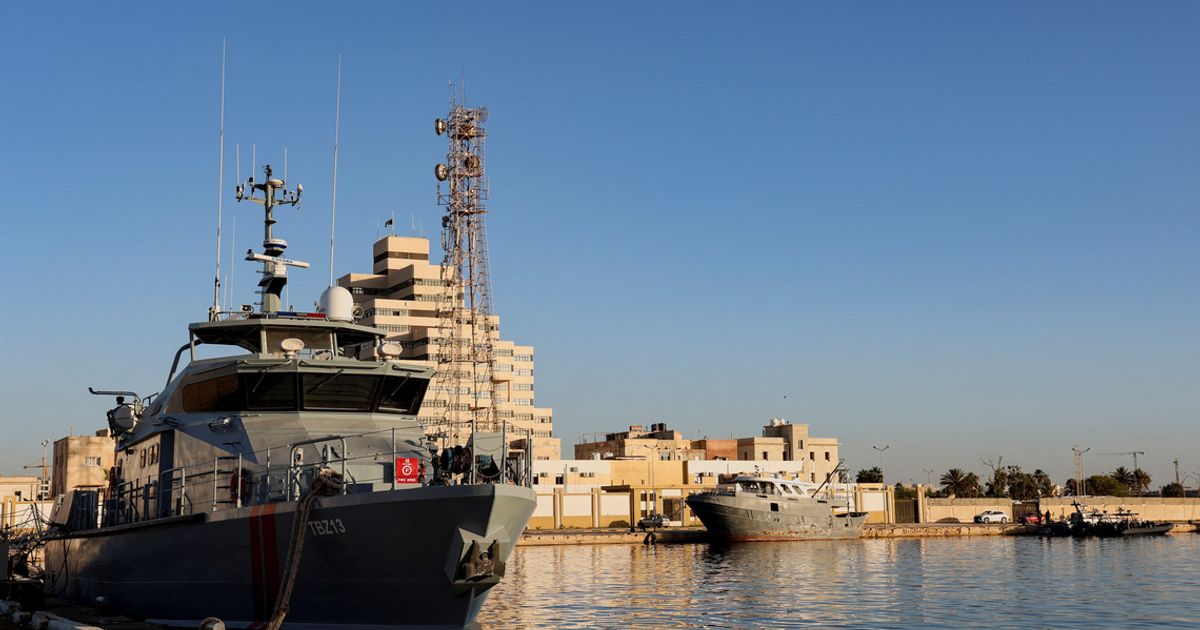
Nov 24 - Ukraine's sinking of a Russian naval vessel in a Libyan port on Sunday showed how a long-paralysed conflict in the North African country, involving a number of regional powers, risks triggering fresh outbreaks of instability.
asserted
conflict → show → instability
Here's why Libya's conflict rumbles on and what it means for the wider region:
asserted
it → rumble → region
HOW DID LIBYA FALL APART?
asserted
LIBYA → apart → ?
After Libyans ended Muammar Gaddafi's 42-year rule in a 2011 NATO-backed uprising, an attempted democratic transition was derailed as groups of fighters built local power bases around rival political factions and seized economic assets.
asserted
groups → end → assets
In 2014, fighting in the capital Tripoli followed an election and most new parliament members moved east, recognising Khalifa Haftar as military chief, and setting up a parallel administration there.
asserted
members → follow → administration
A political agreement backed by the UN was meant to resolve the dispute and reunify Libya's warring east and west, but eastern factions spurned the deal and, in 2019, Haftar's Libyan National Army (LNA) attacked Tripoli.
asserted
Army → back → Tripoli
Though backed by the United Arab Emirates, Russia and Egypt, Haftar's assault was staved off by western factions supported by Turkey, leading to a 2020 truce that stopped major warfare.
asserted
that → back → warfare
A UN-backed effort to resolve Libya's underlying dispute led to the installation of an interim Government of National Unity and a plan for elections in 2021, but the vote was cancelled amid disputes over the rules and candidate eligibility.
asserted
vote → back → rules
With no agreement among rival factions on a new way forward, the conflict has remained paralysed and the country divided.
asserted
country → remain → way
Tripoli lacks sway over much of Libya's territory and foreign powers are still dug in on the ground.
asserted
powers → lack → ground
WHICH COUNTRIES ARE INVOLVED IN LIBYA?
RUSSIA:
asserted
COUNTRIES → involve → LIBYA
A panel of UN experts reported in 2019 that Russia's Wagner company had up to 1,200 mercenaries in Libya and in 2020 the US said Moscow sent warplanes.
asserted
Moscow → report → warplanes
Russia denied sending troops or jets.
asserted
Russia → deny → troops
After the 2020 ceasefire Russia continued to operate in Libya, expanding facilities at six LNA-controlled airbases according to the US military's National Geospatial-Intelligence Agency.
uncertain
Russia → continue → Agency
It has also docked warships at LNA-controlled naval bases, it said.
asserted
it → dock → bases
Analysts say Russia's presence in Libya is important for its ability to project influence deeper into Africa.
asserted
presence → say → Africa
The government in Tripoli has called for Russia to leave.
asserted
Russia → call → Tripoli
The LNA does not generally comment on the Russian presence in eastern Libya, but its media office has periodically posted pictures of visits by Russian military officials.
asserted
office → comment → officials
Two Libyan security officials told Reuters in March that Ukrainians were operating out of western Libya, providing training to forces affiliated with the government in Tripoli while also carrying out operations against Russian targets.
asserted
Ukrainians → tell → targets
The Government of National Unity in Tripoli has not denied there is a Ukrainian presence in western Libya but says it will not permit Libyan territory to be used as a launchpad for attacks.
asserted
territory → deny → attacks
Turkish President Tayyip Erdogan sent troops, drones and armoured vehicles to Libya in 2019 at the request of the internationally recognised government to help it fight off Haftar's attack.
asserted
Erdogan → send → attack
The country retains a military presence in western Libya with Tripoli's support including an airbase at al-Watiya and a naval base in Misrata.
asserted
country → retain → Misrata
The government in Tripoli in 2019 signed an agreement with Turkey on Mediterranean maritime boundaries that was rejected by Greece, Egypt and Israel, and, initially, by Libya's eastern-based parliament.
asserted
that → sign → parliament
Turkey has since improved ties with eastern factions and the parliament approved the maritime deal this year.
asserted
parliament → improve → deal
Emirati backing for Haftar goes back to 2014 when it saw him as a bulwark against factions linked to the Muslim Brotherhood.
asserted
it → go → Brotherhood
UN experts said the UAE supplied drones, air defences and armoured vehicles to Haftar, while the government in Tripoli in 2019 accused it of carrying out airstrikes and shipping in African mercenaries.
asserted
government → say → mercenaries
The UAE denied all of that.
asserted
UAE → deny → that
While staying close to Haftar, the UAE has since built ties with Dbeibah too.
asserted
UAE → stay → Dbeibah
Yes, but big disputes remain and analysts say a deal will be hard to achieve.
asserted
deal → remain → ?
US Libya envoy Massad Boulos is promoting an initiative intended to unify Libya's state institutions and pave the way for elections.
asserted
Boulos → promote → elections
Details of the initiative have not been announced, but Boulos has said the sides have agreed on a comprehensive and clear framework for unification.
asserted
sides → announce → unification
Libya analysts have said the push will be based on the Haftar family, which dominates in the east, and the Dbeibah family, which dominates in the west, agreeing to share power.
asserted
which → say → power
One proposal seen by Reuters this year would involve Dbeibah remaining as prime minister in a new government and Haftar's son Saddam Haftar heading a presidential council.
asserted
son → see → council
That formula may worry some Libyans, who fear the country's main powerbrokers are unlikely to allow real change or set the country on a course toward meaningful elections.
uncertain
powerbrokers → worry → elections
Libya is a major oil exporter but its revenue from output of up to 1.3 million barrels per day has long been the biggest prize for all the main factions, leading to repeated production and export shutdowns.
asserted
revenue → lead → shutdowns
Most oil fields and terminals are in areas controlled by the LNA in the east, but under international agreements all revenue from sales has to go through the central bank in Tripoli, in the west, which is meant to pay for state services across the country.
asserted
which → control → country
Groups have closed oil terminals or halted work at fields as a tactic to put pressure on the government in Tripoli.
asserted
Groups → close → Tripoli
For European countries, Libya's role as a departure point for migrants crossing the Mediterranean is also important.
asserted
role → cross → Mediterranean
 The Aporia