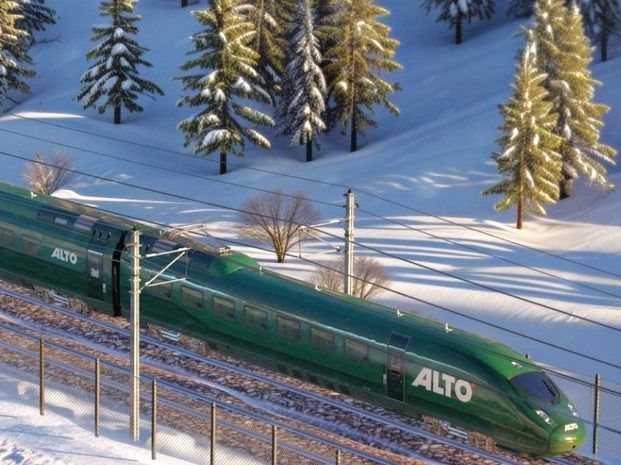
Photo via Toronto Star

Federal minister defends expanded expropriation rules for Alto high-speed rail line

Read the original at Toronto Star ↗
Cite

Tumilty, R. (2026, November 24). Federal minister defends expanded expropriation rules for Alto high-speed rail line. Toronto Star. https://www.thestar.com/politics/federal/federal-minister-defends-expanded-expropriation-rules-for-alto-high-speed-rail-line/article_4387f76b-5ccc-4d88-a9d8-ba1f210d0524.html

Dated from the outlet's own feed. Check the original for its byline.

Toronto Star · collected 2026-11-24 · by Ryan Tumilty

Quick Summary

Transport Minister Steven MacKinnon defended the government's expanded expropriation rules for the Alto high-speed rail project, which allow for quicker land acquisition and new construction restrictions. The rules, introduced in the 2025 budget and clarified in this year’s budget, include an arbitration process for land divided by the rail line. MacKinnon argued that these measures are necessary to avoid delays seen in other projects, while opposition leader Pierre Poilievre criticized the legislation for giving the government excessive power to seize property. The Alto project, estimated to cost between $75 and $113 billion, aims to connect Toronto and Quebec City with trains reaching speeds over 300 km/h.
Written by AI on 2026-11-25, from this article's own text only (the story summary below draws on all the coverage).
See how they differ ↓

AI analysis

Story summary

The federal government is proposing to scrap standard expropriation rules for Canada's first high-speed rail project, known as Alto, between Toronto and Quebec City. Transport Minister Steven MacKinnon defended the new land seizure powers, arguing they would fast-track the project, which was passed as part of Bill C-15 in March. However, rural residents and Ontario Conservative MP Michael Barrett are criticizing the move, saying it replaces the existing Expropriation Act with a separate regime for high-speed rail, potentially disrupting rural communities in eastern Ontario and Quebec. The proposed changes would allow the government to expropriate land for the project without attempting to purchase it first, bypassing standard due process protections.

Written for “Ottawa Defends Land Seizure Powers For Alto Rail” on 2026-11-26, grounded in this article and the 8 other(s) covering the same event.

How they differ

6 outlets covered “Ottawa Defends Land Seizure Powers For Alto Rail”.

What each outlet says

One AI summary per outlet of its latest article on this story, written from that article alone and checked against it. Open the article for the outlet's own words.

Toronto StarThis outlet24 Nov

Transport Minister Steven MacKinnon defended the government's expanded expropriation rules for the Alto high-speed rail project, which allow for quicker land acquisition and new construction restrictions. The rules, introduced in the 2025 budget and clarified in this year’s budget, include an arbitration process for land divided by the rail line. MacKinnon argued that these measures are necessary to avoid delays…

Federal minister defends expanded expropriation rules for Alto high-speed rail line (this article)2 articles from Toronto Star on this story
CBC25 Nov

Rural Ontario residents are protesting against proposed changes to land expropriation rules for the Alto high-speed rail project. The federal government aims to simplify the process by allowing direct land transfers to a private consortium and bypassing public hearings for disputes, which could cost between $60 billion and $90 billion. Critics, like Mike MacGillivray from Kirkview Farms, fear the new rules will…

Rural Ontario residents slam proposed land-seizure powers for Alto high-speed rail project →2 articles from CBC on this story
Toronto Sun25 Nov

Mark Carney's Liberal government is facing criticism for attempting to bypass certain sections of the Expropriation Act and other laws related to Alto, a high-speed rail project in Canada. The budget bill includes measures that exempt Alto from provisions requiring fair compensation and good faith attempts to purchase property before expropriation. Critics argue that these changes circumvent established legal…

LILLEY: Mark Carney’s rail to nowhere? Liberals rip up the rules for Alto →2 articles from Toronto Sun on this story
The Globe and Mail24 Nov

Transport Minister Steven MacKinnon is defending new land seizure powers proposed in draft legislation for the high-speed rail project between Toronto and Quebec City. The proposed legislation, which was included in a 519-page procedural motion on Friday, would allow Ottawa to expedite the process of securing land for the project, potentially avoiding delays that could extend for years. The project, which aims to…

Ottawa defends new land seizure powers proposed for Alto’s high-speed rail project →
Global News24 Nov

Transport Minister Steven MacKinnon is defending new land seizure powers proposed in draft legislation for a high-speed rail project connecting Toronto and Quebec City. MacKinnon argues that these powers are necessary to avoid delays and ensure the project progresses smoothly, despite criticism from Ontario Conservative MP Michael Barrett who fears the changes will lead to significant cost and disruption for rural…

Transport minister defends new land seizure powers proposed for high-speed rail →
The Hub26 Nov

Transport Minister Steven MacKinnon defended the federal plan to expand expropriation powers for the Alto high-speed rail project, which would allow the acquisition of up to 10,000 land parcels between Toronto and Quebec City. The plan would enable the government to bypass the federal Expropriation Act and transfer expropriated land directly to a private consortium. MacKinnon argued that these measures, aimed at…

Ottawa defends plan to expand expropriation powers for Alto high-speed rail →

Where they agree and split

Framing

How the first headlines put it

Stated as fact4
The headlines (4)

Draft budget bill proposes sweeping new land-seizure powers for high-speed rail CBC · stated as fact

Transport minister defends new land seizure powers proposed for high-speed rail Toronto Star · stated as fact

Ottawa defends new land seizure powers proposed for Alto’s high-speed rail project The Globe and Mail · stated as fact

Transport minister defends new land seizure powers proposed for high-speed rail Global News · stated as fact

The full story: what happened, how it changed, and all 9 articles →

Compared with similar articles

This article reads unscored and hedges 15% of its claims. Each row says how that neighbour differs.
Toronto Star
Leans right Hedges 1 of 2 claims Outlet record 65/100
The Globe and Mail
Leans right Hedges 1 of 6 claims Outlet record 52/100
Global News
Leans right Hedges 1 of 6 claims Outlet record 63/100
Toronto Sun
Hedges 0 of 30 claims Outlet record 96/100
The Hub
Leans right Hedges 10 of 42 claims
CBC News
Leans right Hedges 8 of 42 claims Outlet record 70/100
“Article A discusses the minister defending the expanded expropriation rules, while Article B focuses on the draft budget bill proposing sweeping new land-seizure powers, indicating different stages or aspects of the same broader issue but not the same specific event.”
CBC News
Hedges 4 of 27 claims Outlet record 70/100
“While both articles discuss the Alto high-speed rail project and the government's expropriation rules, they describe different perspectives and events: one defending the rules and the other criticizing them from the viewpoint of rural residents.”
Toronto Sun
Leans left Hedges 4 of 31 claims Outlet record 96/100
“While both articles discuss the government's plans to expand expropriation rules for the Alto high-speed rail project, Article A focuses on the minister's defense of the expanded rules, whereas Article B questions the extent of land required and the cost to farmers.”

Story

Ottawa Defends Land Seizure Powers For Alto Rail
Politics · 9 article(s) covering the same event. Compare every outlet's account →
How this article was measured signals, leaning charts, publisher record, byline, topics and claims

Signals How these are calculated →

Claims extracted
20
sentences that state something as happening or true
Uncertain
15%
3 of 20 hedged ("reportedly", "may", "according to")
Leaning
withheld
no quote in the article backed the model's score
Publisher signals
65/100
Toronto Star's corrections and hedging, across everything collected from it. Not a measure of accuracy.
Outlets on this story
9
Politics
Same framing elsewhere
1
articles that frame the event the way this one does
Analyzed 2026-11-25 · how these are computed

How this is being covered How these are calculated →

Article leaning vs. publisher reliability
Source leaning vs. consistency

Publisher

Toronto Star · 18225 article(s) · 34 correction(s) detected
Running correction rate · 34 correction(s)
2026-11-17
Correction
2026-10-26
Correction
2026-10-24
Correction
2026-10-07
Correction
2026-09-24
Correction

Who wrote this

Ryan Tumilty
9 article(s) here · 1 carrying a prediction
Those initial rules let the government expropriate land without a public hearing, gave the government right of first refusal over land they might need and allowed them to prevent new construction on land they may need to expropriate.
OTTAWA—The Carney government will hold immigration levels steady in the coming three years, while also announcing it will add 200,000 permanent residence spots in 2027 for temporary migrants already established in Canada.
OTTAWA—Canadians in six ridings will head to the polls on Dec. 7, as Prime Minister Mark Carney announced six byelections Sunday for two ridings in Ontario, three ridings in Quebec and one in Saskatchewan to fill vacancies in the House of Commons.
As of Tuesday afternoon with almost all votes counted, only two provincial ridings have a majority vote for option two in the referendum, which would have seen the province start the process toward a binding vote to leave Canada.
Poilievre, who was born and raised in Calgary and now represents a rural Alberta riding, made the pitch ahead of Monday’s vote, in which Albertans will choose either to remain in Canada or begin the process toward a second binding referendum on leaving the country.
OTTAWA — With the Liberal government’s backing of a fast-tracked pipeline, the only box left to check in the grand Alberta bargain is the Pathways carbon capture project, which has still not been agreed to and which won’t cancel out the new carbon emissions from all the new oil set to be heading down the pipeline.
The Conservatives’ inroads with unions could hit a dead end if they don’t come out against the Liberals’ changes to Canada’s labour code, but so far the party hasn’t picked a lane on the controversial reforms.
The government first suggested Indigenous communities would have an equity stake in the pipeline when Ottawa purchased it in 2018, and the finance minister said the payment is making up for lost time.
Last month, the Star emailed Alberta MPs to ask how they plan to vote in the Oct. 19 referendum, which will ask whether the provincial government should “commence the legal process required under the Canadian Constitution to hold a binding provincial referendum on whether or not Alberta should separate from Canada.”
Also by Ryan Tumilty
Nothing else under this byline is closely related to this article, so these are simply their most recent.
All 9 articles by Ryan Tumilty →

Topics

Alto Canada Canadians Quebec City Toronto

Subjects

Canada GPE · 2× Canadians NORP · 2× Goldstein PERSON · 2× MacKinnon PERSON · 2× Ontario GPE · 2× Quebec City GPE · 2× Toronto GPE · 2× Liberal NORP · 1× OTTAWA GPE · 1× Transport ORG · 1×

Narrative

In question period, Conservative Leader Pierre Poilievre, who has pledged to cancel the project, said the legislation “gives (Prime Minister Mark Carney) unprecedented powers to seize the property of farmers and homeowners and other law abiding Canadians who saved up their whole life, all to pay for the costly, taxpayer-funded Alto project.”
framing: assertive · carried by 1 article(s) · first seen 2026-11-25
Those initial rules let the government expropriate land without a public hearing, gave the government right of first refusal over land they might need and allowed them to prevent new construction on land they may need to expropriate.

Claims (20 extracted, 3 hedged)

OTTAWA — Liberal Transport Minister Steven MacKinnon said Tuesday his government needs a “bespoke regime” to acquire land for the Alto project as he defended an expanded set of rules for expropriation that the government recently released. asserted
government → say → that
In this year’s budget, the government tweaked rules about land expropriation that the Liberals first gave themselves in the 2025 budget. asserted
Liberals → tweak → budget
Those initial rules let the government expropriate land without a public hearing, gave the government right of first refusal over land they might need and allowed them to prevent new construction on land they may need to expropriate. uncertain
they → let → land
The new rules clarify the government’s rights and allow them to take land not just for the rail line itself, but for related parts of the projects like depots and stations. asserted
them → clarify → depots
It also sets out new rules including an arbitration process for dealing with the construction of crossings across the rails, in cases where a farmer’s land may be cut in two by the project. uncertain
land → set → project
Ahead of a cabinet meeting Tuesday, MacKinnon said a project on this scale needs a new approach to expropriation. asserted
project → say → expropriation
“Other processes can take 10, 12, 15 years,” he said. asserted
he → take → years
“This is really the government following best practices for construction of major projects all around the world and in Canada. asserted
This → follow → Canada
In question period, Conservative Leader Pierre Poilievre, who has pledged to cancel the project, said the legislation “gives (Prime Minister Mark Carney) unprecedented powers to seize the property of farmers and homeowners and other law abiding Canadians who saved up their whole life, all to pay for the costly, taxpayer-funded Alto project.” asserted
who → pledge → project
In the House of Commons, MacKinnon defended the project and said Canada had fallen behind the world in high-speed rail. asserted
Canada → defend → rail
“This technology will help Canadians move between Toronto and Quebec City, will change the way we live, study, work and play,” he said. asserted
he → help → way
The project which could start construction in 2029 had been estimated to cost $60 to $90 billion, but the Parliamentary Budget Officer has recently estimated a higher cost, between $75 and $113 billion. uncertain
Officer → start → cost
It is meant to eventually run between Toronto and Quebec City on dedicated, electrified tracks with the train reaching top speeds of more than 300 km/h, significantly reducing travel times. asserted
train → mean → times
Alto has revealed a 10-kilometre-wide corridor for study along the full stretch of the planned route, but it will only need a 60-metre-wide corridor for the actual line when it is built. asserted
it → reveal → line
Micah Goldstein, an expropriation lawyer at WeirFoulds who has worked for governments and for landowners, said much of what the government has introduced in the new legislation is the same as last year’s expropriation rules, but there is a big new segment on compensation for landowners. asserted
government → work → landowners
Goldstein said his firm was still parsing through what it all means, but he said the provincial compensation regime in Ontario is much clearer. asserted
regime → say → Ontario
“Under the provincial legislation, they make it very, very clear that compensation can be awarded for disturbance damages, business losses … and so I’m reviewing this and I’m just not seeing that clearly,” he said. asserted
he → make → that
Much of the other expropriation rules the government is introducing resemble provincial law and Goldstein said it would make sense to follow the compensation model as well. asserted
it → introduce → model
“It would be very good because you have, it’s a fairly generous model for compensation and there’s a mountain of case law,” he said. asserted
he → have → law
“You have a good regime for compensation in Ontario, but they haven’t mirrored it.” asserted
they → have → it
Give feedback · no sign-in needed

No sign-in needed for now. Your note is sent without a name, so it cannot be answered.

History Support