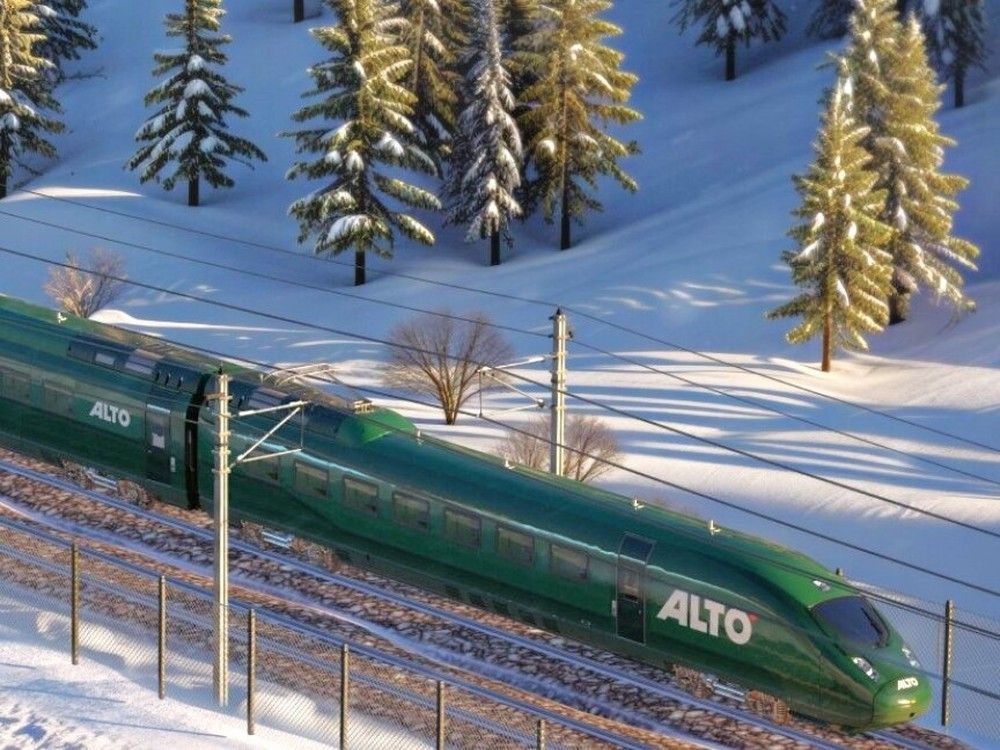
Photo via Toronto Sun

CHARLEBOIS: How much farmland will Alto high-speed rail line cost?

Read the original at Toronto Sun ↗
Cite

McLeod, C. (2026, November 25). CHARLEBOIS: How much farmland will Alto high-speed rail line cost? Toronto Sun. https://torontosun.com/opinion/columnists/how-much-farmland-will-alto-high-speed-rail-line-cost

Dated from the outlet's own feed. Check the original for its byline.

Toronto Sun · collected 2026-11-25 · by Cynthia McLeod

Quick Summary

Charlebois argues that before the Canadian government grants broader expropriation powers for the Alto high-speed rail project between Quebec City and Toronto, it should assess the amount of farmland the project will require. The article uses historical examples like the Mirabel airport and the Pickering airport site to illustrate the long-term impacts on farmers and farmland from such projects. It calculates that 4,450 acres of farmland, which could produce significant agricultural yields, may be affected, emphasizing the need to weigh the agricultural loss against the benefits of the rail project.
Written by AI on 2026-11-25, from this article's own text only (the story summary below draws on all the coverage).
See how they differ ↓

AI analysis

Story summary

The federal government is proposing to scrap standard expropriation rules for Canada's first high-speed rail project, known as Alto, between Toronto and Quebec City. Transport Minister Steven MacKinnon defended the new land seizure powers, arguing they would fast-track the project, which was passed as part of Bill C-15 in March. However, rural residents and Ontario Conservative MP Michael Barrett are criticizing the move, saying it replaces the existing Expropriation Act with a separate regime for high-speed rail, potentially disrupting rural communities in eastern Ontario and Quebec. The proposed changes would allow the government to expropriate land for the project without attempting to purchase it first, bypassing standard due process protections.

Written for “Ottawa Defends Land Seizure Powers For Alto Rail” on 2026-11-26, grounded in this article and the 8 other(s) covering the same event.

How they differ

6 outlets covered “Ottawa Defends Land Seizure Powers For Alto Rail”.

What each outlet says

One AI summary per outlet of its latest article on this story, written from that article alone and checked against it. Open the article for the outlet's own words.

Toronto SunThis outlet25 Nov

Charlebois argues that before the Canadian government grants broader expropriation powers for the Alto high-speed rail project between Quebec City and Toronto, it should assess the amount of farmland the project will require. The article uses historical examples like the Mirabel airport and the Pickering airport site to illustrate the long-term impacts on farmers and farmland from such projects. It calculates that…

CHARLEBOIS: How much farmland will Alto high-speed rail line cost? (this article)2 articles from Toronto Sun on this story
CBC25 Nov

Rural Ontario residents are protesting against proposed changes to land expropriation rules for the Alto high-speed rail project. The federal government aims to simplify the process by allowing direct land transfers to a private consortium and bypassing public hearings for disputes, which could cost between $60 billion and $90 billion. Critics, like Mike MacGillivray from Kirkview Farms, fear the new rules will…

Rural Ontario residents slam proposed land-seizure powers for Alto high-speed rail project →2 articles from CBC on this story
Toronto Star24 Nov

Transport Minister Steven MacKinnon defended the government's expanded expropriation rules for the Alto high-speed rail project, which allow for quicker land acquisition and new construction restrictions. The rules, introduced in the 2025 budget and clarified in this year’s budget, include an arbitration process for land divided by the rail line. MacKinnon argued that these measures are necessary to avoid delays…

Federal minister defends expanded expropriation rules for Alto high-speed rail line →2 articles from Toronto Star on this story
The Globe and Mail24 Nov

Transport Minister Steven MacKinnon is defending new land seizure powers proposed in draft legislation for the high-speed rail project between Toronto and Quebec City. The proposed legislation, which was included in a 519-page procedural motion on Friday, would allow Ottawa to expedite the process of securing land for the project, potentially avoiding delays that could extend for years. The project, which aims to…

Ottawa defends new land seizure powers proposed for Alto’s high-speed rail project →
Global News24 Nov

Transport Minister Steven MacKinnon is defending new land seizure powers proposed in draft legislation for a high-speed rail project connecting Toronto and Quebec City. MacKinnon argues that these powers are necessary to avoid delays and ensure the project progresses smoothly, despite criticism from Ontario Conservative MP Michael Barrett who fears the changes will lead to significant cost and disruption for rural…

Transport minister defends new land seizure powers proposed for high-speed rail →
The Hub26 Nov

Transport Minister Steven MacKinnon defended the federal plan to expand expropriation powers for the Alto high-speed rail project, which would allow the acquisition of up to 10,000 land parcels between Toronto and Quebec City. The plan would enable the government to bypass the federal Expropriation Act and transfer expropriated land directly to a private consortium. MacKinnon argued that these measures, aimed at…

Ottawa defends plan to expand expropriation powers for Alto high-speed rail →

Where they agree and split

Framing

How the first headlines put it

Stated as fact4
The headlines (4)

Draft budget bill proposes sweeping new land-seizure powers for high-speed rail CBC · stated as fact

Transport minister defends new land seizure powers proposed for high-speed rail Toronto Star · stated as fact

Ottawa defends new land seizure powers proposed for Alto’s high-speed rail project The Globe and Mail · stated as fact

Transport minister defends new land seizure powers proposed for high-speed rail Global News · stated as fact

The full story: what happened, how it changed, and all 9 articles →

Compared with similar articles

This article reads leans left and hedges 13% of its claims. Each row says how that neighbour differs.
CBC News
Hedges 4 of 27 claims Outlet record 70/100
CBC News
Leans right further right than this Hedges 8 of 42 claims Outlet record 70/100
Toronto Sun
Hedges 0 of 30 claims Outlet record 96/100
CBC News
Hedges 6 of 24 claims Outlet record 70/100
“Article A discusses the economic benefits of the proposed high-speed rail project, while Article B focuses on the potential impact on farmland and expropriation powers, indicating they cover different aspects of the same larger topic.”
Toronto Star
Hedges 3 of 20 claims Outlet record 65/100
“While both articles discuss the government's plans to expand expropriation rules for the Alto high-speed rail project, Article A focuses on the minister's defense of the expanded rules, whereas Article B questions the extent of land required and the cost to farmers.”

Story

Ottawa Defends Land Seizure Powers For Alto Rail
Politics · 9 article(s) covering the same event. Compare every outlet's account →
How this article was measured signals, leaning charts, publisher record, byline, topics and claims

Signals How these are calculated →

Claims extracted
31
sentences that state something as happening or true
Uncertain
13%
4 of 31 hedged ("reportedly", "may", "according to")
Leaning
Leans left
of the writing, not the subject · beta estimate
Publisher signals
96/100
Toronto Sun's corrections and hedging, across everything collected from it. Not a measure of accuracy.
Outlets on this story
9
Politics
Same framing elsewhere
1
articles that frame the event the way this one does
Analyzed 2026-11-25 · how these are computed

How this is being covered How these are calculated →

Article leaning vs. publisher reliability
Source leaning vs. consistency

Publisher

Toronto Sun · 858 article(s) · 0 correction(s) detected
No corrections detected for this publisher. That may mean careful reporting, or simply that nothing has been checked.

Who wrote this

Cynthia McLeod
4 article(s) here · 1 carrying a prediction
The land had been taken decades before anyone knew whether the original plan would work.
But none of the doctors or nurses will talk to me about my gender dysphoria.
2026-11-24 · assertive framing · ROWE: Death of the Nurse — a tale of two provinces
Grocery inflation could pick up again when Statistics Canada releases its November figures in December.
When I was growing up, it wasn’t uncommon for my parents to argue, yelling so loudly that the sound would reverberate through the two-storey stairwell of our 1911 house.
Also by Cynthia McLeod
Nothing else under this byline is closely related to this article, so these are simply their most recent.

Topics

B.C. Liberal Montreal Ottawa Toronto

Subjects

Ottawa GPE · 6× Alto ORG · 2× B.C. GPE · 2× Canada GPE · 2× Montreal GPE · 2× Ontario GPE · 2× Toronto GPE · 2× Liberal NORP · 1× Parliament ORG · 1× Quebec City GPE · 1×

Narrative

Ottawa should publish a route-by-route assessment of farmland loss and disruption, explain how it will preserve access to fields and compensate farmers for the cost of splitting their operations, and set out how each phase will be financed, built and put into service.
framing: assertive · carried by 1 article(s) · first seen 2026-11-25
The land had been taken decades before anyone knew whether the original plan would work.
2026-11-25 · Toronto Sun
CHARLEBOIS: How much farmland will Alto high-speed rail line cost? · assertive framing

Claims (31 extracted, 4 hedged)

The federal Liberal government is proposing broader expropriation powers to speed up construction of Alto, the high-speed rail line between Quebec City and Toronto. asserted
government → propose → City
Before Parliament gives Ottawa more power to take land, it should ask a basic question: How much productive farmland does this project actually need? asserted
project → give → farmland
Farmers have good reason to ask. asserted
Farmers → have → reason
In 1969, Pierre Elliott Trudeau’s government expropriated 97,000 acres for Mirabel airport. asserted
government → expropriate → airport
Ottawa eventually returned about 80,000 acres. asserted
Ottawa → return → acres
Mirabel was supposed to replace Dorval as Montreal’s main airport. asserted
Mirabel → suppose → airport
By 2004, the last passenger flights had moved back to Dorval, leaving Mirabel to find a new role in cargo and aerospace. asserted
flights → move → cargo
The land had been taken decades before anyone knew whether the original plan would work. asserted
plan → take → ?
In 1972, Ottawa acquired 18,600 acres northeast of Toronto for an airport. asserted
Ottawa → acquire → airport
It took until 2025 for the federal government to formally rule out building one there. asserted
government → take → one
For farm families and communities, the uncertainty alone can shape decisions for decades. asserted
uncertainty → shape → decades
Who invests in drainage, puts up a new barn or plans to hand the farm to the next generation when the future of the land is in doubt? asserted
future → invest → doubt
The St. Lawrence Seaway and its associated hydroelectric development flooded farmland, as did B.C.’s Site C dam. asserted
dam → associate → farmland
The assessment for B.C.’s South Fraser Perimeter Road projected that roughly 259 acres would be lost to the road or cut off from farming. asserted
acres → project → farming
Ontario’s Highway 413 assessment projects the loss of about 1,170 acres designated as prime agricultural area. asserted
assessment → project → area
A project’s footprint tells only part of the story. asserted
footprint → tell → story
A strip of land through a farm can also leave fields harder to reach, more expensive to work or too small to farm profitably. asserted
strip → leave → fields
Number of farms depends on final route Alto has estimated that its first segment, between Montreal and Ottawa, could cross approximately 500 farms. uncertain
segment → depend → farms
The number of farms that would lose land, and how much land each would lose, will depend on the final route. asserted
each → lose → route
That makes this the right time to compare routes and put a price on what each would cost agriculture. asserted
each → make → agriculture
Consider what 4,450 acres could produce in a single year. uncertain
acres → consider → year
If the entire area were suitable for and planted to one crop, it could yield an estimated 45,000 to 64,000 tonnes of potatoes, 16,000 to 20,000 tonnes of grain corn or 12,000 tonnes of winter wheat. uncertain
it → plant → wheat
On paper, depending on the crop and yield, that’s roughly a year’s worth of calories for 50,000 to 100,000 people at 2,000 calories a day, before processing and losses. asserted
that → depend → processing
The point is to put the land’s productive capacity in terms Canadians can picture. asserted
Canadians → put → terms
Those 12,000 tonnes of wheat would amount to about 0.03% of Canada’s total 2025 wheat harvest and about 0.3% of its winter wheat harvest. asserted
tonnes → amount → harvest
For a farm that loses its best field or has to drive farm equipment kilometres out of the way to reach the other side of the tracks, the cost shows up every season. asserted
cost → lose → tracks
That belongs in the project’s economics alongside ridership, travel times and construction costs. asserted
That → belong → ridership
Canada needs better infrastructure, and high-speed rail could improve how people travel between Quebec and Ontario. uncertain
people → need → Quebec
Ottawa should publish a route-by-route assessment of farmland loss and disruption, explain how it will preserve access to fields and compensate farmers for the cost of splitting their operations, and set out how each phase will be financed, built and put into service. asserted
phase → publish → service
It should also say what happens to land it acquires if a segment is delayed, redesigned or cancelled. asserted
segment → say → land
The time to ask whether Alto needs a particular piece of farmland is while Ottawa can still choose where the tracks go. asserted
tracks → ask → farmland
Give feedback · no sign-in needed

No sign-in needed for now. Your note is sent without a name, so it cannot be answered.

History Support